
Have you ever been on a phone call where there is a strange delay? You say “Hello” and then wait two seconds before the other person answers. It is frustrating. It leads to people talking over each other and makes the conversation feel awkward.
Now imagine that delay happening with an AI voice agent. If a customer asks a question and the AI takes three seconds to respond the illusion breaks. The customer gets annoyed and hangs up.
This delay is often caused by distance. If your server is in New York and your caller is in Tokyo the voice data has to travel halfway around the world and back. This takes time.
The solution to this problem is deploying your voice API integration across multiple cloud regions. Instead of having one central brain you put smaller brains all over the world. This ensures that the AI is always close to the customer.
In this guide we will explain how to build a cloud voice infrastructure that spans the globe. We will look at how to reduce delay and how to handle server failures and how platforms like FreJun AI provide the necessary tools to make this complex setup easy.
Table of contents
- Why Is Multi Region Deployment Critical for Voice?
- What Exactly Is Voice API Integration?
- How Does FreJun AI Enable Global Reach?
- What Are the Key Components of Cloud Voice Infrastructure?
- How Do You Achieve Low Latency Routing?
- How Do You Handle Failures Across Regions?
- What Is the Role of Elastic SIP Trunking?
- How Do You Synchronize Data Across Regions?
- What Are the Steps to Deploy Globally?
- How Does FreJun AI Simplify the Complexity?
- Conclusion
- Frequently Asked Questions (FAQs)
Why Is Multi Region Deployment Critical for Voice?
Voice is sensitive. Unlike an email or a text message which can arrive a few seconds late without anyone noticing voice needs to be instant.
In the world of networking we call this “latency.” Latency is the time it takes for data to travel from point A to point B.
If you host your application in only one region, let us say US East, anyone calling from Europe or Asia will experience high latency. Their voice has to cross oceans to reach your server.
According to the Dialaxy, high quality voice interactions require a one way latency of 150 milliseconds or less. Once you go above that number the conversation starts to feel disjointed.
By deploying your voice API integration in multiple regions you bring the server closer to the user. A user in London connects to a London server. A user in Singapore connects to a Singapore server. This keeps the travel time short and the conversation smooth.
What Exactly Is Voice API Integration?
Before we spread it across the world let us define what it is. A voice API integration is the code that connects your software to the telephone network.
In the past you needed physical wires and hardware to make phone calls. Today you use an API. You write code that tells the telecom provider to “make a call” or “record this audio” or “stream this media.”
However standard APIs often act like a single front door. Even if you have users everywhere they all have to walk through that one door.
To fix this we need a multi region voice deployment. This means you have multiple front doors. The challenge is making sure the user walks through the right one and that all the doors lead to the same smart house.
Also Read: What Role Do Voice bot Solutions Play in AI-First Business Workflows?
How Does FreJun AI Enable Global Reach?
This is where infrastructure becomes vital. You could try to build your own global telecom network but that would cost millions of dollars and take years.
FreJun AI acts as your global voice infrastructure. We handle the complex voice infrastructure so you can focus on building your AI.
Our platform is built on a distributed network. We have servers located in key regions around the world. When you use FreJun for your voice API integration you are not just connecting to one server. You are plugging into a global grid.
We utilize low latency routing to ensure that your calls take the fastest possible path. If a call originates in India we process the media in India. This reduces the distance the data travels and ensures that your AI voice agent sounds responsive and human.
What Are the Key Components of Cloud Voice Infrastructure?
To build a global system you need to understand the pieces of the puzzle. A robust cloud voice infrastructure is made of three main parts.
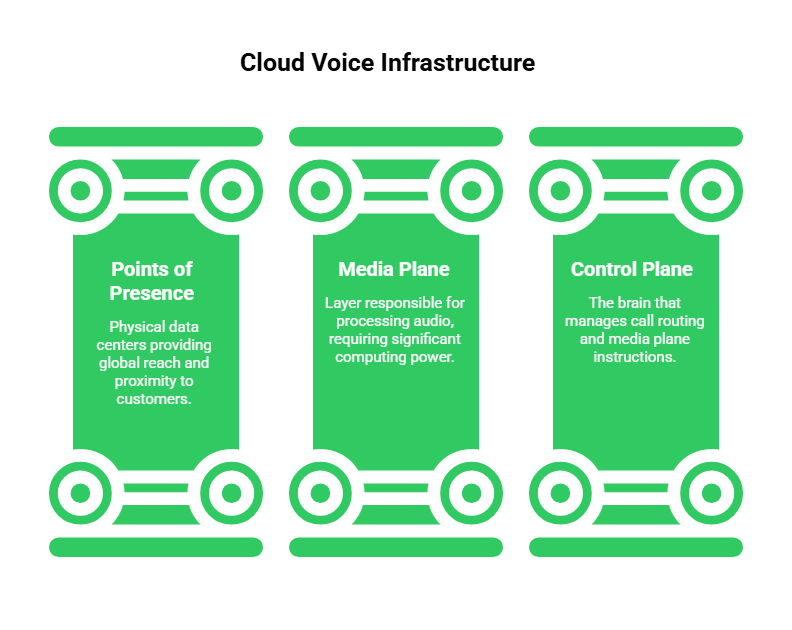
1. Points of Presence (PoPs)
These are the physical data centers where the servers live. To have a global reach you need PoPs in major regions like North America and Europe and Asia. The more PoPs you have the closer you are to your customers.
2. The Media Plane
This is the layer that handles the actual audio. It is heavy lifting. Processing audio requires a lot of computer power. In a multi region voice deployment you want the media processing to happen as close to the caller as possible to avoid lag.
3. The Control Plane
This is the brain. It decides what to do with the call. It tells the media plane “record this” or “play that.” The control plane can be centralized but the media plane must be distributed.
Here is a table showing the difference between a basic setup and a pro setup.
| Feature | Single Region Setup | Multi Region Deployment |
| Server Location | One city (e.g. New York) | Global cities (London, Tokyo, NY) |
| Latency | High for distant users | Low for everyone |
| Reliability | If the region fails the app dies | If one region fails traffic moves to another |
| Complexity | Simple to build | Requires smart routing logic |
| Cost | Lower upfront cost | Higher efficiency at scale |
| User Experience | Inconsistent quality | Consistently high quality |
How Do You Achieve Low Latency Routing?
The magic of a global system is low latency routing. This is the method used to direct traffic to the nearest server.
Imagine you are mailing a letter. You do not mail it to a post office in another country just to have it sent back to your neighbor. You use the local post office.
Routing works the same way. We use technologies like Geo DNS (Domain Name System). When a user makes a request the DNS looks at their IP address to see where they are. It then gives them the address of the closest server.
FreJun AI handles this automatically. When a call comes into our system via FreJun Teler (our telephony arm) we identify the origin of the call. We then route the audio stream to the nearest available media processor. This happens in milliseconds.
Also Read: Why Are Voice bot Solutions Critical for AI-Driven Customer Support?
How Do You Handle Failures Across Regions?
One of the biggest benefits of multi region voice deployment is reliability. Servers crash. Power outages happen. Cables get cut.
If you rely on a single region a power outage in Virginia could knock your entire business offline. In a multi region setup you have a backup plan.
This is called failover. If your server in the US East goes down the system automatically detects the failure. It then reroutes all new calls to the US West server.
FreJun AI is built with this resilience in mind. Our infrastructure is geographically distributed. This means we offer high availability and guaranteed uptime. If one part of the network faces an issue the traffic flows around it like water around a rock.
Ready to start building a global voice agent? Sign up for FreJun AI to access our distributed infrastructure today.
What Is the Role of Elastic SIP Trunking?
To make calls globally you need a connection to the Public Switched Telephone Network (PSTN). This is done through SIP Trunking.
Traditional phone lines are physical and local. You cannot easily move a copper wire from London to New York. But cloud voice infrastructure uses Elastic SIP Trunking.
FreJun Teler provides this feature. “Elastic” means it can stretch. It can handle one call or ten thousand calls. It works across borders.
When you deploy your voice API integration with FreJun Teler you get global connectivity. You can buy phone numbers in different countries and manage them all from one dashboard. The audio from these calls enters our network at the closest entry point ensuring the best possible quality.
How Do You Synchronize Data Across Regions?
This is a common challenge. If a user calls your US number in the morning and your UK number in the afternoon does the AI remember them?
In a distributed system you have separate databases in each region. To make the AI smart you need to sync this data. You have two options.
- Centralized Database: All regions talk to one main database. This is simple but adds latency.
- Replicated Database: Each region has its own copy of the data and they sync with each other in the background.
For voice agents the “context” (what the user just said) needs to be immediate. FreJun allows developers to manage conversational context efficiently. We pass the necessary metadata along with the call ensuring your AI logic has the info it needs regardless of which server is processing the audio.
What Are the Steps to Deploy Globally?
If you are a developer looking to go global here is your roadmap.
Step 1 Choose a Global Partner
Do not try to build data centers yourself. Choose a platform like FreJun AI that already has a global footprint.
Step 2 specificy Your Regions
Look at where your customers are. If 80% are in Asia and 20% are in the US you need servers in Singapore and Virginia.
Step 3 Implement Geo Routing
Configure your DNS or use FreJun’s built in routing to ensure users hit the right entry point.
Step 4 Test Latency
Before going live run tests. Measure the “Round Trip Time” (RTT) from different locations. Ensure the delay is under that critical 150ms mark.
How Does FreJun AI Simplify the Complexity?
Building a multi region voice deployment from scratch involves configuring load balancers and managing replication and negotiating with carriers in every country. It is a headache. FreJun AI abstracts this away. We act as the plumbing.
- Model Agnostic: You bring your AI (LLM and TTS). We handle the transport.
- SDKs: We provide Client Side and Server Side SDKs that handle the connection logic for you.
- Security: We ensure data is encrypted as it travels across regions.
You write the code for your AI agent once. We ensure it runs smoothly whether the caller is in Dubai or Denver.
Also Read: What Makes Voice Bot Solutions Effective for High-Volume Customer Calls?
Conclusion
The world is getting smaller. Businesses operate globally and customers expect high quality service no matter where they are standing. A single server in a basement is no longer enough.
Deploying your voice API integration across multiple cloud regions is the only way to guarantee speed and reliability. It reduces latency which keeps the conversation natural. It provides a safety net so your service never goes dark.
However managing a global network is hard work. That is why smart developers rely on specialized infrastructure. FreJun AI provides the cloud voice infrastructure you need to scale. With low latency routing and the power of FreJun Teler for elastic SIP trunking we ensure your voice agents are always fast and always on.
Want to discuss your global deployment strategy? Schedule a demo with our team at FreJun Teler and let us help you optimize your voice architecture.
Also Read: UK Phone Number Formats for UAE Businesses
Frequently Asked Questions (FAQs)
Voice API integration is the process of connecting your software application to the telephone network using code. It allows your app to make and receive calls and control audio streams programmatically.
Data travels fast but not instantly. The farther the data has to travel through cables and routers the longer it takes to arrive. This travel time is called latency.
A cloud region is a specific geographic location where a cloud provider houses its data centers. Examples include US East (Virginia) or EU West (London).
FreJun AI has a distributed infrastructure with points of presence around the world. We route calls to the nearest media server to minimize the distance the audio travels.
SIP Trunking is a method of sending voice and other unified communications services over the internet. It replaces traditional telephone lines. FreJun Teler offers elastic SIP trunking that scales globally.
No. You usually need servers in key regions that cover your main customer bases. For example one in the US and one in Europe and one in Asia covers most of the world effectively.
In a multi region deployment traffic is automatically rerouted to the next available region. This ensures your service remains active even during a disaster.
It can be if you build it yourself. However using a platform like FreJun AI allows you to leverage shared global infrastructure which is much more cost effective than managing your own data centers.
Yes. With FreJun Teler you can port your existing numbers or purchase new numbers from over 100 countries and manage them all on one platform.
Jitter is the variation in latency. If some voice packets arrive fast and others arrive slow the audio sounds choppy or robotic. A good cloud voice infrastructure minimizes jitter to ensure smooth sound.