
Imagine running a gold mine but throwing away 90% of the gold you find because it looks like dirty rocks. That sounds crazy, right? But that is exactly what thousands of businesses do with their voice data every single day.
Every time a customer calls your support line or a sales agent pitches a product or a user interacts with your voicebot, they are generating valuable data. They are telling you exactly what they want and how they feel and why they are leaving or staying. However, because this data is locked inside audio files, it often gets ignored.
This is where a voice recognition software API comes in. It is the key to unlocking that data. By building an automated analytics pipeline, you can turn those millions of minutes of raw audio into clear and actionable charts and graphs.
In this guide, we will break down exactly how to build these speech analytics pipelines. We will look at how to capture the audio without losing quality and how to process the data for insights and how infrastructure platforms like FreJun AI provide the essential plumbing to make it all possible.
Table of contents
- Why Is Voice Data the New Gold Mine?
- What Exactly Is a Speech Analytics Pipeline?
- How Do You Capture High Quality Audio?
- How Do You Choose the Right Voice Recognition Software API?
- How Do You Process Data for Actionable Insights?
- What Are the Real World Use Cases for Insights Systems?
- How Do You Build the Pipeline Step by Step?
- Conclusion
- Frequently Asked Questions (FAQs)
Why Is Voice Data the New Gold Mine?
Data is the fuel of the modern economy. But not all data is created equal. Most companies are great at analyzing structured data. This includes things that fit neatly into Excel rows like transaction amounts or dates. But voice is different. It is messy and emotional and unstructured.
According to a Venture Beat, it is estimated that 80% of global data will be unstructured by 2025. This includes emails and videos and yes millions of hours of phone calls. If you are not analyzing this data, you are making decisions with only 20% of the information.
A voice recognition software API bridges this gap. It converts that messy audio into text which is structured data that your computers can actually understand. Once it is text, you can track keywords and measure sentiment and spot trends that would otherwise be invisible.
What Exactly Is a Speech Analytics Pipeline?
Before we start building, we need to understand what we are building. A pipeline is just a series of steps that data moves through. For voice analytics, the pipeline typically looks like this:
- Ingestion which is capturing the raw audio from a phone call or microphone.
- Transcription using a voice recognition software API to turn audio into text.
- Analysis using Natural Language Processing known as NLP to find meaning in the text.
- Visualization presenting the data in a dashboard for humans to read.
Here is a simple comparison of how the old manual way compares to a modern automated pipeline.
| Feature | Manual Review (Old Way) | Automated Analytics Pipeline |
| Coverage | Listens to about 1% of calls | Analyzes 100% of calls |
| Speed | Feedback takes days or weeks | Feedback is near instant |
| Cost | Expensive due to human labor | Scalable as software does the work |
| Bias | Subjective based on the reviewer | Objective based on data |
| Trends | Misses subtle long term patterns | Spots trends across thousands of calls |
How Do You Capture High Quality Audio?
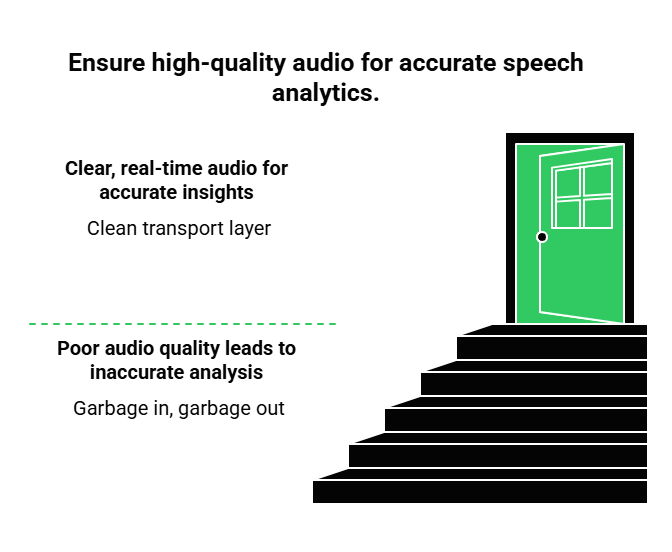
This is the most critical step yet it is the one most developers overlook. You have likely heard the phrase garbage in garbage out. This is incredibly true for speech analytics pipelines.
If the audio entering your pipeline is choppy or has an echo or is delayed, the voice recognition software API will fail. It might transcribe “I want to cancel” as “I want a candle” and your analytics will be useless.
The Role of Infrastructure
This is where FreJun AI plays a massive role. We handle the complex voice infrastructure so you can focus on building your AI.
FreJun acts as the clean transport layer for your audio. Whether you are analyzing inbound customer support calls or outbound sales calls, our platform ensures the media is streamed in real time with ultra low latency.
We utilize FreJun Teler which offers elastic SIP trunking. This means that even if your call volume spikes during a Black Friday sale, our infrastructure scales up to handle the load without degrading audio quality. It ensures that every single conversation is captured clearly giving your analytics engine the high quality fuel it needs to work correctly.
Also Read: What Role Do Voice bot Solutions Play in AI-First Business Workflows?
How Do You Choose the Right Voice Recognition Software API?
Once you have clean audio you need to transcribe it. There are many APIs out there such as OpenAI Whisper or Google Speech to Text or Deepgram or AssemblyAI.
The beauty of FreJun is that we are model agnostic. We do not force you to use a specific transcription engine. We provide the pipe that delivers the audio to whichever voice recognition software API you prefer. When choosing an API for your pipeline consider these three factors:
- Speed asks do you need real time analytics or is post call analysis okay. Real time requires a faster and lower latency API.
- Vocabulary asks does your business use jargon. If you are in medicine or law you need an API that can be trained on specific words.
- Speaker Diarization is a fancy term for distinguishing who is speaking. Your pipeline needs to know the difference between the Agent and the Customer to make sense of the data.
How Do You Process Data for Actionable Insights?
Once the voice recognition software API has turned the audio into text the real magic begins. This stage is often called data processing voice. It is where you turn words into math. You can build your pipeline to look for several types of insights.
Sentiment Analysis
This measures the emotional tone of the conversation. Is the customer happy or angry or neutral. By tracking this over time you can see if a new product launch is causing frustration or if a specific support agent is particularly good at calming angry callers.
Keyword Spotting
This is the simplest form of analytics. You simply tell the system to count specific words.
- Compliance checks did the agent say the required legal disclaimer.
- Sales checks did the customer mention a competitor name.
- Product checks how many times did customers say bug or crash.
Intent Detection
This is more advanced. It uses AI to figure out why the person called. Are they calling to buy or to complain or to update their address. Insights systems that categorize calls by intent can help businesses understand the root cause of their call volume.
Ready to start building your own analytics pipeline? Sign up for FreJun AI to get your API keys and start capturing high quality audio today.
Also Read: Why Are Voice bot Solutions Critical for AI-Driven Customer Support?
What Are the Real World Use Cases for Insights Systems?
So who actually uses these speech analytics pipelines? It is not just tech giants. It is any business that talks to its customers.
1. Call Centers and Support
This is the biggest use case. Managers use analytics to score 100% of calls for quality assurance. Instead of listening to random recordings they get a dashboard showing which agents are performing best and which ones need coaching.
2. Sales Coaching
Sales managers use these pipelines to find the winning formula. They analyze the calls of their top performers to see what phrases they use to close deals. Then they train the rest of the team to use those same techniques.
3. Compliance and Security
In industries like finance and healthcare saying the wrong thing can lead to lawsuits. An automated pipeline can listen to every call and instantly flag any conversation where a required compliance statement was missed allowing the company to fix the error immediately.
How Do You Build the Pipeline Step by Step?
If you are a developer ready to build here is the high level roadmap.
Step 1 Set Up Your Voice Infrastructure
You cannot analyze what you cannot catch. Start by integrating FreJun AI. Our SDKs allow you to initiate or receive calls programmatically.
- Use FreJun Teler for your SIP trunking needs to handle scale.
- Use our media streaming features to fork the audio stream in real time.
Step 2 Connect Your Transcription Service
Set up a WebSocket connection between FreJun and your chosen voice recognition software API.
- As FreJun receives audio packets from the phone call we stream them to your server.
- Your server forwards them to the transcription API.
- The API sends back text JSON objects in real time.
Step 3 Implement the Logic Layer
This is where you write the code for data processing voice.
- Take the text stream and run it through an NLP library like NLTK or SpaCy.
- Tag the text with sentiment scores.
- Check for keywords.
Step 4 Store and Visualize
Finally save the structured data into a database like PostgreSQL or MongoDB. Then connect a visualization tool like Tableau or a custom web dashboard to display the insights systems to your users.
Also Read: What Makes Voice Bot Solutions Effective for High-Volume Customer Calls?
Conclusion
The voice data flowing through your business is one of your most valuable assets. It holds the truth about your customer experience and your operational efficiency. But without the right tools it is just noise.
Building speech analytics pipelines allows you to turn that noise into clear and strategic guidance. It enables you to monitor 100% of your interactions and catch problems before they escalate and train your team based on data rather than guesses.
However remember that the most sophisticated AI model in the world cannot fix bad audio. The foundation of any great analytics system is reliable and low latency voice capture. FreJun AI provides that foundation. By handling the difficult telephony and real time streaming layers we free you up to focus on the magic of the analytics itself.
Want to discuss how our infrastructure can power your specific analytics use case? Schedule a demo with our team at FreJun Teler.
Also Read: UK Phone Number Formats for UAE Businesses
Frequently Asked Questions (FAQs)
A voice recognition software API is a tool that allows developers to convert spoken language into text programmatically. It serves as the bridge between raw audio files and text based data analysis.
Modern APIs are extremely accurate and often exceed 90% accuracy for clear audio. However accuracy depends heavily on audio quality which is why using a high quality infrastructure provider like FreJun AI is essential.
Real time analytics processes the audio while the call is still happening. This allows for immediate actions like popping up a suggestion for a sales agent. Post call analytics processes the recording after the call ends which is useful for long term trend analysis.
No FreJun AI provides the voice infrastructure which is the plumbing. We capture the high quality audio and stream it to your chosen analytics or transcription provider. This gives you the freedom to build your own custom dashboard or use any third party tool you prefer.
FreJun uses FreJun Teler which features elastic SIP trunking. This technology automatically scales your capacity up or down based on demand ensuring that your analytics pipeline never gets overwhelmed by a sudden spike in calls.
Yes. Since FreJun is model agnostic you can connect our audio stream to any voice recognition software API that supports the languages you need. Many modern APIs support dozens of languages and accents.
It used to be very expensive but costs have dropped significantly. With pay as you go pricing for both infrastructure like FreJun and transcription APIs businesses can now build powerful insights systems without a massive upfront investment.
Yes FreJun is designed with enterprise grade security. We encrypt voice data during transmission to ensure that sensitive customer information remains private and secure throughout the pipeline.
Speaker diarization is the process of identifying who spoke when. In a two channel recording or stereo this is easy. In a mono recording the software must guess. FreJun supports stereo recording making it much easier to separate the agent’s voice from the customer’s voice.
Not necessarily. While data science helps with deep analysis setting up the basic pipeline is quite straightforward for a standard web developer using FreJun SDKs and modern APIs.