
Have you ever finished a long and important phone call only to realize you forgot a key detail? Maybe a client gave you their address or a specific price and you simply cannot remember it. In the past, you would have to listen to the entire call recording again to find that one piece of information. This is slow and frustrating.
Imagine if you could just type a word into a search bar and find the exact moment that word was spoken. This is possible today through voice recognition software API technology. By turning spoken words into text, businesses can create a library of information that is as easy to navigate as a website.
In this guide, we will learn how to turn your “dark data” or hidden audio into useful, searchable records.
Table of contents
- What is a voice recognition software API?
- Why are searchable call transcripts important for modern businesses?
- How do you create indexed voice data from phone calls?
- How does FreJun AI help with transcription?
- What makes a transcript search feature effective?
- How can you implement this in your own application?
- What are the best use cases for searchable transcripts?
- Why is low latency important for transcription?
- How do you manage large volumes of voice data?
- How do you ensure high accuracy in your transcripts?
- Conclusion
- Frequently Asked Questions (FAQs)
What is a voice recognition software API?
A voice recognition software API is a specialized tool that allows computer programs to understand human speech. Think of it as a bridge between a person talking and a computer typing. When someone speaks into a microphone or over a phone line, the sound is just a series of waves. A computer cannot “read” a wave. It needs letters and words. The API takes those sounds and matches them against a huge dictionary to find the right words.
The process of turning speech into text happens in several steps. First, the sound is captured. Next, the sound is cleaned up to remove background noise. Then, the voice recognition software API breaks the sound into small pieces called phonemes. Finally, it uses a smart model to guess the most likely words being said. Because modern APIs use artificial intelligence, they are getting better every day at understanding different voices and slang.
FreJun AI serves as a critical partner in this process. While the API handles the “translation” from sound to text, FreJun AI provides the voice infrastructure platform that manages the real time call streaming. FreJun handles the complex voice infrastructure so you can focus on building your AI. This means the audio reaches the transcription tool clearly and without any data being lost.
Why are searchable call transcripts important for modern businesses?
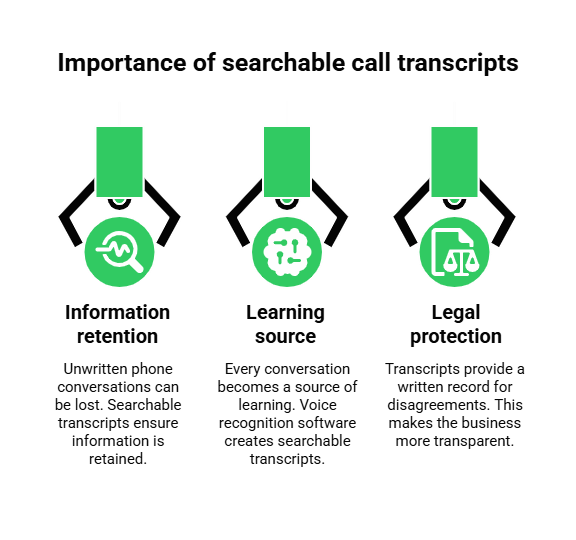
In a busy company, a lot of information is shared over the phone. If that information is not written down, it can be lost forever. Using a voice recognition software API to create searchable call transcripts ensures that every conversation is a source of learning. According to research, the global market for voice recognition technology is growing rapidly and is expected to reach over 53 billion dollars by 2030. This shows that more companies realize that audio data is a gold mine.
When you have transcripts, your team does not have to spend hours searching for details. By creating indexed voice data, you remove this wasted time. You can simply use a search bar to find every time a customer mentioned a specific product or a specific problem.
Furthermore, transcripts are great for legal reasons. If there is ever a disagreement about what was said during a call, you have a written record. It is much easier to share a text document with a manager or a lawyer than it is to send a large audio file. It makes the whole business more transparent and organized.
Also Read: AI Voice Agents for Ride-Hailing Platforms
How do you create indexed voice data from phone calls?
Creating indexed voice data means more than just having a text file. It means making that text “smart” so a computer can find things inside it. The process starts with a high quality audio stream. If the audio is fuzzy or quiet, the voice recognition software API will make mistakes. This is why a strong voice infrastructure is so important.
Once the API generates the text, you need to store it in a way that is easy to search. This usually involves putting the text into a database and creating an “index.” An index is like the table of contents at the back of a thick book. It tells the computer exactly where to find every word. This allows for a fast and efficient transcript search when someone types a query.
| Step | Task | Goal |
| Capture | Raw audio capture | Get clear sound from the call |
| Stream | Real time media streaming | Move the sound to the AI API |
| Transcribe | Voice recognition software API usage | Turn the sound waves into words |
| Index | Database storage | Make the text searchable by keywords |
| Search | User query processing | Return the exact call and timestamp |
By following this workflow, you turn every phone call into a digital document. You can even add “metadata” like the date of the call, the names of the speakers, and the length of the conversation. This makes your search results even more useful for your team.
How does FreJun AI help with transcription?
FreJun AI acts as the “plumbing” for your voice applications. While you choose the voice recognition software API that you like best, FreJun ensures that the audio gets there safely and quickly. Because FreJun is model agnostic, you can connect it to any AI service. You are not locked into one single company. This gives you the freedom to use the best transcription tool on the market.
The platform provides a developer first toolkit that includes comprehensive SDKs for both client side and server side development. This means your developers can easily embed voice features into your web or mobile apps. FreJun manages the telephony layer, which is the most difficult part of building a voice app. They handle the call logic while you focus on the text and the data.
Another strength of FreJun AI is its low latency optimization. If you want to show a live transcript as someone is talking, you cannot have a delay. FreJun streams audio in real time, so every word is transmitted clearly and instantly. This allows for a much better user experience when building tools like live closed captioning or real time notes.
Ready to start building your own voice data tools? Sign up for FreJun AI and get your API keys today.
What makes a transcript search feature effective?
A good transcript search does more than just find a word. It needs to be smart enough to understand the context. For example, if you search for “apple,” do you mean the fruit or the technology company? Advanced search tools use the text generated by the voice recognition software API and combine it with other data to give you the best results.
One important feature is called a “timestamp.” A good transcript will show exactly when each word was said. This means that when you find a word in the search results, you can click on it and the audio player will jump to that exact second. You do not have to guess where the conversation happened. This saves a huge amount of time for managers who are reviewing sales calls or support sessions.
You should also look for a search tool that can handle “fuzzy matching.” This means that if you misspell a word in the search bar, the computer can still find what you are looking for. Since APIs sometimes make small mistakes when transcribing names or technical terms, fuzzy matching ensures that your searchable call transcripts remain useful even if the text is not 100 percent perfect.
How can you implement this in your own application?
Implementing this technology is a straightforward process if you have the right tools. First, you need to choose a voice recognition software API that fits your budget and accuracy needs. There are many famous options from companies like Google, Amazon, and Microsoft. Since FreJun AI is model agnostic, it will work with any of them.
Next, you use FreJun’s SDKs to set up the audio stream. You can capture audio from inbound calls where customers call you or outbound calls where you call them. FreJun handles the raw audio capture and streams it directly to your chosen API. As the API produces text, your backend system can store it in a database like Elasticsearch or MongoDB, which are great for searching text.
Finally, you build a simple user interface. This could be a dashboard where your employees can log in and see a list of recent calls. You add a search bar at the top, and when someone types a keyword, your system looks through the indexed voice data and shows the relevant call fragments. By following these steps, you can launch a professional transcription system in just a few days.
Also Read: Voice AI for Vehicle Service Reminders
What are the best use cases for searchable transcripts?
Every department in a company can benefit from having access to searchable call transcripts. It is not just for one team. It makes the whole organization smarter and more responsive to customer needs.
- Sales Teams: Sales managers can search for keywords like “price,” “discount,” or “competitor.” This helps them understand why some deals are closing and why others are failing.
- Customer Support: Support teams can search for common bugs or complaints. If a hundred people mention the word “login” in one day, the team knows there is a problem with the website.
- Legal and Compliance: Some industries are required by law to keep records of what they tell customers. Searchable transcripts make it easy to prove that an employee followed all the rules.
- Training and Coaching: New employees can search for the “best” calls made by top performers. They can read the transcripts to learn the best way to talk to customers and handle objections.
By using the voice recognition software API to create these records, you ensure that the knowledge of your best employees is shared with everyone. It turns individual experiences into company wide assets.
Why is low latency important for transcription?
In the world of voice AI, latency is the enemy. Latency is the delay between when a sound is made and when the computer processes it. If you are trying to create a live transcript, a three second delay is way too long. It makes the tool feel broken and hard to use. This is why FreJun AI focuses so much on speed.
FreJun is engineered for low latency, ensuring that every word is transmitted as soon as it is spoken. This real time media streaming is essential for advanced features like AI receptionists or intelligent IVR systems. When the voice recognition software API gets the audio immediately, it can provide the text immediately.
This speed also helps with accuracy. When the audio stream is consistent and fast, the API can better understand the flow of the conversation. It can use the words from the beginning of a sentence to help guess the words at the end of the sentence. High quality, low latency infrastructure is the secret ingredient for a successful voice application.
How do you manage large volumes of voice data?
As your business grows, you will start to have thousands of hours of audio. Managing this much data can be a challenge. You need a system that can scale without breaking. This is where FreJun Teler’s elastic SIP trunking comes into play. It allows your voice system to handle more calls automatically as your traffic increases.
When it comes to the text data, you need to use a database that is designed for big data. You should also consider “summarization.” Instead of just having a long transcript, you can use an AI model to create a short summary of the call. This summary can also be part of your indexed voice data, making it even faster for people to understand what happened during a conversation.
You should also think about how long you want to keep your transcripts. Some businesses keep them for a few months, while others keep them for years. A good system allows you to set “retention policies” so that old data is automatically deleted or archived to save on storage costs. This keeps your search system fast and efficient.
How do you ensure high accuracy in your transcripts?
No voice recognition software API is perfect. Sometimes they misunderstand a word, especially if there is a lot of background noise. However, there are things you can do to make the accuracy much higher. The most important thing is the quality of the raw audio capture.
Using FreJun AI ensures that you are getting a clean, digital stream of audio. You should also provide your API with a list of “custom keywords.” These are words that are specific to your business, like product names or technical jargon. When the API knows these words exist, it is much more likely to recognize them correctly during a call.
Finally, you can use “speaker diarization.” This is a fancy term that means the API can tell the difference between speaker A and speaker B. This makes the searchable call transcripts much easier to read because they look like a script from a play. It also makes the search results more accurate because you can search for words spoken specifically by the customer or specifically by the agent.
Want to see how your business can benefit from searchable transcripts? Schedule a demo with our team at FreJun Teler.
Also Read: The Future of Elastic SIP Trunking in an AI-Powered Voice World
Conclusion
Adding searchable transcripts to your business is one of the smartest moves you can make in the digital age. By using a voice recognition software API, you turn every phone call into a valuable piece of data. This allows your team to find information in seconds, improves your customer service, and protects your business legally.
The combination of high quality transcription and powerful search tools creates a system of indexed voice data that grows more valuable every day. Remember that the foundation of any great voice app is the infrastructure. FreJun AI provides the speed, reliability, and flexibility you need to build world class voice agents.
Whether you are a small startup or a large enterprise, the power of transcript search is now within your reach. Do not let your valuable conversations disappear into thin air; turn them into a library of knowledge that helps your business thrive.
Also Read: Outbound Call Techniques for Collection & Billing Teams
Frequently Asked Questions (FAQs)
A voice recognition software API is a set of programming tools that converts spoken language into digital text. It uses machine learning to listen to audio files or live streams and identify the words being said, allowing computers to process and analyze human speech.
Searchable transcripts allow sales managers to quickly find specific moments in a call where a customer mentioned a competitor or a concern about price. This makes it easy to coach sales reps and improve their performance without listening to hours of audio.
Indexed voice data refers to transcripts that have been organized in a database so they can be searched quickly. Much like an index in a book helps you find a page, an index in a database helps the computer find a specific word or phrase in thousands of hours of call text.
Yes, FreJun AI is model agnostic. This means it can connect your voice calls to any voice recognition software API you choose, such as those from Google, Deepgram, or OpenAI. FreJun handles the voice transport while you pick the transcription brain.
Low latency ensures that audio is moved from the call to the transcription engine without delay. This is crucial if you want to provide real time search results or live captions during a conversation. It makes the entire system feel responsive and modern.
It is not difficult if you use a developer first platform like FreJun AI. By using FreJun’s SDKs, you can skip the hard part of building telephony infrastructure and focus on simply saving the text output from your API into a searchable database.
Most modern APIs are very good at understanding a wide variety of accents and dozens of different languages. Since FreJun is model agnostic, you can switch to an API that specializes in a specific language if your business expands globally.
Elastic SIP trunking is a feature of FreJun Teler that allows your voice lines to grow or shrink based on your needs. This means if you have a sudden spike in calls, your transcription system will not crash or slow down; it will simply scale up to handle the load.
Security is a top priority for FreJun AI. The platform is engineered with security by design, using robust protocols to protect your data. When you build your transcription system, you should also ensure your database is encrypted and follows privacy laws like GDPR.
Yes, once the voice recognition software API creates the text, you can send that text to a Large Language Model (LLM) to create a short summary. This makes your search results even more helpful by providing a quick overview of each conversation.