
Have you ever wondered how a computer can listen to your voice and then talk back to you like a real person? It feels like magic, but it is actually a smart combination of different technologies working together. To build something this cool, developers need to connect a “brain” or an AI model to a “mouth” and “ears” or a voice recognition software API.
The biggest problem many businesses face is that these pieces are often hard to stick together. If the pieces do not talk to each other perfectly, the robot sounds slow or makes big mistakes.
In this guide, we will show you how to solve this problem. You will learn how to create a smooth system where your AI model can hear, understand, and speak through a voice recognition software API.
Table of contents
- What is a voice recognition software API?
- Why is ai speech model integration important for modern businesses?
- How do you build efficient voice ai pipelines?
- What is the role of LLM speech input in this process?
- How does FreJun AI manage the voice infrastructure layer?
- What are the steps for AI speech model integration?
- How do you maintain low latency in voice systems?
- What are the biggest challenges in AI model integration?
- What are the best use cases for voice AI agents?
- How can developers get started with FreJun Teler?
- Conclusion
- Frequently Asked Questions (FAQs)
What is a voice recognition software API?
A voice recognition software API is a tool that helps a computer turn spoken words into written text. Imagine you are talking to a friend who is typing everything you say onto a screen. That is exactly what this API does. It listens to the sounds you make and finds the words that match those sounds. This is the first step in any voice conversation between a human and a machine.
However, just having a list of words is not enough. The computer also needs to know what those words mean. This is why we need to connect the API to an AI model. This connection is often the most difficult part of the job. You need a fast and reliable way to move the sound from the phone or the computer to the API and then to the AI.
FreJun AI makes this process much easier for everyone. It acts as the voice transport layer for your application. Instead of you trying to figure out how to capture sound and send it over the internet, FreJun does it for you. We handle the complex voice infrastructure so you can focus on building your AI. This lets you spend your time making your AI smarter instead of worrying about how to connect wires and phone lines.
Why is ai speech model integration important for modern businesses?
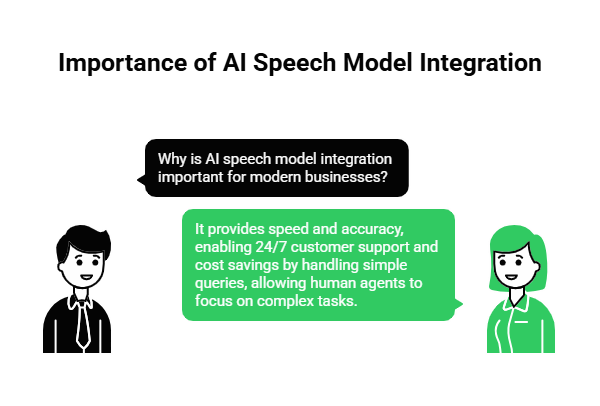
In the world of business today, speed and accuracy are everything. Customers do not want to wait on hold for a human to answer the phone. They want answers right now. This is why ai speech model integration is becoming so popular. According to a report by Market and Markets, the global market for voice recognition technology is growing at a rate of 19% every year. This means more companies are using these tools to talk to their customers.
When a business connects their AI to a voice API, they can create 24/7 customer support agents. These agents never get tired and can handle thousands of calls at the same time. If you use a slow system, you might lose your customers to a faster competitor.
Integrated systems also help businesses save a lot of money. Instead of hiring a huge call center, a company can use an AI voice agent to answer simple questions. The AI can check the status of an order or book an appointment in seconds. This allows the human workers to focus on more important tasks that require a human touch.
Also Read: How to Connect AgentKit Agents to Realtime Voice Calls Using Teler?
How do you build efficient voice ai pipelines?
Building voice ai pipelines is like building a highway for data. You need to make sure the data can travel from one end to the other without hitting any traffic jams. A typical pipeline has three main parts. First, the sound is captured from the user. Second, the voice recognition software API turns that sound into text. Third, an AI model reads the text and decides what to say next.
To make this pipeline work well, you need to use a real time streaming system. This means the computer starts translating the words while the person is still speaking. If you wait for the person to finish their entire sentence before you start, there will be a long and awkward pause. These pauses make the conversation feel unnatural.
FreJun AI is designed to help with these voice AI pipelines by providing a developer first toolkit. It handles the real time media streaming and raw audio capture. This ensures that the audio is clear and moves very fast. Because FreJun is model agnostic, you can connect it to any AI model or API you choose. You are not locked into one single brand, which gives you more freedom to build the best system for your needs.
What is the role of LLM speech input in this process?
An LLM or Large Language Model is the part of the system that does the thinking. When we talk about llm speech input, we mean taking the text from the voice recognition software API and feeding it into the LLM. The LLM then looks at the text and uses its huge memory to figure out a smart response.
The integration must be very tight to work correctly. The LLM needs to know the context of the conversation. For example, if a customer says “I want to change it,” the LLM needs to remember that they were talking about a flight ticket from two minutes ago. This is called conversational context management.
Managing this context is much easier when you have a solid voice infrastructure. FreJun AI helps manage these dialogue states. It keeps the connection between the voice call and the AI model stable. This allows the AI to stay focused on the conversation without losing track of what the person is saying. This results in a much better experience for the person on the other end of the phone.
How does FreJun AI manage the voice infrastructure layer?
The most complicated part of building a voice agent is the telephony layer. This is the “plumbing” of the voice world. It involves connecting to phone networks, handling SIP trunks, and making sure the audio does not drop. Most AI developers do not want to spend their time learning about phone wires. They want to focus on the AI brain.
FreJun AI abstracts away all of this complexity. One of the best features of FreJun Teler is its elastic SIP trunking. This means the system can automatically grow to handle more calls when you are busy. You do not have to buy more hardware or change your settings. The system just works.
FreJun also provides comprehensive SDKs for both the server and the client. This means you can easily embed voice features into a website or a mobile app. You get full control of your AI logic while FreJun ensures the voice layer runs smoothly. This is especially useful for companies that need enterprise grade reliability and security.
Ready to start building your own voice agents? Sign up for FreJun AI and get your API keys to see how simple it is to build your own voice agents.
What are the steps for AI speech model integration?
If you are ready to start your AI speech model integration, you should follow a clear plan. Having a step by step approach ensures that you do not miss any important details. This will help you build a system that is both fast and accurate.
Step 1: Set Up Your Audio Source
The first thing you need is a way to get the audio. This could be a phone call or a microphone in a web browser. You use a platform like FreJun AI to capture this raw audio. FreJun makes sure the sound is clear and high quality, which is very important for the next step.
Step 2: Connect to the Voice Recognition Software API
Once you have the sound, you need to send it to the voice recognition software API. This API will listen to the stream and turn it into text. Because FreJun uses low latency streaming, the API can start turning speech into text almost instantly. This keeps the conversation moving at a natural pace.
Step 3: Send Text to the AI Model
Now that you have the text, you send it to your AI model or LLM. The AI reads the words and creates a response. This is where the thinking happens. After the AI creates a response, you can turn that text back into a voice using a Text to Speech engine and stream it back to the user through FreJun.
| Component | Role in the Pipeline | Why it Matters |
| Audio Capture | Getting sound from the user | Bad sound leads to mistakes |
| Voice Recognition API | Turning sound into text | Essential for the AI to “read” speech |
| AI Model (LLM) | Understanding and responding | The “brain” of the conversation |
| Voice Infrastructure | Moving data between pieces | Low latency prevents awkward pauses |
| Text to Speech | Turning AI text into a voice | Allows the AI to “speak” back |
Also Read: AI Voicebot for Power Outage Reporting
How do you maintain low latency in voice systems?
Latency is the time it takes for a message to travel from the speaker to the AI and back again. If the latency is high, there will be long silences in the conversation. In a normal human talk, we usually wait less than a second before we respond. If your voice recognition software API takes three seconds to respond, the user might think the call has been dropped.
To keep latency low, you must optimize every part of your voice ai pipelines. This means using fast internet connections and very efficient code. It also means using a voice infrastructure that is designed for speed. FreJun AI is engineered for low latency. It uses geographically distributed servers to make sure the data travels the shortest distance possible.
Another way to reduce latency is to use streaming. Instead of sending one big file, you send many tiny pieces of audio. The voice recognition software API can process these pieces one by one. This allows the AI to start thinking before the person has even finished their sentence. This kind of real time processing is what makes modern voice agents feel so smart and responsive.
What are the biggest challenges in AI model integration?
Even with great tools, there are still some challenges you might face during ai speech model integration. One big challenge is background noise. If a user is calling from a loud train station, the voice recognition software API might have a hard time hearing them. Using high quality audio capture from FreJun AI helps, but the AI also needs to be smart enough to filter out the noise.
Another challenge is handling multiple people talking at once. This is called diarization. If two people are speaking, the API needs to know who said what. This is important for the AI to keep the conversation straight. Most modern APIs have features to help with this, but it takes careful setup to get it right.
Finally, you need to think about security and privacy. When people talk to an AI, they might share sensitive information like their address or credit card number. You must use a platform that takes security seriously. FreJun AI is built with security by design. It protects data integrity and confidentiality through robust protocols, so you can focus on building your AI without worrying about data leaks.
What are the best use cases for voice AI agents?
There are many ways that businesses use a voice recognition software API and AI models together. Here are a few of the most popular ways to use this technology today:
- AI Receptionists: These systems can answer phones, book appointments, and answer common questions for doctors, lawyers, or small businesses.
- Intelligent IVR: Traditional phone menus are frustrating. An AI powered system lets callers just say what they need, and the AI routes them to the right place.
- Customer Support: AI agents can help customers track their packages or reset their passwords without needing a human worker.
- Lead Qualification: For sales teams, an AI can call new leads and ask them a few questions to see if they are a good fit for the product.
- Personalized Notifications: Businesses can use voice AI to send automated but natural sounding reminders about appointments or special deals.
In all of these cases, the success of the system depends on how well the ai speech model integration works. If the voice is clear and the responses are fast, customers will love using the system. FreJun AI provides the stable foundation needed to make these use cases a reality for any size of company.
How can developers get started with FreJun Teler?
Starting with FreJun Teler is simple because it is built for developers. You do not need to be a telephony expert to use it. You can start by looking at the comprehensive SDKs. These tools are available for many different programming languages, which makes it easy to add to your existing project.
FreJun provides a model agnostic API. This means you can keep your existing AI models and just plug them into the FreJun infrastructure. You retain full control over your AI logic while FreJun handles the complex media streaming. This is the fastest way to turn your text based AI into a real time voice agent.
If you ever run into trouble, FreJun also offers dedicated integration support. They can help you with everything from planning your system to optimizing it after it is launched. This ensures a smooth journey from your first line of code to a finished product that your customers will enjoy using every day.
Also Read: Handling Billing Queries with Voice AI
Conclusion
Integrating an AI model with a voice recognition software API is the best way to build the next generation of communication tools. While it used to be very difficult, modern infrastructure makes it much simpler. By focusing on voice ai pipelines and low latency, you can create voice agents that feel natural and helpful.
The key to success is having a reliable partner for your voice infrastructure. FreJun AI takes care of the complex telephony and streaming layers, allowing you to focus on the intelligence of your AI.
Whether you are building a simple receptionist or a complex customer support system, the right integration will make your product stand out. As voice technology continues to grow, businesses that use these tools will be able to serve their customers faster and better than ever before.
Want to discuss your specific use case for voice AI? Schedule a demo with our team at FreJun Teler.
Also Read: Telephone Call Logging Software: Keep Every Conversation Organized
Frequently Asked Questions (FAQs)
An AI model is the “brain” that understands meaning and creates answers. A voice recognition software API is the “ears” that turn spoken sound into text so the AI can read it. You need both to have a full voice conversation.
Yes, FreJun AI is model agnostic. This means you can bring any AI model, Speech to Text service, or Text to Speech engine you want. FreJun handles the voice transport layer while you keep control of your AI brain.
FreJun AI is built for speed. It uses geographically distributed servers and real time media streaming to move audio data as fast as possible. This reduces the time it takes for the AI to hear and respond to a user.
Elastic SIP trunking is a feature of FreJun Teler that lets your phone system grow automatically. If you suddenly get a lot of calls at once, the system expands to handle the extra traffic so no calls are dropped.
No, you do not. FreJun handles all the complex telephony infrastructure. You just use the developer SDKs to connect your AI to the voice layer. We handle the “plumbing” so you can focus on building your AI.
Yes, FreJun AI supports both inbound and outbound calls. You can build voice agents that call customers for reminders, feedback, or lead qualification. The AI can have a full conversation with the person who answers.
Most modern APIs support many different languages, including English, Spanish, French, Mandarin, and many more. Because FreJun is model agnostic, you can choose an API that specializes in the language your customers speak.
Security is very important. FreJun AI uses robust protocols to protect data integrity and confidentiality. The infrastructure is designed to be secure from the start, ensuring that your customer conversations remain private.
FreJun provides client side SDKs specifically for web and mobile applications. You can use these tools to add a voice interface directly into your app, allowing users to talk to your AI without needing a separate phone call.
With a platform like FreJun AI, you can launch a production grade voice agent in just a few days. Since the voice infrastructure is already built, you only need to focus on connecting your AI model and setting up your conversation logic.