
Imagine a customer, Sarah, calls your support line. A voicebot answers and, instead of a generic “Hello, how can I help you?”, it says, “Hello, Sarah. I see you recently purchased the ‘Pro’ subscription and you just visited our support page about billing. Are you calling about a question on your latest invoice?” This is not science fiction. This is the power of a modern voice bot solution that is not an isolated island, but a deeply integrated citizen of your entire business technology ecosystem.
The ability to seamlessly connect with your Customer Relationship Management (CRM) and other support systems is what elevates a voicebot from a simple automated menu to a truly intelligent, context-aware, and incredibly powerful agent.
This crm integrated voicebot is the heart of modern support workflow automation. For too long, the phone system has been a “black box,” completely disconnected from the rich reservoir of customer data living in systems like Salesforce, HubSpot, or Zendesk. This created a frustrating, “start-from-scratch” experience for every customer, on every call.
By breaking down these data silos and using APIs to create a real-time, two-way conversation between your voicebot and your core business platforms, you can create a customer experience that is not just more efficient, but profoundly more personal and effective.
Table of contents
The “Amnesia Problem”: Why a Disconnected Voicebot Fails
To appreciate the power of integration, we must first understand the critical failure of a disconnected voicebot. A voicebot that does not have access to your business systems is suffering from a severe case of digital amnesia.
- It Does Not Know Who the Customer Is: It cannot recognize the caller’s phone number and look up their name or account details. Every caller is a stranger, forcing the bot to start with a tedious and impersonal authentication process (“Please enter your 16-digit account number…”).
- It Does Not Know Their History: It has no idea that this is a VIP customer who has been with you for ten years, or that this is a new customer who is struggling with onboarding. It cannot see their past purchases, their previous support tickets, or their recent website activity.
- It Cannot Perform Meaningful Actions: A disconnected bot is a read-only bot. It can answer generic, FAQ-style questions, but it cannot perform the actions that customers actually want. It cannot look up an order status, it cannot process a payment, and it cannot update a shipping address.
- It Cannot Provide a “Warm Transfer”: If the call needs to be escalated to a human agent, the disconnected bot performs a “cold transfer.” It simply passes the call, and the human agent is left to ask the now-frustrated customer, “Hello, how can I help you today?”
Also Read: Voice Recognition SDK Built For Low Latency Voice Streaming
The Architectural Solution: The API-Powered “Data Bridge”
A modern voice bot solution is not a monolithic, closed product. It is an open, programmable platform that is designed to be a citizen of your existing technology stack. The “magic” of integration is powered by Application Programming Interfaces (APIs).
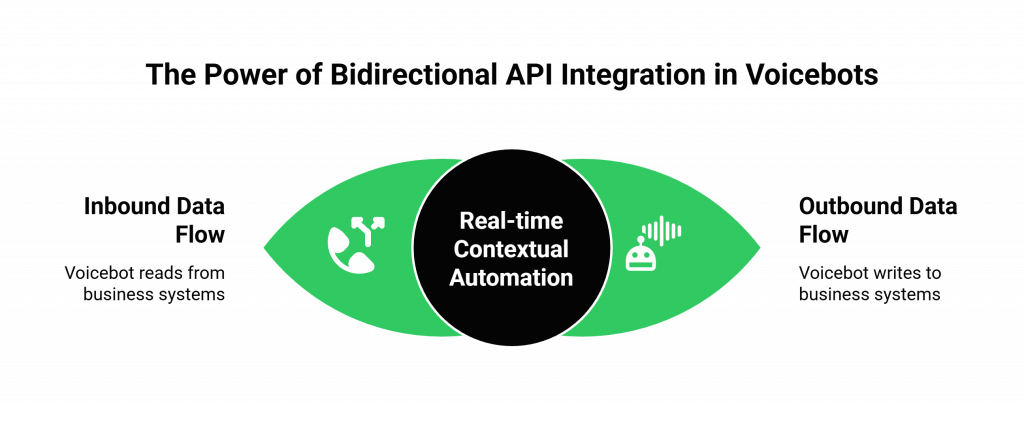
The Two-Way Street of Data
The integration is a continuous, two-way conversation between your voicebot’s “brain” and your business systems.
- The “Read” Operation (Inbound Data): When a call comes in, the voicebot’s brain (your application logic) makes real-time API calls to your CRM and support systems. It uses the customer’s phone number as a key to “read” their data: their name, their account status, their recent orders, their open support tickets. This is what allows the voicebot to have a personalized and context-aware greeting.
- The “Write” Operation (Outbound Data): As the voicebot is having the conversation, it is also making API calls back to your business systems to “write” data. It can create a new support ticket in Zendesk, it can log the details of the conversation as an activity in Salesforce, or it can update an order status in your e-commerce platform.
This real-time, bidirectional data flow is the essence of a crm integrated voicebot. It transforms the voicebot from an isolated tool into a deeply embedded and intelligent part of your support workflow automation.
Also Read: What Should You Look For In A Scalable Voice Recognition SDK?
What Do These Integrated Workflows Look Like in Practice?
When you combine a powerful voicebot with the rich data from your CRM and support systems, you can create incredibly smart and efficient workflows that would be impossible otherwise.
This table provides some powerful, real-world examples of this integration in action.
| The Integrated Workflow | The “Read” Operation (Data In) | The “Write” Operation (Data Out) | The Business Value |
| The Proactive, Personalized Greeting | The voicebot uses the caller’s ID to look up their name and recent activity in the CRM. | The voicebot logs that a call was received. | Creates a “wow” moment for the customer and dramatically shortens the time to resolution by anticipating their needs. |
| The Intelligent, Skill-Based Routing | The voicebot identifies the caller as a “VIP” customer or sees that they have an open, high-priority support ticket. | The voicebot logs the reason for the transfer. | Bypasses the standard queue and routes the high-value customer directly to the appropriate senior agent, improving CX and retention. |
| The Automated, Self-Service Action | A customer wants to know their order status. The voicebot uses the order number to look up the real-time status in the logistics platform. | The voicebot logs that the customer requested a status update. | Deflects a high-volume, repetitive call from a human agent, reducing costs and providing an instant, 24/7 answer for the customer. |
| The “Warm Transfer” to a Human Agent | The voicebot has a full conversation with the customer, gathering all the details of their issue. | The voicebot creates a new support ticket with the full transcript and summary, and then transfers the call, providing the agent with the ticket ID. | Eliminates the “start-over” problem. The agent has all the context before they even say “hello,” reducing handle time and customer frustration. |
Ready to build a voicebot that is as smart as your best data? Sign up for FreJun AI and explore our powerful, API-first voice infrastructure.
What is the Role of the Underlying Voice Platform?
It is crucial to understand that the integration itself is a function of your application’s logic (your voicebot’s “brain”). The role of the underlying voice platform, like FreJun AI, is to be the powerful and flexible “nervous system” that makes these intelligent workflows possible.
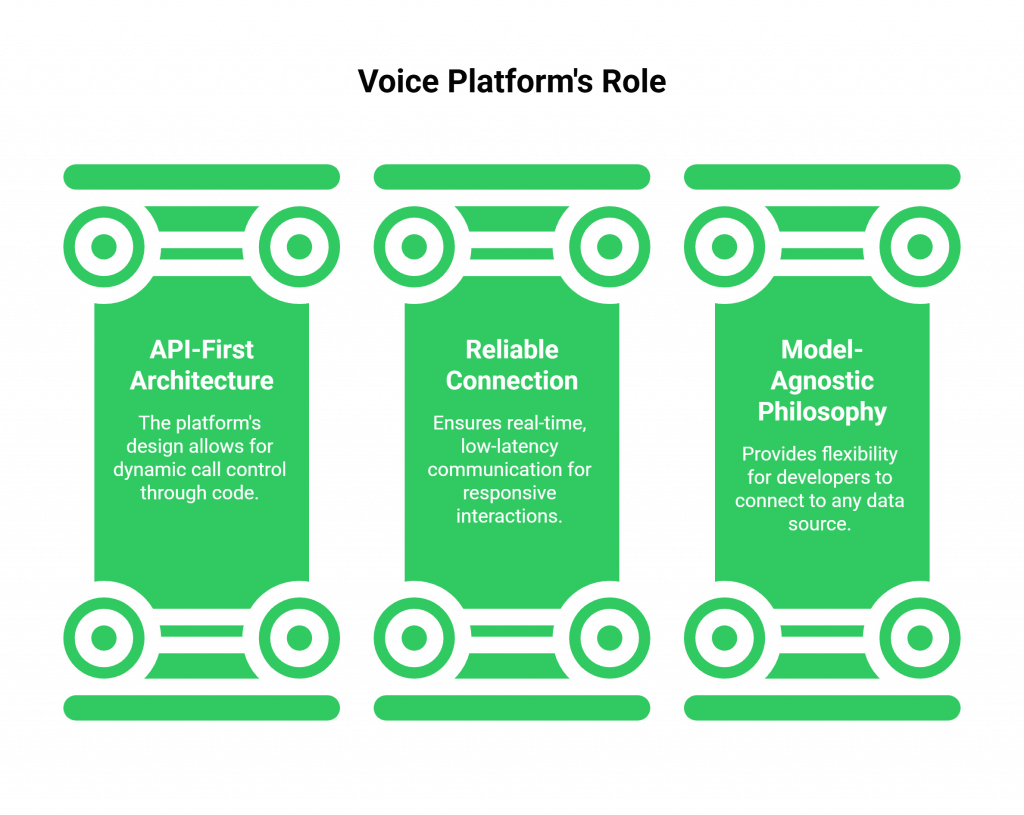
A modern voice platform provides the essential, developer-friendly foundation:
- An API-First Architecture: The entire platform is designed to be controlled by your application’s code. This is what allows your application to dynamically steer the call’s flow based on the data it retrieves from your CRM.
- A Reliable, Low-Latency Connection: The real-time API calls to your business systems add a small amount of latency to the conversation. The voice platform must provide an ultra-low-latency connection to compensate, ensuring the entire interaction still feels fast and responsive.
- A Model-Agnostic Philosophy: We provide the high-performance “voice” and the real-time “plumbing.” You have the complete freedom to build your “brain” and to connect it to any CRM, any support system, or any other data source you need. This is our core promise: “We handle the complex voice infrastructure so you can focus on building your AI.”
The impact of this kind of integrated, automated workflow is transformative. A recent report on business process automation found that organizations that successfully implement automation can see a reduction in operational costs of up to 30%, and support workflow automation is a prime area for these gains.
Also Read: How Can a Voice Recognition SDK Enhance Real Time Call Accuracy
Conclusion
The era of the standalone, amnesiac voicebot is over. The future of AI-driven customer support is a deeply integrated one, where the voice channel is not an isolated island but a fully-fledged, data-aware citizen of your entire technology ecosystem.
A modern voice bot solution is the key that unlocks this future. By using a powerful, API-first architecture to create a real-time, two-way conversation between your voicebot and your core business systems, you can create intelligent voice workflows that are a quantum leap beyond the frustrating IVRs of the past.
A crm integrated voicebot is more than just a piece of technology; it is a new and powerful way to show your customers that you know them, you understand them, and you value their time.
Want to do a deep dive into the API architecture required to integrate our voice platform with your specific CRM or support system? Schedule a demo with our team at FreJun Teler.
Also Read: Future of CRM Call Centers: AI Agents, Automation, and Smart Call Workflows
Frequently Asked Questions (FAQs)
A CRM integrated voicebot is a voice AI that is connected to your Customer Relationship Management (CRM) system. It allow to have personalized, context-aware conversations.
It uses a secure Application Programming Interface (API) to make a real-time request to your CRM, typically using the customer’s phone number to look up their record.
Support workflow automation is the process of using technology, like a voicebot, to automate the steps of a customer support process, such as creating a ticket or routing a call.
Yes. Your application’s logic can be programmed to make an API call to your helpdesk system to automatically create a new, structured ticket with the details of the call.
A warm transfer hands a call to a human agent with full context. The agent receives all prior interaction data. This prevents the customer from repeating information.
Yes, each system (your CRM, your helpdesk, etc.) will have its own API that your application’s logic will need to communicate with.
It is the unnatural stop-and-start rhythm of a traditional voicebot. The user and the AI cannot speak at the same time. This creates long, awkward pauses in the conversation.