
In the world of sales, speed is the ultimate competitive advantage. The time it takes to respond to a new inbound lead is one of the most critical factors in determining whether that lead becomes a customer or a lost opportunity. Yet, for most sales teams, the initial lead qualification process is a massive, manual, and often inefficient bottleneck.
Sales Development Representatives (SDRs) spend a huge portion of their day on repetitive, low-value tasks: dialing numbers that do not connect, leaving voicemails, and asking the same handful of basic qualifying questions over and over again. This is a profound waste of their valuable and expensive human skills. This is the exact problem that modern voice bot solutions are designed to solve.
The future of sales ai is not about replacing human salespeople; it is about augmenting them, about giving them superpowers. By deploying ai sales voicebots to handle the initial, high-volume, and often tedious work of lead qualification, businesses can create a sales pipeline that is faster, more efficient, and dramatically more scalable.
This allows your highly skilled human SDRs to focus exclusively on what they do best: having high-value, consultative conversations with well-qualified, high-intent prospects. This is not just a theoretical improvement; it is a fundamental re-architecting of the sales development process.
Table of contents
The “Leaky Bucket” of Traditional Lead Qualification
To appreciate the impact of automation, we must first be honest about the deep-seated inefficiencies of the traditional, manual lead qualification process. It is a “leaky bucket,” where a huge percentage of potential leads are lost due to slowness and a lack of scalability.
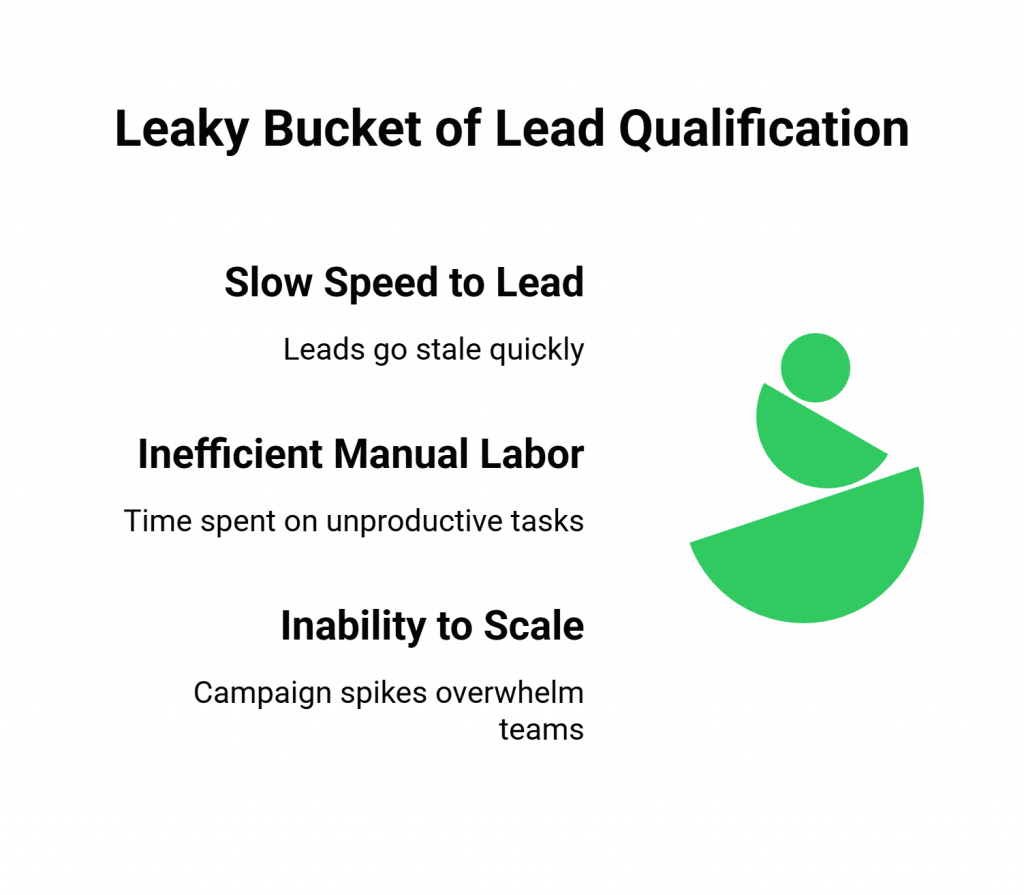
The Crippling Cost of “Speed to Lead”
This is the single most important metric in modern sales. The data is clear and unforgiving. A landmark study published in the Harvard Business Review found that companies that attempt to contact a new lead within an hour are nearly seven times more likely to have a meaningful conversation than those who wait even an hour longer.
- The Problem: A human-powered team simply cannot operate at this speed, especially for leads that come in after hours or on weekends. The lead goes “stale” while it is waiting for an SDR to become available.
Also Read: How Can Building Voice Bots Improve Customer Experience Across Channels?
The Inefficiency of Manual Labor
A human SDR’s day is often a study in unproductive activity.
- The Problem: They spend a huge amount of their time on tasks that do not require their sophisticated sales skills: manually dialing numbers, navigating phone trees, and leaving voicemails. Only a small fraction of their day is spent in actual, meaningful conversation. This is an incredibly expensive use of a skilled employee.
The Inability to Scale
- The Problem: Your lead follow-up capacity depends on SDR count; campaign spikes overwhelm teams, leaving many valuable leads without follow-up.
How Do AI Sales Voicebots Revolutionize This Process?
A modern voice bot solution is not just a better IVR; it is a true AI powered IVR replacement that is specifically design for the world of sales. These outbound voice bots act as a tireless, infinitely scalable team of virtual SDRs.
Solving the “Speed to Lead” Problem Permanently
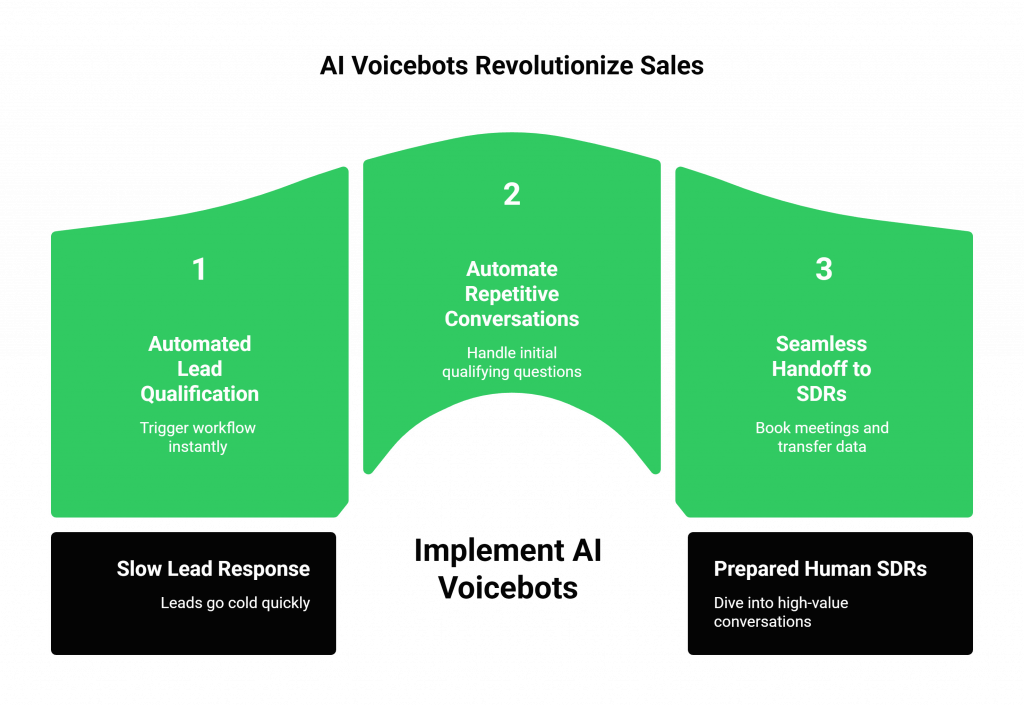
This is the most powerful and immediate benefit. An automated lead qualification workflow can be triggered the instant a new lead is created.
- The Workflow: A user fills out a “contact sales” form on your website. This action creates a new lead in your CRM. This, in turn, triggers a webhook that initiates the voicebot workflow. The voicebot can place an outbound call to that new lead in under 60 seconds.
- The Impact: You are engaging the prospect at the absolute peak of their interest, while your company is still top-of-mind. This dramatically increases the chances of a successful connection and a positive first impression.
Automating the Repetitive, Top-of-Funnel Conversation
The voicebot can be train to handle the entire, initial qualifying conversation.
- The Workflow: The voicebot calls the lead and has a natural, two-way conversation. It can ask the key BANT (Budget, Authority, Need, Timeline) questions:
- “Are you the decision-maker for this kind of purchase?”
- “What is the timeline for your project?”
- “Are you currently working with a specific budget?”
- The Intelligence: The voicebot uses AI to understand the lead’s natural language responses. It is not a rigid script. If the lead asks a question, the AI can provide an answer. This is made possible by a conversational ai voice that is both intelligent and responsive.
Also Read: How Should QA Teams Evaluate Interactions While Building Voice Bots For Users?
The Seamless, Data-Driven Handoff to Human SDRs
The goal of the voicebot is not to close the deal; it is to tee up a perfect opportunity for a human.
- The Workflow: If the voicebot’s AI determines that the lead is qualified, its final action is to book a meeting. It can access the live calendar of your human sales team and offer the lead available slots.
- The Data Transfer: Once the meeting is book, the voicebot’s work is done. It automatically updates the lead’s record in the CRM with a full transcript of the qualifying call, a summary of the key information, and the “lead score.”
- The Impact: The human SDR arrives at the meeting completely prepared. They do not have to waste the first ten minutes asking the basic qualifying questions. They can dive straight into a high-value, consultative conversation.
This table clearly illustrates the powerful division of labor in this new model.
| The Task | The Traditional, Manual Process (Human SDR) | The AI-Powered, Automated Process (Voicebot + Human) |
| Initial Contact | Slow; can take hours or days. The SDR manually dials. | Instant; the voicebot calls the lead in under a minute. |
| Initial Qualification | The SDR spends their time asking the same basic BANT questions. | The ai sales voicebot handles the entire, repetitive qualifying conversation. |
| Scheduling | A manual, back-and-forth process of email or phone tag. | The voicebot books the meeting directly on the SDR’s calendar via an API. |
| The Human SDR’s Role | Wasted on low-value, repetitive tasks. | Focused exclusively on high-value, consultative conversations with pre-qualified, high-intent leads. |
Ready to build a sales pipeline that is supercharged by AI? Sign up for FreJun AI and explore our powerful voice infrastructure.
What Underpins a Successful Sales Voice bot Solution?
To build these outbound voice bots, you need more than just a smart AI. You need a powerful and reliable voice infrastructure to build it upon. This is the critical, and often overlooked, foundation. The platform must provide:
- A Low-Latency, High-Quality Connection: For a sales conversation to be effective, it must feel natural. Any awkward delay or choppy audio will instantly destroy the rapport. A globally distributed, edge-native voice infrastructure is essential.
- A Flexible, Model-Agnostic Architecture: The world of AI is moving at a breakneck pace. A platform like FreJun AI is model-agnostic. It gives you the freedom to integrate the best-in-class STT, LLM, and TTS models from any provider, ensuring your sales bot always sounds its best and understands with the highest accuracy. This is our core promise: “We handle the complex voice infrastructure so you can focus on building your AI.”
- Carrier-Grade Scalability: When your marketing campaign is a massive success, you need a platform that can make thousands of simultaneous outbound calls without breaking a sweat.
Also Read: How Can Small Teams Start Building Voice Bots With Minimal Cost?
Conclusion
The traditional model of sales development is broken. It is a slow, inefficient, and unscalable process that wastes the valuable time of your most precious resource: your human salespeople. Modern voice bot solutions are the key to fixing this.
By automating the entire top-of-funnel lead qualification process, ai sales voicebots can solve the “speed to lead” problem, ensure a consistent and professional first touch, and tee up a pipeline of perfectly qualified, high-intent leads for your human team.
This is more than just an operational improvement; it is a fundamental re-architecting of the sales process, a powerful fusion of human talent and AI efficiency that will define the next generation of high-growth sales organizations.
Want to do a deep architectural dive into how our voice platform can power your automated lead qualification workflow? Schedule a demo with our team at FreJun Teler.
Also Read: 10 Best IVR Software Solutions for 2025: Features, Pricing & Use Cases
Frequently Asked Questions (FAQs)
The main benefit is speed. An automated lead qualification voicebot can contact a new lead in seconds, engaging them at the peak of their interest.
No, it supercharges them. The ai sales voicebot handles the repetitive, top-of-funnel tasks, allowing your human SDRs to focus exclusively on high-value conversations with qualified prospects.
Yes. By using a powerful LLM and a low-latency voice connection, modern outbound voice bots can have incredibly natural and dynamic conversations, far beyond a simple script.
It integrate with your CRM. A new lead being created or a lead’s status changing can act as a trigger for the voicebot to initiate an outbound call.
It integrate with your team’s calendar (like Google Calendar or Calendly) via an API. It can see the real-time availability and book a meeting directly.
“Speed to lead” refers to the critical importance of responding to a new sales lead as quickly as possible. The probability of qualifying a lead drops dramatically with every minute of delay.
Yes. A key part of the future of sales ai is the AI’s ability to understand intent. If a lead says, “I’m not interested,” the AI can politely end the conversation and mark that in the CRM.