
The modern contact center is in a state of perpetual siege. It is a battlefield where a small team of human agents is constantly fighting against a relentless, overwhelming tide of inbound customer calls becuase they don’t know about voice bot solutions. During a product launch, a service outage, or a holiday shopping season, this tide can become a tsunami, completely swamping the contact center’s capacity and leaving a wake of frustrated customers and burned-out agents.
For decades, the only answer to this problem was to hire more agents, a costly, slow, and inefficient solution. Today, a new and far more powerful weapon has entered the arsenal: scalable voicebot solutions.
The ability to handle a massive, sudden, and unpredictable volume of calls is the ultimate stress test for any customer communication platform. This is where modern voice bot solutions are not just a “nice-to-have” feature, but an absolute, non-negotiable architectural necessity for any serious enterprise voice bot strategy.
But what is it, technologically and architecturally, that gives a voicebot this unique and powerful superpower? It is a combination of a cloud-native, elastic infrastructure and an intelligent, AI-powered core. This guide will explore the key characteristics that make high-volume call automation not just possible, but incredibly effective.
Table of contents
The “Perfect Storm”: Why High Call Volumes Are So Destructive
To appreciate the solution, we must first have a healthy respect for the problem. A massive, sudden spike in call volume is a “perfect storm” that attacks a traditional, human-powered contact center on multiple fronts simultaneously.
- The Capacity Wall: The most immediate problem is the hard ceiling of a traditional phone system. If you have 100 human agents, you can handle 100 simultaneous calls. The 101st caller gets a busy signal. This is a jarring and unprofessional experience that instantly damages the customer’s perception of your brand.
- The Plummeting Service Levels: For the callers who do manage to get into the queue, the wait times can skyrocket from a few minutes to an hour or more. This is a massive driver of customer dissatisfaction.
- The Overwhelmed and Ineffective Agents: The agents on the front lines are under immense pressure. They are rushing from one call to the next, dealing with a stream of anxious and often angry customers. This high-stress environment leads to a dramatic increase in errors, a decrease in the quality of the interaction, and a rapid path to agent burnout and high turnover.
- The Data Black Hole: During this chaos, there is no time for proper note-taking or data entry. The valuable information about why all these customers are calling is often lost, preventing the business from quickly diagnosing the root cause of the problem.
Also Read: Why Is A Voice API For Developers Essential For Low Latency Voice Apps?
How Do Scalable Voicebot Solutions Solve This Problem?
Modern voice bot solutions are not just a better version of the old IVR; they are a completely different architectural paradigm. They are designed from the ground up to solve the specific challenges of high-volume call automation. Their effectiveness stems from a few key, interconnected characteristics.
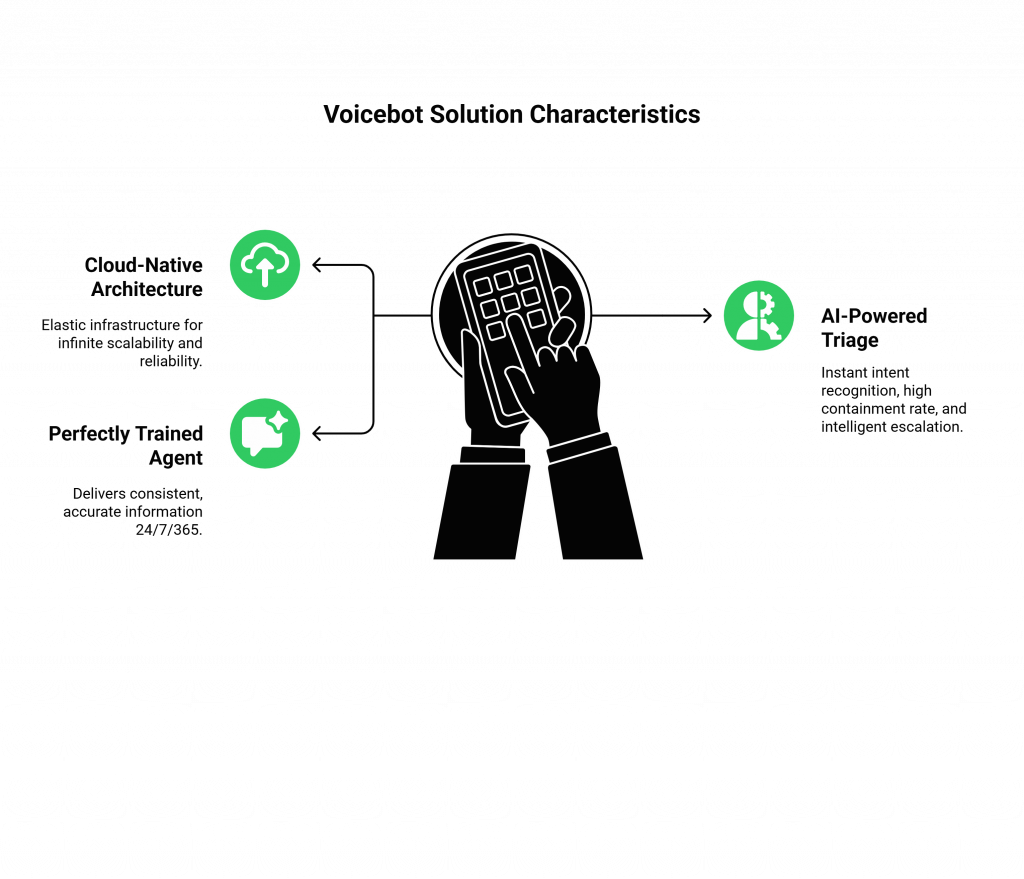
The Power of a Cloud-Native, Elastic Architecture
This is the foundational element. Unlike an on-premise phone system with a fixed number of physical lines, a modern voicebot is built on top of a cloud-native, elastic voice infrastructure.
- Infinite, On-Demand Scalability: The voicebot is not limited by the number of “lines.” It is tapping into a massive, globally distributed pool of capacity. It can automatically and instantly scale to handle a virtually unlimited number of simultaneous calls. Whether you receive 100 calls or 100,000 calls in a single hour, every single caller can be answered instantly. There are no more busy signals.
- A Foundation of Reliability: This cloud-native infrastructure is built with multiple layers of redundancy across different geographic regions, providing the carrier-grade reliability that enterprise voice bots demand.
The Efficiency of AI-Powered Triage and Containment
A voicebot does more than just answer the call; it acts as an incredibly efficient, intelligent “triage officer.”
- Instant Intent Recognition: The voicebot uses AI (NLU/LLM) to instantly understand why the customer is calling. It can distinguish between a simple, repetitive query and a complex, unique problem in a matter of seconds.
- High Containment Rate: For the vast majority of calls, which are often simple and repetitive (e.g., “Is there an outage in my area?”, “What is my account balance?”), the voicebot can provide an instant, accurate answer and completely resolve the inquiry without any human intervention. This ability to “contain” the call is its primary function in a high-volume scenario.
- Intelligent Escalation: For the small percentage of calls that do require a human touch, the voicebot can perform an intelligent “warm transfer.” It gathers the customer’s information, understands their issue, and then routes them to the correct human agent, passing along all of that context so the agent can pick up the conversation without making the customer start over.
Also Read: How Can a Voice API for Developers Enable Real Time AI Calling?
The Consistency of a Perfectly Trained Agent
A voicebot is the ultimate model employee.
- Perfect Consistency: It delivers the exact same, on-brand, and perfectly accurate information on every single call. It never gets tired, it never has a bad day, and it never gives a customer the wrong answer.
- 24/7/365 Availability: The voicebot is always on. It can handle a massive call spike at 3 AM on a Sunday with the same efficiency and professionalism as it does at 3 PM on a Tuesday.
This table provides a clear summary of how these features directly address the challenges of high call volumes.
| The High-Volume Challenge | The Traditional, Human-Powered Response | The Scalable Voicebot Solution |
| Massive Call Spikes | The system is overwhelmed; customers get busy signals. | The elastic, cloud-native architecture scales instantly to answer every single call. |
| Long Wait Times | Customers are stuck in long queues, leading to frustration and abandonment. | There is zero wait time. Every caller is served instantly by the voicebot. |
| Overwhelmed Agents | Agents are stressed, make more errors, and burn out quickly. | The voicebot handles the high volume of simple calls, allowing human agents to focus on complex escalations. |
| Lack of Data | The chaos makes it impossible to gather good data. | Every call is a structured data event, providing real-time insights into the cause of the call spike. |
Ready to build a customer service front door that can withstand any storm? Sign up for FreJun AI and explore our massively scalable voice infrastructure.
What Is the Role of the Underlying Voice Infrastructure?
It is crucial for any enterprise architecting this solution to understand that the voicebot’s “brain” (the AI models) is separate from its “body” (the voice infrastructure). The ability to handle high-volume call automation is a direct function of the quality and scalability of this underlying infrastructure.
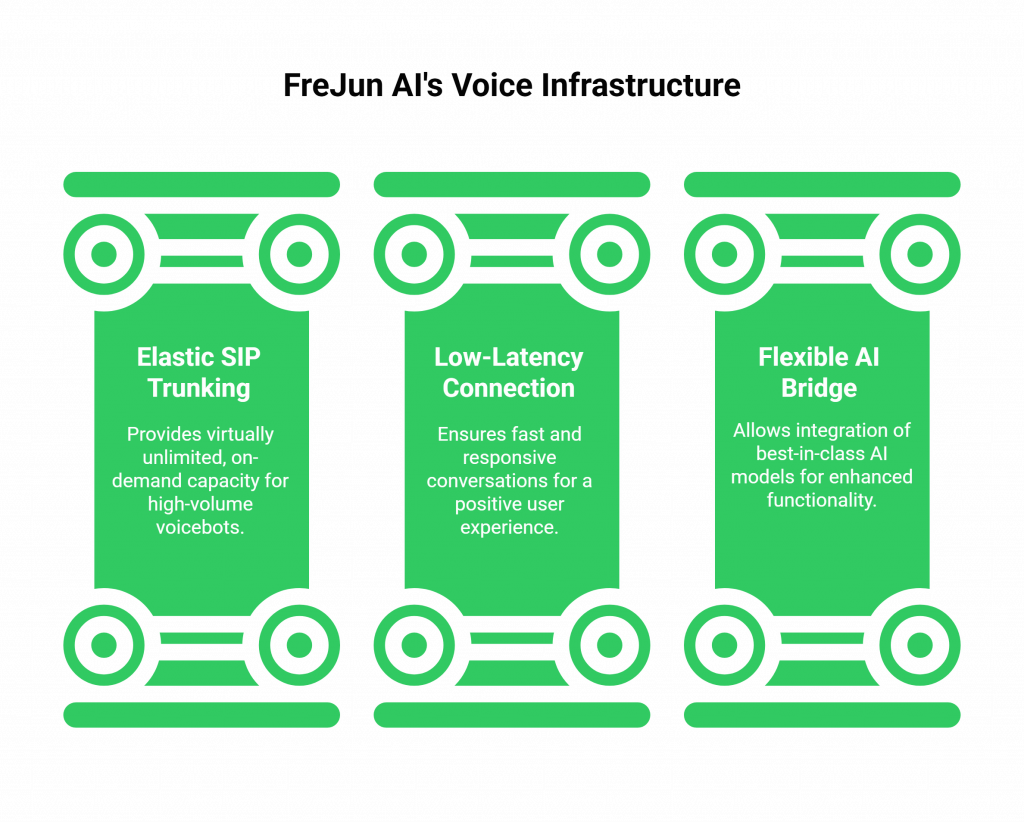
This is the essential role of a platform like FreJun AI. We provide the carrier-grade, globally distributed voice platform that makes enterprise voice bots possible.
- The Elastic SIP Trunking Foundation: Our Teler engine is a powerful, elastic SIP trunking platform that provides the virtually unlimited, on-demand capacity that a high-volume voicebot needs.
- The Low-Latency Connection: Our edge-native architecture ensures that the conversation between the customer and your AI is fast and responsive, which is critical for a positive user experience.
- A Flexible, Model-Agnostic Bridge: Our platform is designed to be a flexible bridge. We provide the high-quality, scalable voice connection, and you have the complete freedom to build or integrate the best-in-class AI “brain” of your choice. This is our core promise: “We handle the complex voice infrastructure so you can focus on building your AI.”
Also Read: How Voice API Benefits For Businesses Reducing Manual Communication Tasks
Conclusion
The traditional, human-powered contact center was simply not designed for the volatile, high-volume demands of the modern digital economy. It is a model that is doomed to fail in the face of a true call spike. Scalable voicebot solutions are the definitive answer to this long-standing challenge.
By combining the infinite, on-demand capacity of a cloud-native voice infrastructure with the intelligent triage and containment capabilities of modern AI, these systems can provide an instant, efficient, and professional response to every single customer, even in the midst of a crisis.
For any business that faces the reality of unpredictable, high-volume customer calls, a powerful voice bot solution is no longer an innovation; it is an operational necessity.
Have a high-volume use case that you need to solve? Want to do a deep dive into the scalability and reliability of our voice infrastructure? Schedule a demo with our team at FreJun Teler.
Also Read: What Is IVR Software? Complete Guide for Businesses
Frequently Asked Questions (FAQs)
The main advantage is their massive, on-demand scalability. They can automatically handle a virtually unlimited number of simultaneous calls without any wait times or busy signals.
A scalable voicebot solution is one that is built on a cloud-native, elastic infrastructure that can automatically increase its capacity to meet any level of demand in real time.
High-volume call automation is the use of a voicebot to handle a large, sudden spike in inbound calls, such as during a service outage or a major marketing event.
While enterprise voice bots excel at handling simple, repetitive calls at scale, they are also designed to intelligently identify complex calls and seamlessly transfer them to the appropriate human agent.
It improves the experience by ensuring that every customer’s call is answered instantly, their basic needs are met, and they are not left waiting on hold for hours.
The containment rate is the percentage of calls that the voicebot is able to fully resolve without needing to transfer the call to a human agent.
It acts as a filter, handling the vast majority of simple, repetitive inquiries, which allows human agents to focus their time and expertise on the most complex and urgent customer issues.