
We have all been there, trapped in the automated purgatory of a traditional phone system. You call a company for help, and a robotic voice greets you: “For sales, press 1. For support, press 2.” You press 2. “For billing, press 1. For technical support, press 2.”
You press 2 again, only to be met with another menu, and then another. This is the frustrating, rigid, and deeply impersonal experience of the traditional Interactive Voice Response (IVR) system.
For decades, it was a necessary evil for businesses trying to manage high call volumes. Today, it is a relic, a primary source of customer frustration, and it is being decisively replaced by a far more intelligent and capable technology: modern voice bot solutions.
The shift from a rigid, touch-tone menu to a fluid, conversational AI is not merely an upgrade; it is a complete revolution in how businesses interact with their customers on the voice channel. The ai powered IVR replacement is no longer a futuristic concept; it is a present-day reality that is driving massive improvements in customer experience and operational efficiency.
This article will explore the deep-seated failures of the traditional IVR and explain why modern voicebot solutions are the new, non-negotiable standard for customer communication.
Table of contents
- What Made Traditional IVR a Necessary Evil?
- Where Do Traditional IVR Systems Fundamentally Fail the Modern Customer?
- How Do Modern Voicebot Solutions Revolutionize This Experience?
- What Are the Tangible Business Benefits of an AI-Powered IVR Replacement?
- What Is the Role of the Underlying Voice Infrastructure?
- Conclusion
- Frequently Asked Questions (FAQs)
What Made Traditional IVR a Necessary Evil?
To understand why the IVR is being replaced, we must first acknowledge why it was created. In the pre-internet era, the phone was the only real-time channel for customer service, and call centers were easily overwhelmed. The IVR was a brilliant, albeit limited, technological solution to a very real business problem.
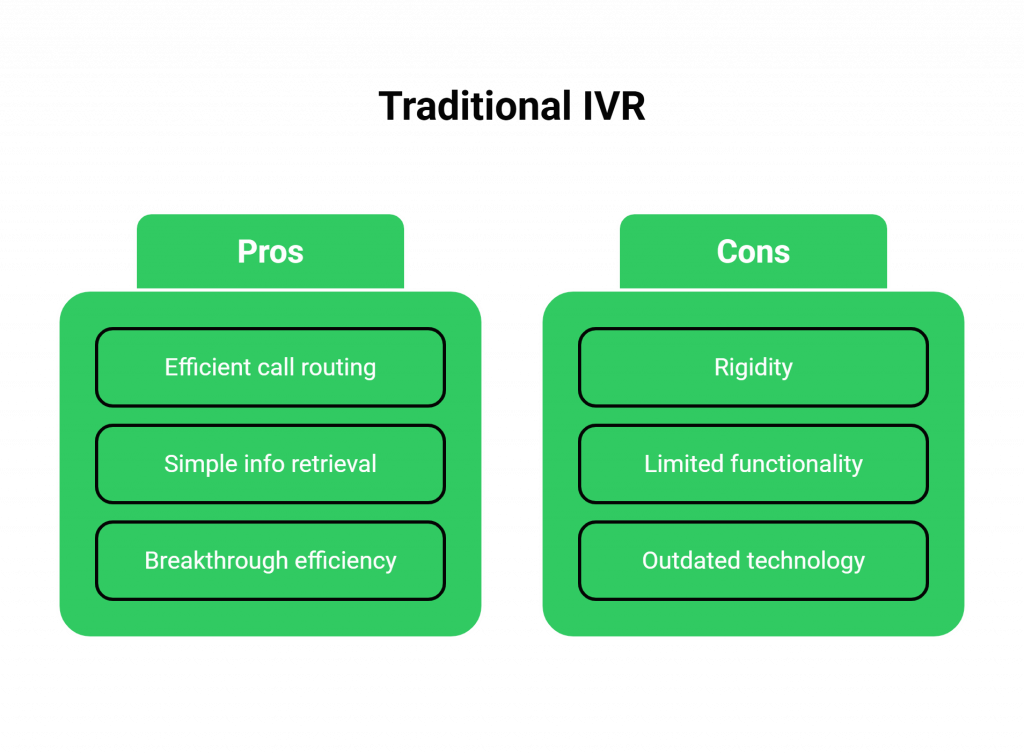
Its primary purpose was to act as a simple, automated switchboard. Using Dual-Tone Multi-Frequency (DTMF) signaling, the formal name for the sounds a touch-tone phone makes, the IVR could perform two basic functions:
- Basic Call Routing: It could sort callers into different queues based on their keypad input, directing billing questions to the billing department and technical questions to the technical support team.
- Simple Information Retrieval: For very simple, repetitive queries, it could play pre-recorded audio files. For example, a caller could press “3” to hear the company’s hours of operation.
In its time, this was a breakthrough in efficiency. But the world has changed, and customer expectations have changed with it. The very rigidity that once made the IVR a reliable tool is now its greatest weakness.
Also Read: How Intelligent Voice API Benefits for Businesses Supporting Daily Support
Where Do Traditional IVR Systems Fundamentally Fail the Modern Customer?
The modern customer is accustomed to the instant, intuitive, and personalized experiences of the digital world. They can ask their smartphone a complex question in natural language and get an immediate answer. When they encounter a traditional IVR, the experience is jarring, frustrating, and feels profoundly outdated. This is the core of the voicebot vs ivr debate: one is a system of limitation, the other a system of understanding.
The “Menu Maze” and High Customer Effort
The most common complaint about IVRs is the “menu maze.” Callers are forced to listen to a long, irrelevant list of options, trying to guess which category their unique problem fits into. If they make the wrong choice, they are often sent down a dead-end path and have to start all over again. This process demands a high level of effort and patience from a customer who is likely already frustrated.
The Lack of Understanding (The “Deafness” Problem)
A traditional IVR is functionally deaf. It does not understand human language. It only understands the twelve tones of a telephone keypad. If a customer’s problem is complex or does not fit neatly into one of the pre-defined options, they have no recourse but to repeatedly press “0” in the hope of reaching a human. This is the ultimate failure of a self-service channel.
The Context Black Hole
The IVR system is a “black box,” completely disconnected from the rest of your business systems. It has no idea who the caller is, what their purchase history is, or that they were just on your website looking at their last invoice. Every caller is treated as an anonymous stranger, and the burden is placed entirely on them to provide all the context.
The “Containment” Failure and Increased Agent Workload
Ironically, most traditional IVRs fail at their primary goal: to “contain” the call and prevent it from reaching a human agent. More often than not, the IVR simply acts as a frustrating, multi-minute-long “pre-amble” to a human conversation.
By the time the customer finally reaches a live agent, they are often angry and have to repeat all the information they may have already entered, which increases the agent’s average handle time and stress level. This is a critical failure, as a recent study by HubSpot found that 33% of customers are most frustrated by having to repeat themselves to multiple support reps.
How Do Modern Voicebot Solutions Revolutionize This Experience?
A modern voicebot is not just a better IVR; it is a completely different species of technology. It is a true ai powered ivr replacement that is built on a foundation of conversational artificial intelligence.
Instead of a rigid, touch-tone flowchart, a voicebot uses a sophisticated pipeline of AI technologies:
- Speech-to-Text (STT): To understand what the user is saying in their natural language.
- Natural Language Understanding (NLU) / Large Language Models (LLM): To determine the intent behind the user’s words.
- Integration APIs: To connect to your core business systems (like your CRM or billing platform) to retrieve personalized information and perform actions.
- Text-to-Speech (TTS): To respond to the user in a clear, natural, and often human-like voice.
Also Read: How Does A Voice API For Bulk Calling Improve Delivery Rates At Scale?
This table provides a definitive voicebot vs IVR comparison.
| Feature | Traditional IVR | Modern Voicebot Solution |
| User Input | DTMF (Touch-Tones) only. A rigid, limited menu. | Natural Language. The user can speak their request in their own words. |
| Intelligence | None. It is a simple, pre-programmed flowchart. | High. It uses AI (NLU/LLM) to understand intent, nuance, and context. |
| Personalization | Anonymous. Every caller gets the same generic experience. | Highly personalized. It can integrate with a CRM to greet the caller by name and understand their history. |
| Task Capability | Limited to basic call routing and playing static audio files. | Can perform complex, multi-step actions like processing a payment, booking an appointment, or troubleshooting a device. |
| Customer Experience | Often frustrating, confusing, and impersonal. | Fast, intuitive, and conversational, leading to a much higher level of satisfaction. |
Ready to start building conversations that actually understand your customers? Sign up for FreJun AI and explore our powerful voice AI infrastructure.
What Are the Tangible Business Benefits of an AI-Powered IVR Replacement?
The move from a traditional IVR to a modern voicebot is not just about improving customer satisfaction; it is a strategic business decision that delivers a powerful and measurable return on investment.
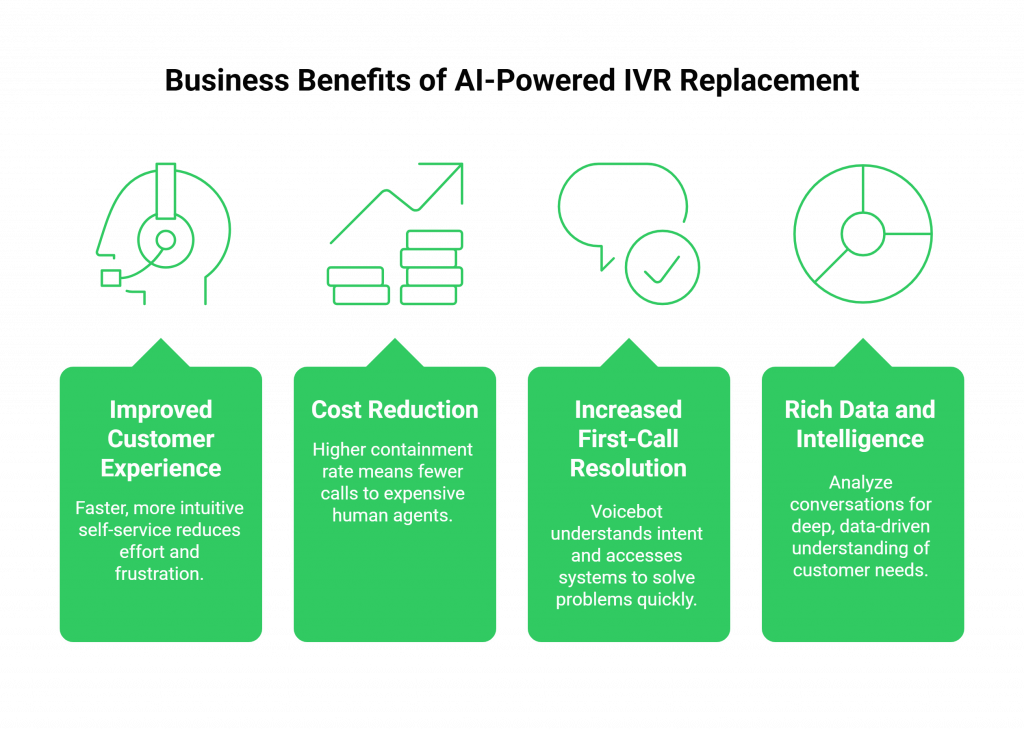
- Dramatically Improved Customer Experience (CX): This is the most important benefit. By providing a faster, more intuitive, and more effective self-service channel, you reduce customer effort and frustration, which is a key driver of loyalty and brand perception.
- Significant Operational Cost Reduction: An intelligent voicebot can successfully resolve a much higher percentage of calls without human intervention. This high “containment rate” means fewer calls are escalated to your expensive human agents, which can drastically lower your average cost-per-call.
- Increased First-Call Resolution: Because the voicebot can understand the customer’s true intent and access back-end systems, it can often solve the problem on the first try. This is a critical metric for any contact center.
- Rich Data and Business Intelligence: Every conversation with a voicebot is a source of rich, structured data. You can analyze thousands of call transcripts to get a deep, data-driven understanding of why your customers are calling, what their most common pain points are, and what new opportunities exist.
What Is the Role of the Underlying Voice Infrastructure?
It is important to understand that the voicebot’s “brain” (the AI models like the STT and LLM) is separate from its “voice and ears” (the core telephony infrastructure). To build a reliable, scalable, and low-latency voicebot, you need a powerful foundation to build it upon.
This is the essential role of a platform like FreJun AI. We provide the carrier-grade, globally distributed voice infrastructure that handles the immense, real-time complexity of the phone call itself.
- The Low-Latency Connection: Our edge-native architecture ensures that the conversation between your customer and your AI is fast and responsive, which is critical for a natural-sounding interaction.
- The Real-Time Media Streaming: Our APIs provide the clean, high-quality audio stream that your AI’s “ears” need to achieve the highest possible accuracy.
- The Scalability and Reliability: Our platform can handle a massive, sudden spike in call volume, ensuring that your voicebot is always on and available, especially during a crisis.
We handle the complex voice infrastructure so you can focus on building the intelligence of your AI.
Also Read: Voice Recognition SDK That Handles Noise with High Precision
Conclusion
The traditional IVR, a once-innovative tool, has become a symbol of impersonal and frustrating customer service. Its rigid, deaf, and disconnected nature is fundamentally at odds with the expectations of the modern consumer. Modern voicebot solutions represent a true paradigm shift.
By leveraging the power of conversational AI, they can understand, personalize, and act, transforming the automated phone call from a dreaded chore into a helpful and efficient experience.
For any business looking to reduce costs, improve efficiency, and build a stronger, more trusting relationship with its customers, the decision to pursue an ai powered ivr replacement is no longer a question of “if,” but “when.”
Want to do a deep dive into the infrastructure required to power a modern, AI-powered voicebot? Schedule a demo with our team at FreJun Teler.
Also Read: Top 7 IVR Software for Call Centers: Automation, Routing & AI Features
Frequently Asked Questions (FAQs)
A voicebot understands natural language, while an IVR only understands touch-tone keypad inputs. This makes the voicebot far more flexible and user-friendly.
Yes, modern voicebot solutions can be integrated with your business systems to perform complex, multi-step actions like processing payments or troubleshooting technical issues.
No, it augments them. The voicebot handles the high volume of routine, repetitive inquiries, freeing up your human agents for more complex and empathetic conversations.
The first step in an ai powered ivr replacement is to analyze your current call data to identify the most common reasons customers are calling.
By integrating with advanced, multilingual Speech-to-Text (STT) models, a voicebot can be trained to accurately understand a wide variety of languages and regional accents.
A well-designed voicebot will have “error handling” logic. It can ask the user to rephrase their request or can offer to seamlessly transfer the call to a live agent.
While there is an initial investment, the long-term ROI is typically very high due to the significant reduction in call center operational costs.