
In the world of business communication, there is a simple, binary truth: the call either works, or it does not. For your customers, a dropped call, a failed connection, or a garbled conversation is not a minor technical glitch; it is a broken promise. It is a moment of friction that can erode trust and damage your brand’s reputation.
This is why, for a developer building a voice application, the single most important, non-negotiable feature of their chosen voice API for developers is not its price or its feature set, but its unwavering, carrier-grade reliability.
The public telephone network and the internet that supports modern VoIP are inherently chaotic and unpredictable environments. Building fault-tolerant voice systems on top of this chaos is a profoundly difficult engineering challenge.
A modern, developer-first voice API is a powerful layer of abstraction that is designed to solve this problem. It is not just a tool for making a call; it is a gateway to a globally distributed, highly redundant, and intelligently managed network that is obsessively engineered to deliver the highest possible levels of voice call uptime api and performance.
This guide will take you “under the hood” to explore the architectural principles and technologies that a modern voice platform uses to deliver the reliability that businesses demand.
Table of contents
The Enemies of Reliability: What Are You Fighting Against?
To build a reliable system, you must first understand the forces of chaos you are up against. A voice call is a long and fragile chain of dependencies, and a failure at any one of these links can break the entire chain. The primary threats to reliability include:
- Carrier Outages: The global telephone network is a patchwork of thousands of carriers. A major carrier in a specific region can, and often does, experience outages.
- Internet Backbone Congestion: Your call’s audio packets travel over the public internet, which can experience periods of heavy congestion, leading to high packet loss and poor quality.
- Data Center Failures: The servers that are processing your call, whether they are the provider’s or your own, can fail due to hardware issues, power outages, or software bugs.
- Distributed Denial-of-Service (DDoS) Attacks: A malicious actor can flood a provider’s network with a massive amount of traffic, attempting to overwhelm their servers and deny service to legitimate users.
Also Read: Voice Recognition SDK Built For Low Latency Voice Streaming
The Architectural Pillars of a Reliable Voice Platform
A truly reliable voice API for developers is not the result of a single feature; it is the outcome of a deep, multi-layered, and deliberate architectural philosophy. It is a system that is designed, from its very foundation, to anticipate and gracefully handle failure.
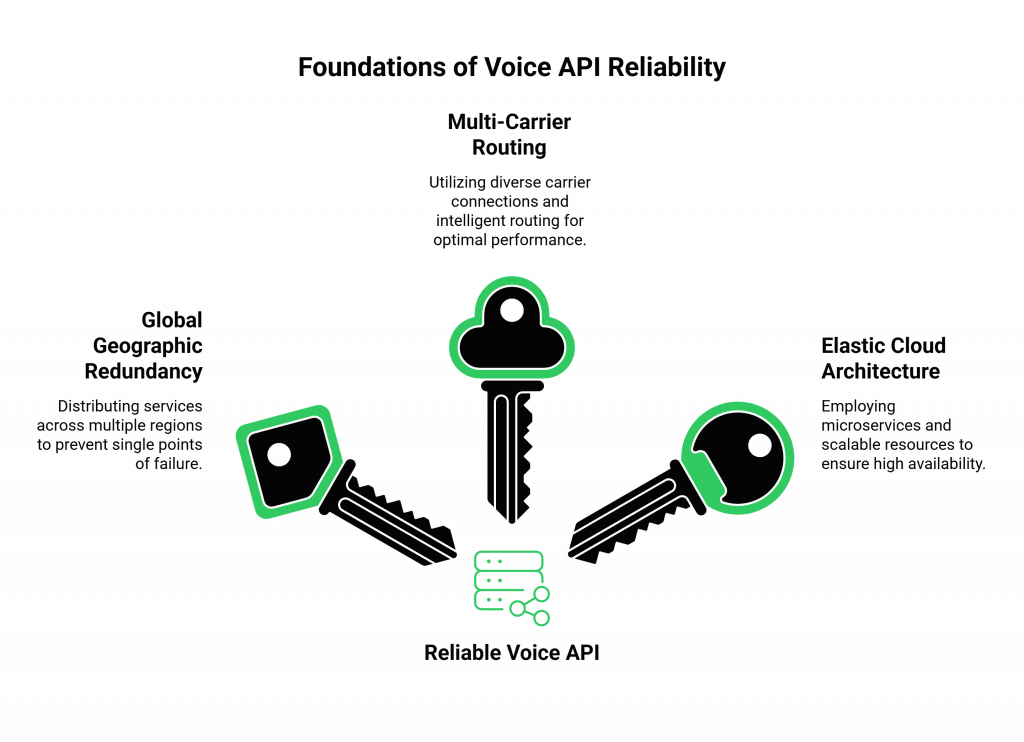
Pillar 1: Global Geographic Redundancy
This is the most important principle for building fault-tolerant voice systems.
- The Flaw of a Single Region: A platform that is hosted in a single data center, or even multiple data centers in the same geographic region, has a massive single point of failure. A regional power outage, a natural disaster, or a major fiber cut can take the entire service offline.
- The Power of Geo-Redundancy: A truly reliable voice platform, like FreJun AI’s Teler engine, distributes globally across multiple independent regions (e.g., North America, Europe, Asia). Each region operates independently. If North America goes offline, Europe and Asia continue running, and traffic reroutes automatically. This setup sets the gold standard for voice API reliability.
Pillar 2: A Multi-Carrier, Intelligently Routed Backbone
A voice platform is only as reliable as the carriers it connects to.
- The Flaw of a Single Carrier: A provider that relies on a single upstream carrier for its connection to the telephone network is inheriting that carrier’s single point of failure.
- The Power of Diversity: A carrier-grade platform maintains a complex and redundant web of interconnections with multiple Tier-1 carriers in every region it operates in. More importantly, it has an intelligent routing engine that is constantly monitoring the performance (latency, jitter, packet loss) of every single one of these carrier paths in real-time. If it detects that a particular carrier is having a problem, it can automatically and instantly reroute your calls through a different, better-performing carrier. This is like having a “Waze” for your voice traffic, always finding the fastest and most reliable path.
Also Read: What Should You Look For In A Scalable Voice Recognition SDK?
Pillar 3: A Highly Available, Elastic Cloud Architecture
The software and infrastructure within each data center must also be designed for resilience.
- Microservices and Redundancy: The platform is not a single, monolithic application. It is broken down into a set of redundant, load-balanced microservices. The failure of any single server will not impact the overall service.
- Elastic Scalability: The platform is designed to handle massive, sudden spikes in traffic. It can automatically scale its resources to meet any level of demand, which is a key part of preventing overload-related failures.
This table provides a clear summary of how these architectural pillars contribute to a reliable service.
| Architectural Pillar | What It Is | How It Improves Reliability |
| Global Geographic Redundancy | The platform is deployed in multiple, independent geographic regions. | It eliminates a regional disaster as a single point of failure, providing the foundation for a voice call uptime api. |
| Multi-Carrier, Intelligent Routing | The platform is connected to many different carriers and can dynamically choose the best path. | It can automatically route around a specific carrier’s outage or a congested part of the internet. |
| Highly Available Cloud Architecture | The software is built on a foundation of redundant, scalable microservices. | It prevents the failure of a single server from causing a service outage and can handle massive traffic spikes. |
Ready to build your mission-critical voice application on a platform that was architected for this level of reliability? Sign up for FreJun AI
How Does This Benefit the Developer and the Business?
This deep, architectural commitment to reliability is one of the most significant voice api benefits for businesses. It is what allows a developer to build their application with confidence, knowing that the foundation they are building on is rock-solid.
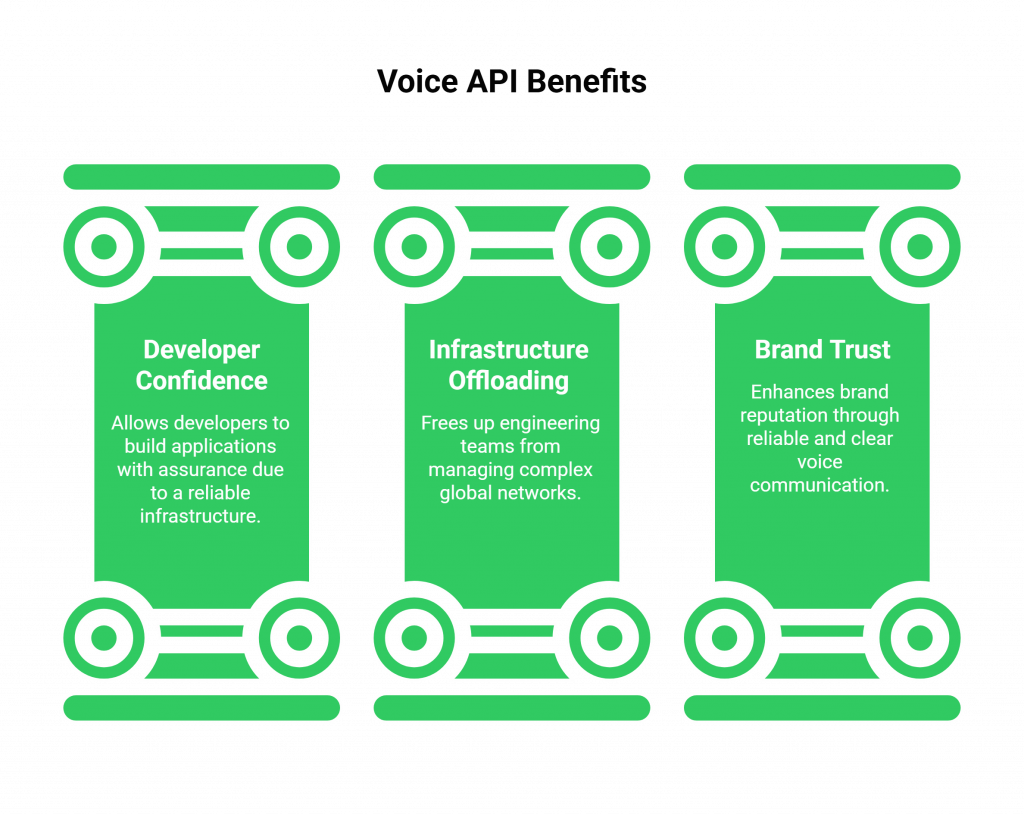
It Allows You to Focus on Your Application, Not the Infrastructure
The single biggest benefit of using a reliable voice api for developers is that it allows you to completely offload the immense, 24/7/365 burden of managing a global, mission-critical infrastructure. Your team does not need to be on call at 3 AM to deal with a carrier outage in Frankfurt. You can sleep soundly, knowing that your provider’s global Network Operations Center (NOC) is doing that for you. This allows your engineering team to focus 100% of their energy on your core application’s logic.
It Provides a Foundation for a Trustworthy Brand
For your end-users, the reliability of your voice channel is a direct reflection of the reliability of your brand. A call that always connects and is always crystal clear sends a powerful message of professionalism and quality. The importance of this trust cannot be overstated.
Also Read: How Can a Voice Recognition SDK Enhance Real Time Call Accuracy
Conclusion
In the world of real-time communications, reliability is not a feature; it is the entire product. A voice application that is not reliable is not a product at all; it is a liability.
While the promise of a voice call uptime api with “five nines” of availability is easy to make, the reality is that achieving it requires a deep, multi-year, and incredibly expensive investment in a globally distributed, geo-redundant, and intelligently managed infrastructure. This is the “hard part” of voice.
By choosing a modern, developer-first voice API for developers that has made this deep architectural commitment, businesses and their developers are making a strategic decision to build on a foundation of rock-solid reliability. This allows them to focus on innovation with the complete confidence that when their customers call, they will always be there to answer.
Have a mission-critical, high-availability use case that requires a deep dive into our specific redundancy and failover protocols? Schedule a demo for FreJun Teler.
Also Read: 7 Best IVR Software for Small Businesses: Affordable & Scalable Options
Frequently Asked Questions (FAQs)
The most important factor is a globally distributed, geo-redundant architecture. This eliminates a single point of failure and is the key to building fault-tolerant voice systems.
“Five nines” refers to 99.999% uptime. This is a very high standard of availability, translating to less than 6 minutes of total downtime over the course of an entire year.
A voice call uptime API does not refer to a specific API; it describes a voice API supported by a platform that guarantees very high uptime.
The best voice API achieves reliability through a multi-layered strategy: a globally distributed network, a multi-carrier backbone with intelligent routing, and a highly available cloud architecture.
It means that the voice platform is not reliant on a single telecom carrier. It has connections to many different carriers and can automatically route calls through the best-performing one at any moment.
A NOC is a centralized location where a team of engineers monitors a network 24/7/365, proactively identifying and responding to any issues to ensure reliability.
An SLA is a formal provider contract guaranteeing a specific service level, such as 99.99% uptime. It usually offers financial credits if the guarantee is not met.