
Every successful application reaches a transformative moment. It grows from serving a few thousand early adopters to millions globally. This is the moment of hyper-growth. It brings exhilarating success but also immense technical strain. The architecture that handled ten thousand users can’t support ten million. This is especially true for the voice layer. For high-scale applications, building communication features on a modern voice API for developers is not just convenient, it is a strategic necessity.
The world’s most successful and fastest-growing applications, the ride-hailing giants, the global e-commerce marketplaces, the massive online collaboration tools, did not build their own global telecommunications networks from scratch. That would have been an insane and suicidal distraction from their core business.
Instead, they made a smart, strategic decision: they chose to build on top of a powerful, programmable, and massively scalable voice platform. This guide will explore the deep, architectural reasons why a high-scale calling infrastructure, delivered through an enterprise voice api, is the only viable choice for applications that are built for growth.
Table of contents
The Immense, Hidden Challenge of Building Voice at Global Scale
To understand why high-scale apps buy rather than build their voice infrastructure, we must first appreciate the monumental, and often invisible, complexity of building a reliable voice platform from the ground up.
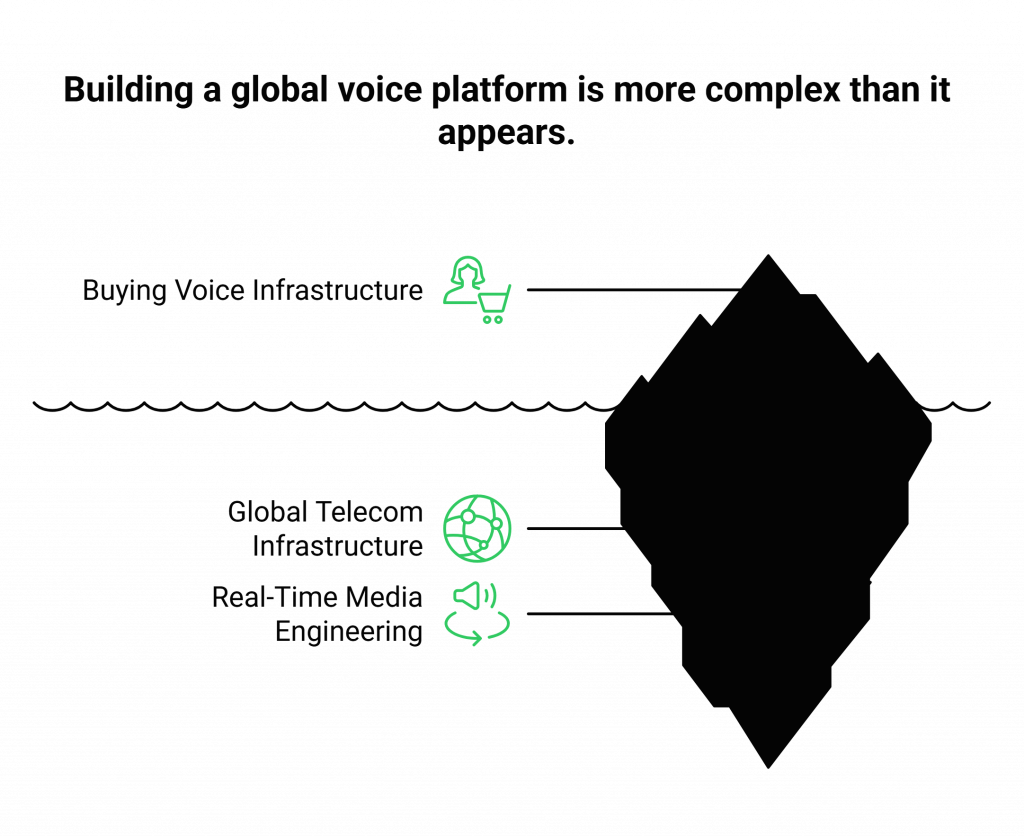
The Nightmare of Global Telecom Infrastructure
This is a challenge of pure physics, capital, and legal complexity.
- Physical Infrastructure: To provide a low-latency experience for a global user base, you would need to build a network of Points of Presence (PoPs), physical data centers with racks of specialized servers, in dozens of locations around the world.
- Carrier Interconnections: In each of these regions, you would need to negotiate complex and expensive interconnection agreements with multiple, local Tier-1 telecommunication carriers.
- Regulatory Hell: You would need to build a global legal and compliance team to navigate the labyrinth of telecom regulations in every single country you operate in.
This is a multi-hundred-million-dollar, multi-year undertaking that has nothing to do with your core application.
Also Read: How Can Building Voice Bots Improve Customer Experience Across Channels?
The Deep Engineering Challenge of Real-Time Media
Even if you could solve the infrastructure problem, you would still need to solve the deep computer science problem of handling real-time media at scale.
- The Stateful Nature of Voice: Unlike a stateless web request, a live phone call is a stateful, long-lived session. Managing the state for millions of simultaneous calls is an incredibly complex distributed systems problem.
- The CPU-Intensive Workload: The real-time processing of audio, receiving RTP streams, managing jitter buffers, mixing audio for conferences, decoding codecs, is a very CPU-intensive task. Building a software stack that can do this efficiently and reliably at a massive scale is a highly specialized engineering discipline.
The Voice API as the “Great Abstraction” of Global Telecom
A modern, developer-first voice API for developers is a powerful layer of abstraction that makes this entire, massive iceberg of complexity simply disappear. It takes the entire, global, carrier-grade telecommunications network and presents it to a developer as a simple, on-demand, and infinitely scalable cloud service.
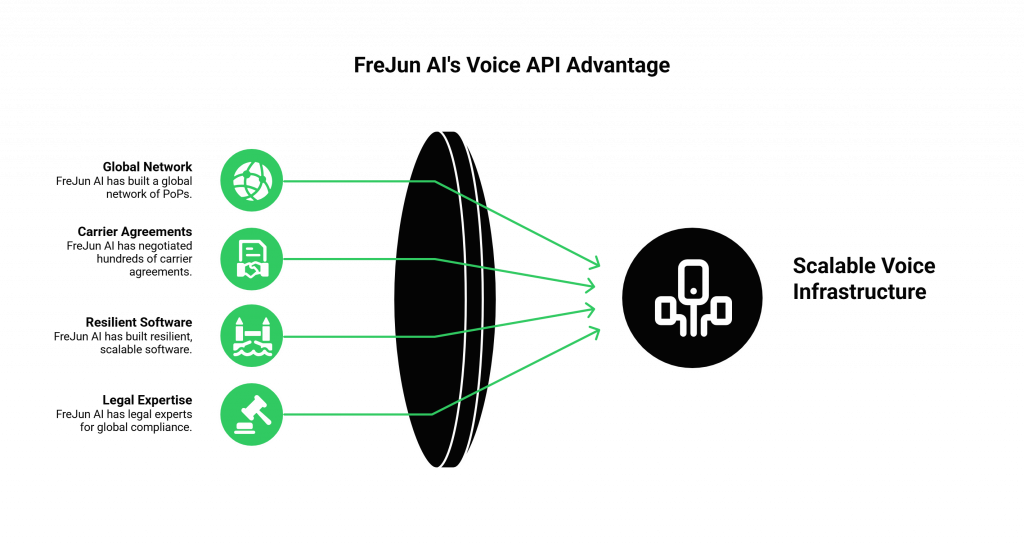
A platform like FreJun AI has already done all the hard work. We have built the global network of PoPs, we have negotiated the hundreds of carrier agreements, we have built the resilient, scalable software, and we have the team of legal experts to manage global compliance.
When a high-scale app chooses our API, they are not just buying a tool; they are leveraging our entire, multi-billion-dollar infrastructure for a tiny fraction of the cost. The power of this model is undeniable.
From a Capital Expense to an Operational Expense
This is a critical financial benefit for a high-growth company. Building your own voice infrastructure is a massive, upfront capital expense. Using a voice API for developers transforms it into a predictable, pay-as-you-go operational expense that scales directly with your usage and revenue. This is a far more efficient and sustainable way to manage cash flow.
Ready to build your application on a platform that was designed for the demands of global scale? Sign up for FreJun AI
This table clearly illustrates why building is not a viable option for most applications.
| The Task | The DIY “Build” Approach | The API “Buy” Approach |
| Global Infrastructure | You must build data centers and negotiate carrier contracts in every country. | You instantly get access to the provider’s pre-built, global network. |
| Scalability | You are responsible for capacity planning and scaling the complex, stateful media servers. | You get access to a massive, elastic infrastructure that scales automatically. |
| Reliability | You must build a geo-redundant system and a 24/7 network operations team. | You are building on a reliable voice platform with a financially backed SLA. |
| Time to Market | Years. | You can be live in a new country in a matter of minutes. |
| Focus of Your Engineering Team | Divided between your core application and the complex “plumbing” of voice. | 100% focused on building the features that differentiate your core application. |
Also Read: How Should QA Teams Evaluate Interactions While Building Voice Bots For Users?
The Architectural Benefits for a High-Scale Application
For the engineering team of a high-scale app, the architectural benefits of using an enterprise voice api are even more compelling than the financial ones.
Offloading the Stateful, Heavy Lifting
The most powerful architectural benefit is that the voice API allows your application to remain simple, lightweight, and stateless.
- The Workflow: Your application acts as the “conductor.” It uses the API to send high-level commands to the voice platform (“Start this call,” “Bridge these two users”). The voice platform’s powerful media servers are the ones that actually execute these commands and do the heavy, stateful work of processing the real-time audio.
- The Scalability Win: Because your application is just a stateless “conductor,” you can scale it with incredible ease. You can run it on a serverless platform or in a standard auto-scaling group, simply adding more instances as your traffic grows. You do not have to worry about the immense complexity of scaling a stateful media processing layer.
The Power of a Unified, Global API
A global application needs a single, consistent way to manage its communications.
- A high-scale calling infrastructure accessed through a unified API means that your developers can use the exact same code to provision a number in India as they do to provision one in Indiana.
- This creates a massive increase in developer velocity and dramatically simplifies the process of international expansion. A recent report on developer productivity found that the use of standardized, third-party APIs can accelerate a project’s time-to-market by an average of 40-60%.
Why FreJun AI is the Platform of Choice for High-Scale Apps
At FreJun AI, we have architected our entire Teler platform with the explicit needs of high-scale, global applications in mind.
- A Massively Scalable, Elastic Infrastructure: Our high-scale calling infrastructure is built on the principles of elastic SIP trunking. It is designed to handle massive, unpredictable traffic surges with ease.
- A Globally Distributed, Low-Latency Network: Our network of global PoPs ensures that your users, wherever they are in the world, will have a crystal-clear, low-latency connection.
- A Radically Developer-First Philosophy: We are an API company first and foremost. We provide the powerful, easy-to-use, and well-documented tools that a high-growth engineering team needs to build, scale, and innovate at a rapid pace.
Also Read: How Can Small Teams Start Building Voice Bots With Minimal Cost?
Conclusion
The decision of how to build the voice communication layer is one of the most important architectural decisions that a high-growth application will make. The temptation to “build it yourself” is a siren song that can lead to years of wasted effort, massive capital expenditure, and a dangerous distraction from your core mission.
The modern voice API for developers offers a powerful and proven alternative. It provides a reliable voice platform and a high-scale calling infrastructure as a simple, on-demand service.
By choosing to build on top of a powerful enterprise voice API, the world’s most successful applications have been able to focus their precious engineering resources on what they do best, while leveraging the power of a global, carrier-grade voice network to deliver a world-class communication experience to their users.
Is your application facing the challenges of hyper-growth? Want to do a deep architectural dive into how our platform can support your scalability needs? Schedule a demo for FreJun Teler.
Also Read: How to Set Up IVR Software for Your Call Center (Step-by-Step Guide)
Frequently Asked Questions (FAQs)
It is a programmable interface that allows a developer’s application to control and manage phone calls, abstracting away the complexity of the underlying telecom infrastructure.
An enterprise voice api is designed for the rigorous demands of a large application, offering carrier-grade reliability, a financially backed SLA, and robust security features.
A high-scale calling infrastructure is a voice network that is designed to handle a massive number of simultaneous calls. It can scale its capacity automatically and instantly.
A reliable voice platform is one that is built with multiple layers of redundancy, has no single point of failure, and can guarantee a very high level of uptime (e.g., 99.99%).
It is difficult because it needs massive investment in physical infrastructure. It also requires complex legal agreements with carriers in every country. Additionally, it demands deep, specialized engineering expertise.
It helps scale by offloading heavy, stateful media processing. Your application can remain a simple, stateless web service, making scaling easy.
It means any instance of your application can handle any request. It doesn’t need to store long-term information about a specific call’s state.