
In the world of software development, the API is the fundamental building block of modern applications. We use APIs to process payments, to send emails, to get mapping data. These APIs are powerful, reliable, and they all share a common characteristic: they are asynchronous. You make a request, and a few hundred milliseconds later, you get a response.
But when a developer’s task is to build a live voice application, this familiar, comfortable world of request-response is shattered. A live phone call is not a static piece of data; it is a continuous, chaotic, and brutally time-sensitive stream of media. This is why, for a voice API for developers, there is one capability that stands above all others as the absolute, non-negotiable key to success: real-time media handling.
The ability to programmatically access, control, and manipulate the raw audio stream of a live call is the superpower that separates a true voice platform from a simple telephony service. It is the foundational technology that enables every single advanced use case, from building a low-latency AI agent to a high-quality conference bridge.
For a developer, the quality of the real-time media API is a direct measure of the power and flexibility of the entire platform. This article will provide a deep dive into what real-time media handling truly is and why it is the indispensable engine of the modern voice application.
Table of contents
The “Hard Part” of Voice: What is Real-Time Media?
To understand why handling it is so critical, we must first respect the profound engineering challenge that real-time media presents.
The Nature of the Beast: The RTP Stream
The audio of a VoIP call is transported over the internet using a protocol called RTP (Real-time Transport Protocol). An RTP stream is not a file; it is a relentless, high-frequency flow of tiny data packets, each containing just a few milliseconds of sound. This stream is inherently messy:
- It is Continuous: The stream is always flowing. It cannot be paused and resumed like a file download.
- It is Time-Sensitive: The packets must be processed the instant they arrive. A delay of even a fraction of a second can make a conversation impossible.
- It is Unreliable: The packets travel over the public internet, where they can be delayed (latency), arrive in the wrong order (jitter), or get lost entirely (packet loss).
The Burden of Processing
If a developer were to try to handle this raw RTP stream themselves, they would need to build a highly specialized, stateful, and resource-intensive voice streaming engine. This would involve:
- Complex Network Engineering: Managing the low-level UDP sockets, parsing the RTP headers, and handling the associated RTCP (control protocol) packets.
- CPU-Intensive Media Processing: Running a continuous process to receive the packets, reorder them, place them in a jitter buffer, decode the audio codec, and then make the raw audio available to the application.
- A Scalability Nightmare: This stateful media processing is incredibly difficult to scale. You cannot just spin up a new stateless web server to handle more calls.
This immense, low-level complexity is a massive distraction from the developer’s real job: building the application’s logic. This is the “hard part” that a modern voice API for developers is designed to solve.
Also Read: How Do You Measure Success After Building Voice Bots? Which KPIs Matter?
The Voice API as the “Media Abstraction Layer”
The primary and most important role of a real-time media api is to act as a powerful layer of abstraction. It takes the entire, monumentally complex task of real-time media handling and hides it behind a simple, elegant, and programmable interface.
A platform like FreJun AI has already built a globally distributed, carrier-grade voice streaming engine (our Teler platform). The voice API for developers is the set of tools that allows your application to control this powerful engine on demand, without ever having to touch a raw RTP packet.
The power of this abstraction is a major driver of innovation. A recent industry report on the API economy found that companies that adopt an API-first strategy are able to bring new products to market 3.7 times faster than their competitors.
From Raw Packets to Clean Streams
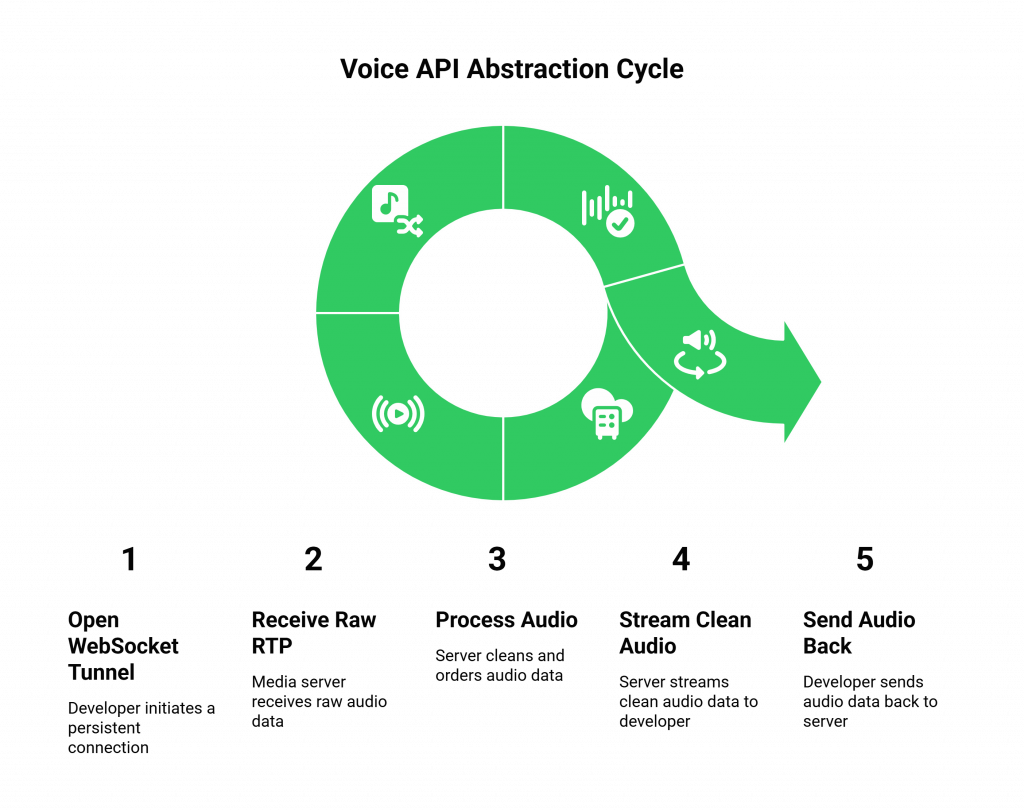
The API transforms the chaotic world of RTP into a clean, manageable stream of data that a developer can actually work with. The most common and powerful way this is done is through a WebSocket API.
- The WebSocket Tunnel: The developer uses a simple API command to instruct the voice platform to open a persistent, bidirectional WebSocket tunnel between its media server and the developer’s application server.
- The Clean Stream: The voice platform’s media server does all the hard work. It receives the raw RTP, processes it, and then streams the clean, ordered audio data over the WebSocket as a simple series of messages.
- The Two-Way Street: Because the WebSocket is bidirectional, the developer’s application can also send audio data back up the same tunnel to be injected into the live call.
Ready to harness the power of real-time media without the complexity? Sign up for FreJun AI
Why is This the Key to All Advanced Voice Applications?
This ability to programmatically access and control the real-time media stream is not just a niche, advanced feature. It is the foundational capability that enables every interesting and valuable modern voice use case.
The Prerequisite for AI Voice Automation
An AI voice agent needs to “hear” and “speak.”
- Hearing: The real-time media api is what allows you to stream the live audio of the call to your Speech-to-Text (STT) engine. Without this, the AI is deaf.
- Speaking: The API is what allows you to inject the audio from your Text-to-Speech (TTS) engine back into the call. Without this, the AI is mute.
The Engine of Real-Time Analytics and Agent Assist
The ability to “fork” the media stream is the key to a whole class of real-time intelligence applications.
- Real-Time Agent Assist: You can stream the audio of a human agent’s call to an AI in real-time. The AI can transcribe the call and provide the agent with on-screen guidance.
- Real-Time Sentiment Analysis: The live audio stream can be piped to an AI model that analyzes the customer’s tone of voice for their emotional state.
The Foundation of High-Quality Conferencing
Building a multi-party conference bridge is, at its core, a media mixing problem.
- The voice streaming engine receives the individual audio streams from all the participants.
- It then mixes these streams together into a single stream and sends that mixed stream back to each participant. A modern voice API gives a developer the high-level commands to manage this complex media mixing without having to build it from scratch.
The importance of this real-time capability is only growing. A recent market analysis projects that the global market for real-time communication will reach over $70 billion by 2027, driven by the explosive growth of these advanced voice and video applications.
Also Read: Why Should Businesses Invest In Building Voice Bots, Not Just Chatbots?
How FreJun AI is Built for Real-Time Media
At FreJun AI, we architected our entire platform around the principle that real-time media is the heart of modern voice communication. Our Teler engine is not just a telephony switch; it is a powerful, globally distributed voice streaming engine designed for high-performance low latency audio processing.
- An Edge-Native Architecture: Our global network of media servers ensures that the media processing happens as close to your end-users as possible, which is the key to minimizing latency.
- A Powerful, Flexible API: Our voice api for developers provides both a high-level, command-based API (using our FML markup language) for simple workflows and a low-level, WebSocket-based real-time media api for applications that need the ultimate in power and control.
- A Commitment to Abstraction: Our core mission is to handle the immense, underlying complexity of real-time media so that you can focus on your application’s logic. This is our promise: “We handle the complex voice infrastructure so you can focus on building your AI.”
Conclusion
In the world of modern software development, the power of an API is measured by the complexity it can successfully abstract away. By this measure, the real-time media api is one of the most powerful tools a developer can have. It takes the profoundly difficult, resource-intensive, and esoteric challenge of real-time media handling and transforms it into a simple, programmable, and scalable service.
This is the key that has unlocked the current explosion in voice innovation. For any developer looking to build the next generation of intelligent, interactive, and conversational voice applications, the choice of a voice API for developers that provides powerful, flexible, and reliable real-time media handling is the most important decision they will make.
Want to do a technical deep dive into our real-time media streaming capabilities and see how you can get your first audio stream up and running in minutes? Schedule a demo for FreJun Teler.
Also Read:IVR Software for Enterprises: Advanced Features & High-Volume Handling
Frequently Asked Questions (FAQs)
The most important feature is the ability to provide programmatic, real-time access to and control over the live audio stream (the media) of a phone call.
A real-time media api is a specific part of a voice API. It allows a developer’s application to receive and send live audio data to and from a phone call.
A voice streaming engine is the high-performance software and hardware that handles real-time audio. It manages low-level tasks like packets and codecs.
Low-latency audio processing is critical for any interactive voice application, especially AI. Because it minimizes the delay in the conversation, making it feel natural and responsive.
The most common and effective method is through a websocket voice API. It creates a persistent, bidirectional data tunnel between the voice platform and your application.
No. This is the key benefit. The API abstracts away the complexity of low-level protocols like RTP, providing you with a clean, simple stream of audio data.
Yes. The API provides the tools to manage the complex media mixing that is require to build a multi-party conference bridge.