
Every developer knows the thrill of a successful launch. Your new voice application is a hit, users are flocking to it, and the initial reviews are glowing. But then, your moment of triumph is interrupted by a flood of alerts. Your servers are overloaded, calls are dropping, and your brilliant application is buckling under the weight of its own success. This is the classic scalability crisis, a painful rite of passage for many applications.
But for a voice application, the challenge is unique and far more acute. The real-time, stateful, and resource-intensive nature of a live phone call makes scalability a monumental engineering challenge. The solution, however, does not lie in frantically adding more servers to your own application. It lies in the architectural choice of the voice API for developers that you build upon.
A modern, cloud-native voice platform is not just a tool for making a call; it is a powerful engine for achieving massive, effortless scale.
By offloading the most difficult and resource-intensive parts of voice communication to a specialized, globally distributed infrastructure, a scalable voice API allows you to build an application that can seamlessly go from handling ten calls to ten thousand, without ever breaking a sweat.
This guide will provide a deep architectural dive into how a modern cloud voice API for developers is the key to unlocking true, enterprise-grade scalability for your voice applications.
Table of contents
The Unique Scalability Challenges of Real-Time Voice
To understand the solution, we must first respect the profound difficulty of the problem. Scaling a voice application is not like scaling a simple, stateless web server. A live voice call is a resource-hungry beast.
The Burden of Real-Time Media Processing
This is the single biggest challenge.
- The Nature of the Workload: A live phone call involves a constant, high-frequency stream of audio packets (RTP). Handling this stream is a CPU-intensive task. It requires receiving the packets, placing them in a jitter buffer to ensure smooth playback, decoding the audio codec, and mixing audio streams.
- The “Stateful” Problem: Unlike a stateless web request that can be handled by any server in a cluster, a live phone call is a “stateful” session. The media for a specific call must be consistently processed by the same server (or a tightly clustered group of servers) for the duration of the call. This makes traditional load balancing far more complex.
- The DIY Nightmare: If you were to build this from scratch, you would need to become an expert in deploying, managing, and scaling a complex stack of real-time communication software (like Asterisk or FreeSWITCH). This is a massive engineering undertaking that is a distraction from your core business.
The Challenge of High Concurrency
The other major challenge is handling a massive number of simultaneous connections.
- The “Thundering Herd” Problem: When you launch a large-scale outbound calling campaign or experience a sudden inbound spike, your system can be hit with thousands of new call requests in a matter of seconds.
- The Connection Overhead: Each one of these calls requires the establishment and maintenance of a persistent signaling connection (SIP) and one or more media streams (RTP). Managing the connection state for tens of thousands of concurrent calls is a significant memory and processing challenge. A high concurrency voice api is designed to handle this specific problem.
Also Read: How Real Time Voice API Benefits for Businesses Transforming Workflows
How Does a Modern Voice API Abstract Away This Complexity?
A modern voice API for developers is, at its core, a massive, globally distributed, and highly scalable real-time communication network that you can rent a small piece of on demand. It is a powerful layer of abstraction that completely separates your application’s “brain” (your business logic) from the incredibly difficult “body” of voice processing.
The provider has already invested the hundreds of millions of dollars and decades of engineering expertise required to build and operate this global network, so you do not have to. This architectural separation is the key to effortless scalability.
Offloading the Heavy Lifting of Media Processing
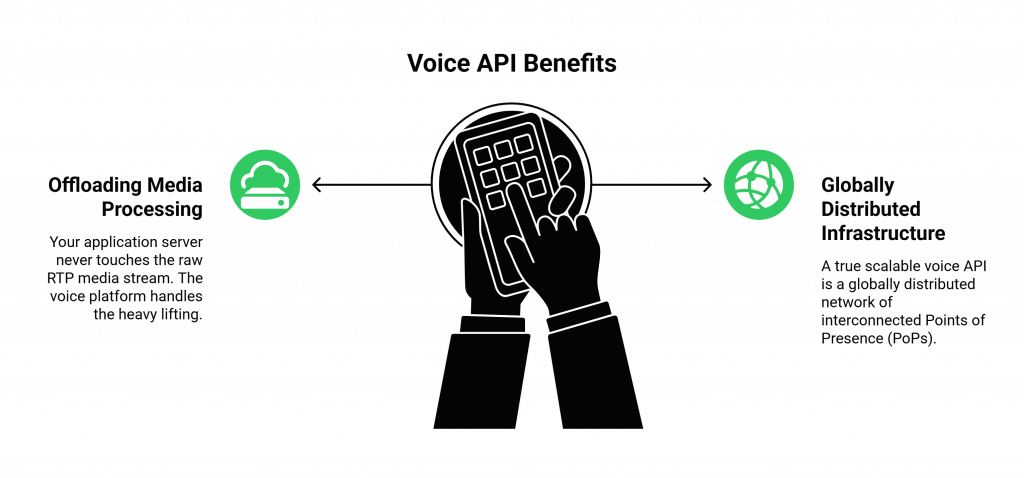
This is the most important benefit. When you use a cloud voice api for developers like FreJun AI, your application server never has to touch the raw RTP media stream.
- The Workflow: Your application acts as the “conductor” of the orchestra, not a player. It uses the API to send high-level commands to the voice platform, like “Answer this call,” “Play this audio file,” or “Bridge this call to another number.”
- The Execution: The voice platform’s powerful, globally distributed media servers (our Teler engine) are the ones that actually execute these commands. They are the ones that do the heavy lifting of processing the audio, mixing the streams, and handling the codecs.
- The Result: Your application’s server is freed from this immense burden. Its only job is to handle the lightweight, stateless API requests and webhooks that control the call flow. This makes your part of the architecture incredibly easy to scale.
A Globally Distributed, Elastic Infrastructure
A true scalable voice api is not a single, monolithic application. It is a globally distributed network of interconnected Points of Presence (PoPs).
- No Single Point of Failure: This architecture is inherently more reliable. An outage in one data center will not bring the entire platform down.
- Infinite, On-Demand Capacity: The platform is built with a massive amount of shared capacity. It is designed to handle the combined peak traffic of all its customers. This means that whether you need to make 10 calls or 100,000 calls, the capacity is always there for you, and it scales automatically.
Also Read: How Voice API Benefits Businesses Strengthen Communication Flow
This table clearly illustrates the difference in architectural responsibility.
| Task | The DIY / Traditional Approach | The Modern Voice API for Developers Approach |
| Real-Time Media Processing (RTP) | Your application’s servers must handle this CPU-intensive task. | The voice platform’s global media servers handle this for you. |
| Managing High Concurrency | You are responsible for building and scaling a stateful connection manager. | The platform’s high concurrency voice api layer handles this automatically. |
| Global Infrastructure & Carrier Management | You would need to build data centers and negotiate carrier contracts in every region. | The provider has already built the global network for you. |
| Your Application’s Core Responsibility | Managing the voice infrastructure and the business logic. | Managing the business logic and orchestrating the call via simple API calls. |
Ready to offload the complexity of voice infrastructure and focus on building your application’s core logic? Sign up for FreJun AI
How This Architecture Directly Enables Application Scalability
By embracing this decoupled, API-driven model, your application’s scalability story becomes dramatically simpler.
Your Application Becomes a Standard, Stateless Web Service
Because all the heavy, stateful work of media processing is offloaded to the voice platform, your application’s “brain” can be designed as a standard, stateless web service.
- The Benefit: This is a huge win. You can now scale your application using the same simple, well-understood tools and techniques you use for any other web backend. You can run it in a Docker container, deploy it on a serverless platform, or put it behind a standard load balancer and simply increase the number of instances as your traffic grows.
- The Contrast: In a DIY model, scaling is a complex, stateful problem. You cannot just spin up a new instance; you have to worry about how to transfer the state of live calls between servers, which is a massive engineering headache. The move to stateless architecture is a major driver of efficiency in modern software.
A recent report on microservices found that 92% of organizations have seen a significant improvement in their application’s scalability and resilience after adopting a stateless, microservices-based architecture.
An Architecture Built for the Future of AI
This scalability is not just for today’s needs; it is the foundation for the next generation of voice AI. As you start to build more sophisticated AI agents that require real-time media streaming for STT and LLM processing, the need for a scalable infrastructure becomes even more critical.
A cloud voice API for developers that provides a high concurrency voice api for both call control and media streaming is the only way to build an AI application that can handle a massive, enterprise-level workload.
Also Read: Voice API For Bulk Calling That Handles Millions Of Calls Seamlessly
Conclusion
The ability to scale is the ultimate test of a modern application. For a voice application, with its unique challenges of real-time media processing and high concurrency, scalability is a challenge that can seem insurmountable. But the solution is not to become an expert in telecommunications infrastructure. The solution is to stand on the shoulders of giants.
A modern, developer-first voice API for developers provides this giant, globally scalable foundation as a simple, on-demand service.
By abstracting away the immense complexity of the voice layer and allowing your application to act as a simple, stateless “conductor,” it provides the ultimate architectural cheat code. It is the key that allows any developer to build a voice application that is not just innovative, but truly, massively scalable.
Want to do a technical deep dive into our scalable architecture and see how our platform can handle your high-concurrency use case? Schedule a demo for FreJun Teler.
Also Read: Top Mistakes to Avoid While Choosing IVR Software
Frequently Asked Questions (FAQs)
It is a programmable interface that allows a developer’s application to control and manage phone calls, abstracting away the complexity of the underlying telecom infrastructure.
A scalable voice api is built on a cloud-native, elastic infrastructure that can automatically handle a massive, sudden increase in call volume without any manual intervention.
A high concurrency voice api is one that is specifically designed to manage the state and resources for a very large number of simultaneous, active phone calls.
A cloud voice api for developers is a voice API that is provided as a fully managed service from the cloud, eliminating the need for any on-premise hardware.
It is difficult because live phone calls are “stateful” and the real-time processing of the audio media is a very CPU-intensive task.
It offloads the heavy lifting. The voice platform’s own globally distributed media servers handle all the real-time audio processing, freeing your application from this burden.
It means that any instance of your application can handle any request, as it does not need to store any long-lived information about a specific call’s state.