
In the global, 24/7 economy, the concept of “business hours” is rapidly becoming obsolete. Your customers are everywhere, your teams are distributed, and your operations never truly sleep. In this always-on calling environment, a communication failure is no longer a minor inconvenience; it is a critical business failure.
A dropped call from a high-value client in another time zone, a failed automated alert to your on-call engineering team, or an unavailable support line during a service crisis can have immediate and severe financial and reputational consequences. This is why, for a modern enterprise, one of the most vital voice API benefits for businesses is not a flashy feature, but a foundational promise: unwavering reliability.
The shift to programmable voice has unlocked incredible potential for innovation, but this new power rests entirely on the stability of the underlying infrastructure. A brilliant AI agent that is unavailable due to a network outage is useless. A sophisticated in-app calling feature that produces garbled audio is a liability.
Achieving true 24/7 voice reliability is a complex engineering challenge, one that separates the consumer-grade voice tools from the platforms that are built for the rigorous demands of the enterprise. This guide will explore what enterprise-grade uptime truly means and how it is the essential, non-negotiable foundation for any serious business communication strategy.
Table of contents
What Does “Reliability” Truly Mean in the Context of a Voice API?
In the world of enterprise technology, “reliability” is not a vague marketing term; it is a precise, multi-faceted, and measurable engineering discipline. When we talk about a reliable voice API, we are talking about a platform that is architected from the ground up to anticipate and mitigate failure at every possible level.
Beyond the “Five Nines”: Understanding Enterprise-Grade Uptime
The most common metric for reliability is uptime, often expressed in “nines” (e.g., 99.999% uptime). While this number is important, enterprise-grade uptime goes deeper. It means:
- No Single Point of Failure: The architecture is designed so that the failure of any single server, data center, or carrier connection does not bring the entire system down.
- Geographic Redundancy: The platform’s infrastructure is not concentrated in one geographic location. It is distributed across multiple, independent regions, ensuring that a regional event (like a power outage or a natural disaster) does not cause a global service failure.
- Financially Backed SLAs: A provider that is truly confident in its reliability will offer a Service Level Agreement (SLA) that provides financial credits if they fail to meet their uptime promise. This is a key indicator of a true enterprise-grade service.
The cost of failing to achieve this is astronomical. A recent report from the Uptime Institute found that the cost of downtime is increasing significantly, with over a third of all outages now costing enterprises more than $250,000.
The Unseen Element: Network Quality and Consistent Performance
Reliability is not just about whether the call connects; it is about the quality of that connection. Constant voice streaming with high fidelity is a core component of a reliable service. This means the platform must be engineered to deliver:
- Low Latency: Minimizing the delay in the conversation to ensure it feels natural and real-time.
- Low Jitter: Smoothing out the variations in packet arrival to prevent choppy, garbled audio.
- Low Packet Loss: Ensuring that all the audio data makes it to its destination to prevent gaps and cut-outs.
A truly reliable voice API delivers a crystal-clear, stable audio experience on every single call, every single time.
Also Read: Voice API For Bulk Calling That Enhances Lead Follow-Up Journeys
How Does a Reliable Voice API Directly Benefit Your Business?
Investing in a platform with enterprise-grade uptime is not just an insurance policy against disaster; it is a direct driver of business value across your entire organization. The voice API benefits for businesses that stem from a foundation of reliability are profound.
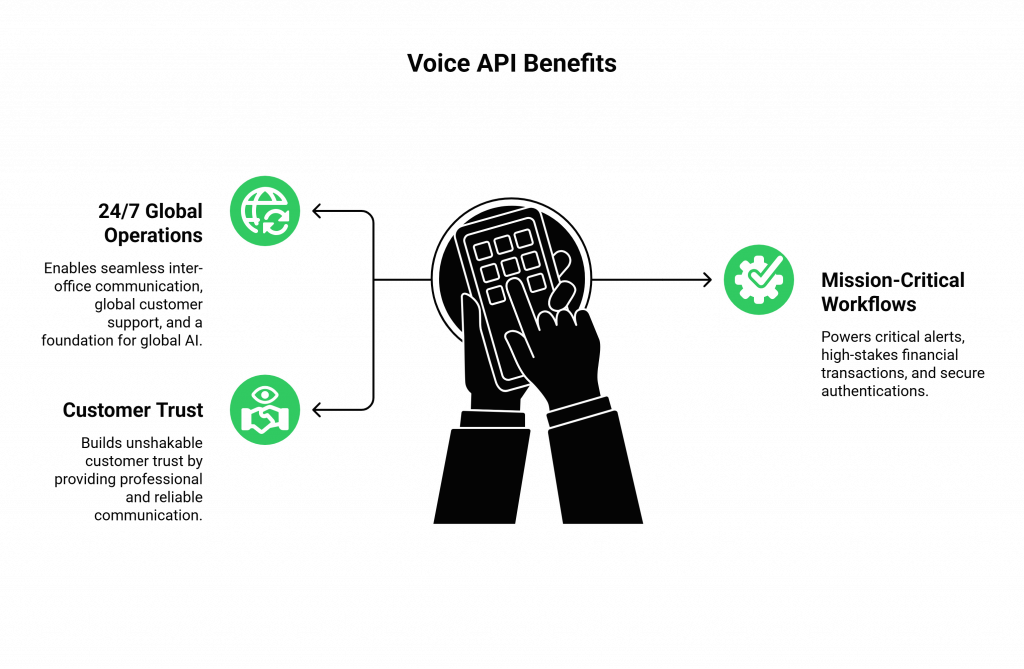
How Does It Enable True 24/7 Global Operations?
For a multinational enterprise, a reliable voice API is the central nervous system of its global operations.
- Seamless Inter-Office Communication: It allows your team in London to have a crystal-clear, instant conversation with your team in Singapore at any time of day, as if they were in the same room.
- Global Customer Support: It is the foundation for a “follow-the-sun” customer support model, ensuring that your customers can always reach a knowledgeable agent, no matter where they are in the world.
- A Foundation for Global AI: For deploying voice AI for businesses, a globally distributed, reliable network is a prerequisite. It ensures that your AI agent is always available and that the AI call response speed is fast for every user, regardless of their location.
How Does It Power Mission-Critical Automated Workflows?
As businesses integrate voice into their core operational workflows, the reliability of that voice channel becomes paramount.
- Critical Alerts: An automated system that sends a voice call to an on-call engineer to alert them of a critical server failure must work. A failed call could mean millions of dollars in losses.
- High-Stakes Financial Transactions: An AI agent that provides real-time stock quotes or processes high-value transactions over the phone requires a connection with 100% real-time audio stability.
- Secure Authentications: A voice biometric system that is used for secure customer authentication is useless if the audio quality is too poor for the AI to accurately identify the voiceprint.
How Does It Build Unshakable Customer Trust?
Every interaction a customer has with your brand is an opportunity to build or erode trust. In the voice channel, reliability is a primary proxy for professionalism.
- A call that connects instantly and sounds crystal clear communicates that you are a professional, reliable, and high-quality brand.
- A call that fails, drops, or is of poor quality communicates the exact opposite. A failed call can absolutely be that one bad experience.
Also Read: Voice API For Bulk Calling: Is It Ideal For High-Volume Notifications?
What Architectural Choices Deliver True Voice Reliability?
Achieving 24/7 voice reliability is the result of a series of deliberate, and expensive, architectural decisions made by the voice API provider. When you are choosing a provider, you are not just buying an API; you are buying into their architectural philosophy.
This table highlights the stark architectural differences between a standard, non-redundant voice setup and a true, enterprise-grade platform.
| Architectural Feature | Standard Voice Platform | Enterprise-Grade, Reliable Voice Platform (e.g., FreJun AI) |
| Infrastructure Design | Single-region or limited to one country. | Globally distributed, multi-region, and edge-native (Points of Presence). |
| Redundancy | A single point of failure; an outage in one data center takes the service offline. | Full geographic redundancy; traffic can be instantly rerouted if an entire region fails. |
| Carrier Connections | Relies on one or two upstream carriers. | A diverse, multi-carrier backbone with intelligent, real-time routing optimization. |
| Scalability | Limited; may struggle with massive, sudden call spikes. | Highly elastic; designed to handle massive, unpredictable traffic surges automatically. |
| Monitoring | Basic uptime monitoring. | Deep, 24/7/365 network operations center (NOC) with proactive monitoring and incident response. |
Ready to build your mission-critical voice applications on an infrastructure that was designed for this level of reliability? Sign up for FreJun AI
How Does FreJun AI’s Teler Engine Embody This Philosophy?
At FreJun AI, we understood from the beginning that for developers to build the future of voice, they needed a foundation they could implicitly trust. Our Teler engine, the core of our platform, was architected with enterprise-grade uptime as its primary design principle.
- A Globally Distributed, Geo-Redundant Network: Our infrastructure is not in one place. We have a network of Points of Presence in data centers across multiple continents. This is the foundation of our always-on calling promise. If our entire North American infrastructure were to go offline, our European and Asian PoPs would continue to operate, and traffic could be rerouted.
- A Multi-Carrier Backbone: We do not rely on a single upstream telecom provider. We maintain a complex, redundant web of connections to multiple Tier-1 carriers around the world. Our intelligent routing engine is constantly analyzing the performance of these paths and will automatically move traffic to the best-performing carrier in real time.
- An Obsession with Quality: We provide the tools for constant voice streaming with high fidelity. Our platform is built to deliver crystal-clear audio, and we provide our developers with the deep analytics they need to monitor and verify the quality of every single call. This is our commitment: “We handle the complex voice infrastructure so you can focus on building your AI.”
Also Read: Smarter Engagement Built Using an Advanced Voice API for Bulk Calling
Conclusion
In the modern, always-on business landscape, the reliability of your communication channels is not just an IT metric; it is a direct measure of your brand’s integrity and your commitment to your customers. The voice API benefits for businesses are vast, but they are all built upon the bedrock of a single, non-negotiable promise: that the call will connect, and the quality will be perfect.
By choosing a voice API provider that has made a deep, architectural commitment to enterprise-grade uptime, 24/7 voice reliability, and real-time audio stability, you are not just buying a service.
You are acquiring a foundational piece of infrastructure that will empower you to build, scale, and innovate with the complete confidence that your voice will always be heard.
Have a mission-critical, high-availability use case that you need to build? Schedule a demo for FreJun Teler.
Also Read: Financial Services IVR Software: Secure, Multi-Level Routing Explained
Frequently Asked Questions (FAQs)
While there are many benefits, the most foundational is reliability, which ensures your business communications are always on and professional.
Enterprise-grade uptime usually refers to a service level of 99.99% or higher, backed by a financially-guaranteed Service Level Agreement (SLA).
It achieves 24/7 voice reliability through a globally distributed, geo-redundant infrastructure that has no single point of failure.
Constant voice streaming refers to the ability of the platform to maintain a stable, high-quality audio stream without jitter, packet loss, or dropouts.
A PoP is a physical data center where a provider has its network equipment. A global network of PoPs is key to reducing latency.
An SLA is a formal commitment from a provider that guarantees a certain level of service, often providing financial credits if that level is not met.
A high-quality provider maintains connections to multiple, redundant carriers and uses intelligent routing to automatically move traffic away from a failing carrier.