
For the better part of a century, the business phone call was a technological constant. It was a simple, one-dimensional conversation between two people, a utility that worked but rarely evolved. Today, that constant is in a state of radical and exhilarating transformation. The business phone call is no longer just a call; it is a programmable, intelligent, and data-rich experience. This revolution is being driven by a single, powerful catalyst: the modern, developer-first voice API.
The voice API benefits for businesses are no longer just about saving money on phone bills; they are about unlocking entirely new ways to engage with customers, automate complex workflows, and build the next generation of intelligent communication systems.
The future of voice AI is not a distant, abstract concept; it is being built, tested, and deployed right now by forward-thinking enterprises. The next gen voice API is the essential toolkit for this construction. It is a powerful layer of abstraction that is transforming the entire global telephone network into a simple, programmable feature of a company’s own software.
This article will explore the key emerging voice trends and show how the capabilities of a modern voice API are the indispensable engine behind the coming ai voice evolution.
Table of contents
The Foundational Shift: From a “Phone System” to a “Voice Platform”
To understand the future, we must first appreciate the fundamental paradigm shift that is happening. For decades, businesses bought a phone system. It was a product, a piece of hardware, and a closed, monolithic box that a specialized telecom team managed. The modern approach is completely different. Businesses now build their voice systems on top of a programmable platform.
A voice API is the gateway to this platform. It provides a set of powerful, developer-friendly tools that allow a company’s own software engineers to weave voice communication directly into their applications and workflows. This shift from “buying” to “building” is the single most important trend in enterprise communications, and it is unlocking a new universe of possibilities.
Also Read: How Does A Voice API For Bulk Calling Improve Delivery Rates At Scale?
How Do the Core Benefits of a Voice API Enable the Future?
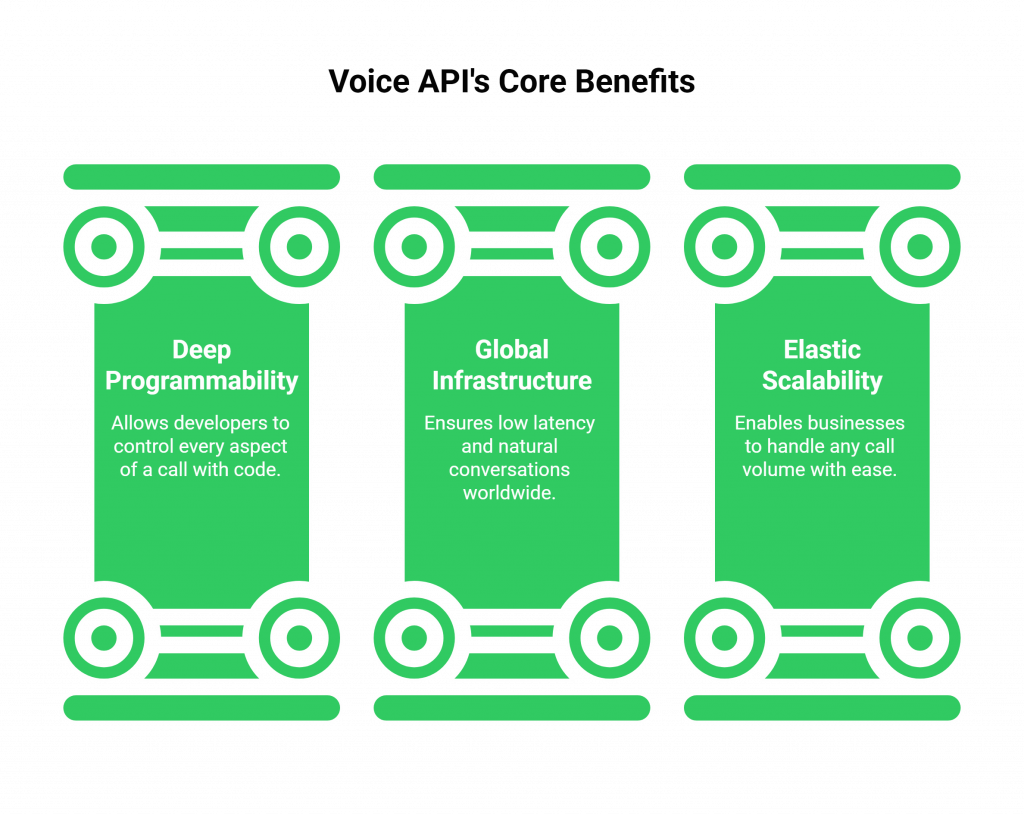
The voice API benefits for businesses are not just a list of features; they are the fundamental enablers of the voice tech 2025 landscape. Let’s explore the three most critical benefits and how they are powering the next wave of innovation.
Benefit 1: Deep Programmability – The Key to Intelligence
A modern voice API does not just make calls; it allows a developer to control every millisecond of the call’s lifecycle with code. This deep programmability is the non-negotiable prerequisite for any meaningful AI integration.
- Real-Time Media Access: The API provides a live, real-time stream of the call’s audio. This is the “input” that allows an AI’s Speech-to-Text (STT) engine to “hear” the conversation.
- Dynamic Call Control: The API allows the application’s logic to dynamically change the call’s flow based on the real-time conversation.
This is the foundation of the future of voice AI. It transforms the phone call from a simple audio connection into an interactive, intelligent, and responsive data session. A recent report from Gartner predicts that by 2026, one in every ten agent interactions will be automated, a trend that is entirely dependent on this deep, programmable control.
Benefit 2: Global, Low-Latency Infrastructure – The Prerequisite for Natural Conversation
The most intelligent AI in the world will feel stupid if its responses are slow. The human brain is incredibly sensitive to conversational delay.
- The Problem of Latency: High latency which means the awkward pause between a user speaking and the AI responding is the single biggest killer of the conversational experience.
- The API-Powered Solution: The best voice API for business communications is built on a globally distributed, edge-native infrastructure. A provider like FreJun AI has a network of servers (Points of Presence) all over the world. The platform automatically handles a call at the location that is physically closest to the end-user. This drastically reduces the network travel time for the audio data, which is the key to creating a fast, snappy, and natural-sounding AI conversation.
Benefit 3: Elastic Scalability – The Engine for Growth
The needs of a modern business are not static. A marketing campaign can cause call volume to spike by 10,000% in a matter of minutes.
- The Old Way: A traditional phone system would simply crash under this kind of load, resulting in a torrent of busy signals and a massive missed opportunity.
- The API-Powered Way: A modern voice API is built on an elastic infrastructure. It can automatically and instantly scale to handle any volume of calls, from one to one hundred thousand. This elastic scalability is what allows a business to think big and to deploy large-scale, automated voice campaigns with confidence.
Ready to start building the future of your business’s communications? Sign up for FreJun AI
Also Read: Voice Recognition SDK That Handles Noise with High Precision
What Does the Future of Voice Systems Look Like in Practice?
These foundational benefits are not just theoretical; they are the building blocks for the specific, transformative emerging voice trends that will define the voice tech 2025 market.
This table highlights some of the key future trends and the voice API benefits that are making them a reality.
| Emerging Voice Trend | How a Modern Voice API Enables It | The Impact on Business Communication |
| Hyper-Personalized, Proactive Outreach | The API allows for deep integration with a CRM. An AI agent can make thousands of simultaneous outbound calls, each with a unique, data-driven script. | Moves marketing from a one-to-many broadcast to a one-to-one conversation at scale, dramatically increasing engagement and conversion. |
| Real-Time Agent Assist and “Co-Pilots” | The API’s real-time media streaming allows an AI to “listen in” on a human agent’s call and provide them with on-screen guidance and automated notes. | Dramatically improves human agent performance, reduces training time, and ensures a more consistent and compliant customer experience. |
| Truly Conversational, Open-Ended IVRs | Instead of a rigid “press 1” menu, the API allows an LLM-powered AI to have a natural, open-ended conversation to understand a customer’s needs. | Slashes customer frustration, improves first-call resolution, and transforms the IVR from a hated barrier into a helpful and efficient tool. |
| Seamless, In-App Voice Experiences | The API and its associated SDKs allow a business to embed a “click-to-call” feature directly into their mobile or web application, often with rich data context. | Creates a seamless, low-friction channel for high-value customer support, bridging the gap between the digital and voice experience. |
Also Read: Can A Smarter Voice Recognition SDK Improve App Experience?
How is FreJun Teler Built for the Future?
At FreJun AI, we are not just a participant in the ai voice evolution; we are a catalyst for it. Our entire Teler platform was architected from the ground up with the explicit goal of being the most powerful, flexible, and developer-friendly foundation for the future of voice AI.
- We Are Obsessed with Low Latency: Our globally distributed, edge-native architecture is designed to provide the fastest possible connection for your real-time AI conversations.
- We Are Radically Developer-First: We believe that developers are the architects of the future. Our APIs and SDKs are designed to be powerful, intuitive, and to abstract away the immense complexity of global telecommunications.
- We Are Fundamentally Open: Our platform is model-agnostic. We provide the high-performance “voice,” and you have the complete freedom to choose the AI “brain” that is perfect for your business. This is our core promise: “We handle the complex voice infrastructure so you can focus on building your AI.”
Conclusion
The future of business communication is intelligent and conversational. Automation will define how teams engage customers. Voice APIs offer benefits beyond basic connectivity. They provide core building blocks for this new era. Deep programmability enables flexible workflows. Global low-latency performance ensures natural conversations. Massive scalability powers the evolution of AI voice systems.
For enterprises that want to lead in this new landscape, the strategic imperative is clear: embrace a developer-first, API-driven approach to voice, and start building the future of conversation today.
Want to do a deep dive into the architecture of our next-gen voice API and see how it can power your vision for the future of voice? Schedule ademo for FreJun Teler.
Also Read: How IVR Software Reduces Call Center Costs Without Hurting CX
Frequently Asked Questions (FAQs)
The main benefit is the ability to transform voice from a static utility into a programmable, intelligent, and scalable channel for customer engagement and automation.
The future of voice AI for businesses is about creating seamless, hyper-personalized, and automated conversational experiences across the entire customer journey, from marketing to sales to support.
A next gen voice API puts developers first, runs on a globally distributed low latency architecture, and gives deep programmatic control over real time media streaming.
Key emerging voice trends for voice tech 2025 include the rise of real-time Agent Assist, hyper-personalized proactive outreach at scale, and the replacement of traditional IVRs with truly open-ended conversational AI.
The ai voice evolution is shifting customer service from a reactive, human-intensive model to a proactive, AI-first model, where intelligent agents handle the majority of routine interactions, freeing up humans for high-value escalations.
A model-agnostic platform is one that is not tied to a single, proprietary AI provider. It gives you the freedom to integrate the best-in-class AI models (STT, LLM, TTS) from any vendor you choose.
Low latency is critical because it minimizes the delay in a conversation. A fast, responsive AI feels intelligent and natural, while a slow, laggy AI feels frustrating and robotic.