
In the high-stakes world of the modern contact center, the human agent is the ultimate problem-solver. They are the voice of empathy for a frustrated customer, the expert guide for a complex technical question, and the calm presence in a crisis. But for too long, we have been sending these critical agents into their most challenging conversations armed with little more than a script and a CRM screen.
That is now changing. A new class of technology, known as “Agent Assist,” is emerging as a powerful “co-pilot” for the human agent, and the foundational technology making it all possible is the modern, developer-first voice API.
One of the most powerful voice API benefits is live conversation analysis. Businesses can access in-flight call data in real time. AI agent assistance can deliver instant insights and guidance. This support helps transform average agents into top performers.
Businesses can leverage a voice API for real-time AI coaching. They can also enable live call transcription. This approach improves efficiency across teams. It elevates human agent capabilities. It delivers a significantly better customer experience.
Table of contents
The Challenge: The “Lonely Island” of a Live Phone Call
To appreciate the solution, we must first understand the problem. A traditional phone call in a contact center is a “lonely island.” The agent and the customer are locked in a private, ephemeral conversation. The agent’s supervisor has no real-time visibility into the call.
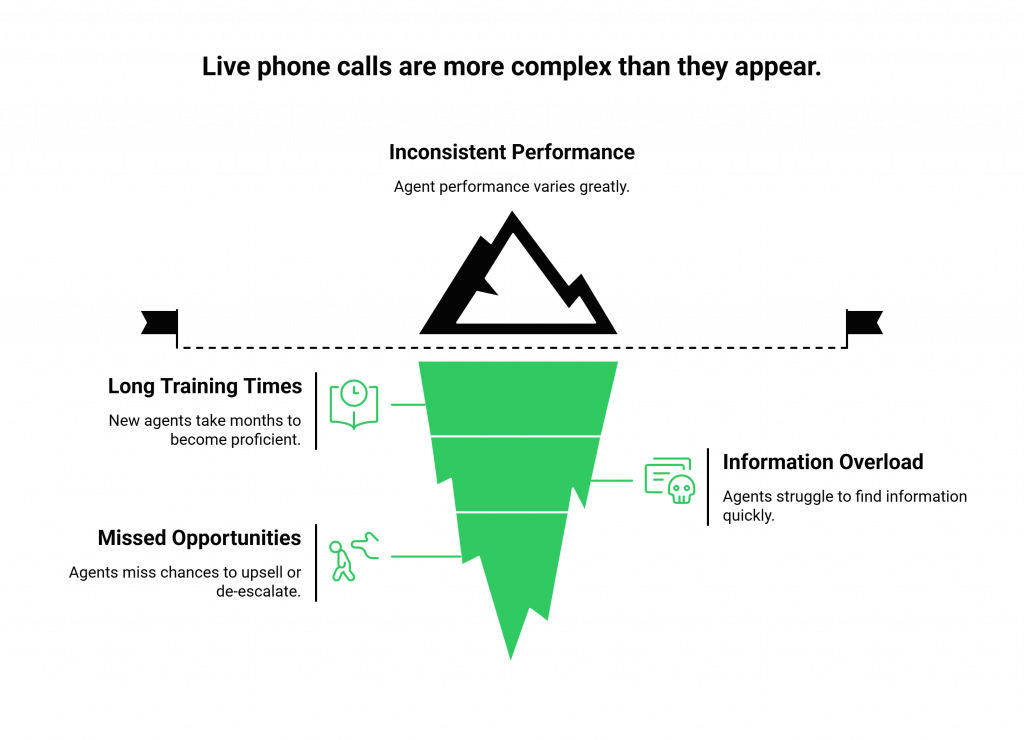
The company’s vast knowledge base is a separate screen that the agent must manually search. The agent is left to rely solely on their own memory, training, and multitasking skills. This creates several significant challenges:
- Inconsistent Performance: An agent’s performance can vary dramatically based on their experience, their mood, or simply how much coffee they have had that day. This leads to an inconsistent customer experience.
- Long Training and Ramp-Up Times: It can take months for a new agent to become fully proficient and confident in handling all types of customer inquiries.
- Information Overload: Agents are often expected to be experts on hundreds of different products, policies, and procedures. Finding the right piece of information while on a live call is a major source of stress and a primary cause of long hold times.
- Missed Opportunities: The agent might not recognize a subtle buying signal from a customer or might miss an opportunity to de-escalate a frustrated customer before they churn.
Also Read: How Does A Voice API For Bulk Calling Improve Delivery Rates At Scale?
How Does a Voice API Create the “Connected Co-Pilot”?
A modern, developer-first voice API shatters the “lonely island” of the traditional phone call. Its most powerful feature, in this context, is the ability to provide real-time media streaming. This is the game-changing capability that allows a business to build an AI-powered co-pilot that can “listen in” on the conversation and provide assistance to the agent in real time.
The Foundational Technology: Live Call Transcription
The entire Agent Assist workflow begins with one critical, real-time process: live call transcription.
- The Call is Connected: The call comes into your contact center through the voice API platform.
- The Media is Forked: Using the API, you programmatically “fork” the audio stream of the live call. This creates a real-time copy of the conversation’s audio (both the agent’s and the customer’s).
- The Real-Time Transcription: This audio stream is piped, in real time, to a Speech-to-Text (STT) engine. The STT engine transcribes the conversation as it is happening, turning the spoken words into a live, streaming transcript.
What are the Key “Agent Assist” Features Powered by This?
Once you have this real-time transcript, you can build a host of powerful ai agent assistance tools that are displayed to the agent on their screen during the live call.
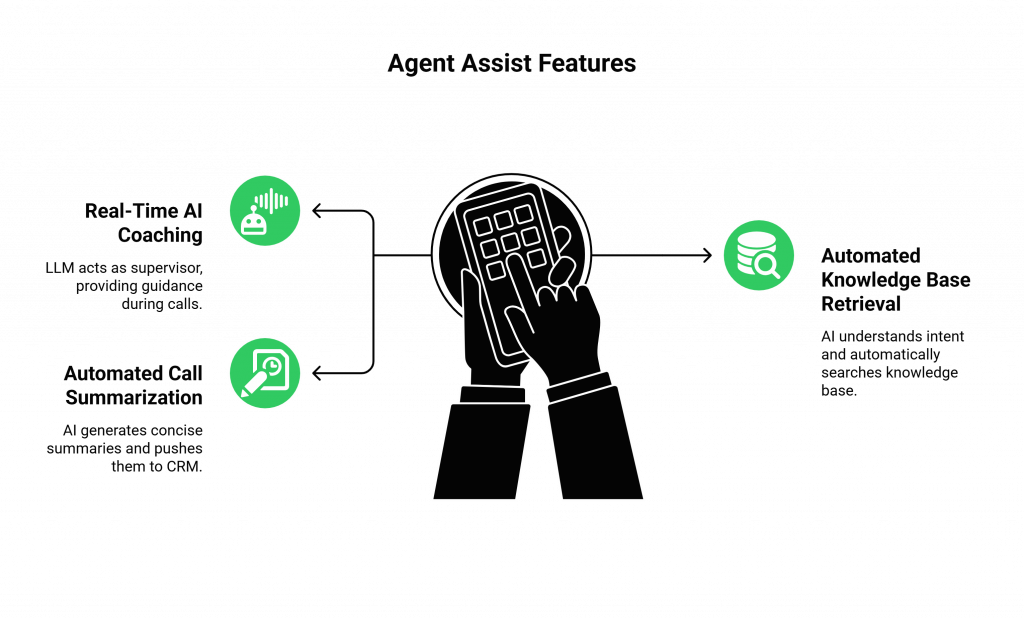
Real-Time AI Coaching and “Whisper” Prompts
This is one of the most powerful applications of real-time ai coaching. The live transcript is fed into a Large Language Model (LLM) that acts as an expert supervisor, listening to the conversation and providing guidance.
- Compliance Adherence: If the agent forgets to read a required compliance script (e.g., “This call is being recorded”), the AI can pop up a reminder on their screen.
- Sentiment Detection: The AI can analyze the customer’s words and tone for signs of frustration. If it detects a rising level of anger, it can “whisper” a prompt to the agent, suggesting a specific de-escalation tactic or an offer to help.
- Upsell/Cross-sell Suggestions: If the customer mentions a keyword (e.g., “I’m thinking about upgrading”), the AI can instantly recognize this buying signal and suggest a relevant product or promotion to the agent.
Automated Knowledge Base Retrieval
This feature solves the “information overload” problem.
- Intent Recognition: As the customer is describing their problem, the AI can understand their intent.
- Automatic Search: It can then automatically search the company’s internal knowledge base, find the relevant article or procedure, and display it on the agent’s screen before the agent even has to ask. This dramatically reduces the need for the dreaded phrase, “Please hold while I look that up.”
Also Read: Voice Recognition SDK That Handles Noise with High Precision
Automated Call Summarization and Note-Taking
The “after-call work” (ACW), where an agent has to manually summarize the call and enter notes into the CRM, is a major time sink.
- The conversational ai for agents can listen to the entire conversation.
- The moment the call ends, it can instantly generate a concise, accurate summary of the call, including the reason for the call, the steps taken, and the final resolution.
- This summary can be automatically pushed into the CRM, saving the agent several minutes of manual work on every single call.
This table summarizes how a voice API enables these key Agent Assist features.
| Agent Assist Feature | How the Voice API Enables It | Direct Benefit to the Business |
| Live Call Transcription | Provides the real-time audio stream to the STT engine. | This is the foundational data feed for all other features. |
| Real-Time AI Coaching | Feeds the live transcript to an LLM for analysis and suggestions. | Improves agent performance, ensures compliance, and increases sales opportunities. |
| Automated Knowledge Base | The AI uses the transcript to understand the customer’s intent and automatically finds the right information. | Drastically reduces hold times and improves first-call resolution rates. |
| Automated Call Summarization | The AI uses the full transcript to generate a summary after the call. | Reduces After-Call Work (ACW) time, increases agent productivity, and ensures consistent data in the CRM. |
Ready to build a “co-pilot” for your contact center agents? Sign up for FreJun AI
What is the Role of FreJun AI in Building an Agent Assist Platform?
At FreJun AI, we provide the foundational, developer-first voice infrastructure that makes a real-time Agent Assist platform possible. While we are not the AI “brain” itself, we are the powerful and reliable “nervous system.”
Our Teler engine provides the core, non-negotiable capabilities:
- The High-Quality Audio Stream: Our globally distributed, low-latency network ensures that the audio stream you send to your STT engine is crystal clear, which is essential for accurate transcription.
- The Real-Time Media API: Our powerful APIs give you the granular, programmatic control you need to fork the call’s media in real-time.
- A Model-Agnostic Philosophy: We are a flexible bridge. We provide the audio stream, and you have the complete freedom to pipe it to the best-in-class STT and LLM providers of your choice. This is the core of our philosophy: “We handle the complex voice infrastructure so you can focus on building your AI.”
Also Read: Can A Smarter Voice Recognition SDK Improve App Experience?
Conclusion
The traditional contact center model left its most valuable asset, the human agent to fend for themselves on the lonely island of a live phone call. The modern, API-driven approach to voice communication is changing that forever. The ability to access and analyze a live conversation in real time is one of the most profound voice API benefits for businesses today.
By leveraging this capability to build a suite of ai agent assistance tools, enterprises can create a powerful, symbiotic relationship between their human agents and their AI.
This “co-pilot” model is the key to improving agent performance, boosting operational efficiency, and, most importantly, delivering a consistently exceptional and empathetic customer experience on every single call.
Want to do a deep dive into our Real-Time Media API and see how you can use it to power your own Agent Assist application? Schedule a demo for FreJun Teler.
Also Read: How IVR Software Reduces Call Center Costs Without Hurting CX
Frequently Asked Questions (FAQs)
Agent Assist is a category of software that provides real-time guidance and automation to human contact center agents during live customer conversations.
The main benefit is the ability to access the live audio stream of a call, which enables live call transcription and powers all Agent Assist features.
Real-time AI coaching is when an AI analyzes a live conversation and provides prompts or suggestions directly to the agent’s screen to help them improve their performance.
Conversational AI for agents works by using AI to listen to the call, understand the context, and then automate tasks like finding information or taking notes.
It is the technical process of creating a real-time copy of a call’s audio stream and sending it to another destination (like an AI service) for analysis.
No. A model-agnostic voice API provider like FreJun AI gives you the flexibility to use the best Speech-to-Text and Language Models from any vendor.
Yes. A modern voice platform can provide a “dual-channel” audio stream, which allows you to transcribe the agent’s and the customer’s speech independently.