
In the world of the modern enterprise, communication is no longer a department; it is a fundamental, data-driven strategy. The ability to proactively reach out to thousands or even millions of customers with timely, relevant, and personalized information is a massive competitive advantage. For years, this large-scale outreach has been dominated by the silent, and increasingly crowded, channels of email and SMS.
The voice channel, the most powerful medium for human connection, has remained a stubbornly manual and unscalable frontier. That is, until now. The modern voice API for bulk calling is the catalyst that is finally allowing enterprises to operationalize the human voice at an unprecedented scale, shaping the future of large-scale business communication.
This is not a story about resurrecting the impersonal “robocall.” It is about a profound architectural shift. We are moving from a world of one-way, static broadcasts to a new era of two-way, dynamic, and intelligent conversations. The vision for enterprise calling 2026 is one where a company can have a million unique, one-to-one conversations simultaneously, all orchestrated by software.
By leveraging a programmable large scale outreach system powered by a voice API for bulk calling, enterprises can now build communication workflows that are not just more efficient, but profoundly more impactful.
Table of contents
The Crippling Limitations of Traditional Enterprise Outreach
The traditional enterprise communication stack was never designed for the scale and agility that modern business demands. The phone system, in particular, was a fortress of rigidity, creating a massive barrier to any form of large-scale, automated voice outreach.
The Wall of Fixed Capacity
The old world was defined by physical and logical limitations. An on-premise PBX connected to the outside world via a fixed number of PRI lines or channelized SIP trunks. This created a hard ceiling on capacity. The idea of making 10,000 simultaneous outbound calls for an urgent fraud alert was a technical impossibility.
The Absence of Programmability
Legacy phone systems operated as closed, black box environments. Telecom specialists managed them through complex command-line tools or clunky portals. These systems were not built for software control. CRM-triggered personalized calls required massive custom integrations. They were never simple API calls.
The Data Black Hole
The old model failed mainly because it lacked data. Manual calling campaigns offered almost no analytical visibility. Teams only knew how many numbers they dialed. They lacked structured data on answer rates and call duration. They also missed insight into the actual conversation content.
This made it impossible to measure ROI, to A/B test different approaches, or to derive any meaningful business intelligence from the outreach.
Also Read: Why Use a Voice Recognition SDK for High Volume Audio Processing
What is a Modern Voice API and Why is it a Game-Changer for Enterprises?
A modern voice API for bulk calling is not just an auto-dialer with a new name. It is a developer-first, cloud-native communication platform that transforms the entire global telephone network into a programmable service. It is, in essence, an enterprise workflow API for voice.
This API-first approach provides the three critical capabilities that were missing from the old model, finally allowing enterprises to build a true large scale outreach system for voice.
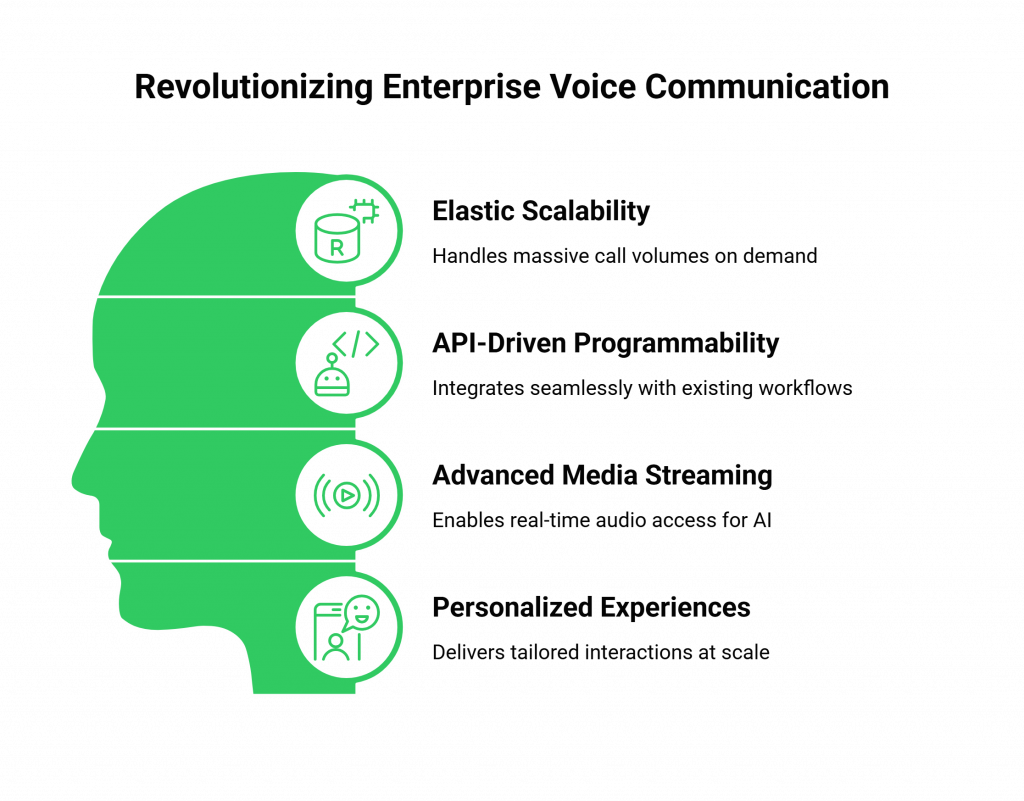
Truly Elastic Scalability
The “bulk” in voice API for bulk calling is powered by an underlying elastic SIP trunking infrastructure. This means you are tapping into a massive, globally distributed network with virtually unlimited, on-demand capacity. Your application can make a single API call to initiate tens of thousands of simultaneous outbound calls, and the platform will handle it automatically.
Deep, API-Driven Programmability
Instead of a closed system, the platform is designed to be controlled entirely by your application’s code. This allows for deep integration into your existing enterprise workflows. Your fraud detection system can automatically trigger a real-time alert call. Your marketing automation platform can add a personalized voice call as a seamless step in a multi-channel customer journey.
The Power of Advanced Media Streaming
This is the feature that unlocks the door to true intelligence. A modern voice API does not just make calls; it gives you programmatic access to the real-time audio of the call. This advanced media streaming capability is the essential prerequisite for any AI integration.
It is how you can pipe the live conversation to a Speech-to-Text (STT) engine to understand what the customer is saying, and how you can inject the audio from a Text-to-Speech (TTS) engine for your AI to respond.
This is the key to creating personalized and interactive experiences at scale. The demand for this is no longer a niche desire; it is a mainstream expectation. A recent report from McKinsey found that 71% of consumers expect companies to deliver personalized interactions, and a voice API is the only way to deliver this personalization on the voice channel at an enterprise scale.
Ready to build an outreach system that can truly scale with enterprise’s ambitions? Sign up for FreJun AI
Also Read: Modern Voice Recognition SDK Supporting Multilingual Apps
How Enterprises Are Using This Technology Today? Real-World Use Cases
The fusion of a voice API for bulk calling with enterprise data is already creating powerful, large-scale communication workflows across a variety of industries.
This table showcases some common and highly effective automated outreach pipelines.
| Industry | Use Case | How the Voice API is Used | Strategic Value |
| Financial Services | A transaction monitoring system detects a suspicious charge on a customer’s credit card. | The system instantly triggers an API call to the customer. An AI agent asks them to verify the transaction by pressing a key or saying “yes” or “no.” | Dramatically reduces fraud losses, builds customer trust, and meets regulatory requirements for timely notification. |
| Utilities | A power grid monitoring system detects a major outage affecting a specific geographic area. | The system pulls a list of all affected customers and uses the API to make thousands of simultaneous outbound calls, delivering a recorded or AI-generated message with the ETR. | Massively reduces inbound call volume to the contact center during a crisis, reduces customer anxiety, and improves public safety communication. |
| Logistics & E-commerce | On the morning of a scheduled delivery for a large appliance, the system calls all customers on that day’s routes to confirm someone will be home. | The AI agent confirms the delivery window and can even understand and process a request to reschedule. | Significantly reduces the incredibly high cost of failed “not at home” delivery attempts and improves last-mile efficiency. |
| Healthcare | A public health agency needs to quickly inform the residents of a specific county about a new vaccination clinic or a local health advisory. | The agency uses the API to call thousands of residents in a targeted area with a clear, consistent, and urgent message. | A powerful tool for rapid, large-scale public health communication, ensuring critical information reaches the community quickly. |
Conclusion
The enterprise communication landscape is undergoing a once-in-a-generation transformation. The ability to proactively engage with customers and stakeholders at a massive scale, with a personal and intelligent touch, is the new frontier of competitive differentiation.
The modern voice API for bulk calling is the enabling technology for this revolution. It is the powerful, programmable engine that allows enterprises to finally integrate the voice channel into their automated workflows, creating a large scale outreach system that is more efficient, more impactful, and more intelligent than ever before.
For the enterprise that is ready to shape the future of its own communications, the journey begins with a single API call.
Want to do a deep dive into our enterprise workflow API and see how it can integrate with your specific business systems? Schedule a demo for FreJun Teler.
Also Read: 7 Best Multi-Level IVR Software for Large Support Teams
Frequently Asked Questions (FAQs)
It is a programmable interface that allows a developer’s application to initiate and manage a large number of outbound phone calls simultaneously and automatically.
The enterprise calling 2026 trend points to hyper-personalized, AI-driven, and proactive voice engagement at a massive scale, fully integrated into core business workflows.
A large scale outreach system is a platform that combines a voice API for bulk calling with a CRM or other data source to execute automated, data-driven calling campaigns.
Advanced media streaming is the ability of the voice API to provide real-time, programmatic access to a call’s raw audio, which is essential for AI integration.
Yes. By using a Text-to-Speech (TTS) engine and data from your enterprise systems, a modern voice API can generate a unique, personalized audio message for every call.
Absolutely. By integrating an AI (like an LLM) and leveraging media streaming, the system can understand the recipient’s spoken responses and have a dynamic, two-way conversation.
FreJun AI provides the foundational, globally scalable voice API for bulk calling. We handle the complex infrastructure, ensuring your automated calls are high-quality, reliable, and compliant.