
In the world of sales, marketing, and customer engagement, the outreach pipeline is a finely tuned machine. It is a carefully orchestrated sequence of emails, text messages, and social media touches, all designed to nurture a lead from initial awareness to final conversion. But for years, this machine has had a glaring hole in its process: the voice channel.
The phone call, long the most powerful tool for human connection, has remained a stubbornly manual, inefficient, and unscalable part of the process. That is, until now. The modern voice API for bulk calling is the missing gear, the powerful component that finally allows businesses to integrate high-touch, conversational voice into their automated outreach pipelines at massive scale.
This is not about resurrecting the hated “robocall.” This is about a fundamental transformation of what an automated call can be. We are moving from a world of one-way, impersonal broadcasts to a new era of two-way, intelligent, and data-driven conversations.
The automated outreach landscape in 2026 will favor meaningful human-like connections. Success will not depend on sending the most emails. It will depend on timely and scalable engagement. Programmable voice pipeline engines enable this shift. Businesses can build workflows that are efficient and deeply effective.
Table of contents
The Problem: Why Has Voice Been the “Missing Link” in Automation?
For years, marketing and sales automation platforms have excelled at managing text-based communication. It is easy to send a million personalized emails. But scaling the human touch of a phone call has been a near-impossible challenge. The traditional barriers included:
- The Scalability Wall: A human agent can only make one call at a time. Trying to manually call a list of 10,000 leads is an operational nightmare.
- The Inefficiency of Manual Dialing: A huge portion of a sales development representative’s (SDR’s) day is wasted on unproductive tasks: dialing numbers that do not connect, navigating phone trees, and leaving voicemails.
- The “Black Box” of the Phone Call: A manual call is an un-trackable, un-analyzable event. There is no structured data, no analytics, and no easy way to integrate the outcome of the call back into the automated workflow of the CRM.
- The High Cost of Labor: Manually dialing a large list of leads is an incredibly expensive use of human capital, especially when a large percentage of those leads may not be qualified.
Also Read: How Does a Voice Recognition SDK Improve AI Driven Interactions
What is a Modern Voice API and How Does it Solve These Problems?
A modern voice API for bulk calling is not just an auto-dialer with a new name. It is a developer-first, cloud-native platform that transforms the public telephone network into a programmable service. It is an enterprise workflow API for voice.
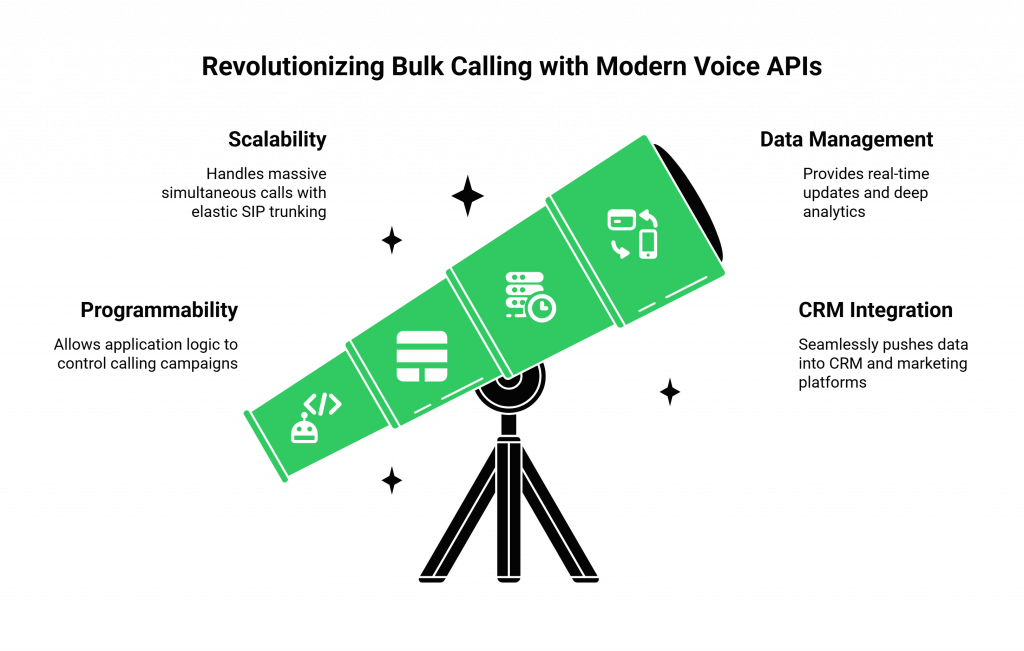
Instead of a closed system, it provides a powerful set of API commands that allow your application’s logic to control every aspect of a large-scale calling campaign. This programmability is what finally allows voice to be integrated as a seamless, automated step in your existing outreach pipelines.
How It Solves the Scalability Problem
The “bulk” in voice API for bulk calling is powered by an underlying elastic SIP trunking infrastructure. This means you are tapping into a massive, globally distributed network with virtually unlimited capacity. Your application can make a single API call to initiate ten thousand simultaneous outbound calls, and the platform will handle it automatically.
How It Solves the Data Problem
Because the entire process is API-driven, every single call is a structured, trackable data event.
- Real-Time Status Updates: The API provides real-time webhooks for every stage of the call’s lifecycle (“ringing,” “answered,” “completed,” “busy,” “failed”).
- Deep Call Analytics: Every call is logged with a rich set of metadata, including call duration, cost, and even a full recording and transcription.
- Seamless CRM Integration: This structured data can be instantly and automatically pushed back into your CRM or marketing automation platform, providing a complete, 360-degree view of the customer’s journey.
This ability to transform a voice call into a piece of structured data is revolutionary. A recent study by Salesforce highlighted that 80% of sales reps believe that access to real-time data is critical for their job, and a modern voice API finally brings this capability to the voice channel.
Ready to integrate the power of voice into your automated workflows? Sign up for FreJun AI
Also Read: What Should You Look For In A Scalable Voice Recognition SDK?
Building the “Voice Pipeline Engine”: Real-World Workflows
A voice API for bulk calling is the engine, but your application’s logic is the driver. By combining the API with your existing business systems, you can create incredibly powerful, automated voice pipeline engine workflows.
This table showcases some common and highly effective automated outreach pipelines.
| Pipeline Stage | Triggering Event | Automated Voice API Action | Business Goal |
| Top of Funnel | A user downloads a whitepaper from your website. | The API triggers an immediate call from a friendly AI agent to thank them for the download and ask a few qualifying questions. | Instantly qualify new leads while their interest is at its peak, dramatically reducing lead response time. |
| Mid-Funnel | A lead has not responded to the last two marketing emails. | The API triggers a call that leaves a personalized, pre-recorded voicemail from their assigned sales rep, prompting them to check their inbox for a special offer. | Re-engage “cold” leads on a different channel, breaking through the noise of their inbox. |
| Bottom of Funnel | A user abandons their shopping cart on your e-commerce site. | The API triggers a call from an AI agent an hour later, offering to answer any questions or provide a small discount to complete the purchase. | Recover abandoned carts and significantly boost conversion rates. |
| Post-Conversion | A new customer has just been onboarded. | The API schedules a series of automated “check-in” calls from a friendly AI over the next 30 days to offer tips and answer common questions. | Improve customer onboarding, reduce churn, and increase customer lifetime value. |
Also Read: Voice Recognition SDK Built For Low Latency Voice Streaming
The Power of AI-Driven Interaction
The automated outreach 2026 trend is not just about automating the dial; it is about automating the conversation. By integrating an AI (like an LLM) into these workflows, the calls can become interactive.
- Instead of just leaving a voicemail, the AI can have a two-way conversation to qualify a lead.
- Instead of just reminding a customer about a payment, the AI can securely process the payment over the phone.
This is made possible by a voice API for bulk calling that provides the real-time media streaming capabilities necessary for an AI to “hear” and “speak.”
What is the Role of FreJun AI in Your Voice Pipeline Engine?
At FreJun AI, we provide the foundational, carrier-grade infrastructure that makes these powerful, automated pipelines possible. Our Teler engine is a globally scalable voice API for bulk calling that is designed for the demands of the modern enterprise.
A Platform Built for Developers and Automation
Our entire platform is built on an API-first philosophy. We provide the enterprise workflow API that gives your developers the granular control they need to deeply integrate voice into your existing systems, whether it is Salesforce, HubSpot, or a custom-built CRM.
The Low-Latency Infrastructure for AI
We understand that the future of outreach is conversational. Our globally distributed, edge-native architecture is obsessively optimized for low latency, providing the high-performance foundation that is essential for a natural-sounding, real-time AI conversation.
A high-latency voice connection is a primary cause of this poor experience. We handle the complex voice infrastructure so you can focus on building your AI.
Also Read: How Can a Voice Recognition SDK Enhance Real Time Call Accuracy
Conclusion
The phone call is the most powerful and personal tool in the engagement toolkit, but for too long, its power has been limited by its manual nature. The modern voice API for bulk calling shatters this limitation.
It provides the essential, programmable bridge that allows businesses to finally integrate the voice channel into their sophisticated, automated outreach pipelines. This is more than just a new feature; it is a new way of thinking about customer engagement.
By creating a powerful voice pipeline engine, you can scale the human touch, engage with your customers in a more timely and relevant way, and build a more efficient and effective business. The automated outreach 2026 landscape will be led by the companies that master this powerful new capability.
Want to do a deep dive into our enterprise workflow API and see how it can integrate with your specific CRM or marketing automation platform? Schedule a demo for FreJun Teler.
Also Read: Building an IVR Flow: Best Practices & Tools
Frequently Asked Questions (FAQs)
It is a programmable interface that allows a developer’s application to initiate and manage a large number of outbound phone calls simultaneously and automatically.
A traditional auto-dialer is a closed, hardware-based system. A voice API is a flexible, cloud-native, and developer-first platform that allows for deep integration with other business systems.
It is a sequence of automated communication touchpoints (like emails, SMS, and now voice calls) that are designed to guide a lead or customer through a journey.
A voice pipeline engine is the combination of a voice API for bulk calling and a business’s own application logic that work together to execute these automated voice workflows.
The automated outreach 2026 trend points towards hyper-personalized, omnichannel communication, where intelligent AI agents can engage with leads in real-time, two-way conversations across voice, text, and other channels.
An enterprise workflow API is a set of programming tools that is specifically designed to be integrated into a large company’s core business processes and systems, like their CRM or ERP.
Yes. By using a Text-to-Speech (TTS) engine and data from your CRM, a modern voice API can generate a unique, personalized audio message for every single person it calls.