
In the high-stakes world of outbound calling, one metric reigns supreme: the connect rate. It is the simple, brutal measure of how many of your calls are actually answered by a human being. For any business that relies on a voice API for bulk calling whether for sales, marketing, customer notifications, or collections, a low connect rate is a catastrophic waste of money, time, and opportunity.
You can have the most persuasive agent or the most intelligent AI on the other end of the line, but if the call goes straight to voicemail or is flagged as “Spam Likely,” your effort is worthless.
For too long, the bulk calling industry has been engaged in a brute-force numbers game, prioritizing quantity over quality. But a new, more intelligent approach is emerging, one that recognizes that the how of a call is just as important as the what. This is the world of routing intelligence and quality-first calling.
A modern, developer-first voice API for bulk calling is no longer just a high-volume dialer. It is a sophisticated platform that leverages a globally optimized network and intelligent routing algorithms to solve the single biggest problem in outbound calling: getting the right person to actually pick up the phone.
Table of contents
Why is Your Connect Rate So Low? The Anatomy of a Failed Call
To solve the problem of low connect rates, we must first diagnose its root causes. A failed call is not just a matter of bad luck or a person choosing not to answer. It is often the result of a series of technical and reputational failures in the underlying voice network.
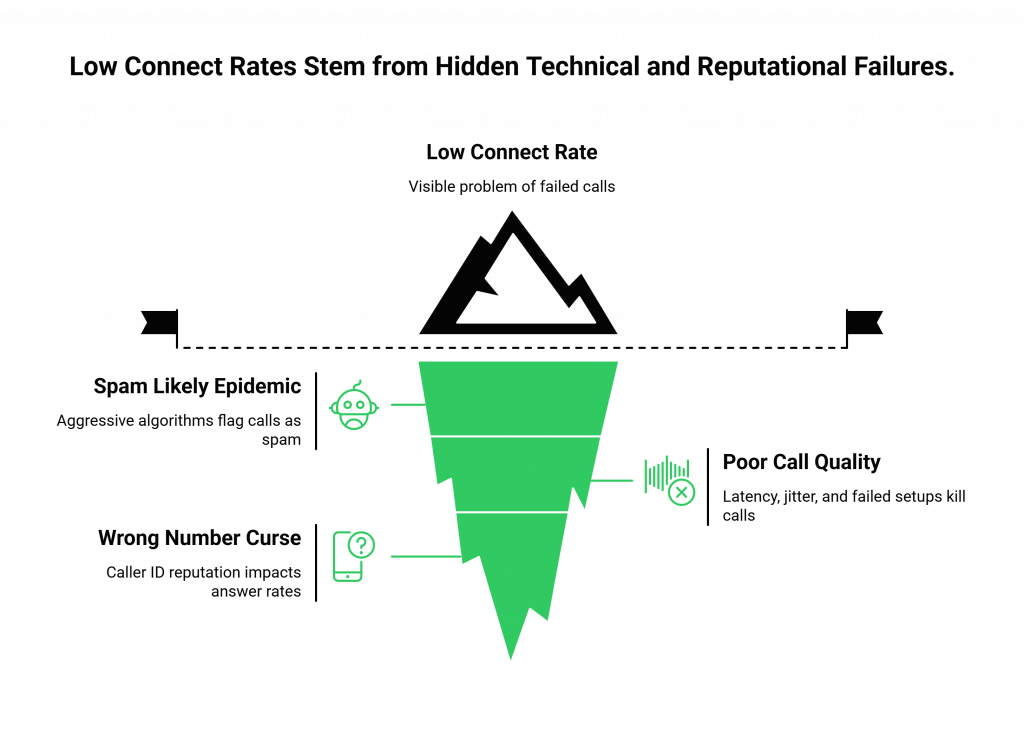
The “Spam Likely” Epidemic
This is the single biggest enemy of a modern outbound calling campaign. In response to the flood of illegal robocalls, mobile carriers have implemented increasingly aggressive and often opaque algorithms to identify and flag calls as potential spam.
- The Problem: These systems look for suspicious calling patterns. If a single phone number is used to make thousands of calls in a short period of time, it is a massive red flag. Even legitimate businesses are getting caught in this dragnet.
- The Impact: When your call is flagged, it shows up on the recipient’s screen with a warning like “Spam Likely” or “Scam Risk.” This is the digital equivalent of a “do not enter” sign. Your connect rate plummets.
The Problem of Poor Call Quality
Even if your call is not flagged as spam, a poor-quality connection can kill the conversation before it even starts.
- Latency and Jitter: If there is a long, awkward pause of dead air after the person says “hello” (high latency), or if the audio is choppy and garbled (high jitter), the person on the other end will simply hang up, assuming it is a bad connection or a robocall.
- Failed Call Setups: In a low-quality network, a significant percentage of calls may fail to connect at all, resulting in a “technical failure” before the phone even has a chance to ring.
- The “Wrong Number” Curse: Caller ID Reputation
The phone number you use to make the call, your caller ID has a reputation.
- Local Presence: People are far more likely to answer a call from a local number they recognize than a toll-free number or a number from an unknown area code. If you are using a single, national number to call people all over the country, you are fighting an uphill battle.
- Number “Burning”: If a number is overused or has been flagged by users, its reputation is “burned.” It will be more likely to be blocked or flagged by the carriers in the future.
Also Read: How Can Building Voice Bots Improve Customer Experience Across Channels?
How Does a Modern Voice API Solve These Problems with Routing Intelligence?
A modern voice API for bulk calling is not just a dumb pipe to the phone network. It is an intelligent, software-defined network (SDN) that actively works to solve these problems and maximize your connect rate. This routing intelligence is the key to a successful quality-first calling strategy and is a core part of the connect rate optimization 2026 trend.

Intelligent Number Management and Local Presence
This is the first and most powerful tool. A modern platform gives you the programmatic ability to manage a large portfolio of phone numbers and use them intelligently.
- The Workflow: When you initiate an outbound call via the API, you can specify that you want to use “local presence.” The platform will automatically select a phone number from your portfolio that has the same local area code as the person you are calling.
- The Impact: The recipient sees a familiar, local number on their caller ID, which can increase answer rates by as much as 400%, according to some industry studies.
- Number Rotation: To avoid “burning” your numbers, the API can be used to automatically rotate through your portfolio of local numbers, ensuring that no single number is overused.
Proactive Network and Carrier Optimization
This is the hidden “magic” of a high-quality voice platform. A provider like FreJun AI operates a global, carrier-grade network.
- Least Cost vs. Highest Quality Routing: A cheap provider will always route your call through the absolute cheapest carrier path, even if the quality is poor. A quality-first calling platform is constantly monitoring the real-time performance (latency, jitter, and call completion rates) of hundreds of different carrier paths around the world.
- Dynamic, Real-Time Adjustments: Our routing intelligence engine will automatically and dynamically route your call through the highest-quality path at that specific moment in time. If a particular carrier is having a bad day in a certain region, our platform will automatically route your calls around them, ensuring your call has the best possible chance of connecting with crystal-clear audio.
Also Read: How Should QA Teams Evaluate Interactions While Building Voice Bots For Users?
This table summarizes how these intelligent features directly combat the common causes of a low connect rate.
| Problem | The Brute-Force Approach | The Voice API for Bulk Calling with Routing Intelligence |
| “Spam Likely” Flagging | Uses a single number to make thousands of calls, getting it flagged. | Intelligently rotates through a large portfolio of numbers to avoid detection. |
| Poor Call Quality (Latency/Jitter) | Uses the cheapest possible carrier path, regardless of quality. | Dynamically routes calls through the highest-quality network path in real-time. |
| Low Answer Rate from Unknown Numbers | Uses a single, non-local toll-free or national number. | Uses a local presence feature to automatically display a familiar, local caller ID. |
| Call Failures | Has no visibility into carrier performance; continues to send calls down a failing path. | Proactively monitors carrier performance and automatically routes around outages. |
Ready to build an outbound calling strategy that prioritizes quality and connection? Sign up for FreJun AI
What Role Does FreJun AI’s Teler Engine Play?
At FreJun AI, our Teler engine is the powerful, globally distributed infrastructure that underpins our voice API for bulk calling. We have built our entire network on the principles of routing intelligence and quality-first calling.
Our platform is not a black box. We provide developers with deep, real-time analytics and visibility into the performance of their calls. You can see the connect rates, the call durations, and the quality metrics for every single call. Our APIs give you the granular control you need to manage your number portfolio, implement a local presence strategy, and build a truly intelligent and effective outbound calling operation.
We handle the immense, behind-the-scenes complexity of global carrier management and network optimization, so you can focus on the quality of your message and the intelligence of your AI.
Also Read: How Can Small Teams Start Building Voice Bots With Minimal Cost?
Conclusion
In the competitive landscape of outbound communication, the brute-force approach of the past is a recipe for failure. A low connect rate is a tax that you cannot afford to pay. The future of successful bulk calling lies in a smarter, more nuanced strategy that prioritizes quality and intelligence at every step of the process. A modern voice API for bulk calling provides the essential tools to implement this strategy.
Businesses can leverage intelligent call routing capabilities. Smart number management improves local presence and trust. Proactive network optimization ensures clear audio quality. These improvements reduce spam labeling issues. Most importantly, they significantly increase call connect rates.
This is the foundation of connect rate optimization 2026 and the key to turning your outbound calling from a costly gamble into a predictable and powerful engine for growth.
Want to see a live demonstration of our routing intelligence and local presence features? Schedule a demo for FreJun Teler.
Also Read: IVR Software Analytics: How Reporting Improves Call Center Performance
Frequently Asked Questions (FAQs)
It is a programmable interface that allows a developer’s application to initiate and manage a large number of outbound phone calls simultaneously and automatically.
Routing intelligence refers to a platform’s ability to dynamically and automatically choose the best possible network path for a call based on real-time quality and performance data.
The main goal of connect rate optimization 2026 is to use technology like AI and intelligent routing to combat “spam likely” flagging and increase call answer rates.
Local presence automatically displays a caller ID with a local area code, which makes the call look familiar and trustworthy to the recipient, increasing answer rates.
Least cost routing always picks the cheapest carrier path. Quality-first calling picks the most reliable, highest-quality path to ensure a good connection, prioritizing the user experience.
Using a smart number rotation strategy through your voice API for bulk calling is the most effective way to avoid overusing any single number and getting it flagged.
It affects whether they will stay on the phone. If there is a long, silent pause after they say “hello,” they are very likely to hang up.