
Voice applications are evolving rapidly, and businesses now demand intelligent, context-aware systems that go beyond traditional telephony. With programmable SIP, developers gain full control over call flows, routing, and real-time streaming, enabling AI agents to understand and respond naturally. Combining SIP with LLMs, TTS, STT, and retrieval-based systems allows multi-turn, personalized conversations across inbound and outbound calls.
This blog explains how programmable SIP benefits modern voice applications, explores technical advantages, compares with traditional telephony, and introduces FreJun Teler as the infrastructure layer for scaling intelligent voice experiences, providing actionable insights for founders, product managers, and engineering teams.
What Is Programmable SIP And Why Does It Matter For Voice Applications?
In the modern digital landscape, businesses are increasingly turning toward voice applications to enhance customer engagement, improve operational efficiency, and deliver personalized experiences. However, developing real-time, context-aware voice applications requires more than traditional telephony – it requires a programmable, flexible, and reliable communication layer. This is where programmable SIP comes into play.
Session Initiation Protocol (SIP) is a standard protocol used to initiate, maintain, and terminate voice or video calls over IP networks. Programmable SIP takes this a step further by allowing developers to control these sessions programmatically through APIs. This approach transforms conventional telephony into a dynamic, programmable voice layer, suitable for modern applications powered by AI, LLMs, and other intelligent agents.
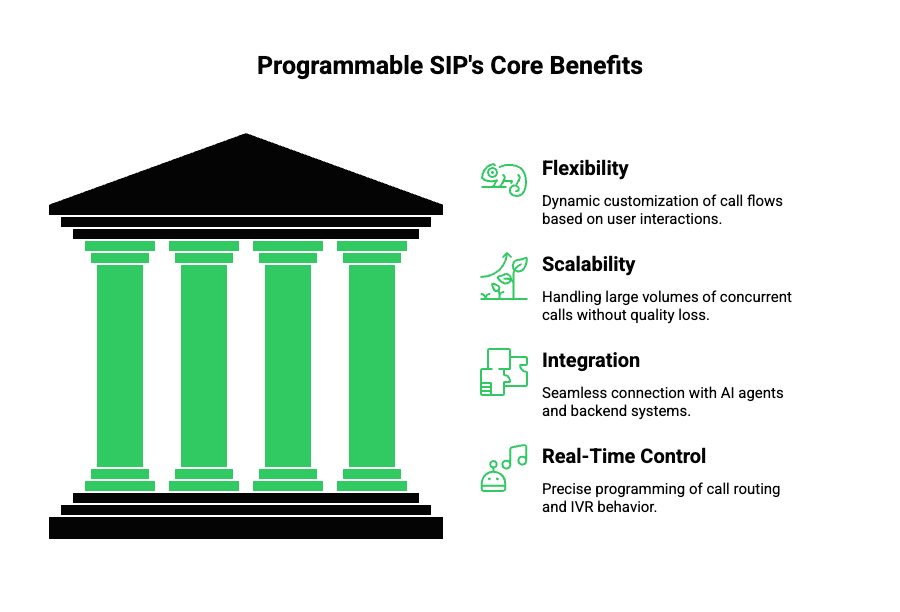
Key Reasons Programmable SIP Matters:
- Flexibility: Customize call flows dynamically based on user interactions or backend logic.
- Scalability: Handle large volumes of concurrent calls without compromising quality.
- Integration: Easily connect with TTS, STT, AI agents, or backend systems.
- Real-Time Control: Program call routing, conferencing, and IVR behavior with precision.
By integrating programmable SIP, organizations can develop context-aware voice AI applications capable of delivering personalized experiences. Unlike traditional telephony systems, programmable SIP allows real-time monitoring and modification of call behavior, making it a core technology for modern conversational applications.
How Can Programmable SIP Enable Context-Aware Voice AI?
Building a context-aware voice AI requires maintaining continuity across conversations, understanding user intent, and responding in a personalized manner. Context-aware voice applications leverage speech-to-text (STT), text-to-speech (TTS), LLMs, and retrieval-augmented generation (RAG) to process input and generate accurate responses.
Programmable SIP provides the foundation for this process by:
- Capturing real-time audio: Incoming calls are streamed as low-latency audio to the AI engine.
- Maintaining session state: SIP enables the application to track the conversation state across multiple interactions.
- Streaming responses back: TTS output is streamed back over the call instantly, ensuring a natural conversation flow.
- Event-driven triggers: Webhooks allow the AI to react to call events such as hold, transfer, or disconnect, maintaining contextual accuracy.
Practical Example:
- A customer calls a banking support line.
- SIP captures the audio in real time and sends it to an AI agent.
- The AI checks the account context, identifies the query (e.g., recent transactions), and streams a spoken response.
- If the user requests a follow-up action, SIP routes the call dynamically to the right department without losing conversation context.
This pipeline highlights why programmable SIP is essential for intelligent voice apps. Without it, AI agents would struggle to maintain context, resulting in delayed responses and fragmented conversations.
What Technical Advantages Does Programmable SIP Offer?
Programmable SIP is more than just a communication protocol – it’s a powerful infrastructure layer that supports complex, real-time voice interactions. Here are the key technical advantages:
1. Low-Latency Voice Streaming
- SIP supports real-time media streaming, reducing delays between user speech and AI response.
- Latency is typically less than 150ms when optimized, maintaining conversational flow.
- Essential for applications like virtual receptionists or automated customer support agents.
More than half of cloud telephony platforms now incorporate AI‑enabled features like intelligent routing and virtual assistants, demonstrating how programmable SIP enables advanced voice capabilities.
2. Full Control Over Call Logic
- Developers can dynamically configure:
- Interactive Voice Response (IVR) systems
- Call routing and forwarding
- Conference calls or group interactions
- Custom retry and fallback logic
- Interactive Voice Response (IVR) systems
- This level of control is crucial for context-aware voice AI to react to real-time inputs.
3. Event-Driven Architecture
- SIP supports webhooks and callbacks for all call events:
- Call start/end
- Hold or transfer
- DTMF inputs
- Call start/end
- Event-driven triggers allow AI agents to make immediate decisions based on current call state.
4. Scalability and Reliability
- Cloud-based programmable SIP platforms handle thousands of concurrent calls globally.
- Built-in redundancy ensures minimal downtime and uninterrupted service.
- Reliability is key for enterprise-grade voice AI applications.
5. Seamless Integration with AI/LLM Pipelines
- SIP acts as a transport layer, delivering audio to AI models and receiving responses in real time.
- Maintains session context, enabling AI to handle multi-turn conversations and personalized interactions.
- Compatible with any TTS or STT engine, offering flexibility for technical teams.
How Does Programmable SIP Compare To Traditional Telephony Platforms?
Many conventional telephony platforms focus only on basic inbound/outbound calling and do not offer advanced programmability. Let’s compare the differences:
| Feature | Traditional Telephony | Programmable SIP |
| Call Flow Control | Fixed, rule-based IVR | Dynamic, API-controlled call flows |
| AI Integration | Limited | Supports LLM, TTS, STT, and tool integration |
| Event Handling | Minimal | Real-time webhooks for all call events |
| Context Awareness | None | Maintains conversational context across calls |
| Scalability | Hardware-limited | Cloud-based, global scalability |
| Latency | Higher | Low-latency streaming (<150ms) |
Key Insight: For conversational AI telephony, programmable SIP provides the flexibility and infrastructure necessary for building context-aware, intelligent voice applications. Traditional platforms simply cannot match this capability.
Why Should You Choose FreJun Teler For AI-Powered Voice Applications?
After understanding the technical benefits of programmable SIP, it’s important to explore how FreJun Teler leverages these advantages to support context-aware voice AI.
FreJun Teler provides a robust voice layer for AI agents:
- Model-Agnostic Integration: Connects seamlessly with any LLM or AI engine.
- Real-Time Streaming: Captures and delivers voice with ultra-low latency, preserving conversation flow.
- Developer-First SDKs: Offers APIs for web, mobile, and backend integration, simplifying complex workflows.
- Session Management: Maintains context across multi-turn conversations without losing critical data.
- Global, Reliable Infrastructure: Ensures high availability and consistent call quality, even at scale.
Example Technical Workflow with Teler:
- Call Initiation: SIP session is established via Teler’s API.
- Audio Capture: Voice input is streamed to the connected AI agent in real time.
- AI Processing: The LLM processes the input, optionally fetching data via RAG or other backend tools.
- Voice Response: TTS output is streamed back to the caller with minimal latency.
- Dynamic Routing: If further actions are needed, Teler manages call routing without breaking context.
By providing this specialized SIP layer, Teler allows developers to focus on building the AI logic rather than worrying about telephony infrastructure, call reliability, or latency issues.
What Real-World Use Cases Can Programmable SIP Power?
Programmable SIP is versatile and enables several high-impact applications for businesses:
1. Intelligent Inbound Call Handling
- AI-powered receptionists and IVRs
- Natural language understanding for support queries
- Automated routing to departments based on conversation context
2. Personalized Outbound Campaigns
- Appointment reminders, follow-ups, and notifications
- Lead qualification and customer surveys
- Dynamic message adaptation based on prior interactions
3. Multilingual Voice Agents
- Regional TTS/STT integration for global users
- Seamless conversation in multiple languages without human agents
4. Integration With Enterprise Tools
- CRM and ERP systems
- RAG pipelines for data retrieval
How Can Developers Implement Best Practices With Programmable SIP?
Building context-aware voice AI applications requires careful planning and execution. Implementing programmable SIP effectively ensures both reliability and high-quality conversational experiences.
1. Optimize Session Management
- Maintain conversational state across multiple calls and interactions.
- Use session tokens or unique identifiers for each call to track context.
- Employ event-driven callbacks to update the AI agent about call progress.
2. Choose the Right LLM + TTS + STT Pipeline
- Select LLMs with low-latency response capabilities for real-time interactions.
- Ensure STT engines provide accurate transcription for natural speech variations.
- Use TTS systems optimized for clarity and minimal lag, ensuring responses feel human-like.
- Test combinations to find the lowest latency configuration without sacrificing accuracy.
3. Handle Errors and Failures Gracefully
- Implement retries for failed calls or dropped audio packets.
- Log all call events and AI interactions for debugging and analytics.
- Design fallback responses for ambiguous or unrecognized input to maintain smooth conversation flow.
4. Secure and Comply
- Encrypt all call streams using TLS or SRTP to protect sensitive information.
- Follow regulatory standards like GDPR, HIPAA, or PCI-DSS depending on the domain.
- Limit access to session data and implement role-based permissions for APIs.
5. Monitor and Optimize Performance
- Track latency between audio input, AI processing, and audio output.
- Continuously monitor call quality metrics and adjust SIP settings as needed.
- Utilize analytics to improve AI responses and routing efficiency over time.
By following these best practices, developers can ensure that programmable SIP not only delivers reliable call infrastructure but also enables advanced, context-aware AI behaviors across complex workflows.
What Are Some Advanced Implementation Strategies For Context-Aware Voice Applications?
1. Multi-Turn Conversational Context
- Store and retrieve conversation history to provide personalized responses.
- Use RAG (Retrieval-Augmented Generation) to fetch context-relevant data from external knowledge bases during the call.
- Example: A customer calls for support on a recurring issue; AI recalls previous resolutions and recommends next steps automatically.
2. Real-Time Decision Making
- Implement event-driven triggers for call actions:
- Transfer to another agent or department
- Escalate priority based on sentiment analysis
- Dynamically update IVR menus
- Transfer to another agent or department
- Programmable SIP allows these decisions to happen without interrupting the conversation, enhancing user experience.
3. Parallel Audio Processing
- Capture audio for STT transcription while simultaneously streaming to monitoring systems or logging services.
- This ensures faster AI response and enables additional insights for analytics or compliance.
4. Integration With Business Tools
- Connect your SIP-enabled AI with CRMs, ticketing systems, or ERP software.
- Use webhooks to update customer records automatically based on conversation outcomes.
- Example: After a call, automatically log key information such as lead status, issue resolution, or follow-up actions.
5. Multi-Channel Flexibility
- Extend programmable SIP beyond phone calls:
- WebRTC-based web or mobile applications
- VoIP or SIP endpoints in distributed office setups
- WebRTC-based web or mobile applications
- This allows context-aware voice AI to operate seamlessly across different platforms.
How Can Programmable SIP Improve Conversational AI Telephony Outcomes?
Programmable SIP isn’t just about enabling calls – it fundamentally enhances AI-driven conversations:
1. Better Customer Engagement
- Low-latency voice streaming maintains natural conversation flow.
- Real-time responses increase satisfaction and reduce frustration.
2. Operational Efficiency
- Automate repetitive tasks like appointment reminders, surveys, or verification calls.
- Reduce the workload on human agents while maintaining high-quality interactions.
3. Data-Driven Insights
- Capture every event in the call lifecycle.
- Use analytics to optimize AI behavior, IVR routing, and call quality.
- Identify gaps in knowledge or frequently asked questions for improvement.
4. Personalization at Scale
- Maintain context across multiple sessions.
- Customize responses based on user history or CRM data.
- Ensure multi-turn conversations feel coherent and intelligent.
What Are Common Challenges And How Can They Be Addressed?
Even with programmable SIP, building context-aware voice applications comes with challenges. Understanding these early helps reduce deployment risks.
1. Latency and Audio Quality
- High latency breaks conversational flow.
- Mitigation: Use optimized STT/TTS, low-latency codecs (Opus, G.722), and geographically distributed infrastructure.
2. Complex Context Management
- Multi-turn conversations can become difficult to track.
- Mitigation: Implement session tokens, context storage layers, and retrieval-based AI methods.
3. Event Handling Complexity
- Handling multiple SIP events in real time can be challenging.
- Mitigation: Leverage robust SDKs and modular architecture to simplify event-driven call handling.
4. Integration Overhead
- Combining LLM, TTS, STT, RAG, and business tools may seem complex.
- Mitigation: Use a model-agnostic platform like FreJun Teler to standardize the voice layer, allowing developers to focus on AI logic.
Why Programmable SIP And FreJun Teler Are A Winning Combination
FreJun Teler provides a ready-to-use programmable SIP infrastructure tailored for AI agents. By integrating Teler, developers can:
- Avoid telephony complexity: Teler handles session management, routing, and low-latency streaming.
- Focus on AI innovation: Developers concentrate on AI logic, context management, and TTS/STT optimization.
- Scale globally: Teler’s cloud infrastructure ensures high availability and reliability across geographies.
- Integrate Any AI Model: Works with all LLMs and custom agents without vendor lock-in.
This combination transforms SIP from a simple call protocol into a powerful engine for intelligent, context-aware voice applications.
What Are Actionable Takeaways For Founders, Product Managers, And Engineering Leads?
- Programmable SIP is foundational: It provides the flexibility, control, and reliability needed for AI-driven voice applications.
- Context is key: Multi-turn conversations, session management, and event-driven triggers make voice applications intelligent.
- Choose model-agnostic platforms: Teler enables integration with any LLM or AI agent, giving maximum technical freedom.
- Focus on user experience: Low-latency streaming, error handling, and personalization are critical for adoption.
- Leverage analytics: Use call events and AI interactions to continually improve conversational accuracy and business outcomes.
Conclusion
Programmable SIP has transformed voice applications, enabling context-aware AI to deliver real-time, intelligent, and scalable conversations. By integrating LLM, STT, TTS, and retrieval-based logic, developers can build multi-turn voice agents that retain context, personalize interactions, and automate complex tasks seamlessly.
FreJun Teler provides a robust, model-agnostic infrastructure, handling SIP session management, low-latency streaming, and global reliability, so teams can focus on AI logic without telephony complexity.
For founders, product managers, and engineering leads, adopting Teler ensures faster deployment, higher efficiency, and enhanced customer experiences.
Explore Teler’s programmable SIP APIs and schedule a demo today to start building context-aware voice applications that scale globally.
FAQs –
- Q: What is programmable SIP?
A: Programmable SIP allows developers to control voice calls via APIs, enabling real-time, intelligent, and context-aware voice applications. - Q: How does SIP support AI voice agents?
A: SIP streams audio to AI engines, retains context, triggers events, and returns TTS responses for natural conversation flow. - Q: Can I use any LLM with programmable SIP?
A: Yes, model-agnostic platforms like Teler allow integration with any LLM, AI agent, or custom backend system. - Q: Why is low-latency important in voice AI?
A: Low-latency ensures immediate responses, preventing awkward pauses, maintaining natural multi-turn conversations, and improving user satisfaction. - Q: How does Teler simplify SIP integration?
A: Teler handles session management, global routing, and reliable streaming, so developers focus on AI logic and context management. - Q: Can SIP retain multi-turn conversation context?
A: Yes, programmable SIP with backend context storage allows AI agents to manage multi-turn dialogues effectively. - Q: What are common SIP use cases?
A: Examples include AI receptionists, IVRs, appointment reminders, personalized outreach, multilingual support, and automated customer engagement. - Q: Is SIP secure for sensitive calls?
A: Yes, encryption, TLS/SRTP, and compliance standards ensure secure handling of sensitive voice data in enterprise applications. - Q: How scalable are programmable SIP applications?
A: Cloud-based SIP infrastructure handles thousands of concurrent calls globally, enabling enterprise-level deployment for AI voice systems. - Q: Why should businesses choose Teler for SIP?
A: Teler provides low-latency streaming, model-agnostic AI integration, developer-first SDKs, and reliable global infrastructure for intelligent voice applications.