
In the past decade, businesses have increasingly relied on digital solutions to engage customers. Chatbots became the go-to tool, offering instant text-based support and automating repetitive tasks. However, while chatbots provide convenience, they have inherent limitations. With the rise of voice-first interactions, businesses are realizing that voice bots deliver a richer, more natural, and human-like conversational experience.
Voice bots combine speech recognition, natural language understanding, text-to-speech output, and real-time intelligence, allowing customers to interact naturally without typing. This shift is not just technological – it’s strategic. Companies adopting voice bots can enhance engagement, streamline operations, and create a voice-first customer experience that sets them apart from competitors.
What Are Voice Bots And How Do They Differ From Chatbots?
Many teams assume voice bots are simply “chatbots with speech.” In reality, they involve entirely different architectures, technical components, and operational workflows.
| Feature | Chatbots | Voice Bots |
| Input | Text typed by user | Speech captured via microphone or phone call |
| Output | Text response | Spoken response via TTS (text-to-speech) |
| Conversation Flow | Limited multi-turn context | Maintains full conversational context |
| Data Integration | Optional | Real-time RAG/tool calling possible |
| Engagement | Text-based, slower for some users | Natural, immediate, hands-free interaction |
| Accessibility | Requires literacy and typing | Inclusive for all ages, multi-lingual users |
From a technical perspective, voice bots rely on four primary layers:
- Speech-to-Text (STT): Converts audio into text that the AI can process.
- AI or LLM Engine: Interprets intent, manages context, and generates responses.
- Tooling and RAG Layer: Fetches dynamic, real-time information for personalized responses.
- Text-to-Speech (TTS): Converts the AI-generated response back into natural-sounding audio.
This combination enables real-time, multi-turn conversations that text-based chatbots struggle to achieve.
Why Is Real-Time Conversation Important For Businesses Today?
Businesses operate in a fast-paced, connected world. Customers expect immediate, human-like interactions, regardless of the platform. Chatbots, limited by text-based responses, can create friction when:
- Users type slowly or make errors
- Multi-turn conversations break due to limited context retention
- Emotional nuance or urgency is difficult to interpret
Voice bots address these challenges by providing instant understanding and response. For example, a customer calling a support line can describe a problem naturally. The system instantly converts speech to text, queries the AI engine, retrieves relevant data, and responds – all in real-time.
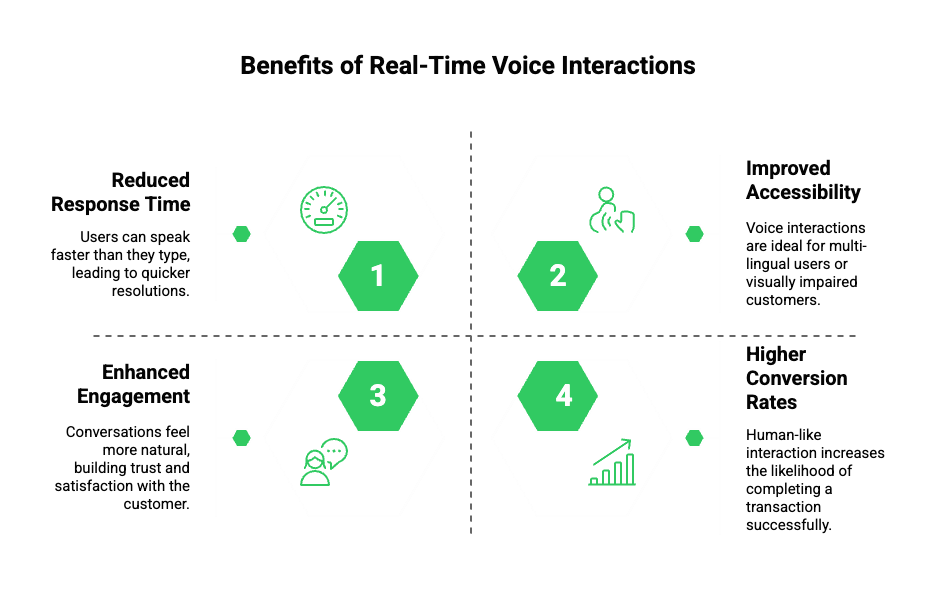
Benefits of real-time voice interactions include:
- Reduced response time: Users can speak faster than they type.
- Improved accessibility: Ideal for multi-lingual users or visually impaired customers.
- Enhanced engagement: Conversations feel more natural, building trust and satisfaction.
- Higher conversion rates: Human-like interaction increases the likelihood of completing a transaction.
Transitioning to voice-first interactions is no longer optional – it’s a strategic move that directly impacts customer satisfaction and retention.
How Do Voice Bots Work Technically?
Understanding the technical workflow of voice bots helps businesses plan scalable and efficient implementations. Voice bots integrate multiple components to create a seamless experience:
1. Speech-to-Text (STT)
- Captures live audio from calls or devices.
- Converts spoken words into text for processing.
- Supports multiple languages and accents to increase reach.
- Optimized for low latency, ensuring minimal delay in conversation.
2. AI or LLM Engine
- Receives text input from the STT layer.
- Interprets intent, maintains context, and generates logical responses.
- Can be any modern AI agent or large language model (GPT, Claude, etc.)
- Handles multi-turn conversations by retaining dialogue state and context.
3. Retrieval-Augmented Generation (RAG) / Tool Integration
- Fetches real-time data dynamically from databases, CRMs, or APIs.
- Enables voice bots to provide accurate, personalized responses.
- Example: Checking order status or appointment availability during a call.
4. Text-to-Speech (TTS)
- Converts AI-generated text responses into natural-sounding audio.
- Supports multiple voices, tones, and languages for personalization.
- Ensures smooth delivery without noticeable lag.
5. Voice Infrastructure
- Manages real-time call streaming, SIP/VoIP integration, and low-latency transmission.
- Maintains conversation continuity even during network fluctuations.
- Provides analytics on call quality, latency, and user engagement.
Flow Overview (Simplified):
User Speech → STT → LLM Processing → RAG/Tool Calls → TTS → User Hears Response
This technical structure ensures that voice bots are highly scalable, flexible, and adaptable to different business use cases.
What Are The Key Advantages Of Voice Bots Over Chatbots?
Businesses often ask why they should invest in voice bots when chatbots already exist. Here’s a technical and operational breakdown:
Faster Engagement
- Speech is faster than typing.
- Multi-turn conversations can be handled without repeated input from the user.
Context Awareness
- Voice bots retain conversation state across multiple turns.
- Can handle interruptions, corrections, and clarifications seamlessly.
Emotional Intelligence
- Tone, pace, and volume can be analyzed to detect sentiment.
- Enables personalized responses based on urgency or mood.
Accessibility
- Voice bots are inclusive, supporting users who are unable to type or read.
- Multi-lingual support enables global customer reach.
Integration With Business Workflows
- Voice bots can fetch data dynamically via RAG or call backend tools.
- Example: AI voice agent can retrieve order info, update CRM, and schedule follow-ups without human intervention.
Voice AI agents are expected to expand from a $2.4 billion market in 2024 to $47.5 billion by 2034, reflecting rapid enterprise investment in voice‑first automation.
Why Do Traditional Platforms Fall Short For AI-Powered Voice Agents?
Most traditional telephony platforms focus on call management rather than AI-driven conversation. Key limitations include:
- No real-time AI orchestration: Calls are routed but not intelligently handled by AI.
- Limited context handling: Multi-turn conversations fail in complex scenarios.
- Fixed workflows: Hard-coded IVRs cannot adapt dynamically.
- Minimal personalization: Voice and tone remain generic.
In contrast, modern AI-powered voice bots combine flexible LLMs, STT/TTS, and RAG capabilities, allowing businesses to deliver a voice-first customer experience without the constraints of traditional telephony solutions.
How Does FreJun Teler Make Building Voice Bots Easier And More Reliable?
Introducing FreJun Teler here is natural, as it addresses the limitations discussed above. Teler acts as a robust infrastructure layer, enabling any AI or LLM to become a voice agent efficiently.
Key Technical Advantages of FreJun Teler:
- Low-Latency Streaming: Captures user speech and plays AI responses in real-time with minimal delay.
- Model-Agnostic Integration: Works with any LLM or AI agent, allowing businesses to choose their preferred AI engine.
- Full Conversational Context: Maintains dialogue state, even in multi-turn interactions, ensuring consistent responses.
- Enterprise Reliability and Security: Built on geo-distributed infrastructure with encryption, role-based access, and high uptime.
- SDKs for Developers: Provides server and client-side SDKs for easy integration into apps or backend systems.
Teler effectively bridges the gap between AI intelligence and telephony infrastructure, letting businesses focus on building their conversational AI logic instead of worrying about call quality, latency, or infrastructure.
Sign Up for FreJun Teler Today
What Are Real-World Use Cases For Voice Bots In Business?
Voice bots are not just a technological novelty – they are practical solutions that streamline operations, enhance customer engagement, and drive measurable outcomes. Companies that adopt voice bots can transform multiple areas of their business.
1. Intelligent Inbound Customer Support
- AI voice agents can serve as 24/7 receptionists, reducing the need for human operators.
- Capable of handling complex multi-turn conversations, including follow-up questions and clarifications.
- Can route calls dynamically based on intent, urgency, or customer profile.
- Example: A bank call center using voice bots to guide customers through account inquiries, dispute resolution, or loan applications without human intervention.
2. Personalized Outbound Campaigns
- Automate outbound calls such as appointment reminders, renewals, and feedback collection.
- Voice bots can reference customer data dynamically using RAG and tool integrations.
- Personalized, conversational interactions significantly increase engagement and conversion rates compared to robotic IVR calls.
3. Operational Notifications and Updates
- Voice bots can provide proactive updates for logistics, delivery confirmations, or service alerts.
- Businesses can configure automated voice agents to fetch live data and notify customers in real-time.
- Example: A logistics company uses voice bots to call recipients with precise delivery windows, reducing missed deliveries and manual follow-ups.
4. Sales and Lead Qualification
- Voice bots can pre-qualify leads by asking key questions and capturing intent during the call.
- Direct integration with CRMs allows real-time logging of leads, next steps, and follow-ups.
- Example: An insurance company uses a voice bot to gather preliminary information, schedule human-agent callbacks only for high-value prospects, optimizing agent workload.
How Can Businesses Measure ROI Of Building Voice Bots?
Investing in voice bots is strategic, but founders and product managers often need tangible metrics to justify deployment. The ROI comes from both cost efficiency and enhanced customer outcomes.
1. Operational Cost Savings
- Reduce reliance on human support agents for routine queries.
- Automate repetitive tasks without sacrificing quality.
- Example: A company handling 10,000 calls per month can reduce staff workload by 30–40% using voice bots.
2. Increased Engagement And Conversion
- Real-time, personalized interactions improve customer satisfaction.
- Human-like responses reduce abandonment rates during calls.
- Example: Outbound sales calls conducted by voice bots can achieve 15–20% higher conversion than generic IVR systems.
3. Faster Issue Resolution
- Multi-turn conversation capability enables end-to-end handling without human intervention.
- Customers get answers immediately, reducing follow-up calls and email tickets.
- This directly affects Net Promoter Score (NPS) and customer retention.
4. Analytical Insights
- Voice bots provide call metrics, sentiment analysis, and intent tracking.
- Businesses can identify trends, optimize scripts, and improve AI model responses over time.
- Helps in refining both customer engagement strategy and internal operations.
Table: ROI Comparison – Voice Bots vs. Traditional Chatbots
| Metric | Chatbots | Voice Bots |
| Response Time | Moderate | Immediate for spoken queries |
| Engagement | Limited to text | High, natural conversation |
| Multi-turn Handling | Partial | Full, context-aware |
| Personalization | Limited | Dynamic, RAG-based |
| Cost Savings | Moderate | High (reduces human workload significantly) |
| Accessibility | Requires typing literacy | Inclusive, multi-lingual support |
What Are The Best Practices For Implementing Voice Bots?
For engineering leads and product managers, following best practices ensures efficient deployment and performance.
1. Choose The Right LLM + STT/TTS Combination
- Any voice bot architecture relies heavily on AI’s ability to understand and respond accurately.
- LLM handles intent recognition, multi-turn context, and dynamic generation.
- STT and TTS engines must support low latency and natural-sounding speech.
- Consider multi-lingual or accent adaptation if serving a global audience.
2. Optimize Latency And Conversational Flow
- Real-time interaction is crucial for natural conversations.
- Minimize processing delays across STT, AI engine, RAG retrieval, and TTS.
- Introduce fallback mechanisms for network or system disruptions.
3. Integrate RAG And Tool Calls
- Enable voice bots to fetch context-aware information from CRMs, databases, or APIs.
- Improves response accuracy and personalizes conversations.
- Example: Appointment confirmation bots dynamically pulling schedules from a calendar system.
4. Test Multi-Turn Context Handling
- Simulate long conversations with interruptions, corrections, and clarifications.
- Ensure the bot maintains proper context across multiple exchanges.
- Use logs and analytics to identify weaknesses in dialogue flow.
5. Implement Monitoring And Analytics
- Track call quality, user satisfaction, sentiment, and engagement metrics.
- Use analytics to improve AI responses and identify high-impact use cases.
- Establish continuous feedback loops for performance optimization.
Why Should Businesses Think Voice-First For Customer Experience?
Investing in voice bots is not merely a technological upgrade – it’s a strategic initiative to lead in customer experience. A voice-first approach provides:
- Natural Interaction: Customers interact with systems as they would with humans.
- Inclusive Accessibility: Supports users across age groups, abilities, and language preferences.
- Efficiency At Scale: Handles thousands of conversations simultaneously without human bottlenecks.
- Actionable Insights: Captures voice data that can be analyzed for sentiment, intent, and operational improvements.
Transition to Voice-First Strategy:
- Start by identifying high-impact areas (support, sales, notifications).
- Choose a modular, scalable architecture that can integrate any AI engine and TTS/STT solution.
- Utilize platforms like FreJun Teler to manage the voice infrastructure, allowing your team to focus on AI logic and business outcomes.
Conclusion
Voice bots are no longer optional – they are a strategic necessity for businesses aiming to enhance customer engagement, reduce operational costs, and deliver a voice-first experience. By leveraging LLM-powered AI, STT/TTS, and dynamic tool integration, voice bots provide faster, natural, and context-aware conversations that text chatbots alone cannot achieve. Enterprises can scale support, personalize interactions, and extract actionable insights to optimize operations.
Platforms like FreJun Teler simplify the implementation by handling low-latency voice infrastructure, allowing teams to focus on AI logic, multi-turn context, and tool integrations. Start building sophisticated voice agents today to stay ahead in customer experience innovation.
FAQs –
- Q: What’s the main difference between a chatbot and a voice bot?
A: Chatbots rely on text, while voice bots combine STT, LLM, TTS, and RAG for natural speech interactions. - Q: Can I integrate any AI with a voice bot?
A: Yes, voice bots are model-agnostic, allowing any LLM or AI agent to manage conversations effectively. - Q: How does STT improve voice bot performance?
A: STT converts spoken words to text in real-time, enabling accurate intent recognition and dynamic responses. - Q: Do voice bots handle multi-turn conversations?
A: Absolutely, they maintain context across multiple interactions, ensuring coherent and human-like dialogue. - Q: How is RAG used in voice bots?
A: RAG retrieves real-time information from databases or APIs, enabling voice bots to answer dynamically. - Q: Are voice bots suitable for global audiences?
A: Yes, they support multi-lingual STT/TTS engines, enhancing accessibility and engagement worldwide. - Q: What ROI can businesses expect from voice bots?
A: Businesses see cost reductions, faster issue resolution, higher engagement, and improved customer satisfaction. - Q: How does FreJun Teler simplify voice bot implementation?
A: Teler manages low-latency streaming, SIP/VoIP integration, and infrastructure, letting teams focus on AI logic. - Q: Can voice bots automate outbound campaigns?
A: Yes, they handle reminders, notifications, and lead qualification with personalized, natural-sounding interactions. - Q: How do I measure voice bot success?
A: Track metrics like call duration, engagement, resolution time, sentiment analysis, and conversion rates for ROI evaluation.