
High-volume notifications are no longer just about delivering messages. Instead, they are about completing actions, confirming outcomes, and reducing operational friction at scale. As businesses grow, static bulk calling systems begin to show limitations in flexibility, intelligence, and responsiveness. Meanwhile, modern voice APIs enable teams to move beyond broadcast-style calls and toward real-time, interactive voice workflows. By combining programmable voice infrastructure with AI-driven logic, companies can design notification systems that scale reliably while remaining context-aware.
This blog explores how voice APIs power bulk calling, why ultra-scalable streaming matters, and how engineering teams can build intelligent, high-volume notification systems using modern voice infrastructure.
Why Is Voice Still The Most Reliable Channel For High-Volume Notifications?
Even with messaging apps, emails, and push notifications everywhere, voice calls remain the most dependable way to reach users at scale. This is especially true when the message is urgent, regulated, or time-sensitive.
To begin with, voice calls do not depend on internet connectivity, app installation, or user preferences. Instead, they work directly over PSTN and VoIP networks, which gives them near-universal reach. As a result, enterprises continue to rely on voice for scenarios such as appointment reminders, compliance alerts, delivery notifications, and payment follow-ups.
Moreover, voice creates a stronger sense of urgency. Unlike text-based channels, a ringing phone demands immediate attention. Because of this, high-volume notifications delivered through voice often achieve higher engagement and acknowledgment rates.
According to Bonafide Research, the global telecom API market – which includes voice APIs for call orchestration – is expected to grow from USD 334.7 billion in 2024 to over USD 831 billion by 2030, showing a strong shift toward real-time voice and programmable communication use cases.
From a system design perspective, this is why mass calling technology still plays a central role in large-scale communication systems. However, while voice remains effective, the way it is implemented has evolved significantly. That evolution begins with Voice APIs.
What Is A Voice API For Bulk Calling And How Does It Work?
A voice API for bulk calling allows applications to programmatically place, control, and monitor phone calls at scale. Instead of manually managing telecom infrastructure, developers interact with software interfaces that abstract complex telephony operations.
At a high level, a voice API provides the following capabilities:
- Initiating outbound calls programmatically
- Connecting calls to phone numbers across regions
- Streaming or playing audio during calls
- Receiving call events and status updates
- Handling retries, failures, and reporting
However, under the hood, much more is happening.
Core Technical Components Behind Voice APIs
To understand how bulk calling works, it helps to break the system into layers:
- Call Control Layer
Handles call setup, ringing, answering, and termination using SIP or VoIP protocols. - Media Layer
Manages audio transport using RTP streams, codecs, buffering, and jitter control. - Event Layer
Emits real-time events such as call answered, busy, failed, or completed. - Integration Layer
Allows backend systems to trigger calls and react to call outcomes.
Because of this layered approach, voice APIs make it possible to execute thousands of calls concurrently without building telecom systems from scratch. Consequently, they are widely used for bulk notifications APIs in enterprise environments.
How Have Traditional Bulk Voice Platforms Handled Mass Calling?
Historically, bulk calling platforms focused on broadcast-style communication. In other words, the same message was delivered to a large audience with minimal variation.
Typically, these systems follow a campaign-based model:
- Upload a list of phone numbers
- Upload or select a pre-recorded audio file
- Schedule or trigger the campaign
- Calls are placed in batches
- Reports are generated after completion
This approach works well for simple announcements. For example, outage notifications or generic reminders fit this model.
Common Capabilities In Legacy Bulk Calling Systems
- Pre-recorded or static TTS audio playback
- Batch execution with rate limits
- Basic retry logic for unanswered calls
- Simple analytics such as call duration and pickup rate
- DTMF input for limited interaction
However, as notification needs grew more complex, these platforms started showing limitations.
Why Do Traditional Bulk Notifications APIs Break At Scale?
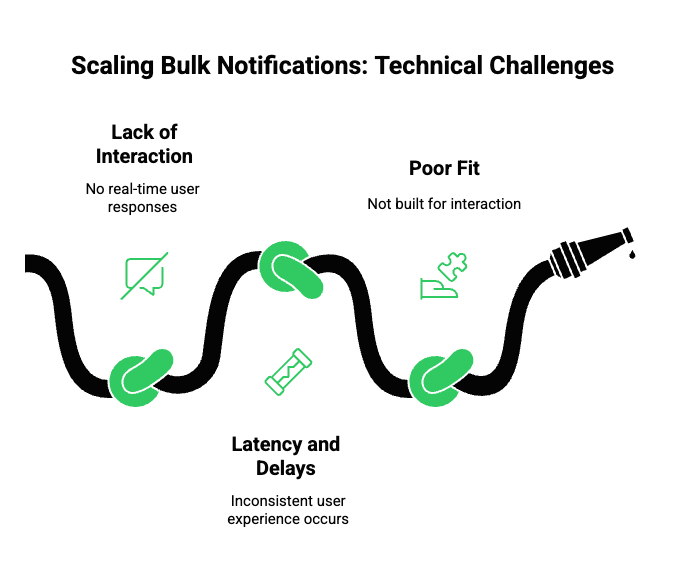
At first glance, scaling bulk calling seems straightforward. Just place more calls, right? In practice, scaling voice systems introduces several technical challenges.
Lack Of Real-Time Interaction
Most traditional systems are designed for one-way delivery. Because of this, they struggle with:
- Real-time user responses
- Dynamic branching logic
- Context-aware follow-ups
As a result, any change in message content requires a new campaign setup.
Latency And Audio Delays
Since many platforms rely on pre-generated audio and batch execution, delays can occur due to:
- Audio file loading
- Buffering issues
- Call queuing during peak loads
Over time, this leads to inconsistent user experience, especially during large campaigns.
Poor Fit For Intelligent Workflows
Modern notification flows often require logic such as:
- Confirming or rescheduling appointments
- Collecting spoken responses
- Escalating to human agents
- Updating backend systems in real time
Unfortunately, static bulk calling platforms are not built for this level of interaction. Therefore, while they handle volume, they fail at intelligence.
Why Does High-Volume Calling Require Ultra-Scalable Streaming?
As notification systems evolve, streaming becomes the key technical requirement. Instead of playing fixed audio files, modern systems stream audio in real time.
This shift introduces several benefits.
Real-Time Audio Streaming Advantages
- Lower latency between user input and system response
- Ability to interrupt, adapt, or personalize messages
- Continuous media flow instead of stop-start playback
- Better support for two-way conversations
Because of this, ultra scalable streaming is now a core requirement for next-generation bulk calling platforms.
What Makes Streaming Hard At Scale?
However, streaming thousands of calls simultaneously is not trivial. Engineering teams must handle:
- Thousands of concurrent RTP streams
- Session persistence for each call
- Audio quality under network variability
- Fault tolerance and reconnection handling
Therefore, scalability is no longer just about call count. Instead, it is about managing real-time media streams reliably.
How Does AI Change The Way Bulk Voice Notifications Work?
This is where AI fundamentally changes the equation.
Instead of treating calls as static delivery mechanisms, AI allows systems to reason, adapt, and respond during the call itself.
What Is A Voice Agent In Technical Terms?
A modern voice agent is not a single component. Rather, it is a combination of:
- Speech-To-Text (STT) to convert user speech into text
- Large Language Models (LLMs) to interpret intent and generate responses
- Text-To-Speech (TTS) to convert responses into natural audio
- Context Storage to track conversation state
- Tool Calling to trigger actions such as updates or confirmations
In short:
Voice agents = LLM + STT + TTS + context + tools
Why This Matters For Bulk Notifications
With AI-driven voice agents:
- Messages become conversational instead of static
- Users can respond naturally instead of pressing keys
- Notifications can adapt based on real-time input
- Systems can complete workflows without human agents
Consequently, bulk notifications APIs in 2026 are expected to support intelligent, two-way voice interactions rather than simple broadcasts.
What Infrastructure Is Needed To Run AI Voice Agents At Scale?
While AI models handle reasoning, voice infrastructure handles reality. This distinction is critical.
To run AI-powered bulk calling, systems need:
- Bidirectional audio streaming for every call
- Stable low-latency connections
- Session-level context handling
- Event-driven orchestration
- Failure recovery at scale
Without this foundation, even the most advanced AI will fail to deliver a smooth voice experience.
Therefore, the real challenge is not choosing an LLM. Instead, it is building or adopting a voice layer that can reliably connect AI logic to thousands of live phone calls.
How Does FreJun Teler Enable AI-Driven Bulk Calling At Scale?
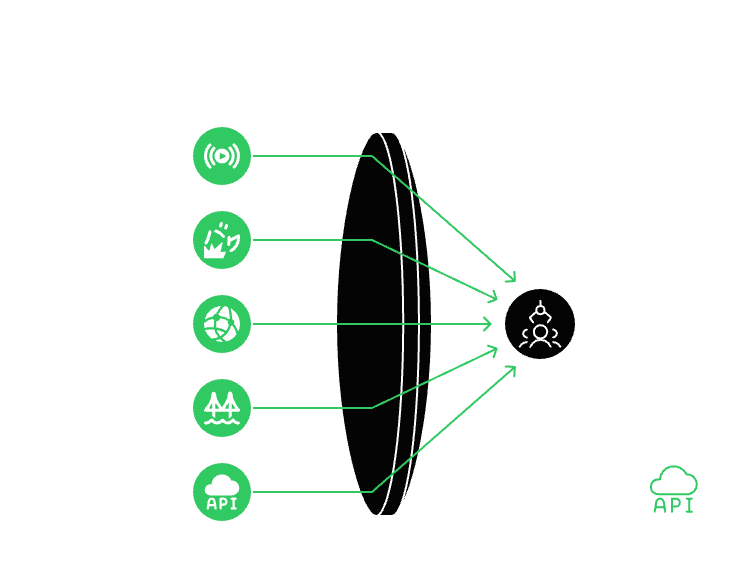
Now that we understand why bulk calling requires real-time streaming, conversational intelligence, and strong infrastructure, the next question is practical: how do teams actually implement this without building telecom systems from scratch?
This is where FreJun Teler fits into the architecture.
FreJun Teler is not an AI model and not a chatbot framework. Instead, it is a global voice infrastructure layer designed specifically for AI agents and LLMs. Its role is clear and focused: it handles real-time voice transport so engineering teams can focus on intelligence and logic.
What FreJun Teler Does At A Technical Level
FreJun Teler sits between phone networks and your backend systems. More specifically, it provides:
- Real-time, bidirectional audio streaming from live calls
- Low-latency voice ingestion and playback
- Global call connectivity over PSTN, VoIP, and cloud telephony
- Stable session handling for each call
- Event-driven APIs and SDKs for orchestration
Importantly, it does not dictate which AI model, STT engine, or TTS provider you must use. As a result, teams remain fully flexible.
In simple terms, Teler powers the voice layer, while your systems control the intelligence.
How Does A Teler-Based Bulk Calling Architecture Work End-to-End?
Once Teler is part of the stack, the full system becomes easier to reason about. Although the underlying system is powerful, the flow itself remains clean and predictable.
Step-By-Step Call Flow
- Bulk Call Triggered: Your backend system triggers a bulk calling job using your own logic or scheduler.
- Calls Established At Scale: Teler initiates outbound calls concurrently across regions, handling routing and connectivity.
- Live Audio Stream Captured: As soon as a call is answered, audio is streamed in real time to your backend.
- Speech Converted To Text: The live stream is passed to your chosen STT engine.
- LLM Processes Context: The transcribed text is processed by your LLM, along with context and business rules.
- Response Generated And Spoken: The LLM response is converted to audio via TTS and streamed back through Teler.
- Events And Outcomes Recorded: Call events, responses, and outcomes are logged and pushed to downstream systems.
Because this entire loop operates in real time, conversations feel natural rather than scripted.
Why Is This Architecture Ideal For High-Volume Notifications?
At first, AI-driven voice calling might sound expensive or complex. However, when designed correctly, it actually reduces operational overhead.
Key Technical Advantages
- No Pre-Generated Audio: Messages are generated on demand, which removes the need to manage audio assets.
- Dynamic Personalization At Scale: Each call can adapt based on user data, timing, or response.
- Two-Way Completion Of Tasks: Confirmations, updates, and acknowledgments happen within the same call.
- Reduced Human Intervention: Many workflows complete without agent escalation.
Because of these factors, voice APIs for bulk calling are no longer limited to announcements. Instead, they become execution channels for real workflows.
How Does This Compare With Traditional Mass Calling Technology?
To understand the shift clearly, it helps to compare both approaches side by side.
| Capability | Traditional Bulk Calling | AI-Driven Voice API |
| Audio Delivery | Pre-recorded | Real-time streaming |
| Interaction | DTMF only | Natural speech |
| Personalization | Minimal | Dynamic per call |
| Intelligence | None | LLM-based reasoning |
| Scalability Focus | Call count | Streams + context |
| Automation | Limited | End-to-end workflows |
As this table shows, the difference is architectural, not incremental.
How Can Engineering Teams Design Ultra-Scalable Streaming Systems?
Although Teler handles the voice layer, system design still matters. Therefore, engineering teams should follow a few best practices.
Design Principles For Scale
- Separate Voice From Intelligence: Keep media transport independent from AI processing.
- Use Stateless Processing Where Possible: Store conversation state externally to allow horizontal scaling.
- Stream Early, Respond Incrementally: Do not wait for full sentences before generating responses.
- Fail Gracefully: Handle dropped calls, silence, or partial responses cleanly.
Because bulk calling involves thousands of simultaneous streams, these principles become essential.
What Are The Most Practical Use Cases For AI-Based Bulk Voice Notifications?
While the technology is flexible, certain use cases benefit the most.
Appointment And Schedule Confirmations
- Call users automatically
- Confirm, reschedule, or cancel using voice
- Update systems in real time
Payment And Compliance Notifications
- Explain context dynamically
- Answer basic questions
- Escalate only when needed
Proactive Customer Updates
- Delivery status
- Service interruptions
- Account changes
Surveys And Feedback Collection
- Ask follow-up questions
- Adapt based on responses
- Capture structured data
In each case, voice agents complete tasks rather than just deliver messages.
What Should Founders And Product Teams Consider Before Implementing This?
Before adopting an AI-driven bulk notifications API, teams should evaluate readiness.
Key Questions To Ask
- Do notifications require user response or confirmation?
- Is personalization important at call time?
- Are workflows blocked by manual follow-ups?
- Is call volume high enough to justify automation?
If the answer to several of these is yes, then static bulk calling will likely become a bottleneck.
How Will Bulk Notifications APIs Evolve In 2026 And Beyond?
Looking ahead, bulk notifications API 2026 expectations are already clear.
Future systems will:
- Support real-time conversations by default
- Integrate seamlessly with AI agents
- Scale by streams, not campaigns
- Focus on outcomes, not call counts
As a result, mass calling technology is shifting from broadcast infrastructure to intelligent execution platforms.
Final Thoughts
Voice remains the most dependable channel for high-volume notifications, but its implementation must evolve. Traditional bulk calling systems focus on reach, yet they lack intelligence, adaptability, and real-time interaction. Modern voice APIs change this by enabling streaming-based, AI-driven voice workflows that scale reliably and complete actions within a single call. For founders, product leaders, and engineering teams, this approach reduces manual follow-ups, improves user experience, and future-proofs communication systems.
FreJun Teler supports this shift by acting as the real-time voice infrastructure layer for AI agents, allowing teams to integrate any LLM, STT, and TTS stack without vendor lock-in.
Schedule a demo to see how Teler powers scalable, intelligent bulk voice notifications.
FAQs –
1. What is a voice API for bulk calling?
A voice API allows applications to programmatically place, manage, and scale thousands of voice calls using telecom infrastructure.
2. How is bulk calling different from voice broadcasting?
Bulk calling supports programmable logic and interaction, while broadcasting typically delivers static, one-way recorded messages.
3. Can voice APIs handle real-time user responses?
Yes, modern voice APIs support live audio streaming, enabling speech recognition and conversational responses during calls.
4. Why is streaming important for high-volume calling?
Streaming enables low-latency, two-way conversations and prevents delays caused by batch processing or static audio playback.
5. Do I need a specific AI model to use voice APIs?
No, voice APIs are model-agnostic and can integrate with any LLM, STT, or TTS provider.
6. How does AI improve bulk notifications?
AI enables dynamic responses, contextual understanding, task completion, and reduced dependency on human agents.
7. Is bulk calling suitable only for alerts?
No, it also supports confirmations, surveys, lead qualification, compliance workflows, and proactive customer communication.
8. How scalable are modern bulk calling systems?
They scale by managing concurrent audio streams, sessions, and events rather than just increasing call volume.
9. What industries benefit most from AI-driven bulk calling?
Healthcare, finance, logistics, utilities, SaaS, and enterprises with high notification or compliance requirements benefit most.
10. How long does it take to implement a voice API solution?
With modern SDKs and APIs, teams can integrate scalable voice workflows within days, not months.