
Call centers today face unprecedented pressure from rising call volumes, complex queries, and escalating operational costs. Traditional workflows struggle to meet customer expectations, leaving agents overwhelmed and service quality inconsistent. Voicebot solutions, powered by advanced AI and real-time voice infrastructure, offer a transformative approach—automating repetitive tasks, reducing handling time, and improving efficiency. By understanding how voicebots integrate with any AI model, STT/TTS engines, and backend systems, decision-makers can design scalable, low-latency conversational experiences.
This guide explores the technical depth of voicebots, their operational benefits, and how platforms like FreJun Teler make deployment seamless for enterprises aiming to optimize support efficiency and reduce costs.
Why Are Call Centers Struggling With Operational Overload Today?
Call centers are the backbone of customer support for many enterprises. However, the rising customer expectations, increasing call volumes, and operational inefficiencies are creating significant challenges. Organizations are facing:
- Longer customer wait times
- Increased agent fatigue
- High operational costs
- Frequent call escalations due to unresolved issues
For example, a mid-sized call center often handles thousands of calls per day. Even with skilled agents, repetitive queries like account balance checks, appointment confirmations, and order tracking consume most of their time. This leads to reduced agent productivity and delayed response for complex queries that require human intervention.
Traditional call center setups rely heavily on human agents and manual workflows. These setups cannot scale efficiently during peak seasons or sudden traffic surges. Therefore, enterprises need solutions that can automate routine tasks, handle repetitive interactions, and maintain high service quality. This is where voicebot solutions come into play.
What Exactly Is A Voicebot And How Can It Interact Like A Human?
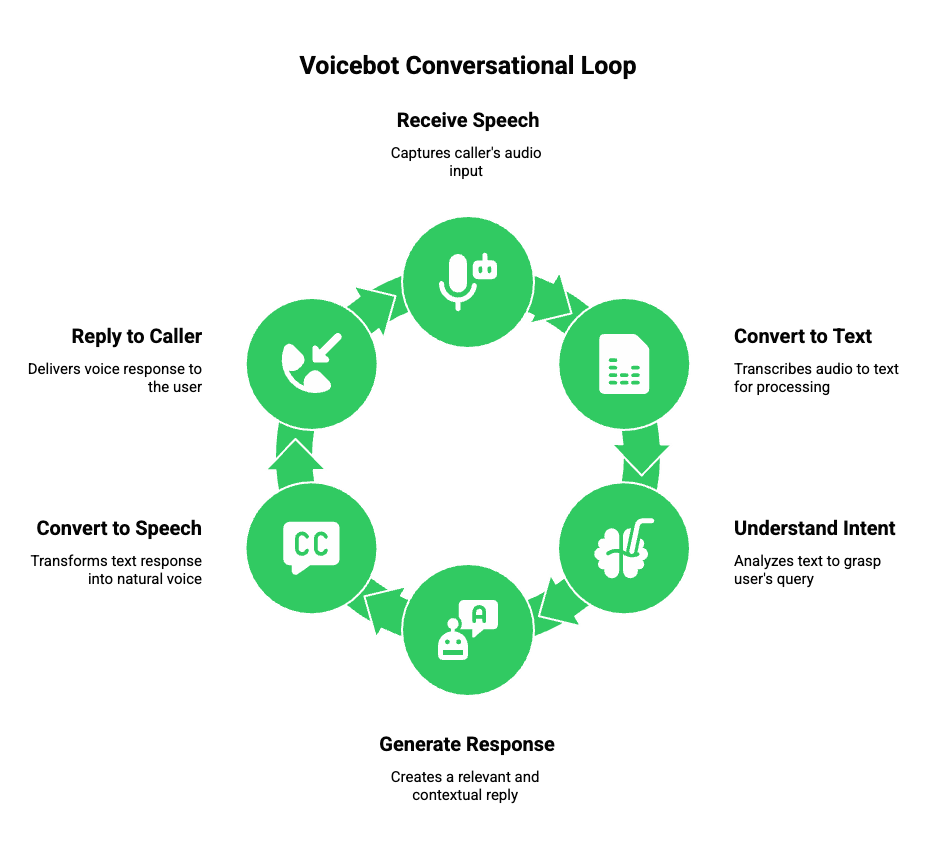
Voicebots are advanced systems that allow human-like conversations over the phone or VoIP channels. Unlike traditional IVRs, modern voicebots leverage structured workflows and AI-based language understanding to process and respond to customer queries.
A typical voicebot includes several integrated components:
- AI Agent / Large Language Model (LLM)
Understands the intent behind the user’s query and generates responses. This forms the brain of the voicebot. - Speech-To-Text (STT)
Converts incoming audio from the caller into text for the AI agent to process. - Text-To-Speech (TTS)
Converts AI-generated responses back into natural voice for the caller. - Retrieval-Augmented Generation (RAG)
Pulls relevant information from knowledge bases, CRM systems, or databases to provide accurate and contextual answers. - Tool Calling Layer
Integrates with backend systems like payment gateways, ticketing platforms, and customer management tools for actionable workflows.
The voicebot functions as a full conversational loop: receiving speech, understanding intent, generating a response, and replying via speech, all in real-time. By maintaining multi-turn conversation context, it can handle follow-up queries without requiring the caller to repeat information.
Technical Flow Overview:
| Step | Component | Function |
| 1 | Caller Audio | Captures user speech in real-time |
| 2 | STT | Converts speech to text |
| 3 | LLM / AI Agent | Interprets intent & generates response |
| 4 | RAG | Pulls contextual information from databases |
| 5 | Tool Calling | Executes necessary backend actions |
| 6 | TTS | Converts text response to voice |
| 7 | Caller Receives Response | Real-time audio delivery with minimal latency |
This architecture ensures low-latency conversations, accurate responses, and scalability to handle hundreds or thousands of simultaneous calls.
Why Should Call Centers Adopt Voicebot Solutions For Automation?
Voicebot solutions address both operational efficiency and customer experience. They reduce the manual workload on agents and optimize call center operations. Some key benefits include:
- Handling High Call Volumes: Voicebots can manage multiple calls concurrently, eliminating bottlenecks during peak hours.
- Reducing Repetitive Tasks: Routine queries such as billing status, order tracking, or appointment scheduling are automated, freeing agents for complex tasks.
- Ensuring Consistency: Every caller receives the same level of service with precise and accurate responses.
- Reducing Operational Costs: Automated handling reduces the need for additional agents while improving resolution speed.
Moreover, modern voicebot solutions are flexible and model-agnostic. They allow organizations to integrate any LLM, connect preferred STT/TTS engines, and implement RAG-based knowledge retrieval. This ensures companies are not locked into a single vendor or AI model.
By implementing voicebots, companies can achieve support efficiency, faster issue resolution, and measurable voicebot cost reduction.
How Do Voicebot Solutions Lighten The Operational Burden On Call Centers?
Voicebots tackle multiple operational challenges by automating and streamlining call workflows. Here’s how:
1. Automated Call Routing And Triage
- Voicebots interpret the caller’s intent before forwarding the call to an agent.
- Reduces misrouted calls and unnecessary escalations.
- Minimizes average handling time (AHT) and improves first-call resolution (FCR).
2. Real-Time Query Resolution
- Common queries like account balance, order status, and payment verification are answered instantly.
- Voicebots access CRM and backend systems in real-time.
- Prevents agents from handling repetitive calls.
3. Outbound Notifications And Reminders
- Voicebots execute large-scale outbound campaigns for payments, appointments, and renewals.
- Personalized interactions using dynamic customer data.
- Enables thousands of simultaneous outbound calls without increasing headcount.
4. Data Capture And CRM Integration
- Transcribes conversations and extracts structured data automatically.
- Updates customer records in real-time.
- Supports analytics for customer behavior, trends, and operational insights.
5. Multi-Lingual And Accent Adaptation
- STT models can recognize multiple languages and accents.
- Expands coverage to global or regional customers.
- Improves customer satisfaction by understanding natural speech patterns.
Example Operational Impact Table:
| Use Case | Before Voicebot | After Voicebot | Reduction / Improvement |
| Average Handling Time | 5 minutes | 2 minutes | 60% |
| Calls Handled per Agent per Day | 60 | 150 | 150% increase |
| Agent Escalations | 30% | 10% | 66% reduction |
| Operational Cost per 1000 Calls | $1,000 | $400 | 60% cost saving |
The result is a streamlined call center workflow where agents focus only on tasks requiring human judgment, while voicebots handle volume, routing, and repetitive interactions.
How Can You Measure The Impact Of Voicebot Solutions On Call Center Performance?
To ensure effective implementation, organizations need to track key performance indicators (KPIs). Some critical metrics include:
- Average Handling Time (AHT): Reduced by automating repetitive tasks.
- First Call Resolution (FCR): Higher because voicebots handle routine queries before escalation.
- Customer Satisfaction (CSAT): Increased by faster response and accurate answers.
- Cost per Call: Lowered due to reduced human intervention.
- Agent Productivity: Freed from repetitive tasks, agents handle complex cases efficiently.
Pro Tip: Combine STT logs with CRM data to evaluate which queries are automated and which require human intervention. This allows iterative improvement of workflows.
By monitoring these metrics, call centers can quantify operational load reduction and demonstrate ROI from voicebot solutions.
What Are The Common Hurdles While Implementing AI Voicebots?
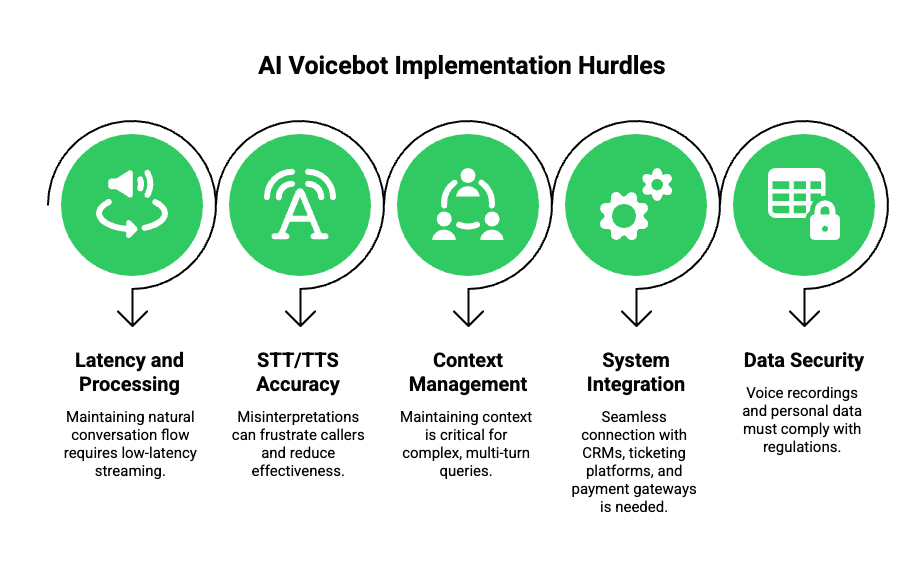
While voicebots bring substantial benefits, deploying them requires careful planning:
- Latency and Real-Time Processing: Low-latency streaming is essential to maintain natural conversation flow.
- Accuracy of STT and TTS Models: Misinterpretations can frustrate callers.
- Context Management: Maintaining multi-turn conversation context is critical for complex queries.
- Integration With Existing Systems: CRMs, ticketing platforms, and payment gateways must be seamlessly connected.
- Data Security and Compliance: Voice recordings and personal data must comply with regulations (PCI, GDPR, etc.).
Addressing these challenges requires a robust voice infrastructure capable of real-time audio streaming, model-agnostic AI integration, and secure system connectivity.
How Can Teler Enable Seamless AI Voicebot Integration?
For many organizations, integrating AI agents into call centers presents multiple technical challenges. This is where FreJun Teler plays a crucial role. Teler is a global voice infrastructure platform that provides a low-latency, real-time voice layer, allowing any LLM or AI agent to interact naturally over phone networks.
Key Technical Advantages of Teler:
- Model-Agnostic Architecture
- Connect any LLM or AI agent.
- Compatible with different TTS and STT engines.
- Allows teams to choose models based on cost, accuracy, or domain expertise.
- Connect any LLM or AI agent.
- Real-Time Media Streaming
- Ensures sub-second latency between user speech and AI response.
- Enables multi-turn conversations without breaks or awkward pauses.
- Ensures sub-second latency between user speech and AI response.
- Stable Conversational Context
- Maintains conversation memory across multiple turns.
- Essential for complex queries, follow-ups, or cross-department routing.
- Maintains conversation memory across multiple turns.
- SDKs for Backend and Client Integration
- Supports web, mobile, and server-side development.
- Facilitates fast integration with CRMs, databases, and enterprise tools.
- Supports web, mobile, and server-side development.
- Enterprise-Grade Security and Reliability
- Geo-distributed infrastructure ensures high availability.
- End-to-end encryption for voice and data.
- Compliance with PCI-DSS and GDPR standards.
- Geo-distributed infrastructure ensures high availability.
Technical Workflow Using Teler:
- Caller initiates an inbound call.
- Teler streams audio in real-time to the AI agent.
- AI agent processes text via STT, consults RAG-enabled knowledge sources.
- Tool calls update CRM, ticketing, or payment systems.
- Response converted to voice via TTS and streamed back to the caller.
- Call logs, transcripts, and analytics automatically recorded for operational insight.
By offloading the voice infrastructure complexity, Teler allows engineering teams to focus on building the AI logic, implementing RAG pipelines, and designing high-value workflows.
What Steps Should Teams Take To Deploy Voicebot Solutions Successfully?
Implementing voicebots requires careful planning to maximize operational load reduction. Here is a structured approach:
1. Identify High-Volume Repetitive Tasks
- Analyze call logs to find queries that consume most agent time.
- Examples: account balance checks, order status, appointment reminders.
2. Choose AI Agent and STT/TTS Models
- Select LLMs based on domain expertise, query complexity, and language requirements.
- Choose STT engines optimized for accent, noise tolerance, and latency.
- Select TTS models that produce natural, human-like voice for better customer experience.
3. Integrate With Teler
- Use Teler API and SDKs for real-time voice streaming.
- Maintain a stable, low-latency connection for inbound and outbound calls.
- Enable context tracking and multi-turn conversation handling.
4. Connect Backend Tools
- Integrate with CRM, ticketing, and other enterprise systems.
- Implement RAG for dynamic responses and knowledge lookup.
- Automate actionable workflows such as payments, ticket creation, or lead qualification.
5. Test and Iterate
- Conduct pilot testing to identify edge cases.
- Optimize conversation flow and AI responses.
- Use metrics like AHT, FCR, and CSAT to measure improvements.
6. Monitor and Improve Continuously
- Collect analytics from Teler’s streaming logs and AI outputs.
- Adjust AI behavior, refine knowledge sources, and retrain models where necessary.
- Expand automation to additional call types gradually.
Where Do Voicebot Solutions Deliver Maximum Operational Savings?
Voicebots reduce operational load most effectively in high-volume and repetitive areas. Common use cases include:
Intelligent Inbound Call Handling
- Voicebots can answer FAQs, verify customer identity, and route complex calls.
- Example: An AI receptionist handles 60% of calls automatically, allowing human agents to focus on escalations.
Outbound Notifications and Campaigns
- Automates appointment reminders, payment alerts, and feedback collection.
- Personalized messages using dynamic customer data.
- Enables thousands of outbound calls simultaneously without increasing staff.
Lead Qualification and Sales Assistance
- Voicebots can screen incoming leads, gather required details, and forward qualified prospects to agents.
- Reduces human time spent on unqualified leads, improving sales team efficiency.
Payment Processing and Verification
- Handles voice-based authentication and PCI-compliant payment operations.
- Reduces errors and ensures compliance without increasing operational load.
Multi-Language and Global Operations
- Voicebots can handle multiple languages and accents via advanced STT models.
- Expands customer coverage and improves support efficiency across regions.
Example Use Case Table:
| Use Case | Operational Impact | Key Benefits |
| Inbound Call Handling | 60% automation | Faster resolution, reduced agent load |
| Outbound Reminders | 2000 calls/day | High personalization, reduced missed appointments |
| Lead Qualification | 50% leads pre-screened | Focused sales efforts, higher conversion |
| Payment Processing | 100% automated verification | Compliance, error reduction |
| Multi-Language Support | 10+ languages | Global coverage, improved CSAT |
How Can Voicebots Reduce Operational Cost While Improving Support Efficiency?
Voicebot solutions impact both cost and efficiency.
- Voicebot Cost Reduction:
- Fewer agents required for repetitive tasks.
- Lower operational costs per call.
- Scalable during peak periods without additional hires.
- Fewer agents required for repetitive tasks.
- Support Efficiency Tools:
- Automated routing and query resolution improve first-call resolution.
- Integration with CRMs and analytics platforms reduces manual data entry.
- Continuous monitoring and AI feedback loops optimize workflows over time.
- Automated routing and query resolution improve first-call resolution.
- Real-World Impact:
- Call centers report up to 60% reduction in AHT.
- Agent workload drops significantly, improving retention and satisfaction.
- Customers receive instant responses, improving CSAT scores.
- Call centers report up to 60% reduction in AHT.
How Will Voicebot Solutions Evolve To Further Reduce Call Center Load?
The future of voice automation focuses on intelligent, proactive, and integrated AI agents:
- Predictive Call Routing: Voicebots identify customer needs in real-time and route calls to specialized agents automatically.
- Advanced Retrieval-Augmented Responses: Combining LLMs with RAG for complex queries reduces escalation.
- Proactive Outreach: Voicebots can notify customers about upcoming events, payments, or issues without waiting for inbound calls.
- Multi-Modal Interfaces: Integration of voice, chat, and visual channels for seamless customer support.
- Continuous Learning: AI models refine themselves with every conversation, improving accuracy and reducing repeated human intervention.
With a robust voice infrastructure like Teler, organizations can implement these advanced capabilities efficiently, scaling operations without additional overhead.
Why Should Modern Call Centers Invest In AI Voicebot Solutions Now?
Voicebots are no longer just an optional automation tool—they are a strategic asset for modern call centers. Key takeaways:
- Operational Load Reduction: Automates repetitive tasks, optimizes agent workload, and reduces call handling time.
- Cost Savings: Lowers operational costs per call while increasing call-handling capacity.
- Support Efficiency Tools: Enhances first-call resolution, improves agent productivity, and boosts customer satisfaction.
- Scalability and Flexibility: Integrates with any AI agent, TTS/STT engine, and backend systems.
- Future-Proofing: Prepares call centers for predictive, multi-lingual, and multi-modal support.
By combining voicebot solutions with a robust voice infrastructure like Teler, organizations can launch sophisticated voice agents quickly, maintain real-time performance, and scale efficiently.
Conclusion
Voicebot solutions are no longer optional, they are essential for reducing operational load, improving efficiency, and ensuring consistent customer experiences. By leveraging a robust voice infrastructure like FreJun Teler, organizations can seamlessly integrate any AI agent, LLM, or TTS/STT model, enabling real-time, low-latency conversations with full contextual awareness. Voicebots handle repetitive queries, automate outbound campaigns, and maintain precise operational tracking, freeing human agents to focus on complex tasks. For founders, product managers, and engineering leads, implementing Teler ensures scalability, security, and measurable cost reductions.
Explore Teler today to transform your voice automation strategy: Schedule a demo
FAQs –
- What is a voicebot?
A voicebot automates call center interactions using AI, STT/TTS, and LLMs, handling queries without human intervention efficiently. - How do voicebots reduce call center workload?
They automate repetitive tasks, route calls intelligently, maintain context, and integrate with CRMs to relieve agent operational load. - Which AI models work best with voicebots?
Any LLM or AI agent can integrate; selection depends on domain expertise, latency requirements, and desired natural language understanding. - Can voicebots handle multi-language calls?
Yes, modern STT/TTS models support multiple languages and accents, enabling global call coverage and improved customer satisfaction. - How fast is voicebot response time?
With low-latency infrastructure like Teler, voicebots process speech, generate AI responses, and deliver audio in milliseconds for natural flow. - Do voicebots integrate with CRM systems?
Absolutely; voicebots connect with CRMs, ticketing, and backend tools for real-time data updates and workflow automation. - What are common implementation challenges?
Challenges include latency, context retention, integration with enterprise systems, STT/TTS accuracy, and secure handling of sensitive data. - Can voicebots manage outbound campaigns?
Yes, they automate reminders, notifications, and surveys at scale, personalizing interactions while reducing agent workload effectively. - How do voicebots improve first-call resolution?
By automating Tier-1 queries and providing contextual, real-time AI responses, voicebots resolve many issues without human escalation. - Are voicebots cost-effective for call centers?
Yes, by reducing average handling time, labor requirements, and repetitive work, voicebots provide measurable operational and financial savings.