
In the world of customer service, feedback is gold. But the traditional methods of collecting it are deeply flawed. The post-call email survey is often ignored, and the “please stay on the line to answer a few questions” prompt is a common trigger for an immediate hang-up.
These methods are reactive, delayed, and they fail to capture the customer’s feelings in the one moment that truly matters: during the live conversation. What if you could get a real-time, unfiltered stream of feedback, not just on what your customers are saying, but how they are saying it? This is the transformative power of a modern voice recognition SDK that is designed for instant audio feedback.
This is not about simple speech-to-text. It is about a new class of conversational feedback AI that can analyze the raw audio stream of a live call to provide a rich, real-time understanding of the caller’s experience.
For a business, this is like gaining a new superpower. It is the ability to move from a post-mortem analysis of customer satisfaction to a live, in-the-moment pulse of the conversation’s health. This technology, enabled by a sophisticated voice recognition SDK, is revolutionizing everything from agent training to AI bot design.
Table of contents
What is the Problem with “After-the-Fact” Feedback?
For decades, the standard for measuring the quality of a customer interaction has been the post-call survey. While this can provide some useful data, it is a fundamentally limited and backward-looking approach.
The Flaws of the Traditional Survey
- It Suffers from “Recency Bias”: The customer’s memory of the call is often colored by the very last thing that happened, not the entire experience.
- It Has a Low Response Rate: A very small and non-representative sample of customers actually take the time to fill out these surveys. You are often only hearing from the very happy or the very angry, not the majority in the middle. A recent survey on customer feedback highlighted this, showing that only about 1 in 26 unhappy customers actually complain, meaning you are missing a huge amount of valuable feedback.
- It Lacks Granular Detail: A numerical rating of “3 out of 5” does not tell you why the customer was only moderately satisfied. It does not pinpoint the specific moment in the conversation where things started to go wrong.
This after-the-fact approach means that by the time you discover there was a problem with a call, it is already too late to fix it for that customer.
Also Read: How Long Does It Take to Go from Prototype to Production While Building Voice Bots?
What is “Instant Caller Feedback” and How Does it Work?
Instant audio feedback is a completely new paradigm. It is the ability to use AI to analyze the live, real-time audio stream of a phone call to extract live caller insights as the conversation is happening. This is made possible by a voice recognition SDK that is designed not just for transcription, but for deep, real-time media analysis.
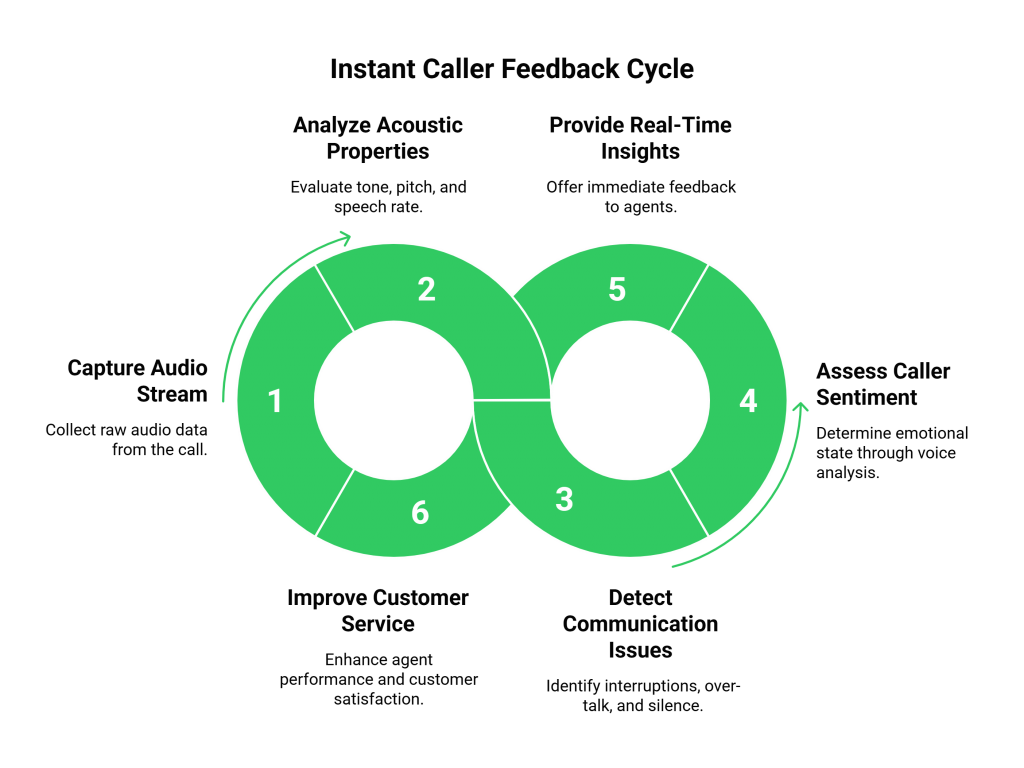
The process is a sophisticated, multi-layered analysis of the voice itself, completely separate from the meaning of the words. It is about analyzing the “music” of the conversation, not just the lyrics.
The Key Components of Conversational Feedback AI
A powerful conversational feedback AI system, built on a modern voice platform, can analyze a number of key acoustic properties in real time:
- Sentiment Analysis: This is the most common feature. The AI analyzes the caller’s tone of voice, pitch, and speech rate to determine their emotional state (e.g., positive, neutral, negative/frustrated).
- Interruption and Over-talk Detection: The system can detect when one party is speaking over the other. A high rate of over-talk is a strong indicator of a communication breakdown and customer frustration.
- Silence Detection: Long, awkward periods of silence on a call can be a sign that an agent is struggling to find information or that a customer is confused.
- Speech Rate and Volume Analysis: A sudden increase in a caller’s speech rate and volume is a very reliable indicator of rising frustration or anger.
This is a technical marvel that requires a specific kind of infrastructure. For this real-time analysis to be possible, the voice recognition SDK must provide raw, low-latency access to the call’s audio stream. This is a core feature of the FreJun AI platform. Our Real-Time Media API is designed to provide this live, unadulterated stream of audio data, which is the essential fuel for any conversational feedback AI.
Ready to start listening to the “music” of your customer conversations? Sign up for FreJun AI
Also Read: How Can Building Voice Bots Improve Customer Experience Across Channels?
What Are the Real-World Applications of This Technology?
The ability to get live caller insights is not just a cool piece of technology; it is a powerful tool that can be used to drive significant business value in two key areas: empowering human agents and improving AI agents.
This table highlights the impact of this technology on both human and AI-powered conversations.
| Application Area | How Instant Feedback is Used | The Business Benefit |
| Human Agent Support (Contact Center) | A real-time dashboard can show a supervisor the “health” of all live calls. If a call’s sentiment score suddenly turns negative, the supervisor can be alerted. | Proactive Intervention: A supervisor can discreetly “whisper” a suggestion to the agent or even join the call to de-escalate the situation before it gets out of hand. |
| AI Voice Bot Performance Tuning | The aggregated feedback data can be used to analyze the performance of an AI voice agent at a massive scale. | Data-Driven AI Improvement: You can pinpoint the exact prompts or parts of your AI’s conversation that are causing user frustration (high rates of over-talk or negative sentiment) and use this data to continuously improve the bot’s script and logic. |
A New Era of Agent Training and Coaching
For a contact center, this technology is a revolutionary training tool. Instead of just reviewing a handful of call recordings after the fact, a supervisor can see exactly which agents are consistently struggling and in what specific situations. This allows for highly targeted, data-driven coaching that is far more effective than traditional methods.
The impact of better training is immense, with one study showing that companies that invest in comprehensive training programs see a 24% higher profit margin on average.
Building a More Empathetic AI Voice Bot
For a developer building voice bots, this is the ultimate feedback loop. You can release a new version of your AI agent and get immediate, real-world data on how users are reacting to it. Are they speaking over a certain prompt? Does the AI’s tone at a certain point cause a negative sentiment spike? This allows for a continuous, iterative process of conversational tone tuning that is based on real, empirical data, not just guesswork.
What Should You Look for in a Voice Recognition SDK for This Purpose?
To enable this kind of sophisticated, real-time analysis, you cannot just use any voice recognition SDK. You need a platform that is specifically designed for low-level media access and real-time processing.
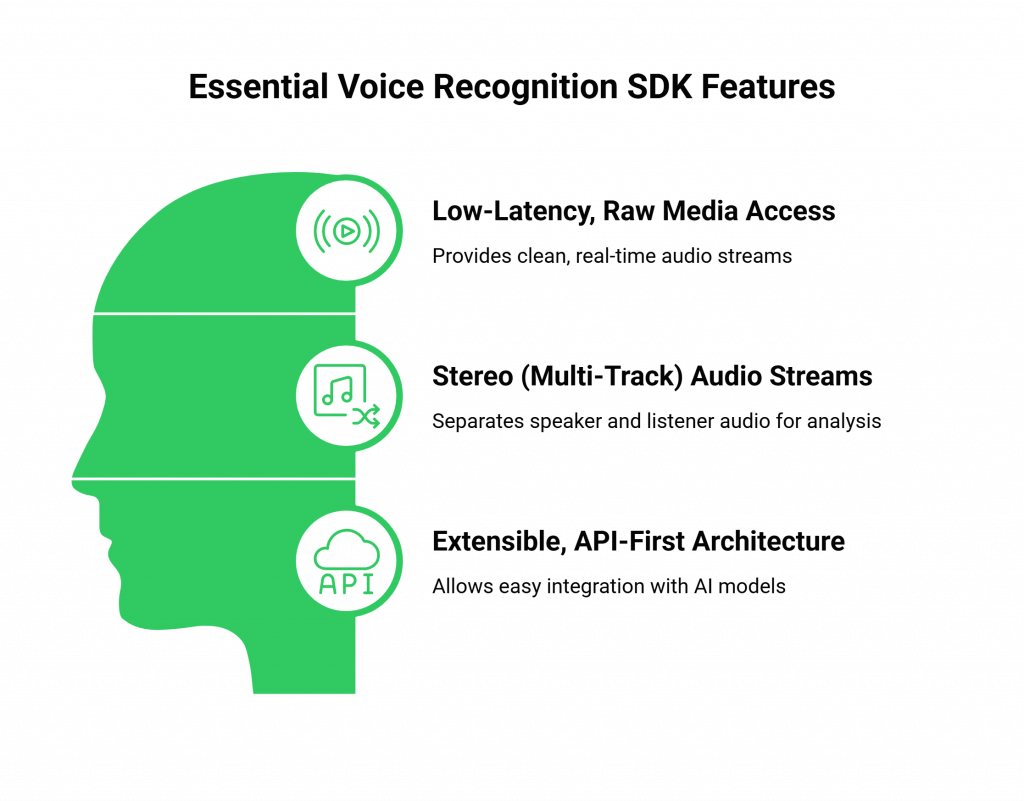
The key features to look for are:
- Low-Latency, Raw Media Access: The SDK must provide a way to get a clean, raw, and low-latency stream of the live call audio. This is a non-negotiable prerequisite.
- Stereo (Multi-Track) Audio Streams: For accurate over-talk and interruption detection, you need to be able to analyze the speaker’s and the listener’s audio streams separately. The SDK should provide the audio as two separate “tracks.”
- An Extensible, API-First Architecture: The SDK should be part of a flexible platform that allows you to easily integrate the real-time audio stream with third-party or in-house AI models for sentiment analysis or other analytics.
Also Read: What Monetization Strategies Work After Building Voice Bots for Businesses?
Conclusion
The future of customer experience is real time. The old model of waiting for complaints or surveys is fading. A new and proactive paradigm now focuses on listening and understanding the customer as they speak. A modern voice recognition SDK makes this possible. Its instant audio feedback capabilities enable this major transformation.
By providing live caller insights that are rich and granular, this technology empowers businesses in real time. It gives teams unmatched ability to improve human agent performance. It also enables the creation of more intelligent, empathetic, and effective AI voice agents. This technology unlocks deeper understanding of customer conversations. It helps companies deliver a truly exceptional service experience.
Want to do a technical deep dive into our Real-Time Media APIs and see how you can use our platform to build your own conversational feedback AI? Schedule a demo for FreJun Teler.
Also Read: UK Mobile Code Guide for International Callers
Frequently Asked Questions (FAQs)
A voice recognition SDK (Software Development Kit) is a set of software tools that allows developers to integrate voice processing capabilities into their applications.
Instant audio feedback is generated in real-time during the live conversation by an AI that analyzes the speaker’s tone of voice.
Conversational feedback AI is a special type of artificial intelligence. It analyzes the acoustic properties of a live conversation and provides insights into conversation quality and the emotional state of participants. It does this without needing to understand the actual meaning of the words.
Yes. Through a process called sentiment analysis, the AI can analyze acoustic features like pitch, volume, and speech rate in the audio stream.
To get live caller insights, you need a voice recognition SDK that provides a real-time media streaming feature.
Absolutely. This is one of the most powerful use cases. By analyzing how real users react to your AI voice bot on a large scale, you can identify the exact points in the conversation.
It is the ability of the AI to detect when two parties on a call are speaking at the same time. A high amount of over-talk is a strong indicator of a poor-quality conversation where the parties are not understanding each other.
FreJun AI provides the foundational, low-latency voice infrastructure and the powerful voice recognition SDK with Real-Time Media APIs.