
In the early days of voice technology, the choice of a voice recognition SDK was a simple, one-dimensional decision. You picked a provider, you integrated their black box, and you were locked into their ecosystem, for better or for worse. The SDK was a rigid tool with a single function: to turn speech into text. But the world of software development has changed, and the world of artificial intelligence has changed even more profoundly.
Today’s developers are not just building simple voice commands; they are architecting complex, mission-critical, and highly specialized conversational AI systems. In this new landscape, the old, one-size-fits-all approach is no longer just inconvenient; it is a direct barrier to innovation.
The modern developer’s mantra is one of flexibility, control, and ownership. They are being asked to build voice experiences that are faster, more accurate, and more context-aware than ever before. To meet these demands, they are increasingly rejecting the closed, proprietary “walled gardens” of the past in favor of a new breed of open, flexible, and model-agnostic voice platforms.
This is not just a passing trend; it is a fundamental shift in how developers think about their technology stack. This article will explore the key drivers behind this shift and explain why a flexible voice API is no longer a “nice-to-have” feature, but the single most important characteristic of a modern voice recognition SDK.
Table of contents
The Old Model: The “Walled Garden” SDK
To understand the new paradigm, we must first recognize the limitations of the old one. The first generation of voice platforms, and many that still exist today, were built as monolithic, “all-in-one” solutions.
The All-in-One Proposition
The pitch was simple: “Use our SDK, and we will handle everything for you.” This meant that the provider offered a single, vertically integrated package that included:
- The voice connectivity (the telephony).
- The Speech-to-Text (STT) engine.
- Often, their own proprietary Natural Language Understanding (NLU) or bot-building framework.
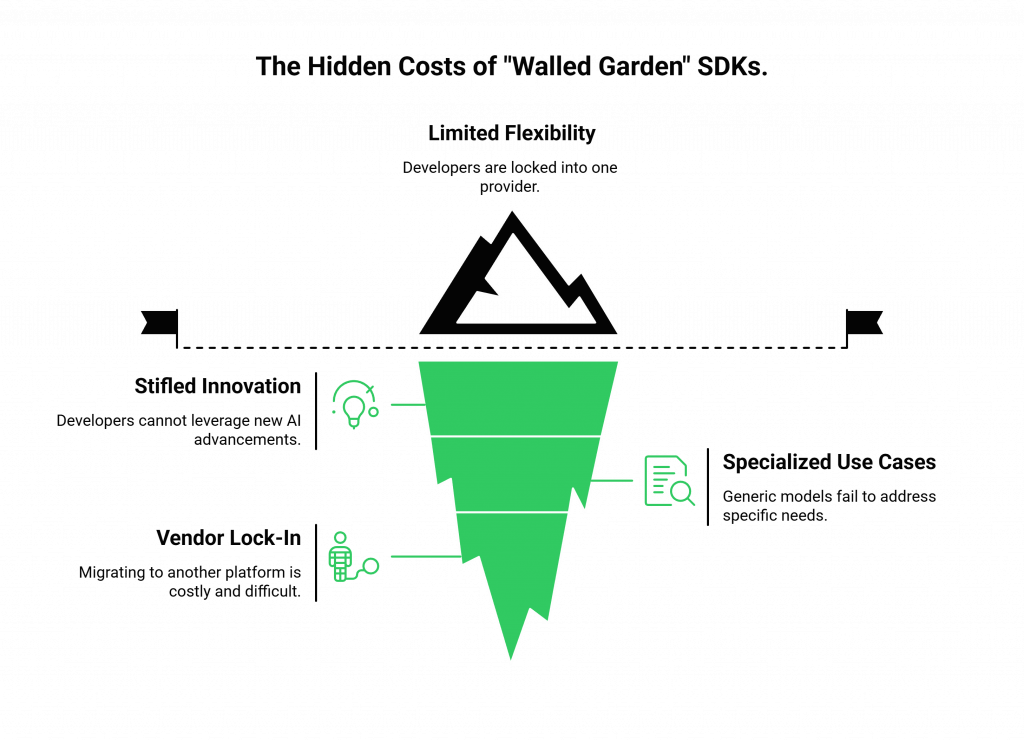
While this seemed simple on the surface, it came with a massive, hidden cost: a complete loss of flexibility and control. You were locked into their STT engine, their NLU, and their way of doing things.
Why This Model is Failing the Modern Developer
This “walled garden” approach is fundamentally at odds with the needs of a modern development team.
- It Stifles Innovation: The world of AI is moving at a breathtaking pace. A new, more accurate or cost-effective STT model may launch tomorrow. Lock-in prevents adoption and forces you to wait for provider updates.
- It Fails to Address Specialized Use Cases: A generic, one-size-fits-all STT model is a master of none. An STT model that is great at transcribing casual conversations may be terrible at understanding the complex medical terminology in a doctor’s dictation. A model that works well in a quiet room may fail completely in a noisy warehouse. The “walled garden” model rarely gives you the option to use a specialized, fine-tuned model for your specific needs.
- It Creates Vendor Lock-In: Once you have built your entire application’s logic on a provider’s proprietary NLU framework, migrating to another platform is a massive and costly undertaking. This lack of portability is a major strategic risk for any business.
Also Read: Top Use Cases Of Media Streaming In Customer Communication Platforms
The New Paradigm: The Power of a Flexible, Model-Agnostic SDK
The modern developer is demanding a new kind of voice recognition SDK, one that is built on a philosophy of openness, flexibility, and modularity. This is the model-agnostic approach.
FreJun AI provides a flexible, model-agnostic SDK that connects your app to global voice networks and delivers real-time audio streams.
This decoupled architecture provides a level of freedom and control that is simply impossible in a walled garden. A recent survey on enterprise AI adoption found that over 70% of organizations are using a multi-cloud or hybrid-cloud strategy, a clear indicator that businesses are prioritizing flexibility and avoiding vendor lock-in. A model-agnostic voice platform is the communications equivalent of this modern IT strategy.
What Does “Model-Agnostic” Mean in Practice?
It means that the voice infrastructure is completely decoupled from the AI models. The job of the voice recognition SDK is to provide you with the raw, real-time audio stream of the call. What you do with that stream is entirely your choice. You can send it to:
- Google’s STT API for its broad language support.
- AssemblyAI’s API for its powerful summarization and diarization features.
- A specialized provider like Deepgram for its speed.
- A custom, in-house model that you have trained on your own proprietary data.
This is the essence of a truly flexible voice API.
This voice toolkit comparison table illustrates the strategic differences.
| Feature | “Walled Garden” SDK | Flexible, Model-Agnostic Voice Recognition SDK |
| STT Engine | Locked into the provider’s single, proprietary model. | Bring Your Own Model (BYOM); choose the best STT for your specific use case. |
| Flexibility | Low; you are stuck with their feature set and roadmap. | High; you can instantly adopt new AI innovations from any vendor. |
| Specialization | Poor; a generic model struggles with niche domains. | Excellent; you can use a model that is fine-tuned for your industry (e.g., medical, finance). |
| Vendor Lock-In | High; migrating your application’s logic is very difficult. | Low; because the voice and AI are decoupled, you can switch providers easily. |
| Future-Proofing | Poor; you are dependent on one company’s rate of innovation. | Excellent; your application is ready for the customizable STT 2026 landscape. |
Ready to experience the freedom and power of a truly flexible voice platform? Sign up for FreJun AI
Also Read: Optimizing Media Streaming Performance For High-Quality Voice AI Experiences
Why is a Developer-Friendly SDK the Key to Unlocking This Flexibility?
Having a flexible architecture is one thing. Making that flexibility accessible and easy for a developer to use is another. A truly developer friendly SDK is the key that unlocks the full potential of a model-agnostic platform. A great SDK provides:
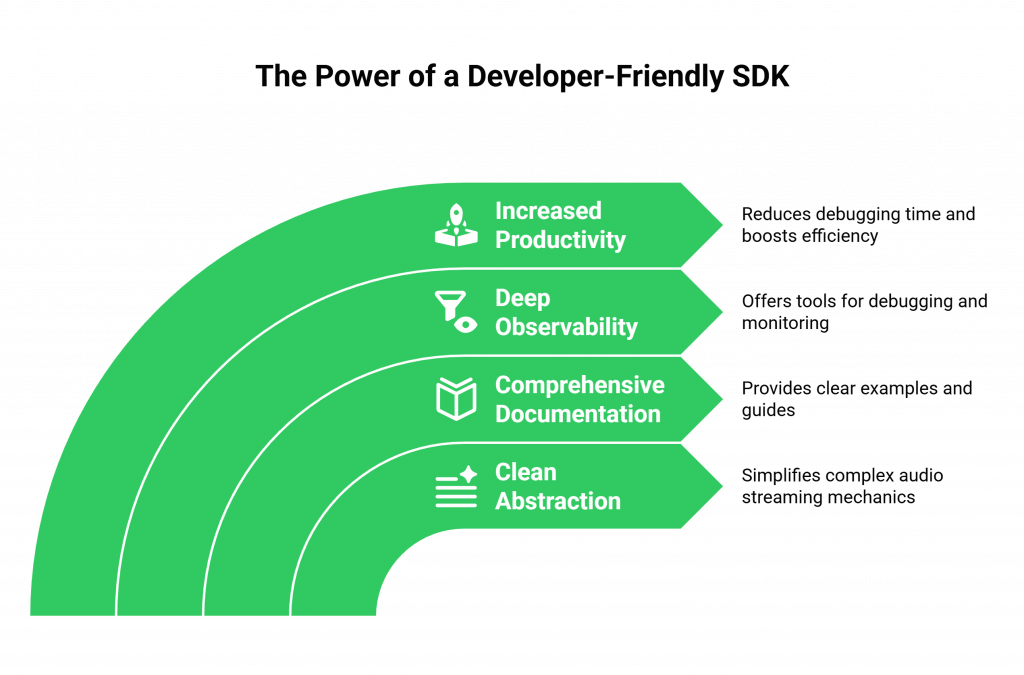
- A Clean Abstraction: It handles the complex, low-level mechanics of real-time audio streaming (like handling RTP packets and websockets) and presents it to the developer as a simple, easy-to-use interface.
- Comprehensive Documentation and Examples: It provides clear, practical examples of how to integrate with a variety of popular, third-party STT providers. A developer should be able to get their first “hello world” transcription from their preferred STT engine in a matter of minutes.
- Deep Observability and Debugging Tools: When things go wrong, the developer needs to be able to see what is happening. The SDK and its platform must provide detailed logs on the media stream itself, allowing the developer to quickly diagnose whether a problem is in their code, the STT provider’s API, or the underlying voice network.
A recent study on developer productivity found that developers spend, on average, over 17 hours a week debugging code, and a lack of observability is a major contributor to this.
Also Read: Media Streaming For AI: The Future Of Interactive Voice Experiences
Conclusion
The era of the one-size-fits-all, “walled garden” voice recognition SDK is over. The demands of modern AI development and the rapid pace of innovation have made flexibility, control, and openness the new, non-negotiable requirements. Today’s developers are choosing platforms that empower them, not restrict them. They are choosing a flexible voice API that allows them to build a best-in-class, specialized, and future-proof AI stack.
By embracing a model-agnostic approach and providing a truly developer friendly SDK, platforms like FreJun AI are not just providing a service; they are providing the foundational toolkit for the next generation of voice innovation.
Want to do a technical deep dive into how our SDK makes it easy to integrate with your preferred STT provider? Schedule a demo for FreJun Teler.
Also Read: UK Phone Number Formats for UAE Businesses
Frequently Asked Questions (FAQs)
A voice recognition SDK (Software Development Kit) is a set of software libraries and tools that allows a developer to integrate voice recognition (Speech-to-Text) capabilities into their own applications. It handles the capturing and streaming of audio to a recognition engine.
A model-agnostic SDK is one that is decoupled from the actual Speech-to-Text (STT) engine. It provides the developer with the raw audio stream and allows them to send it to any STT provider they choose (e.g., Google, AssemblyAI, or their own custom model).
A flexible voice API is better because it provides freedom and prevents vendor lock-in. It allows you to choose the absolute best STT model for your specific use case (e.g., a model trained for medical terminology) and to easily switch to a new, better model in the future without rebuilding your entire application.
A developer friendly SDK should have clean and thorough documentation, practical code examples for common use cases, robust error handling, and deep observability tools for debugging. It should make the process of troubleshooting voice integrations as simple as possible.
A voice toolkit comparison for a developer will focus on technical aspects like the quality of the API design, the performance (latency), the flexibility (is it model-agnostic?), and the quality of the documentation and SDKs. A business user might focus more on the overall cost and the pre-built features.
The world of AI is moving incredibly fast. The best STT model in 2026 will likely be far more advanced than today’s. A flexible, model-agnostic platform ensures that your application can easily adopt these future innovations, making it a future-proof investment.
The FreJun AI voice recognition SDK is built on our model-agnostic philosophy. Our core job is to provide you with a high-quality, low-latency, real-time audio stream via our APIs. We give you the raw material and the complete freedom to connect it to any AI “brain” you choose.
It can mean slightly more initial setup, as you have to manage your relationship with your chosen STT provider. However, the long-term benefits of flexibility, improved accuracy, and the ability to innovate far outweigh this. A good SDK will provide examples that make this integration straightforward.
It gives you much greater control over your costs. You can “shop around” for the STT provider that offers the best balance of price and performance for your specific needs. In a “walled garden,” you are stuck with whatever price your platform provider dictates.