
The promise of voice automation is undeniably compelling: a world of 24/7 customer service, massive operational efficiency, and a truly modern customer experience. But for a business leader, the journey from a compelling vision to a signed-off project runs directly through one critical question: “What is the return on this investment?” Unlike many other technology projects, the ROI of building voice bots is not a vague, long-term aspiration; it is a concrete, quantifiable, and, most importantly, predictable outcome.
For too long, the adoption of AI has been treated as a leap of faith. But a production-grade voice automation project is not a speculative experiment; it is a strategic business decision that can and should be underpinned by a solid financial model.
By using a clear framework for voice automation cost modeling and efficiency gain estimation, any business can move from hopeful guesswork to a data-driven ROI prediction. This article will provide a practical, step-by-step guide to forecasting the financial impact of your voice bot initiative before you write a single line of code.
Table of contents
Why is a Pre-Build ROI Calculation So Critical?
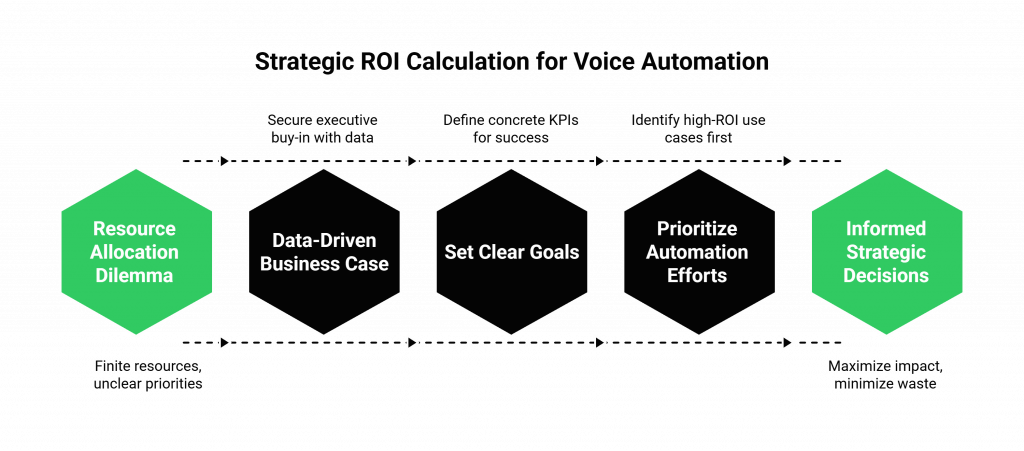
In the world of business, resources are finite. Every dollar and every developer hour spent on one project is a dollar and an hour not spent on another. A pre-build ROI calculation is the essential tool that allows business leaders to make informed, strategic decisions.
The Importance of a Data-Driven Business Case
- Securing Executive Buy-In: A well-researched conversational ai roi calculator transforms your proposal from a “cool technology project” into a “smart financial investment.” A clear projection of cost savings and efficiency gains is the language that C-suite executives understand and respect.
- Setting Clear Goals and KPIs: The process of building the ROI model forces you to define what success looks like. It moves you from a vague goal of “improving customer service” to a concrete KPI like “reduce average call handling time by 45 seconds” or “deflect 30% of all inbound billing inquiries.”
- Prioritizing Your Automation Efforts: You likely have dozens of potential use cases for voice automation. A solid kpi prediction frameworks approach allows you to identify the “low-hanging fruit”, the use cases that will deliver the highest and fastest return on investment, so you can prioritize your development efforts for maximum impact.
Also Read: How Developers Use Voice Calling SDKs to Power AI-Driven Conversations?
How Do You Build the ROI Model? A Four-Step Framework
A credible ROI prediction is built on a simple equation: the financial gains from the automation minus the total cost of the project. The key is to be rigorous and data-driven in how you calculate each side of this equation.
Step 1: Calculate Your “Cost Side” – The Total Investment
This is the most straightforward part of the model. Your total cost will be a combination of one-time setup costs and ongoing operational costs.
- Development and Implementation Costs: This includes the hours your development team will spend building voice bots, integrating them with your backend systems, and testing. If you are working with an external partner, this would be their project fee.
- Platform and Infrastructure Costs: This is the ongoing cost of the voice communication platform itself. With a modern, API-first provider like FreJun AI, this is typically a transparent, pay-as-you-go cost based on your actual usage (e.g., per-minute of call time).
- AI Model Costs: This is the cost of using the underlying AI models (STT, LLM, TTS) from providers like OpenAI, Google, or Anthropic. This is also a usage-based cost.
- Maintenance and Optimization Costs: Budget a small, ongoing amount of time for your team to monitor the bot’s performance, analyze its conversations, and make continuous improvements.
Step 2: Calculate Your “Gains Side” – The Efficiency Gains
This is where the real power of the model lies. The gains from voice automation are primarily driven by a massive increase in operational efficiency, which can be directly translated into cost savings.
The core of this calculation is a process of cost-per-call forecasting.
- Determine Your Current “Cost Per Call” for a Human Agent: This is your baseline. This number is more than just the agent’s salary. It is the “fully loaded” cost, which includes their salary, benefits, training, the cost of their equipment, and a portion of the contact center’s overhead.
- Identify Your Target Automation Use Cases: Analyze your current inbound call data. What are the top 3-5 most frequent, repetitive, and simple reasons that customers call? These are your prime candidates for automation (e.g., “What is my account balance?”, “I need to make a payment,” “Where is my order?”).
- Estimate Your “Call Deflection” Rate: Based on your call data, estimate what percentage of your total inbound calls fall into these automatable categories. A conservative starting point is often between 20-40%.
- Calculate Your Direct Cost Savings: The calculation is simple: (Total Monthly Calls) x (Estimated Deflection Rate) x (Cost Per Human Call) = Gross Monthly Savings from Deflection.
This efficiency gain estimation is the single biggest contributor to your ROI. This table provides a simple example of this calculation:
| Metric | Your Data |
| Total Monthly Inbound Calls | 20,000 |
| Fully Loaded Cost Per Human Call | $8.00 |
| Identified Automatable Call Volume | 35% |
Ready to build a voice bot with a clear and compelling ROI? Sign up for FreJun AI!
Also Read: Voice Calling SDK vs Voice API: What’s the Real Difference for Developers?
Step 3: Factor in the “Soft” ROI – The Intangible Benefits
While the direct cost savings from call deflection are the easiest to calculate, they are not the only benefits. These “soft” benefits are harder to quantify but are often just as important to the overall business case.
- Improved Customer Satisfaction (CSAT): By providing 24/7, instant, self-service options, you are eliminating wait times and giving customers the convenience they crave. While you can’t put a direct dollar value on this, it is a major driver of customer loyalty and retention.
- Increased Employee Satisfaction and Reduced Agent Churn: By automating the most monotonous and repetitive calls, you are making the job of your human agents more interesting and engaging. This leads to higher job satisfaction and can significantly reduce the high costs associated with agent turnover.
- Enhanced Data and Business Intelligence: Every conversation with your AI voice bot is a source of clean, structured data about your customers’ needs and pain points. This data is a goldmine for improving your products and services.
Step 4: Put It All Together – The Final ROI Calculation
You now have all the pieces to complete your conversational AI ROI calculator.
- Payback Period: (Total Initial Investment) / (Net Monthly Savings) = Number of months to recoup your investment.
- Annual ROI: ((Total Annual Savings – Total Annual Costs) / Total Annual Costs) * 100 = Your annual ROI percentage.
A payback period of less than 12 months and an annual ROI of over 100% are very common and achievable for a well-planned voice automation project.
How Can FreJun AI Help You Build a High-ROI Voice Bot?
The final, critical factor in your ROI calculation is the platform you choose to build on. The platform’s pricing, flexibility, and ease of use will have a direct impact on both your “cost side” and your “gains side.” The FreJun AI platform is designed to maximize your ROI:
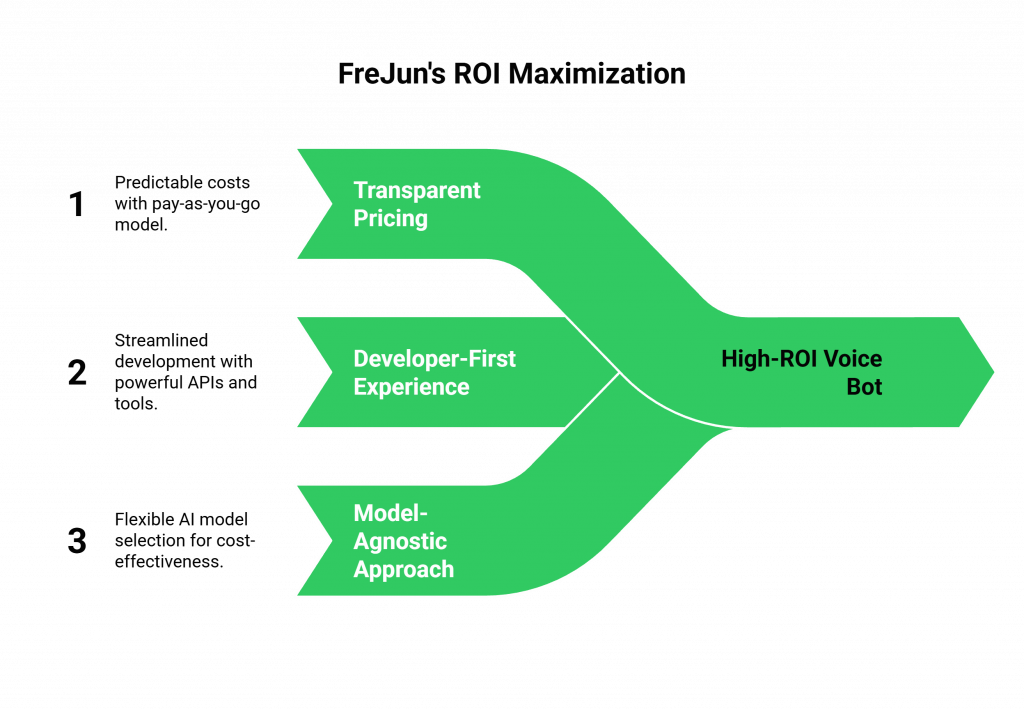
- A Transparent, Pay-as-You-Go Model: Our pricing is simple and usage-based. This makes your cost-per-call forecasting easy and ensures that your costs scale directly with your usage. There are no large, upfront licensing fees or complex contracts.
- A Developer-First Experience: Our powerful APIs and developer tools dramatically reduce the time and effort required for building voice bots. A faster, more efficient development process directly lowers your initial investment cost.
- A Model-Agnostic Approach: We give you the freedom to choose the most cost-effective and best-performing AI models for your specific use case, ensuring you are not locked into an expensive, proprietary AI stack.
Also Read: Top 10 Features Every Modern Voice Calling SDK Should Have in 2026
Conclusion
Building voice bots is no longer a speculative foray into a futuristic technology; it is a mature, proven, and financially sound strategy for transforming business communications. By moving beyond a vague sense of “it would be cool to have an AI” and embracing a rigorous, data-driven approach to ROI prediction, business leaders can make their investment with confidence.
By systematically calculating your costs, using KPI prediction frameworks to estimate your efficiency gains, and factoring in the powerful soft benefits, you can build a business case for voice automation that is not just compelling, but undeniable. The tools and the frameworks are here. The only remaining question is how much value you are ready to unlock.
Want a personalized consultation to help you build an ROI model for your specific use case? Schedule a demo for FreJun Teler.
Also Read: Leveraging Cloud Telephony Analytics: Call Metrics and Performance Insights
Frequently Asked Questions (FAQs)
The most important first step is to analyze your current call center data. You need to understand your total call volume, your current cost per call, and the most common reasons why your customers are calling. This data is the foundation of your entire voice automation cost modeling.
To calculate this, first sum all monthly contact center costs, including agent salaries, benefits, supervisor pay, software, and facilities. Then divide that total by the number of calls handled by human agents that month.
This is the percentage of your total inbound calls that you predict your voice bot will be able to handle from start to finish without needing to escalate to a human. This is a key variable in any conversational ai roi calculator.
The best initial use cases are high-volume, low-complexity, and highly repetitive. This often includes things like order status inquiries (“Where is my order?”), simple payment processing, and basic account balance questions.
Though harder to dollarize, measure impact using NPS or CSAT by comparing bot interactions to human-agent interactions.
A KPI prediction framework forecasts a technology’s impact on metrics like AHT, FCR, and Call Deflection Rate for a voice bot.
To forecast bot call costs, sum per-minute voice/STT charges, per-token LLM costs, and per-character TTS costs; a modern platform can assist.