
You have just launched your first AI voice bot. It is a technical marvel, a sophisticated assembly of Speech-to-Text, Large Language Models, and Text-to-Speech engines, all working in sub-second harmony. You have run your tests, and it seems to work perfectly.
But the moment it takes its first real call from a real customer, a flood of critical questions emerges. Are customers happy with the experience? Where in the conversation are they getting stuck? What are they asking that you did not anticipate? Are they frustrated? Answering these questions is the difference between a bot that is merely functional and one that is truly exceptional. The key to finding these answers is conversation analytics.
When it comes to building voice bots, the launch is not the finish line; it is the starting line. The process of creating a great conversational AI is not a one-time build, but a continuous cycle of listening, learning, and iterating.
Conversation analytics is the powerful engine that drives this cycle. It is the practice of transforming the raw, unstructured data of a phone call into a rich, structured set of insights that can be used to make your voice bot smarter, more empathetic, and more effective. This is where analytics-driven improvements become the cornerstone of your entire voice AI strategy.
Table of contents
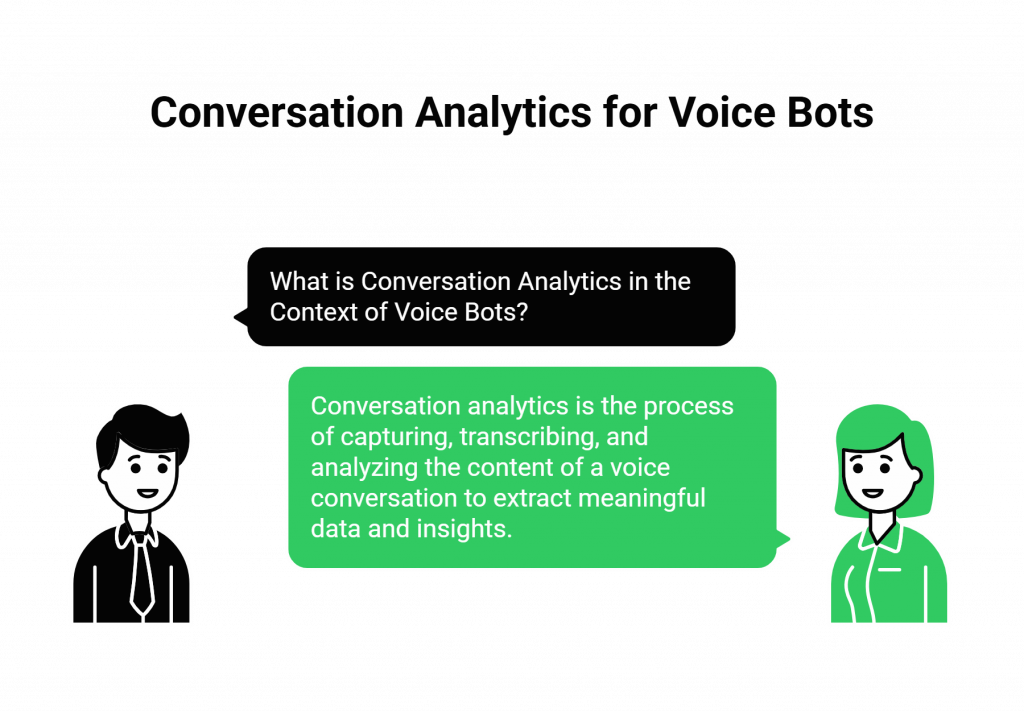
What is Conversation Analytics in the Context of Voice Bots?
Conversation analytics is the process of capturing, transcribing, and analyzing the content of a voice conversation to extract meaningful data and insights. For a voice bot, this is not just about getting a simple transcript; it is about a deep, multi-layered analysis of both what was said and how it was said.
A comprehensive conversation analytics platform provides a suite of powerful tools to dissect every interaction:
- Accurate Transcription: The foundation of all analysis is a highly accurate, speaker-diarized transcript of the call. This is the raw material for call transcript mining.
- Intent and Entity Recognition: The system can identify the primary purpose of the call (intent detection metrics) and can extract key pieces of information (entities) like names, order numbers, or locations.
- Sentiment Analysis: The AI can analyze the words used and, more importantly, the tone of voice, to gauge the customer’s emotional state throughout the call. This provides powerful sentiment analytics for calls.
- Topic Modeling: The system can automatically identify the key topics and themes that are being discussed across thousands of calls.
Also Read: 5 Common Mistakes Developers Make When Using Voice Calling SDKs
How Do These Analytics Drive a Better Voice Bot Experience?
The insights gleaned from conversation analytics are not just interesting data points; they are a direct and actionable roadmap for analytics-driven improvements. They provide a continuous feedback loop that allows you to iterate on and enhance every aspect of your voice bot.
By Identifying and Fixing Conversational Breakdowns
This is the most immediate and impactful use of conversation analytics. By analyzing calls, you can pinpoint the exact moments where your bot is failing.
- The “I’m Sorry, I Didn’t Understand” Problem: By using call transcript mining, you can create a report of every time your bot said a phrase like “I didn’t get that.” This is a goldmine. It shows you exactly what your customers are asking that your bot’s LLM is not trained to handle. You can then use these real-world utterances to retrain and improve your AI’s understanding.
- Identifying Loops and Dead Ends: Analytics can reveal where customers are getting stuck in a repetitive conversational loop. This is a clear signal that a part of your bot’s conversational design is confusing or that an escalation path is needed.
By Understanding the True “Voice of the Customer”
Your voice bot’s calls are a massive, untapped source of raw, unfiltered customer feedback.
- Discovering Unmet Needs: Topic modeling can reveal that a large number of customers are calling to ask about a feature that your product does not have, or a service that your company does not offer. These post-call conversational insights are an invaluable source of ideas for your product and marketing teams.
- Gauging Customer Emotion: Sentiment analytics for calls can give you a powerful, high-level view of customer satisfaction. You can track your average sentiment score over time and can even get alerts for calls with an unusually high level of negative sentiment, allowing a human manager to proactively review the interaction and reach out to the customer.
Also Read: Best Practices for Testing and Debugging Voice Calling SDK Integrations
By Measuring and Optimizing Key Performance Indicators (KPIs)
When building voice bots, you need to be able to measure their success. Conversation analytics provides the data to track the intent detection metrics that truly matter.
This table shows some of the key metrics that analytics can provide and the improvements they drive.
| Metric | What It Measures | How It Drives Improvement |
| Containment Rate | The percentage of calls that are fully resolved by the bot without needing to be escalated to a human. | This is a primary measure of the bot’s effectiveness and ROI. The goal is to increase this over time by improving the bot’s capabilities. |
| Average Handle Time | The average duration of a call with the bot. | A decreasing handle time can indicate that your bot’s conversational flow is becoming more efficient and streamlined. |
| Intent Recognition Accuracy | The percentage of times the bot correctly identifies the user’s reason for calling on the first try. | A low score here is a clear signal that your LLM’s training data needs to be improved with more real-world examples. |
| Sentiment Score | The average positive, negative, or neutral sentiment of the calls. | Tracking this over time gives you a high-level view of customer satisfaction with the automated experience. |
| Escalation Rate | The percentage of calls that are transferred to a human agent. | Analyzing the transcripts of escalated calls tells you exactly what the bot is currently unable to handle. |
Ready to start building a voice bot that gets smarter with every call it takes? Sign up for FreJun AI and explore how our platform enables deep conversational insights.
What is the Technical Foundation for Capturing These Analytics?
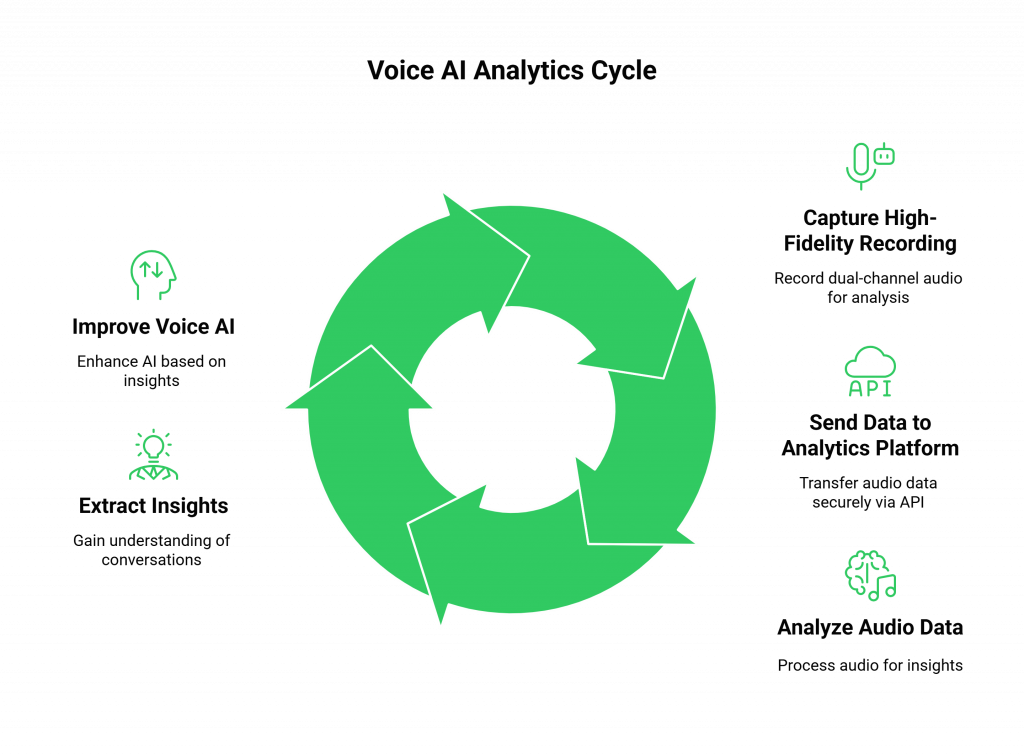
To perform this kind of deep analysis, you first need to capture a high-fidelity recording of the conversation. This is a core feature of a modern voice platform like FreJun AI.
The Role of Dual-Channel Recording
The key to accurate analysis, especially for speaker diarization (knowing who said what) and sentiment analysis, is a dual-channel recording. This means the audio from the caller (the “customer leg”) and the audio from your AI agent (the “bot leg”) are recorded as separate tracks. A platform like FreJun AI can be easily configured to provide this dual-channel recording for every call.
Also Read: How a Voice Calling SDK Can Improve Customer Experience in AI Voice Agents?
The Integration with Analytics Platforms
The FreJun AI platform is designed to be a flexible, open data source. The call recordings can be automatically and securely sent to a dedicated conversation analytics platform (like a third-party AI service or your own internal data lake) via an API.
Our job is to provide the pristine, raw audio data. Your job is to choose the “brain” that will analyze it. This is a core part of our philosophy: “We handle the complex voice infrastructure so you can focus on building your AI.”
Conclusion
Building voice bots is not a “set it and forget it” endeavor. A voice bot that is not learning is a voice bot that is failing. The process of creating a truly great conversational experience is a continuous journey of improvement, and conversation analytics is the compass that guides that journey.
By systematically capturing, analyzing, and acting on the rich data contained in every call, you can move beyond simply building a functional bot and start crafting an intelligent, empathetic, and constantly evolving conversational partner.
The post-call conversational insights are not just a report; they are the voice of your customer, telling you exactly how to make your service better. Listening to that voice is the key to success.
Want to do a technical deep dive into how our platform can provide the dual-channel recordings and data hooks you need to power your conversation analytics strategy? Schedule a demo with our team at FreJun Teler.
Also Read: The Future of Cloud Telephony: Trends, AI, and Unified Messaging (2026 Edition)
Frequently Asked Questions (FAQs)
It is the process of analyzing the content and metadata of a voice bot’s conversations to extract actionable insights. This includes transcribing the calls, identifying the customer’s intent and sentiment, and tracking key performance metrics to drive analytics-driven improvements.
The most important piece of raw data is a high-quality, dual-channel recording of the call. This separates the caller’s audio from the bot’s audio, which is essential for accurate transcription and analysis.
Sentiment analytics for calls use AI to analyze both the words a customer speaks (such as ‘I’m very frustrated’) and their tone of voice (such as high pitch and rapid speech) to assign a positive, negative, or neutral sentiment score to the conversation.
Intent detection metrics measure how accurately and quickly your voice bot can identify the customer’s reason for calling. A low accuracy score is a clear sign that the bot’s AI model needs to be retrained with more diverse examples.
Call transcript mining is the process of searching and analyzing all of your call transcripts. You can use it to find every call where the bot said “I don’t understand,” which will give you a list of the exact queries your bot is currently failing to handle, providing a perfect roadmap for improvement.