
For a modern software developer, the world is a symphony of APIs. You can orchestrate a global payment network, spin up a fleet of servers, or send a million emails, all with a few lines of code. The digital world is your oyster.
But when your application needs to touch the oldest, most ubiquitous communication network on the planet, the telephone system, you often hit a wall of archaic protocols and rigid configurations. For decades, SIP (Session Initiation Protocol) was a part of this closed world, a powerful but intimidating protocol managed by telecom engineers, not software developers. That era is over.
The advent of programmable SIP has shattered this old paradigm, transforming the global voice network into just another API-driven service, ready to be integrated into the next generation of voice first applications.
This is not just an incremental update; it is a fundamental re-imagining of what a voice network can be. It is the application of a modern, developer-first philosophy to a century-old technology.
For a developer, this is the blueprint you have been waiting for. It is the key to unlocking the full potential of voice, allowing you to build the kind of intelligent, scalable, and deeply integrated communication experiences that will define the sip for voice first world. This guide provides a developer’s blueprint for understanding what programmable SIP is and how to wield it.
Table of contents
- What Was the “Old World” of SIP? (The Static Configuration Era)
- What Exactly Makes SIP “Programmable”? (The API-Driven Revolution)
- What is the Architectural Blueprint for a Programmable SIP Application?
- What Kind of Voice-First Applications Does This Blueprint Enable?
- Conclusion
- Frequently Asked Questions (FAQs)
What Was the “Old World” of SIP? (The Static Configuration Era)
To understand what makes SIP programmable, we must first examine its traditional implementation. The first wave of SIP trunking revolutionized voice connectivity, but it solved an IT administrator’s problem by replacing expensive physical PRI lines with a more cost-effective, IP-based connection to a hardware PBX.
In this model, the SIP trunk was a “black box” configured through a web portal.
- Static and Declarative: You would log in to a GUI and declare a set of static rules. “When a call comes in on this number, forward it to this specific IP address (our PBX).”
- The Media Was Hidden: The SIP provider’s job ended at delivering the call to your PBX. The raw audio stream (the media) was then handled entirely within your private, on-premise hardware, making it incredibly difficult for your other software applications to access.
- No Real-Time Control: The entire workflow was pre-configured. There was no way for your application to dynamically change the call’s routing or behavior while it was in progress.
For a developer, this was a dead end. It was a system you could configure, but not one you could program.
Also Read: Voice AI in Fleet Dispatch Systems
What Exactly Makes SIP “Programmable”? (The API-Driven Revolution)
A programmable SIP overview reveals that the innovation is not a change to the underlying SIP protocol itself, but the addition of a powerful, developer-friendly API layer on top of the carrier-grade SIP infrastructure. This API layer acts as a remote control, allowing your application’s code to orchestrate the behavior of the voice network in real time.
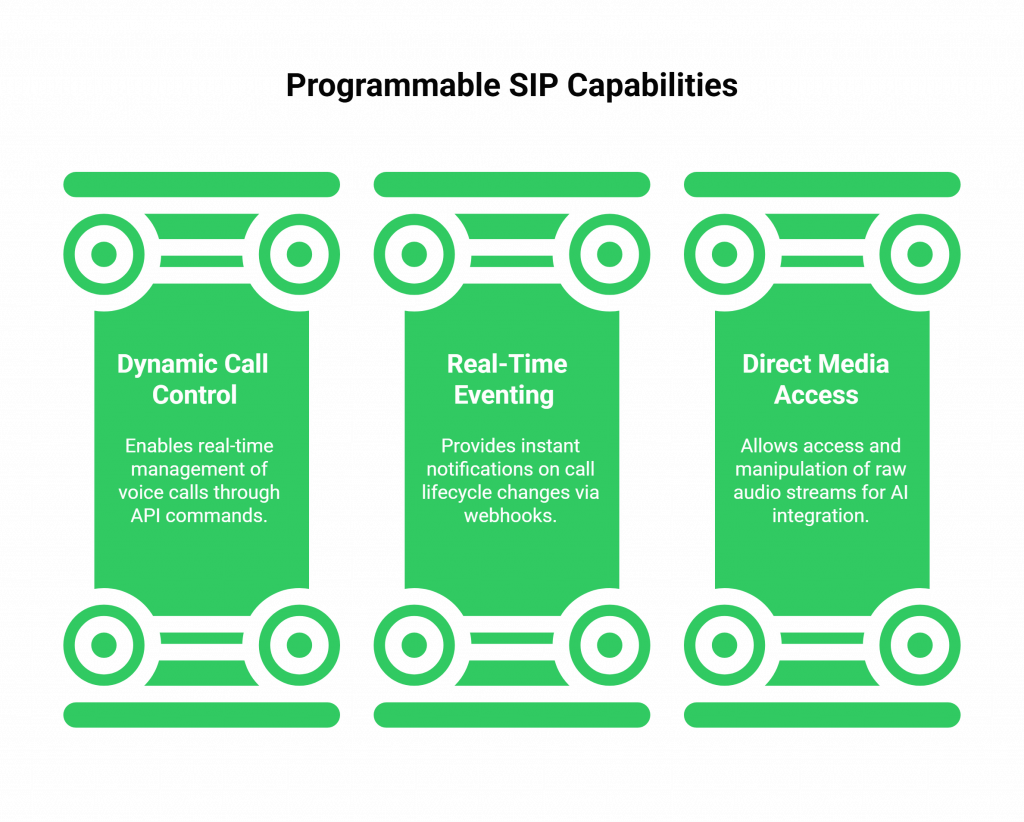
This programmability is defined by three core capabilities that a developer can control with code.
Dynamic Call Control via APIs
This is the “command” part of the equation. Your application can make a standard REST API call to the voice platform to tell it what to do. This includes actions like:
- Initiating a new outbound call.
- Answering an inbound call.
- Playing a pre-recorded audio file or a synthesized text-to-speech message.
- Transferring a call, putting it on hold, or hanging it up.
Real-Time Eventing with Webhooks
This is the “notification” part. A voice call is a long-lived, event-driven process. A programmable SIP platform communicates with your application by sending a stream of real-time event notifications (webhooks) to an endpoint you specify.
Your application receives events for every state change in the call’s lifecycle, such as incoming, ringing, answered, and completed. This is what allows your application to be stateful and reactive.
Direct, Programmable Media Access
This is the game-changer for voice first applications and AI. A programmable platform gives you the power to access and manipulate the raw, real-time audio stream (RTP) of the call. The API allows you to “fork” the media stream and send it directly to your application’s server, where it can be fed into a Speech-to-Text engine. This capability is the essential prerequisite for an AI to “hear” a caller.
The rise of this API-driven model is a major trend, with one report indicating that 83% of organizations now consider API integration to be a critical part of their business strategy.
Also Read: Managing Returns with AI Voice Support
What is the Architectural Blueprint for a Programmable SIP Application?
The power of programmable SIP is fully realized when you adopt a modern, decoupled architecture. This sip developer blueprint is about a clear separation of concerns, which is the key to building a scalable and resilient application.
The architecture has three main components:
- The Voice Infrastructure (The Engine): This is the provider’s platform, like FreJun AI’s Teler engine. It is the carrier-grade, globally distributed SIP network that handles all the low-level telecom complexity.
- Your Application (The Brain): This is your code, which we call your AgentKit. It is where your business logic, conversational intelligence (your LLM), and connections to other systems (like your CRM) reside.
- The API/Webhook Layer (The Nervous System): This is the communication bridge. Your “Brain” tells the “Engine” what to do via API calls. The “Engine” tells the “Brain” what is happening via webhooks.
This table visualizes this clear division of labor:
| Component | Role in the Architecture | Key Responsibilities |
| The Voice Infrastructure (e.g., FreJun Teler) | The “Engine” or the “Voice” | Manages phone numbers, carrier connections, SIP signaling, real-time media streaming, and executes API commands. |
| Your Application (e.g., AgentKit) | The “Brain” or the “Logic” | Manages business logic, conversational state, integrates with AI models (STT/LLM/TTS), and decides the call’s next action. |
| The API/Webhook Layer | The “Nervous System” or the “Bridge” | Facilitates real-time, event-driven communication between the Voice Infrastructure and Your Application. |
This decoupled, API-first model is the heart of the Communication Platform as a Service (CPaaS) market, a sector projected to grow to a staggering $45.3 billion by 2027.
Ready to start building with a true, developer-first programmable SIP platform? Sign up for FreJun AI and explore our powerful APIs.
What Kind of Voice-First Applications Does This Blueprint Enable?
This architectural blueprint is not just a theoretical concept; it is the foundation for a new generation of innovative voice first applications.
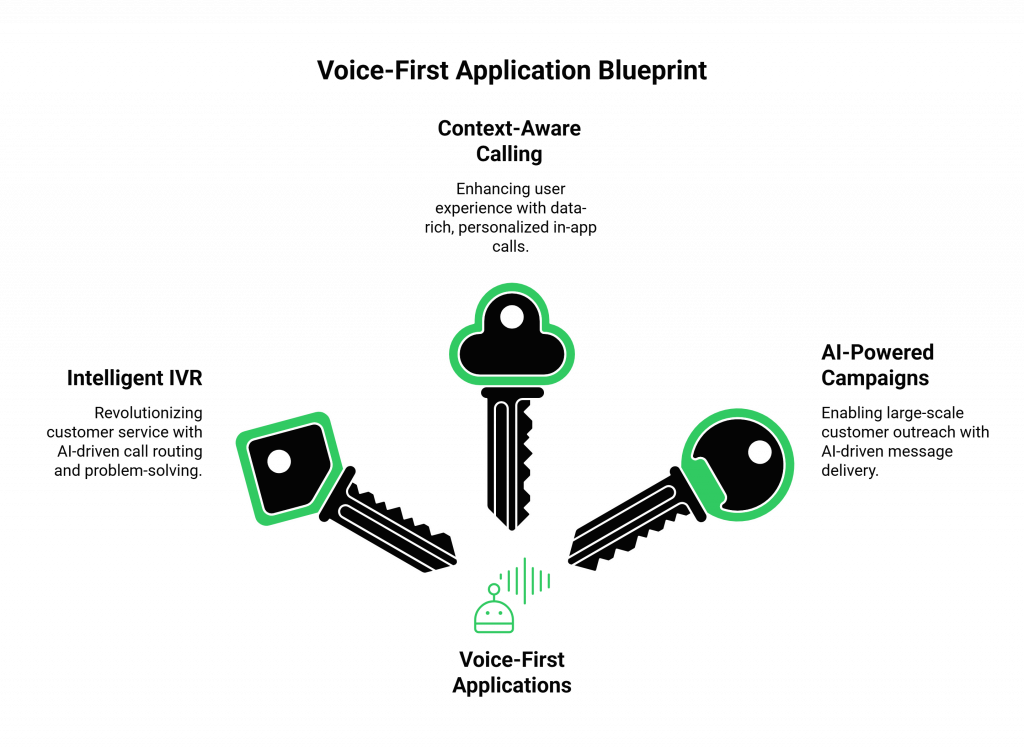
The Truly Intelligent IVR
The old “press-1” IVR is a symbol of customer frustration. With programmable SIP, when a call comes in, you can use the API to stream the audio to an AI agent powered by an LLM. The AI can understand the caller’s natural language, and your application can then use the API to dynamically route the call to the right department, or even have the AI solve the problem itself.
Context-Aware In-App Calling
Imagine a user in your mobile banking app is looking at a transaction they do not recognize. They can press a “call support” button. Your app can make an API call to initiate a call between the user and your contact center.
Because the call was initiated by your app, it can pass along the user’s context (their account number, the transaction ID they were looking at). The call is not just a call; it is a data-rich, context-aware interaction.
Large-Scale, AI-Powered Outbound Campaigns
A business needs to notify 100,000 customers about an important update. Your application can loop through your customer list and make an API call for each one, triggering a massive, simultaneous outbound dialing campaign. The call is answered by an AI agent that can deliver the message and even ask for a confirmation.
Also Read: Real-Time Driver Support via AI Voice
Conclusion
Programmable SIP acts as the crucial abstraction layer that finally unlocks the global telephone network for software developers. It transforms voice from a rigid, hardware-defined utility into a dynamic, flexible, and intelligent service that developers can weave into the fabric of any application.
By understanding the architectural blueprint of a modern, decoupled voice application and by leveraging the power of a developer-first platform, you are no longer just using the phone system; you are programming it. This is the foundation upon which the entire voice-first future will be built.
Want a personalized architectural review and a technical deep dive into how our programmable SIP platform can power your specific application? Schedule a demo with our team at FreJun Teler.
Also Read: How to Log a Call in Salesforce: A Complete Setup Guide
Frequently Asked Questions (FAQs)
Programmable SIP is a modern approach to voice communication where a developer can control every aspect of a live phone call, from call setup to real-time audio by using web APIs and event-driven webhooks.
Traditional SIP trunking is a static, pre-configured service designed to connect to a PBX. Programmable SIP is a dynamic, API-driven service designed to be controlled by a software application in real-time.
The API is the “remote control.” It is the set of commands that your application’s code uses to tell the voice platform what actions to perform on a live phone call, such as “play this audio” or “transfer this call.”
A webhook is a real-time notification that the voice platform sends to your application to inform it of a call event (like a new call or the user speaking). It is the trigger that allows your application to react and orchestrate the call flow, making it essential for an interactive experience.
It provides the two essential ingredients for AI: the ability to scale to thousands of calls instantly and, most importantly, the programmable access to the real-time audio stream, which the AI needs to “hear” the caller.
The media stream is the raw, real-time audio of the conversation itself, which is transmitted using the Real-time Transport Protocol (RTP). A programmable platform allows you to access and manipulate this stream.
While open-source platforms are powerful, they require you to manage the entire global infrastructure, including carrier connections, scalability, and security. A managed platform like FreJun AI handles all of that for you, allowing you to get to market much faster and with carrier-grade reliability.
Yes. A production-grade platform uses strong authentication (like API keys), secures all communication with HTTPS, and provides tools like request signing to ensure that the communication between your application and the platform is secure and authentic.
The decoupled architecture separates your AI and business logic (your “Brain”) from the voice infrastructure (the “Engine”). This makes your application much more flexible, easier to scale, and simpler to debug and maintain.