
For decades, SIP (Session Initiation Protocol) has been the quiet, reliable workhorse of the telecommunications industry. It is the fundamental protocol that powers Voice over IP (VoIP), the engine that allowed businesses to move their phone calls from the old copper-wire network to the internet.
But for most of its life, SIP has been a technology managed by engineers, for engineers, configured in complex network hardware. A new paradigm has now emerged, one that takes this powerful protocol and hands its keys to the software developer. This is the world of programmable SIP.
This shift from a configured to a programmed approach is not merely an academic distinction; it is the single most important architectural evolution that is enabling the current explosion in AI-powered voice agents.
An intelligent AI agent is a dynamic, unpredictable, and highly data-dependent application. It cannot be constrained by a static, pre-configured communication path. It requires a voice infrastructure for ai that is just as dynamic and intelligent as the agent itself.
A programmable SIP platform provides this essential, fluid sip backbone, transforming the global telephone network into a fully programmable component of the modern AI stack.
Table of contents
What Was the “Old World” of Configured SIP?
To appreciate the “programmable” revolution, we must first understand the static world it is replacing. In a traditional SIP trunking model, the workflow was rigid and one-dimensional.
A System of Static Pipes
- The Configuration Mindset: An IT administrator would log into a web portal and configure a “trunk.” This involved telling the provider’s system to take all the calls that came in to a specific phone number and “terminate” them to a single, static IP address, usually the company’s on-premise PBX or Session Border Controller (SBC).
- A Black Box for Developers: For a software developer, this system was a complete black box. A call would arrive at the PBX, and that was it. The developer had no visibility into the call’s setup, no control over its routing in real time, and, most importantly, no way to access the raw audio stream of the conversation. The phone system and the application world were two completely separate universes.
- Inflexible and Slow to Change: If you wanted to change the routing, perhaps send calls to a different server on weekends, it required a manual login and reconfiguration. It was a slow, human-driven process that was completely antithetical to the agile, automated world of modern software development.
What Does “Programmable SIP” Truly Mean?
Programmable SIP is a fundamentally different architectural approach. It is not about configuring a static path; it is about giving your application the power to control the path, step by step, in real time. It is a model where the voice network actively asks your application for instructions at every stage of the call.
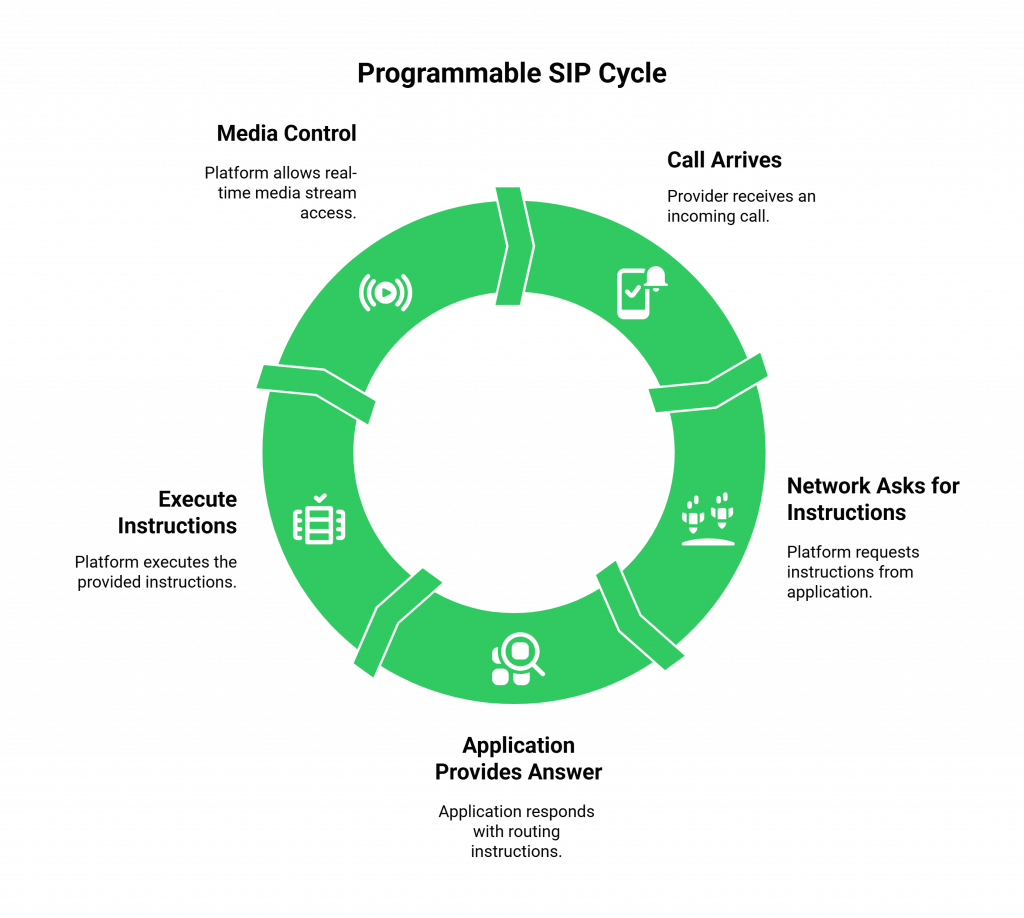
The Shift from “Push” to “Pull”
Instead of the provider “pushing” a call to a pre-configured destination, a programmable SIP platform works on a “pull” or, more accurately, a “request-response” model.
- A Call Arrives: The provider’s platform receives an incoming call.
- The Network Asks for Instructions: Instead of looking at a static routing table, the platform immediately makes an HTTP request (a webhook) to your application’s server. This request essentially says, “I have a new call from this number to that number. What should I do with it?”
- Your Application Provides the Answer: Your application’s code receives this request. It can then perform its own logic, perhaps check the time of day, look up the caller’s number in a CRM, or query a database and then it responds with a set of instructions. These instructions tell the voice platform exactly what to do next: “Answer the call and play this welcome message,” or “Reject the call with a busy signal,” or “Forward the call to this other phone number.”
This request-response loop continues for the entire duration of the call, turning your application into the real-time, dynamic “brain” of the call routing logic.
Beyond Call Control: Programmable Media
The true power of programmable SIP for AI is unlocked when this control is extended to the media stream itself. A modern platform does not just ask, “Where should this call go?” It allows you to ask, “Can you give me a live audio stream of this call?”
- A developer can use a programmable voice api to instruct the sip backbone to “fork” the real-time audio (the RTP stream) and send it directly to their AI application’s server.
- This is the critical capability that allows the AI’s Speech-to-Text (STT) engine to “hear” the caller in real time, a non-negotiable requirement for any ai conversation infrastructure.
This is the core of the FreJun AI platform. Our Teler engine is not a traditional SIP trunking service; it is a fully programmable, API-driven voice infrastructure. We provide the tools for you to build the intelligence, and our platform acts as the powerful, obedient servant that executes your real-time commands.
The market’s shift to this model is undeniable; a recent report on enterprise communications found that 47% of businesses see clear business value in using APIs, a trend that programmable SIP directly enables.
This table highlights the fundamental differences between the two models.
| Aspect | Traditional (Configured) SIP | Programmable SIP |
| Control Paradigm | Static, pre-configured routing (“Push”). | Dynamic, real-time, and event-driven (“Request-Response”). |
| Primary Interface | Web-based GUI for IT administrators. | REST API and Webhooks for software developers. |
| Media Access | The media stream is hidden and terminated at a PBX. | The media stream is exposed and can be accessed programmatically. |
| Flexibility | Rigid and slow to change. | Highly flexible; call logic can be changed with a simple code deploy. |
| AI Readiness | Fundamentally incompatible with real-time AI. | The essential foundation for any serious voice AI application. |
Ready to move beyond static configurations & start building a truly dynamic voice infrastructure? Sign up for FreJun AI.
Also Read: Integrating a Voice Calling SDK with Your AI Model: Step-by-Step Guide
How This Architecture Forms the Backbone for Voice AI?
An AI-powered voice agent is, at its heart, a highly sophisticated, event-driven application. A programmable SIP platform provides the perfect, symbiotic foundation for this kind of application.
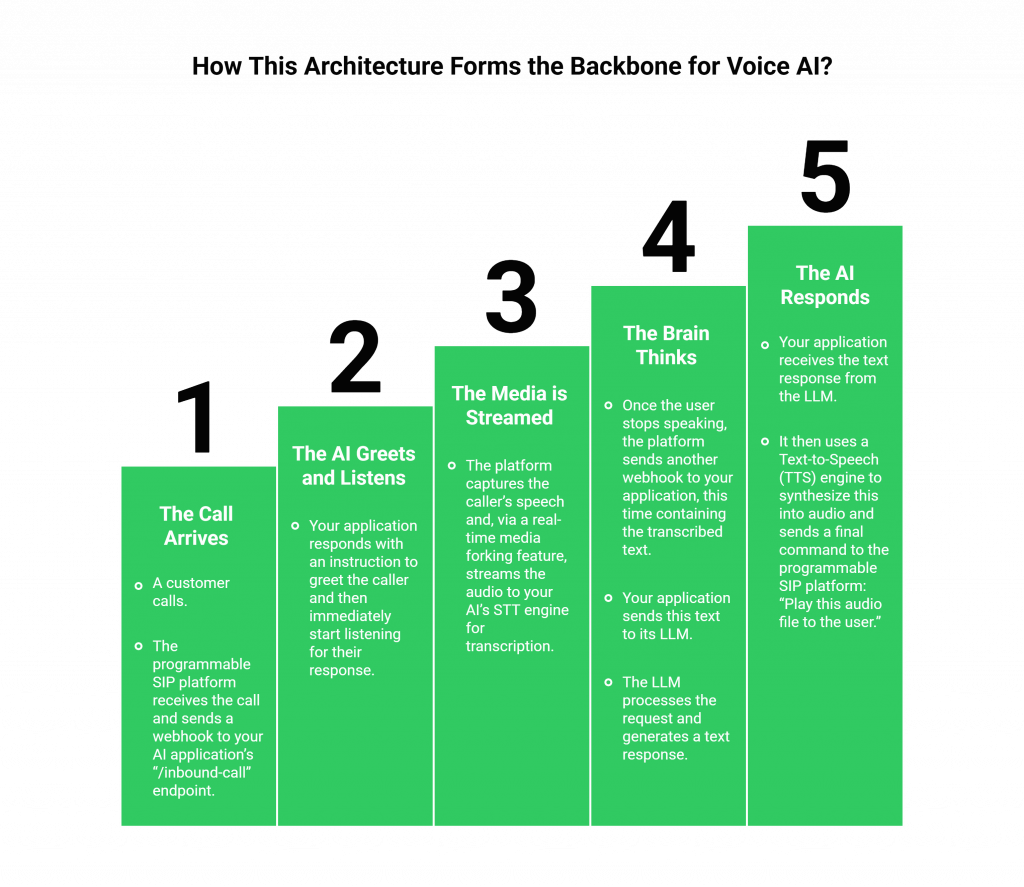
A Real-World AI Call Workflow
Let’s trace the journey of an AI-powered customer service call to see how this works in practice.
- The Call Arrives: A customer calls. The programmable SIP platform receives the call and sends a webhook to your AI application’s “/inbound-call” endpoint.
- The AI Greets and Listens: Your application responds with an instruction to greet the caller and then immediately start listening for their response.
- The Media is Streamed: The platform captures the caller’s speech and, via a real-time media forking feature, streams the audio to your AI’s STT engine for transcription.
- The Brain Thinks: Once the user stops speaking, the platform sends another webhook to your application, this time containing the transcribed text. Your application sends this text to its LLM. The LLM processes the request and generates a text response.
- The AI Responds: Your application receives the text response from the LLM. It then uses a Text-to-Speech (TTS) engine to synthesize this into audio and sends a final command to the programmable SIP platform: “Play this audio file to the user.”
This entire loop, a dance between your application’s logic and the voice platform’s real-time execution is the essence of a modern ai conversation infrastructure.
Conclusion
The evolution from configured SIP to programmable SIP is one of the most important and transformative shifts in the history of telecommunications. It marks the moment when the power to control the global voice network was taken out of the exclusive hands of telecom engineers and given to the creative and agile world of software developers.
For the burgeoning field of voice AI, this was the critical enabling step. The dynamic, data-driven, and unpredictable nature of an AI conversation requires a voice infrastructure for ai that is equally dynamic and programmable.
Want to get a hands-on look at our programmable voice API and see how you can build your first AI agent in minutes? Schedule a demo with our team at FreJun Teler.
Also Read: Call Log: Everything You Need to Know About Call Records
Frequently Asked Questions (FAQs)
Configured SIP uses a static, pre-set routing rule (e.g., “all calls go to this IP address”). Programmable SIP is dynamic; it asks your application for instructions in real-time for every single call, allowing your code to control the call flow.
A webhook is the real-time HTTP request that the programmable SIP platform sends to your application’s server to notify it of a new event, such as an incoming call. It is the trigger that starts your application’s logic.
No. This is the key benefit. A modern programmable voice api abstracts away the low-level complexity of the SIP protocol. As a developer, you interact with the system using familiar web technologies like REST APIs and JSON/XML.
It provides the two things an AI agent needs most: 1) The real-time, event-driven control to manage a dynamic conversation, and 2) The programmatic access to the live audio stream, which is how the AI “hears” the caller.
The term sip backbone refers to the core network infrastructure of a voice provider. For AI applications, you need a backbone that is globally distributed (for low latency), highly scalable, and fully programmable.
Absolutely. You would use the programmable voice api to make a single API call to initiate the outbound call. Once the call is answered, the platform would send a webhook to your application. At that same real-time conversational loop would begin.
A traditional CCaaS platform is often a closed, all-in-one application. A programmable SIP platform is an infrastructure-level service (a CPaaS). It is a set of building blocks that gives you the power and flexibility to build your own custom solutions, including your own AI-powered contact center.
It means the voice platform is not tied to any specific AI provider. It is responsible for handling the voice and media. You are completely free to use any AI models (STT, LLM, TTS) you choose in your own application logic.