
For the past two decades, the Session Initiation Protocol (SIP) has been the quiet, unassuming workhorse of the VoIP revolution. It was the digital signaling standard that made the dream of internet-based telephony a reality, the protocol that set up, managed, and tore down trillions of calls.
But for most of its life, SIP has been a largely static protocol, a set of pre-configured rules for connecting Point A to Point B. That era is now coming to a dramatic end. The rise of Large Language Models (LLMs) and the explosion in voice AI are forcing a radical reinvention of this foundational protocol, transforming it from a simple signaling mechanism into a dynamic, intelligent, and fully programmable fabric for communication. This is the new world of programmable SIP.
The future of SIP protocol is no longer a topic for quiet standards committees; it is being actively forged in the crucible of AI development. As businesses race to deploy intelligent voice agents, they are discovering that the “call” itself is no longer a simple connection but a complex, data-intensive application.
The AI telephony future demands an infrastructure that is not just connected, but is also context-aware, flexible, and controllable in real-time. This is where programmable SIP moves from a niche developer tool to the central, indispensable enabler of the next generation of business communication.
Table of contents
From Static Signaling to Dynamic Orchestration: The Evolution of SIP
To understand the profound nature of this shift, we must first look at the traditional role of SIP.
The Past: SIP as a “Digital Switchboard Operator”
The original purpose of SIP was to replicate the functions of the old Public Switched Telephone Network (PSTN) in the IP world. Its job was to handle the signaling for a call, much like an old-time switchboard operator.
- It would receive a request to make a call (a SIP INVITE).
- It would find the intended recipient’s address.
- It would “ring” their device.
- Once answered, it would establish the audio stream (the RTP media) and then step back, only to return at the end of the call to tear down the session.
In this model, the routing logic was almost entirely static. A call to a specific number was always routed to a specific, pre-configured IP address (like an office PBX). The SIP infrastructure was a passive transport layer, not an active participant in the application.
The Present: The Rise of Programmable Control
The first major shift came with the advent of Communication Platforms as a Service (CPaaS). These platforms introduced a revolutionary concept: a developer could use a web API to interact with and control a live SIP session. This was the birth of programmable SIP. Suddenly, the call was no longer a black box. A developer could:
- Receive a webhook when a call came in.
- Dynamically decide, with code, where to route that call.
- Inject audio into the call or transfer it to another party mid-conversation.
This was a massive leap forward, but its primary use was still centered around human-to-human workflows. The true catalyst for the next stage of evolution was the arrival of the LLM.
Also Read: The Role of Voice Calling SDKs in the Future of Voice AI and LLMs
How Do AI and LLMs Force the Next Stage of SIP Evolution?
An LLM-powered voice agent is not a simple endpoint like a phone or a PBX. It is a complex, distributed application that places a completely new set of demands on the underlying SIP infrastructure. This is where the programmable SIP trends are now being defined.
The Demand for Real-Time, In-Session Media Manipulation
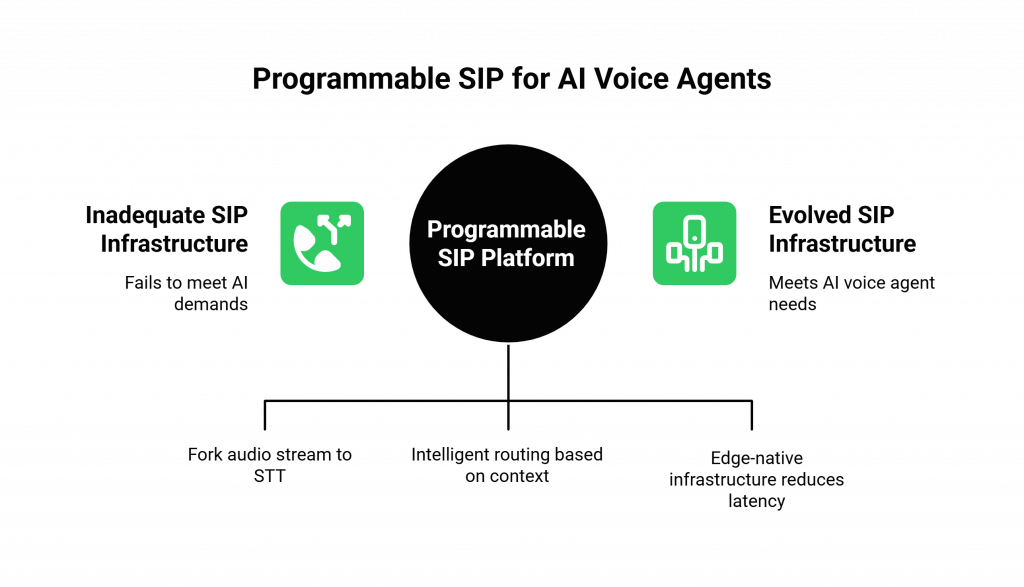
An LLM needs to “hear” the caller in real time. This requires more than just routing a call; it requires the ability to manipulate the media stream within the live SIP session. A truly programmable SIP platform must allow a developer to programmatically “fork” the raw audio stream (RTP) and send a live copy of it directly to a Speech-to-Text (STT) engine, all while keeping the primary call leg active.
This process goes beyond a simple call transfer and requires the platform to initiate and control sophisticated, real-time media processing through an API
The Need for Dynamic, Application-Aware Routing
Call routing for AI agents is a far more complex challenge than routing to a static PBX. A sophisticated voice AI application might be composed of multiple, specialized AI agents.
- An “intake” agent might handle the initial greeting and intent detection.
- A “billing” agent might handle payment questions.
- A “support” agent might handle technical issues.
A programmable SIP infrastructure allows the application’s code to make intelligent, real-time routing decisions, seamlessly transferring the live SIP session from one AI agent’s endpoint to another as the context of the conversation changes, or even bringing a human agent into a conference.
The Criticality of Low-Latency Signaling
In an AI conversation, every millisecond counts. The total latency is the sum of the AI’s “thinking” time plus the network transport time. The SIP signaling itself, the time it takes to set up a call, transfer it, or execute a command is now a critical part of this latency equation.
In 2026, providers will define the evolution of SIP by offering globally distributed, edge-native infrastructure that executes signaling commands as close to the user as possible, shaving precious milliseconds off the total round-trip time.
This table summarizes the evolution from a static to a fully AI-aware programmable model.
| Aspect | Static SIP (The Past) | Basic Programmable SIP (The Present) | AI-Aware Programmable SIP (The Future) |
| Primary Function | Connects calls between fixed endpoints (e.g., PBX). | Allows developers to dynamically route and control calls via API. | Acts as an intelligent, real-time media and data fabric for AI. |
| Media Handling | A passive “black box”; media is sent to the endpoint. | Allows basic media injection (e.g., playing a file). | Enables real-time media forking and streaming to AI services. |
| Routing Logic | Static and pre-configured in a GUI. | Dynamic and controlled by application code at the start of a call. | Hyper-dynamic; can be re-routed mid-conversation based on AI logic. |
| Key Enabler | VoIP adoption. | The rise of CPaaS and APIs. | The explosion of LLMs and conversational AI. |
Ready to build on a platform that was designed for the future of AI telephony? Sign up for FreJun AI and explore our powerful, API-driven voice infrastructure.
Also Read: Integrating a Voice Calling SDK with Your AI Model: Step-by-Step Guide
The Future of SIP Protocol: What Will the SIP Evolution of 2026 Look Like?
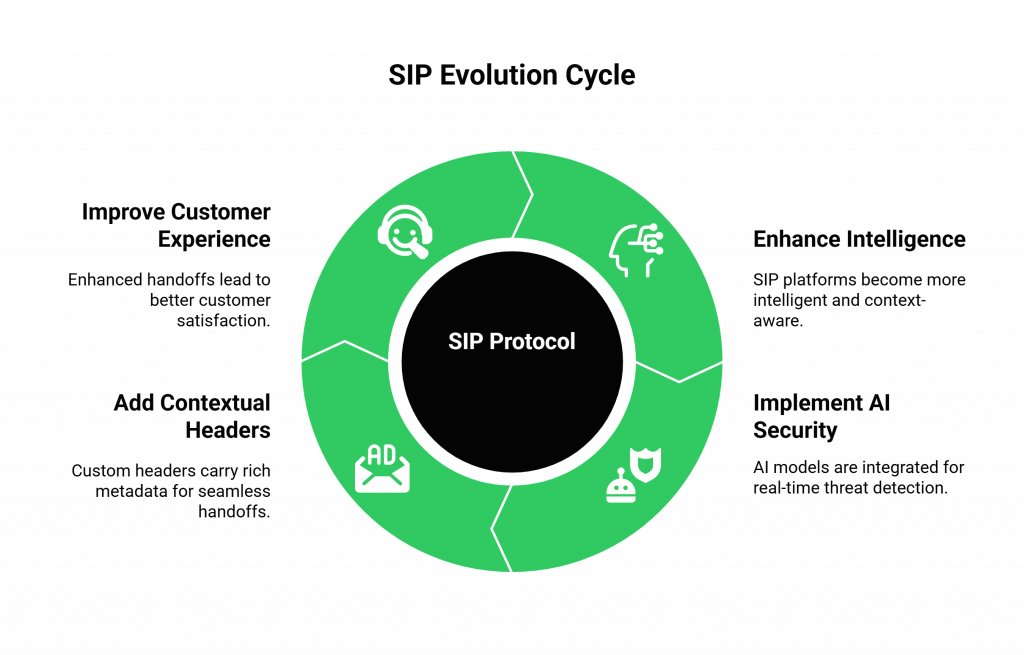
The ai telephony future will see the line between the SIP infrastructure and the AI application blur even further. The SIP platform itself will become more intelligent and context-aware.
AI-Powered Security and Fraud Detection at the SIP Layer
The SIP protocol itself can be a vector for attack. The future will see providers building AI models directly into their SIP edge. These models will analyze signaling patterns in real time to detect and block denial-of-service attacks and fraudulent call activity before they ever reach your application.
A recent report on telecommunications fraud highlighted the scale of this problem, with global losses estimated at over $39 billion annually. AI-powered programmable SIP is a powerful new weapon in this fight.
The Rise of Contextual SIP Headers
The SIP protocol allows for custom headers. Imagine a future where an AI agent, when transferring a call to a human, can insert a custom SIP header containing a summary of the conversation so far, the user’s identified intent, and even a real-time sentiment score.
This rich metadata, carried within the signaling of the call itself, would allow for a seamless and context-rich handoff, dramatically improving the customer experience.
Also Read: Why Latency Matters: Optimizing Real-Time Communication with Voice Calling SDKs
Conclusion
The Session Initiation Protocol, for so long a stable and predictable part of the telecom landscape, is in the midst of its most exciting evolution yet. The insatiable demands of AI and LLMs are transforming it from a static signaling protocol into a dynamic, real-time, and fully programmable fabric for intelligent communication.
The future of SIP protocol is inextricably linked to the ai telephony future. For enterprises and developers looking to lead in this new era, the key will not just be to build the smartest AI, but to build it on top of a programmable SIP infrastructure that is powerful and flexible enough to bring that intelligence to life, instantly and at a global scale.
Want to do a deep dive into our APIs and explore how you can leverage programmable SIP for your AI application? Schedule a demo with our team at FreJun Teler.
Also Read: Call Log: Everything You Need to Know About Call Records
Frequently Asked Questions (FAQs)
Standard SIP is a protocol with set of pre-configured rules, typically for connecting call to a fixed endpoint like PBX. Programmable SIP allows a developer to use an API to intercept a live SIP session. It dynamically control its behavior, such as changing its routing or manipulating its media stream, with code.
No. A key benefit of a modern, developer-first platform like FreJun AI is that it abstracts away the low-level complexity of the protocol. Developers can control SIP session using high-level API commands and a simple markup language, without needing to manually craft SIP packets.
It enables a more efficient architecture. Instead of routing a call through multiple separate systems (such as a gateway, a PBX, and an application server), a programmable SIP platform can fork the media stream directly from its edge server to the AI’s STT engine, creating the shortest possible data path.
Media forking is the ability to create a real-time copy of the call’s raw audio stream (the RTP media) and send it to a different destination while the original call remains active. It is the essential mechanism that allows a voice AI application to “listen” to the caller without interrupting the call.
Yes. The future of SIP protocol will see more AI-powered security features built directly into the infrastructure. By analyzing signaling patterns in real time, the platform can detect and block fraudulent activity, like denial-of-service attacks or toll fraud, at the network edge.
A SIP header carries metadata about the call within the SIP message. In the future, systems can use custom headers to pass rich, real-time context such as an AI-to-human conversation summary or a user’s sentiment score between systems during a call transfer.
Yes, a hybrid approach works. For example, inbound calls can first reach a programmable SIP application for AI-powered screening or IVR, and the application can then transfer the call to your existing IP-PBX when a human agent is needed.
The SIP evolution 2026 will see an even tighter convergence between worlds of traditional telephony (SIP) and web-based communication (WebRTC). A unified, programmable platform will allow for seamless call transitions between user on a web browser and a user on public telephone network.
A global CPaaS provider like FreJun AI has already done the hard work of building a global network of interconnections with Tier-1 carriers in countries all over the world. We manage all of this complexity behind the scenes, presenting it to the developer as a single, unified API.