
For years, the world of enterprise telephony has been on a slow but steady march of progress, moving from physical lines to the digital realm of SIP. This transition was a huge leap forward, offering cost savings and flexibility. But for the most part, SIP was still just treated as a better, cheaper “pipe”, a way to connect a traditional, monolithic phone system to the outside world.
Today, a new, far more radical transformation is underway. A new generation of developers and businesses are realizing that the SIP protocol itself is not just a pipe; it is a powerful, programmable language for real-time communication. This is the world of programmable SIP.
The rise of sophisticated AI and Large Language Models (LLMs) has created an insatiable demand for a new kind of next generation telephony, one that is not just connected, but is deeply and dynamically integrated with intelligent software.
Businesses no longer want to just route calls; they want to orchestrate them. They want to build AI IVR systems that can have natural conversations and automated call handling workflows that can solve complex problems without human intervention.
The rigid, pre-configured SIP trunk of the past is simply not built for this world. Programmable SIP is the foundational technology that is finally making this intelligent, automated future a reality.
Table of contents
What is the “Programmable” in Programmable SIP?
To understand the revolution, we must first understand the distinction. Traditional SIP trunking was a product sold to IT administrators. It was a static connection that was configured once in a web portal to point to a single destination, like an on-premise PBX.
Programmable SIP is fundamentally different. It is a service built for software developers. It takes the low-level, real-time signaling and media capabilities of the SIP protocol and exposes them to be controlled by an application’s code via a simple, high-level API.
This means that instead of your phone system being a “black box,” the call itself becomes a dynamic, programmable entity. Your application can make real-time decisions that change what happens on a live phone call, moment by moment. It is the difference between a pre-recorded television show and a live, interactive broadcast where the audience can change the plot.
Why is Traditional Call Routing Insufficient for Modern Customer Support?
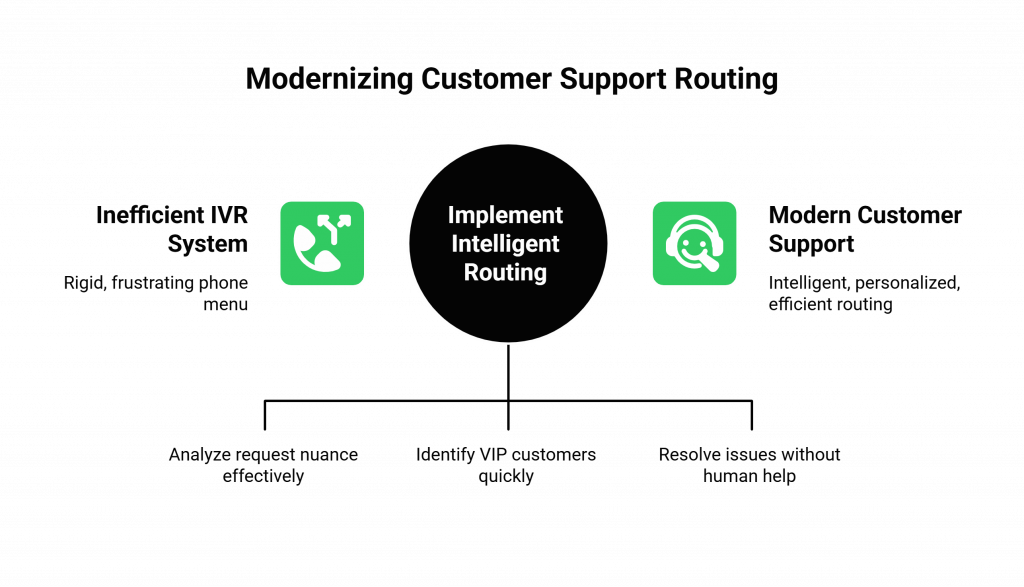
The “automated” customer support of the past was defined by the rigid, frustrating phone menu (the IVR). “Press 1 for sales, press 2 for support…” This model is a relic. It is a system that is universally despised by customers and is simply not intelligent enough to handle the demands of modern support.
The Failure of the Static Phone Menu
The old IVR model fails for several key reasons:
- It is a One-Way Street: The IVR speaks at the customer, forcing them down a rigid, pre-defined path. It cannot understand the nuance or the true intent of their request.
- It Lacks Context: The IVR has no idea who the customer is. It does not know that this is a VIP customer who has called three times today about a critical issue. To the IVR, every caller is the same anonymous entity.
- It is a Dead End: The ultimate goal of most old IVRs is simply to route the caller to the correct human queue. It cannot solve problems on its own.
Also Read: From Text Chatbots to Voice Agents: How a Voice Calling SDK Bridges the Gap
How Does Programmable SIP Enable Intelligent, Automated Call Handling?
Programmable SIP is the foundational technology that allows a business to replace that dumb phone menu with a truly intelligent, conversational AI agent. It provides the real-time, API-driven control that is the essential prerequisite for automated call handling.
Let’s look at a modern SIP for customer support workflow for an e-commerce company:
- The Call Arrives: A customer calls the support line. A platform like FreJun AI receives the call via its programmable SIP infrastructure.
- The First API Call: Instead of routing to a static IVR, the platform makes an API call (a webhook) to the company’s “call control” application. This webhook contains the caller’s phone number.
- The Contextual Decision: The application takes the phone number, does a real-time lookup in its CRM, and instantly knows who the caller is. It sees this is a high-value customer whose new, high-end order was just marked as “delivered” an hour ago. The application’s logic predicts that this is likely a call about that new order.
- The Dynamic Response: The application’s code makes a real-time decision. It uses the provider’s API to respond with a dynamic command, telling the infrastructure to start a conversation with a specialized AI agent.
- The AI Conversation: The AI IVR system starts, not with a generic menu, but with a personalized, context-aware greeting: “Hi, Sarah. I see your new camera was just delivered. Are you calling about that order?”
This table highlights the key differences between the old and new models.
| Feature | Traditional SIP & IVR | Programmable SIP & AI |
| Call Logic | Static and pre-configured in the phone system. | Dynamic and controlled by the application’s code in real-time. |
| Customer Context | Anonymous; no knowledge of the caller. | Context-aware; uses real-time data lookups (CRM, etc.). |
| User Interface | Rigid “Press 1” DTMF menu. | Natural, conversational language. |
| Primary Goal | Route the caller to the correct human queue. | Solve the caller’s problem automatically. |
| Architecture | A closed, monolithic telecom product. | An open, API-driven software integration. |
Ready to move beyond static phone menus and build truly intelligent customer experiences? Sign up for FreJun AI.
Also Read: Security in Voice Calling SDKs: How to Protect Real-Time Audio Data
How FreJun AI Delivers a True Programmable SIP Experience?
At FreJun AI, our entire platform was built on the philosophy that voice is a programmable entity. Our Teler engine is not just a SIP trunk; it is a globally distributed, API-first voice and media server.
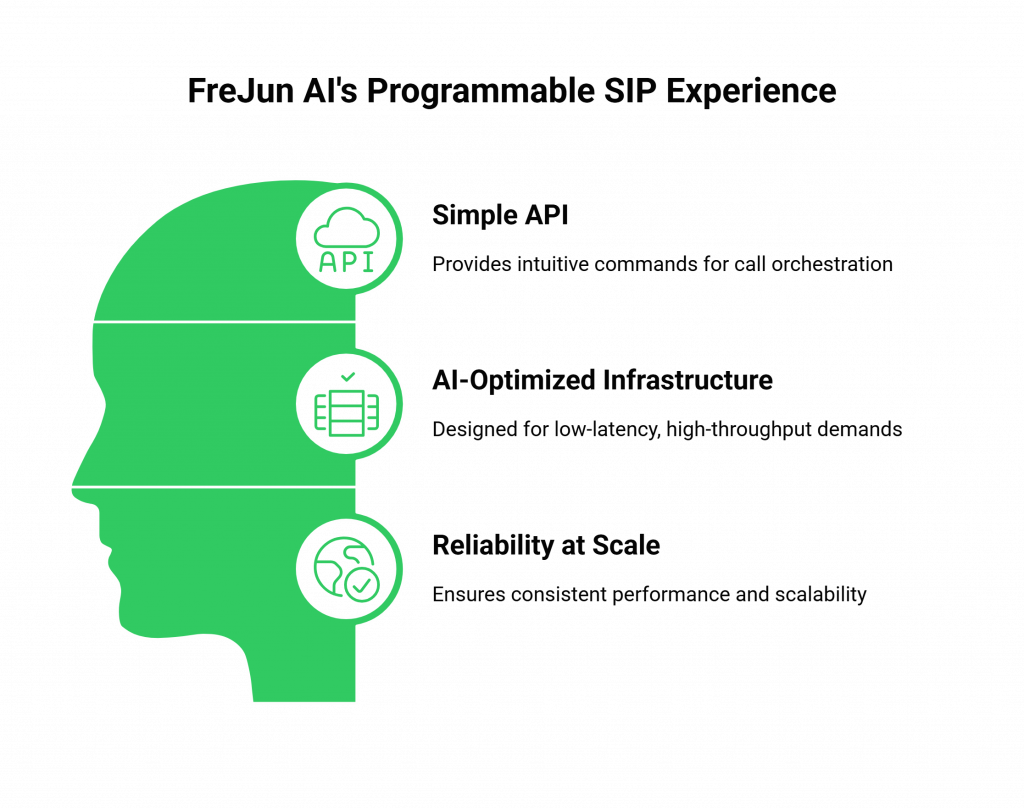
- A Simple, High-Level API: We abstract away the immense complexity of the underlying SIP protocol. Our developers do not need to be telecom experts. They can orchestrate complex call flows using simple, intuitive API commands and our FML markup language.
- Built for AI: Our infrastructure was designed from day one for the low-latency, high-throughput demands of real-time automated call handling. Our Real-Time Media APIs provide the direct audio access that is essential for SIP for customer support AI.
- Reliability at Scale: We handle the hard work of managing a carrier-grade, globally redundant infrastructure, so you can focus on the logic of your application, confident that the underlying voice layer is always on and always ready to scale. The importance of this reliability is paramount; a recent report on customer service automation found that system reliability was the #1 factor for businesses choosing an automation platform.
Also Read: 5 Common Mistakes Developers Make When Using Voice Calling SDKs
Conclusion
The customer support landscape is in the midst of a profound transformation, and the technology of programmable SIP is at the very heart of this change. It marks the final and most important step in the evolution of voice from a closed, hardware-based utility to an open, software-driven platform for innovation.
By providing the real-time, API-driven control needed to orchestrate intelligent and automated call handling, this next generation telephony is enabling businesses to build the AI IVR systems and conversational agents that will define the future of the customer experience.
The era of the dumb phone menu is over. The era of the intelligent, programmable conversation has arrived.
Want to see a live demonstration of how our programmable SIP infrastructure can be used to build a context-aware AI agent? Schedule a demo with our team at FreJun Teler.
Also Read: United Kingdom Country Code Explained
Frequently Asked Questions (FAQs)
Programmable SIP is a modern, developer-focused approach to SIP trunking. Instead of a static connection, it provides a set of APIs that allows a software application to control the behavior of a phone call in real-time, making it possible to build dynamic and intelligent voice workflows.
Regular SIP trunking typically operates as a static service that connects to a single phone system (such as a PBX). Programmable SIP functions as a dynamic service that an application’s code controls moment by moment.
An AI IVR system is the evolution of the traditional “press 1” phone menu. Instead of a rigid menu, it uses a conversational AI to understand a caller’s natural language, allowing for a much more flexible and intelligent interaction.
It provides the core building blocks for automated call handling. The API allows an application to answer a call, understand the caller’s intent (by integrating with an AI), and then programmatically perform an action, like routing the call, playing a message, or even resolving the issue without a human.
This is the ability for an application to get a live copy of the call’s audio stream. It is a critical feature of programmable SIP because it is how an AI application is able to “hear” the caller for transcription.