
In the rapidly evolving landscape of artificial intelligence, we have collectively become obsessed with the “brain”, the Large Language Model (LLM). We celebrate its ability to reason, its fluency, its ever-expanding knowledge. But for a voice AI agent, the brilliance of its brain is utterly dependent on the quality of its nervous system.
That nervous system, the infrastructure that connects the AI to the real world of a phone call has, for too long, been a slow, rigid, and “dumb” pipe. The result is the all-too-common experience of an AI that sounds intelligent but feels slow and robotic. This is not an AI problem; it is a network problem.
The solution lies in a profound architectural shift: the move from static, configured SIP to dynamic, programmable SIP.
The future of voice AI is not just about better models; it is about faster, more adaptive, and more intelligent connections. Programmable SIP is the technology that transforms the underlying voice network from a passive conduit into an active, software-defined participant in the conversational workflow.
By giving developers granular, API-driven control over the real-time mechanics of a call, it provides the essential toolkit for sip latency optimization and advanced sip performance tuning. This is the key to unlocking a new generation of voice AI that is not just smart, but truly conversational.
Table of contents
What is the “Static SIP” Problem for AI Voice?
The first generation of SIP trunking was designed to solve a simple problem: replacing old, physical phone lines with a more cost-effective internet-based alternative. It was architected to be configured once and then left alone. This “set it and forget it” model is a complete architectural mismatch for the dynamic, real-time demands of an AI-powered call.
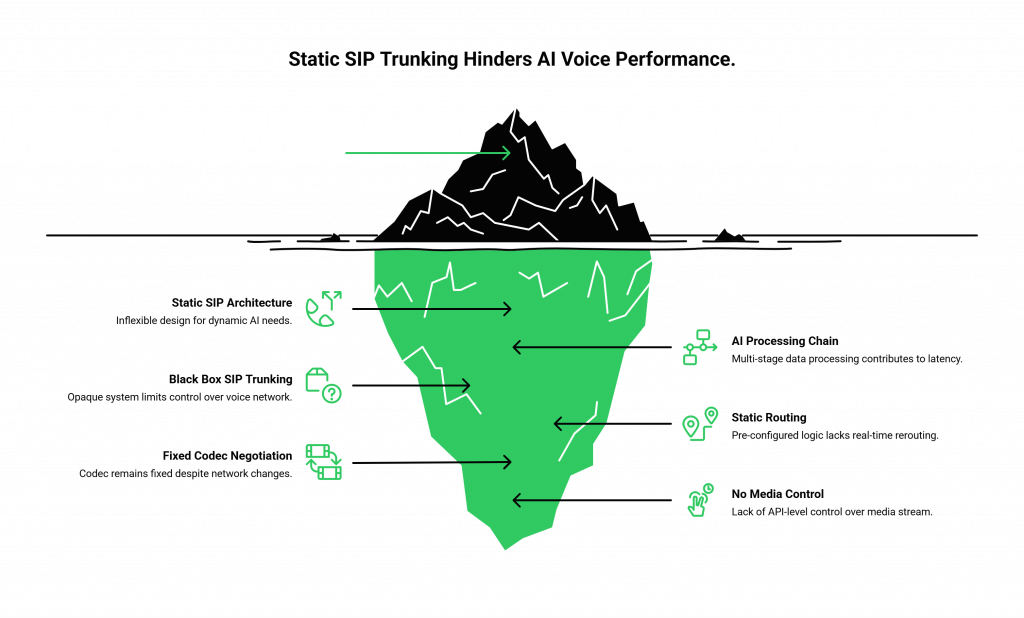
The Compounding Effect of the AI Processing Chain
An AI conversation is a complex, multi-stage data-processing event. The total latency is the sum of every step in this chain:
- Network Latency (User to Platform): The time for the user’s voice to travel to the voice platform.
- STT Latency: The time for the Speech-to-Text engine to transcribe the audio.
- LLM Latency: The time for the AI brain to process the text and generate a response.
- TTS Latency: The time for the Text-to-Speech engine to synthesize the response into new audio.
- Network Latency (Platform to User): The time for the AI’s voice to travel back to the user.
A traditional SIP trunk treats this entire process as a black box and only offers control over the most basic aspects of the connection. It provides no tools to actively manage or reduce the latency within this chain. A recent study on user experience highlighted that delays of as little as 400 milliseconds in a conversation can be perceived as negative, making every single millisecond a precious commodity.
The “Black Box” of Traditional SIP Trunking
With a traditional SIP provider, the voice network is an opaque system. You configure your connection, and then you are at the mercy of the provider’s routing decisions and the unpredictable nature of the public internet.
- Static Routing: Your calls are routed based on a pre-configured, static logic. You have no real-time control to reroute a call around a congested network path.
- Fixed Codec Negotiation: The audio codec (the algorithm that compresses the voice) is typically negotiated once at the start of the call and remains fixed, even if network conditions change.
- No Real-Time Media Control: The provider’s job ends at delivering the call. You have no API-level control over the raw media stream itself, which is the foundational element an AI needs.
Also Read: From Text Chatbots to Voice Agents: How a Voice Calling SDK Bridges the Gap
How Does Programmable SIP Redefine the Voice Network?
Programmable SIP is not a new protocol. It is a new, developer-first philosophy and a powerful software layer built on top of the existing SIP standard. It transforms the SIP trunk from a static, configured utility into a dynamic, real-time, and fully programmable entity that is controlled by your application’s code.
From Configuration to Orchestration
The fundamental shift is from “configuration” to “orchestration.”
- Configuration (Static): You use a web portal to set up your trunk once. The rules are fixed.
- Orchestration (Dynamic): You use a low latency voice api to actively manage and orchestrate the behavior of every single call in real-time, based on the specific needs of that call at that exact moment.
Think of it as the difference between a pre-programmed sprinkler system (static) and a smart irrigation system that uses real-time weather data and soil sensors to decide exactly when and where to water (dynamic). Programmable SIP brings this level of intelligence to the voice network.
Exposing the Low-Level Controls via an API
The “programmable” part is enabled by a rich, powerful API that gives developers access to the low-level levers and dials of the voice network that were previously hidden away. This is what allows for active, real-time sip performance tuning. The API exposes the ability to control the network, not just use it.
What Are the Key Mechanisms for SIP Performance Tuning via an API?
So, how does this actually work in practice? How can an API call improve call quality sip or reduce latency? It is done through a set of powerful, real-time mechanisms that a programmable platform provides.
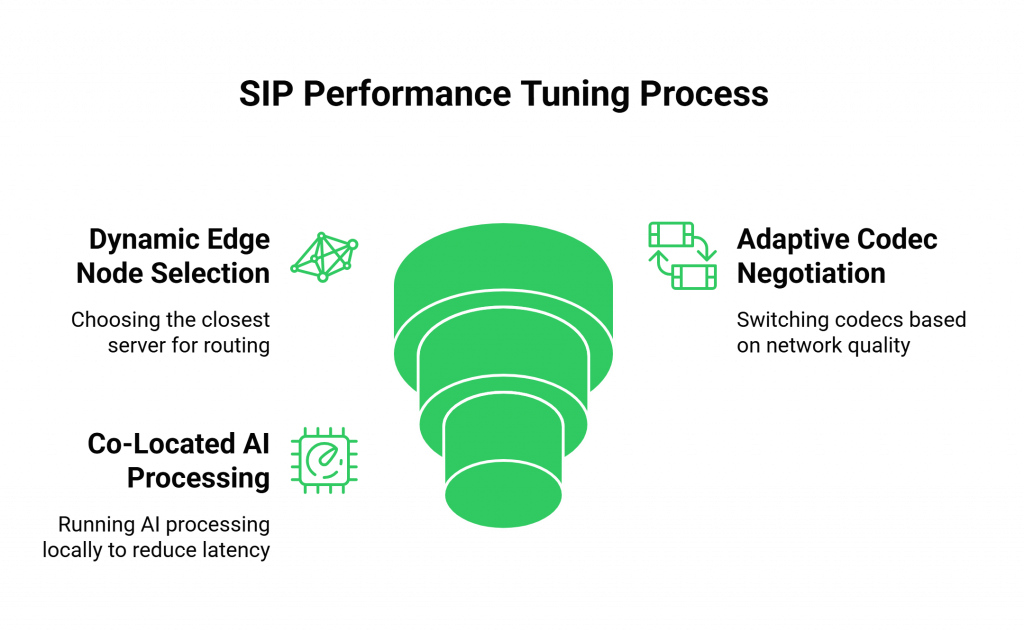
Dynamic Edge Node Selection and Intelligent Routing
A global, programmable voice platform is not a single entity; it is a distributed network of servers, or Points of Presence (PoPs), located in data centers all over the world.
- How it Works: A low latency voice api allows your application to have a say in the routing. When you initiate an outbound AI call to a user in Germany, your application can explicitly instruct the platform to originate that call from its Frankfurt PoP.
- The Impact: This ensures that the “on-ramp” to the global telephone network is as physically close to the end-user as possible. This is the single most effective technique for sip latency optimization, as it dramatically reduces the round-trip time for the audio packets.
Adaptive, Real-Time Codec Negotiation
Different audio codecs have different characteristics. G.711 offers high-fidelity, uncompressed audio but is very sensitive to network issues like packet loss. Opus, on the other hand, is a more modern, resilient codec that can maintain high quality even on a less-than-perfect network.
- How it Works: The voice platform is constantly monitoring the quality of a live call (measuring jitter and packet loss). If it detects that the network quality is degrading, your application can be notified via a webhook. Your code can then make an API call to instruct the platform to attempt to renegotiate the codec mid-call, switching from G.711 to Opus to better handle the poor conditions.
- The Impact: This dynamic adaptation is a powerful tool to improve call quality sip. It allows the call to gracefully degrade in quality instead of becoming completely unintelligible, which is critical for keeping a conversation on track.
Also Read: Security in Voice Calling SDKs: How to Protect Real-Time Audio Data
Co-Located AI Processing
A truly advanced programmable SIP provider will allow you to run your AI’s “brain” (your AgentKit) in the same edge data centers where their voice infrastructure (the Teler engine) lives.
- How it Works: Instead of the audio stream having to travel from the edge PoP, across the public internet to your application server, and back again, the entire AI processing loop (STT -> LLM -> TTS) can happen on the same local network.
- The Impact: This eliminates a huge portion of the round-trip latency, bringing the AI call response speed down to its absolute physical minimum. It is the architectural gold standard for building the fastest possible voice AI.
This table summarizes these advanced, programmable mechanisms.
| Programmable Mechanism | How It Works via API | Impact on AI Call Performance |
| Dynamic Edge Node Selection | Your application can specify the geographic origin point for an outbound call. | Drastically Reduces Network Latency: Minimizes the physical distance the audio has to travel. |
| Adaptive Codec Negotiation | Your application can be notified of poor network quality and command a mid-call codec change. | Significantly Improves Call Quality: Provides resilience against real-world network issues like jitter and packet loss. |
| Co-Located AI Processing | The platform allows you to deploy your AI application in the same edge data center as the voice infrastructure. | Achieves Ultra-Low Latency: Reduces the “middle mile” of the AI processing loop to near-zero. |
How Does FreJun AI’s Teler Engine Embody This New Paradigm?
At FreJun AI, we did not start as a traditional telecom company and add an API. We started as a developer-first, API-driven company that built a global voice infrastructure to support our vision. Our Teler engine is the embodiment of the programmable SIP philosophy.
Teler is designed to give developers the granular, real-time control they need to build the next generation of voice experiences. Our low latency voice api is not just a feature; it is the core of our product.
We provide the globally distributed, edge-native infrastructure and the powerful, easy-to-use tools for sip performance tuning. Our core mission is to handle the immense underlying complexity of the voice network so that you can focus on the intelligence of your AI.
Ready to move beyond static connections and start building on a truly programmable voice platform? Sign up for FreJun AI and explore our powerful, real-time APIs.
Also Read: 5 Common Mistakes Developers Make When Using Voice Calling SDKs
Conclusion
The quality of an AI-powered voice call is no longer a matter of chance, dependent on the whims of the public internet. It is now a matter of choice, an architectural choice to embrace a more intelligent and dynamic approach to voice infrastructure.
The shift from static, configured SIP to dynamic, programmable SIP is the single most important enabler of this new era. It transforms the voice network from a dumb pipe into a smart, software-defined partner in the conversational workflow.
For developers and businesses on the frontier of voice AI, mastering the art of sip performance tuning through a powerful low latency voice api is the key to creating experiences that are not just artificially intelligent, but genuinely and impressively conversational.
Want a technical deep dive into our API and to discuss how you can use it to optimize your specific AI voice application? Schedule a demo with our team at FreJun Teler.
Also Read: United Kingdom Country Code Explained
Frequently Asked Questions (FAQs)
Standard SIP is a protocol that is typically configured once for a static connection. Programmable SIP refers to a modern, API-first approach where a developer can use code to dynamically control and orchestrate the behavior of every call in real-time, including aspects like routing and media.
An API enables sip latency optimization primarily through intelligent routing. It allows an application to programmatically choose the provider’s edge server (PoP) that is physically closest to the end-user, which is the most effective way to reduce the network travel time for the audio data.
A codec (coder-decoder) is the algorithm used to compress and decompress voice data for transmission over the internet. The choice of codec is a trade-off between audio fidelity and resilience to network problems. Being able to programmatically negotiate codecs helps to improve call quality sip.
An edge node or PoP is a smaller, geographically distributed data center that is part of a larger network. In a programmable SIP platform, these edge nodes are the “on-ramps” to the voice network, and handling a call at the closest one is key to reducing latency.
Yes. A sophisticated, programmable voice platform can support mid-call codec renegotiation. Your application can be notified of degrading network quality and can then use the API to trigger this change, for example, from a high-bandwidth codec to a more resilient one.
The initial setup might require more of a developer’s mindset, but it is not necessarily more complex. A traditional SIP trunk setup can involve complex firewall and PBX configurations. A programmable SIP setup is about interacting with a well-documented API. It is a more familiar paradigm for modern development teams.
No. This is a key benefit. A modern low latency voice api abstracts away the deep network engineering. It gives a software developer high-level controls (like “originate this call from this region”) without requiring them to be an expert in the underlying BGP routing or carrier peering.
For a global application, it is essential. It allows you to create geo-routing logic. For example, a call from a user in Asia can be automatically routed to an AI agent hosted in a Singapore data center, ensuring the lowest possible latency for both the voice network and the AI processing.
Yes, indirectly. While the primary benefits are quality and control, these can lead to cost savings. For example, by dynamically choosing codecs, you can reduce bandwidth usage. More importantly, by enabling a high-quality AI agent, you can automate calls that would otherwise have to be handled by an expensive human agent.