
For the better part of a decade, Session Initiation Protocol (SIP) has been the quiet workhorse of the enterprise voice revolution. Its primary job was to be a “dumb pipe”, a more efficient, cost-effective, and scalable replacement for the rigid PRI lines of the past. It was a utility, a means to an end.
But the ground beneath the world of telecommunications is shifting. The rise of powerful, conversational AI and Large Language Models (LLMs) is transforming what is possible, and in this new era, the “dumb pipe” is no longer enough. The future belongs to an intelligent, developer-centric, and real-time controllable fabric: programmable SIP.
The programmable SIP in 2026 landscape will not be defined by how many calls it can connect, but by how intelligently it can orchestrate them. As businesses move from simple, robotic IVRs to truly dynamic, human-like AI voice agents, the underlying infrastructure must evolve from a static configuration to a dynamic, programmable entity. This is a fundamental paradigm shift.
We are no longer just connecting calls; we are building intelligent, automated voice workflows. This article will explore five forward-looking programmable sip use cases that will define the next generation of business communication and customer interaction.
Table of contents
What Makes “Programmable SIP” a Paradigm Shift?
Before we explore the use cases, it is crucial to understand what makes programmable SIP a radical departure from traditional SIP trunking.
- Traditional SIP Trunking: This is a statically configured service. An IT administrator uses a web portal to point a trunk to a specific IP address (like a PBX or a contact center). The provider’s job ends at delivering the call. It is a “set it and forget it” model.
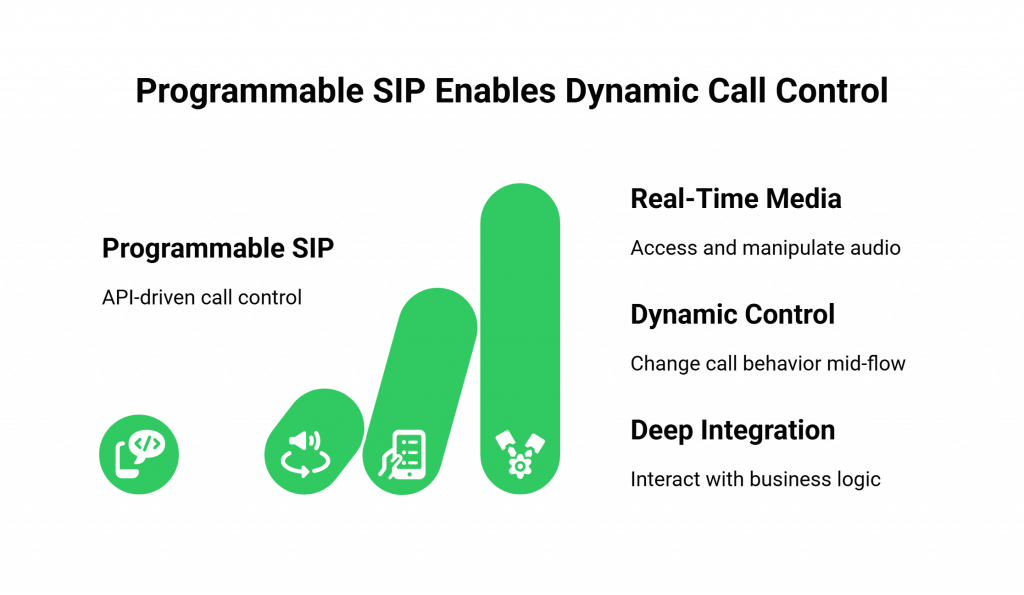
- Programmable SIP: This is a dynamic, API-driven model. It treats a live phone call not as a black box, but as a fully programmable entity. A developer can use a powerful API to control every aspect of the SIP session in real-time.
This shift is about moving control from a static configuration file to your live application code. The key capabilities that programmable SIP unlocks for a developer are:
- Real-Time Media Access: The ability to programmatically access and manipulate the raw audio stream (RTP) of a live call. This is how an AI “hears” and “speaks.”
- Dynamic Call Control: The power to change a call’s behavior mid-flow based on external events or your application’s logic (e.g., transferring a call, injecting audio, or even changing the caller ID).
- Deep Integration with Business Logic: The ability to have the SIP session interact directly with other software, like a CRM, a database, or an AI model, to make intelligent decisions on the fly.
This API-driven approach is the foundation for the explosive growth in automated business communications. A recent analysis projects that the market for conversational AI will grow by over 19 % annually, a clear signal that enterprises are investing heavily in this technology.
Ready to move beyond static configurations and start building dynamic voice workflows? Sign up for FreJun AI and explore our powerful, API-driven voice infrastructure.
Also Read: Best Practices for Testing and Debugging Voice Calling SDK Integrations
The Top 5 Programmable SIP Use Cases for 2026
These are not just theoretical ideas; they are the practical applications that are being built today and will be mainstream by 2026, all powered by a sophisticated programmable SIP infrastructure.
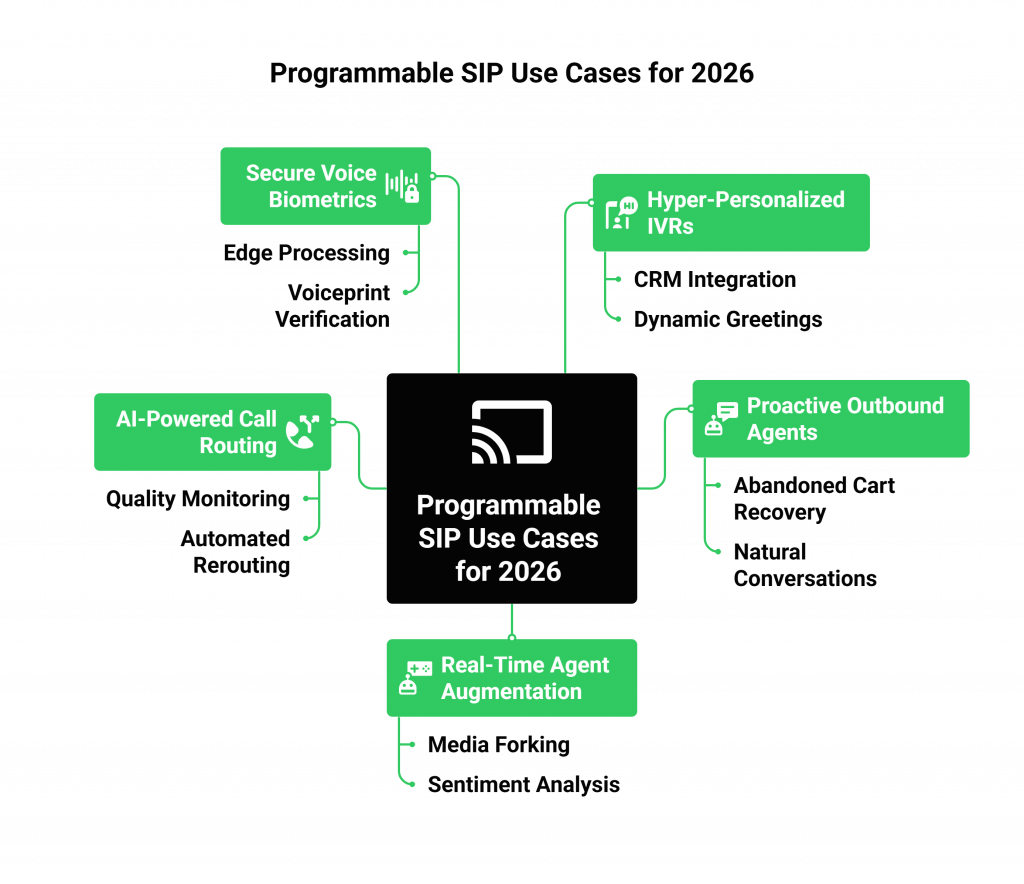
1. Hyper-Personalized, Context-Aware IVRs
The traditional Interactive Voice Response (IVR) is a source of universal frustration (“Press 1 for sales…”). The future of sip for customer support is an IVR that already knows who you are and what you probably want before you even press a button.
- How It Works: A customer calls your support line. The programmable SIP platform receives the call and immediately sends a webhook to your application with the caller’s phone number. Your application does a real-time lookup in your CRM. It sees that this customer has a delivery that is scheduled for today. Instead of a generic menu, your application uses the programmable API to construct a personalized, dynamic greeting: “Hi, Sarah. I see you have a delivery scheduled for today. Are you calling about that order?” The customer can say “yes” and be immediately routed to a specialized AI agent (or a human) that has all the order details on screen.
- The Programmable SIP Advantage: This is impossible with a traditional SIP trunk. It requires the ability to intercept the call, communicate with an external application (the CRM), and then dynamically control the call’s initial audio and routing, all in the first few milliseconds of the call.
2. Proactive, Conversational Outbound Agents
This is one of the most powerful ai voice agents examples. It goes far beyond simple, pre-recorded reminder calls.
- How It Works: An e-commerce company’s system detects that a high-value customer has abandoned their shopping cart. Instead of just sending an email, it triggers an outbound call from an AI agent. The AI can have a natural conversation: “Hi, Alex. This is a quick call from StyleStream. I noticed you were looking at the new leather jacket. I just wanted to let you know that we can offer you free overnight shipping if you complete the order today. Would you like me to send a direct link to your cart to your phone?” Based on Alex’s response, the AI can trigger an SMS, transfer the call to a human sales agent, or simply end the call politely.
- The Programmable SIP Advantage: The entire workflow is code. The application uses the API to initiate the call, stream the audio to and from the LLM to have the conversation, and then, based on the outcome, execute another action (like triggering an SMS API).
3. Real-Time In-Call Agent Augmentation
This use case enhances the performance of your human agents, making them smarter and more effective in real time.
- How It Works: A new customer support agent is on a call with a frustrated customer. A programmable SIP feature called “media forking” is used to create a silent, real-time copy of the call’s audio stream. This stream is fed to an AI that is trained on the company’s knowledge base. The AI listens to the customer’s question and instantly pushes the correct answer or a link to the relevant policy document to the human agent’s screen. It can even analyze the customer’s tone of voice for sentiment and provide the agent with real-time coaching prompts, like “The customer seems frustrated. Try showing more empathy.”
- The Programmable SIP Advantage: Media forking is a core feature of an advanced, developer-first SIP platform. The ability to access the live media of a call without interrupting it is the essential prerequisite for this kind of real-time analysis and augmentation. This is a powerful shift, as poor customer service can be incredibly costly. A study from HBR noted that acquiring a new customer can be anywhere from 5 to 25 times more expensive than retaining an existing one.
Also Read: How a Voice Calling SDK Can Improve Customer Experience in AI Voice Agents?
4. AI-Powered Global Call Routing and Optimization
This is a more network-level application that uses AI to improve the quality and resilience of the voice infrastructure itself.
- How It Works: A large enterprise has a global contact center with agents and customers all over the world. An AI model is constantly monitoring the real-time quality metrics (latency, jitter, packet loss) of the programmable SIP provider’s global network. If it detects a degradation in performance on a particular carrier path between, say, Brazil and Spain, it can automatically make an API call to the provider to reroute all future calls between those regions over a different, higher-quality carrier path.
- The Programmable SIP Advantage: This requires a provider that not only exposes real-time quality data via an API but also allows for the programmatic control of routing policies. It turns network management from a reactive, manual process into a proactive, automated one.
5. Secure Voice Biometric Authentication at the Edge
This use case combines security and AI to create a seamless and highly secure user experience.
- How It Works: A customer calls their financial services company. The programmable SIP platform answers the call at the network edge. The AI asks the customer to state their name and the reason for their call. The platform captures this initial audio utterance and sends it to a specialized voice biometric AI model to verify the customer’s identity based on their unique voiceprint. Once the identity is verified, the programmable API passes the call, along with a secure “authenticated” token, to the main application.
- The Programmable SIP Advantage: This requires the ability to intercept and process a call’s media at a very low level, at the edge of the network, before the call is even fully connected to the core application. This is a sophisticated workflow that is only possible with a truly programmable, developer-centric voice platform like FreJun AI’s Teler engine.
This table provides a quick summary of these five use cases.
| Use Case | Key AI Function | Essential Programmable SIP Capability |
| 1. Hyper-Personalized IVR | Real-time data lookup and dynamic response generation. | Webhooks on call initiation; dynamic call control via API. |
| 2. Proactive Outbound Agent | Natural language conversation and intent detection. | API-initiated outbound calls; real-time media streaming. |
| 3. In-Call Agent Augmentation | Real-time transcription, knowledge retrieval, and sentiment analysis. | Real-time media forking (media streaming). |
| 4. AI-Powered Global Routing | Real-time network quality analysis and decision making. | API access to call quality metrics; programmatic routing control. |
| 5. Voice Biometric Authentication | Voiceprint analysis and identity verification. | Low-level media access at the network edge; secure call handoff. |
Also Read: Voice Calling SDKs for Enterprises: Scaling Conversations with AI and Telephony
Conclusion
The era of the “dumb pipe” is over. The programmable SIP in 2026 landscape will be defined by a deep and powerful synergy between the voice network and the AI applications it serves. The network is no longer just a utility for connecting calls; it is an intelligent, programmable, and active participant in the creation of next-generation customer experiences.
The programmable sip use cases we have explored are just the beginning. For enterprises and developers looking to innovate and gain a competitive edge, the strategic question is no longer if they should adopt a programmable voice strategy, but how fast they can build on it.
The future of business communication is being written in code, and programmable SIP is the language it will be written in.
Want to dive deeper into the APIs that power these use cases and see how you can start building them on our platform? Schedule a personalized demo with our team.
Also Read: UK Mobile Code Guide for International Callers
Frequently Asked Questions (FAQs)
Traditional SIP is statically configured, usually through a web portal, to deliver calls to a fixed destination. Programmable SIP is dynamic and API-driven, allowing a developer’s code to control every aspect of the live call in real-time.
Media forking is a feature of programmable SIP that allows you to create a real-time, silent copy of a call’s audio stream and send it to another destination (like an AI for analysis). It is essential for use cases like in-call agent augmentation and compliance recording.
A secure platform uses a multi-layered approach, including encryption of the signaling (TLS) and the media (SRTP), robust API key management, and the ability to integrate with security-focused AI like voice biometrics to prevent fraud.
Yes. This is a critical workflow. The AI application can make a simple API call to the programmable SIP platform to initiate a “warm” or “cold” transfer of the live call to a human agent’s phone number or SIP extension.
No. This is the key benefit. A modern, developer-first platform like FreJun AI abstracts away the immense low-level complexity of the SIP protocol. If you are a developer who is comfortable working with standard REST APIs, you have the skills you need.
A high-performance programmable SIP platform is built on a globally distributed, edge-native infrastructure. It processes the call at a data center physically close to the end-user, which is the most effective way to minimize network latency.
You can use any language that can make standard HTTP requests to interact with the provider’s REST API. Most modern providers also offer helpful SDKs in popular languages like Python, JavaScript (Node.js), Java, C#, and more.
UCaaS/CCaaS platforms are finished products with a defined set of features. Programmable SIP is an infrastructure-level component. It is a set of powerful building blocks that gives your developers the freedom to build completely custom voice experiences and workflows that are perfectly tailored to your unique business needs.
The LLM is the “brain” of the operation. The programmable SIP platform is the “nervous system” that gets the sensory input (the user’s voice) to the brain and carries the brain’s commands (the AI’s response) back out to the world.
FreJun AI provides the complete, developer-first infrastructure. Our Teler engine is the globally scalable programmable SIP platform, and our powerful APIs, webhooks, and developer tools are the building blocks. We handle all the underlying telecom complexity so you can focus on your AI’s intelligence. This is our core promise: “We handle the complex voice infrastructure so you can focus on building your AI.”