
You have made the strategic decision. Your next product, application, or feature will be powered by voice. Whether you are building an AI-powered customer service agent, an in-app support channel, or a global collaboration tool, you know that real-time communication is the key to a richer user experience.
Now, you face the single most important technical decision in this journey: choosing a voice calling SDK.
This is not a decision to be taken lightly. The voice calling SDK you choose is not just a piece of software; it is the very foundation of your application’s communication layer. It will dictate the quality of your calls, the speed of your development, your ability to scale globally, and your capacity for future innovation.
A wise choice can be a massive competitive advantage, while the wrong one can lead to a cascade of technical debt, poor user experience, and endless developer frustration.
This guide will provide a comprehensive SDK comparison checklist and a strategic framework for your voice calling platform selection, ensuring you make a decision that aligns with your product’s needs today and your vision for tomorrow.
Table of contents
- Why is This More Than Just a “Buy vs. Build” Decision?
- The SDK Comparison Checklist: 8 Non-Negotiable Factors
- 1. Architectural Philosophy: Is It Truly Developer-First?
- 2. Global Infrastructure: Is It Built for Low-Latency Performance?
- 3. Core Voice Quality: What is Under the Hood?
- 4. AI Readiness: Can It Power the Next Generation?
- 5. Scalability and Reliability: Can It Handle My Busiest Day?
- 6. Security and Compliance: Is My Data Safe?
- 7. Observability: Can I See What’s Going On?
- 8. Pricing Model: Is It Transparent and Predictable?
- The FreJun AI Difference: An SDK Built for the Future
- Conclusion
- Frequently Asked Questions (FAQs)
Why is This More Than Just a “Buy vs. Build” Decision?
For a modern software company, the idea of building a global voice network from the ground up is a non-starter. The complexity of carrier negotiations, hardware management, and regulatory hurdles is simply insurmountable. The real decision is not “buy vs. build,” but “which partner do I choose to build with?” The voice calling SDK is the interface to this partnership.
Think of it like choosing a cloud provider. You would not choose between AWS, Google Cloud, and Azure based on a single feature. You would evaluate them on a whole host of factors: performance, global reach, security, developer experience, and pricing. The same rigorous evaluation is required when choosing a voice SDK.
The SDK Comparison Checklist: 8 Non-Negotiable Factors
A thorough evaluation process requires a clear set of criteria. Here are the eight most critical factors that should be on every developer’s and product manager’s SDK comparison checklist.
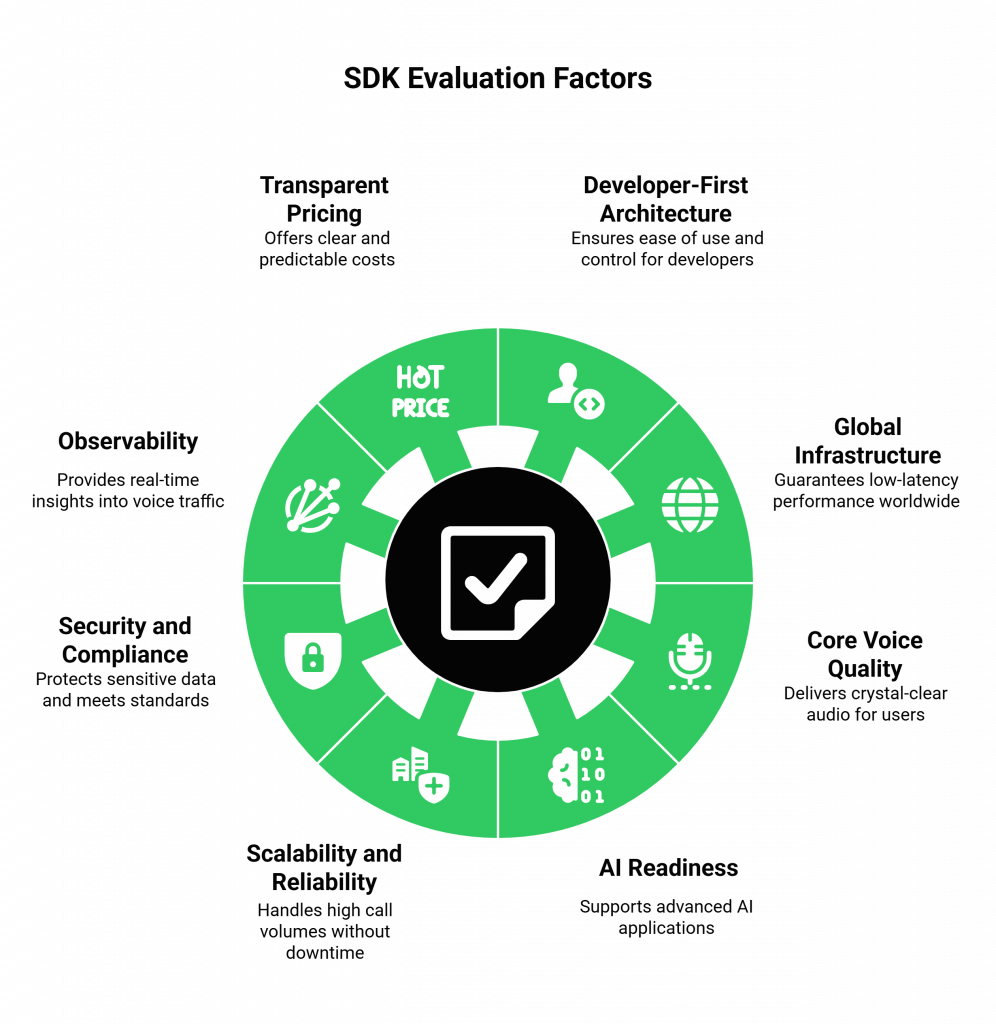
1. Architectural Philosophy: Is It Truly Developer-First?
This is the most important, and sometimes most subtle, factor. A true developer-first platform is not just a legacy telecom service with an API bolted on. It is a system that is architected from the ground up to be controlled by code.
- Ask: Is every single function, from buying a number to managing a live call, accessible via a clean, well-documented API? Are the SDKs in my preferred languages actively maintained and feature-rich? Is the documentation filled with real-world code examples and tutorials?
2. Global Infrastructure: Is It Built for Low-Latency Performance?
The quality of a voice call is a direct function of the underlying network’s architecture. For real-time voice, especially for AI, latency is the enemy.
- Ask: Does the provider have a globally distributed network of Points of Presence (PoPs)? Does the platform automatically route calls to the PoP closest to the end-user (an “edge-native” architecture)? What is their publicly stated average latency and jitter performance?
Also Read: From Chatbots to Callbots: How the Best Voice APIs Are Redefining Business Communication
3. Core Voice Quality: What is Under the Hood?
Crystal-clear audio is non-negotiable. This is determined by the provider’s network and the technology they employ.
- Ask: Does the provider have direct, Tier-1 carrier interconnections, or are they reselling lower-quality routes? Do they support modern, high-fidelity audio codecs like Opus? Do they offer advanced features like AI-powered noise cancellation or Packet Loss Concealment (PLC)?
4. AI Readiness: Can It Power the Next Generation?
If voice AI is on your roadmap, this is a make-or-break factor. This is where you separate a basic voice calling SDK from the best SDK for AI apps.
- Ask: Does the platform provide a simple, powerful API for accessing the raw, real-time media stream of a live call? Is this feature a core part of their offering or a complex, add-on product? Is the platform model-agnostic, allowing me to bring my own STT, LLM, and TTS models?
5. Scalability and Reliability: Can It Handle My Busiest Day?
Your voice platform is a mission-critical service. It must be as reliable as your database and as scalable as your web servers.
- Ask: Does the provider offer a financially backed Service Level Agreement (SLA) for uptime (look for 99.99% or higher)? Is their infrastructure truly elastic, able to handle a massive, sudden spike in call volume without any manual intervention? A recent report on enterprise IT found that downtime costs businesses an average of $9,000 per minute, making reliability a critical financial consideration.
6. Security and Compliance: Is My Data Safe?
Voice calls often carry sensitive information. Your provider must be a trusted steward of this data.
- Ask: Does the platform support end-to-end encryption with TLS for signaling and SRTP for media? Can they demonstrate compliance with major international standards like SOC 2, ISO 27001, and GDPR? Are they willing to sign a Business Associate Agreement (BAA) for HIPAA-compliant healthcare applications?
7. Observability: Can I See What’s Going On?
When something goes wrong, you need deep, real-time visibility into your voice traffic. A “black box” provider is a debugging nightmare.
- Ask: Does the platform provide detailed, per-call logs and quality metrics via an API? Does it offer a real-time analytics dashboard? Does it have a robust webhook system to notify my application of every event in a call’s lifecycle?
Also Read: Best Voice API for Global Business Communication: What to Look for Before You Build
8. Pricing Model: Is It Transparent and Predictable?
The business model must be as modern and flexible as the technology.
- Ask: Is the pricing a simple, pay-as-you-go model, or are there complex, long-term contracts and hidden channel commitments? Is the pricing for all features, including advanced ones like media streaming, clearly documented and easy to understand? The move to usage-based pricing is a major trend, with one study showing that over 56% of SaaS companies are now experimenting with this model.
Ready to evaluate a platform that was built to excel in all eight of these critical areas? Sign up for FreJun AI and put our voice calling SDK to the test.
The FreJun AI Difference: An SDK Built for the Future
At FreJun AI, our Teler platform and our voice calling SDK were architected from day one to be the answer to this SDK comparison checklist. Our philosophy is to provide the most powerful, flexible, and developer-friendly building blocks for any voice application.
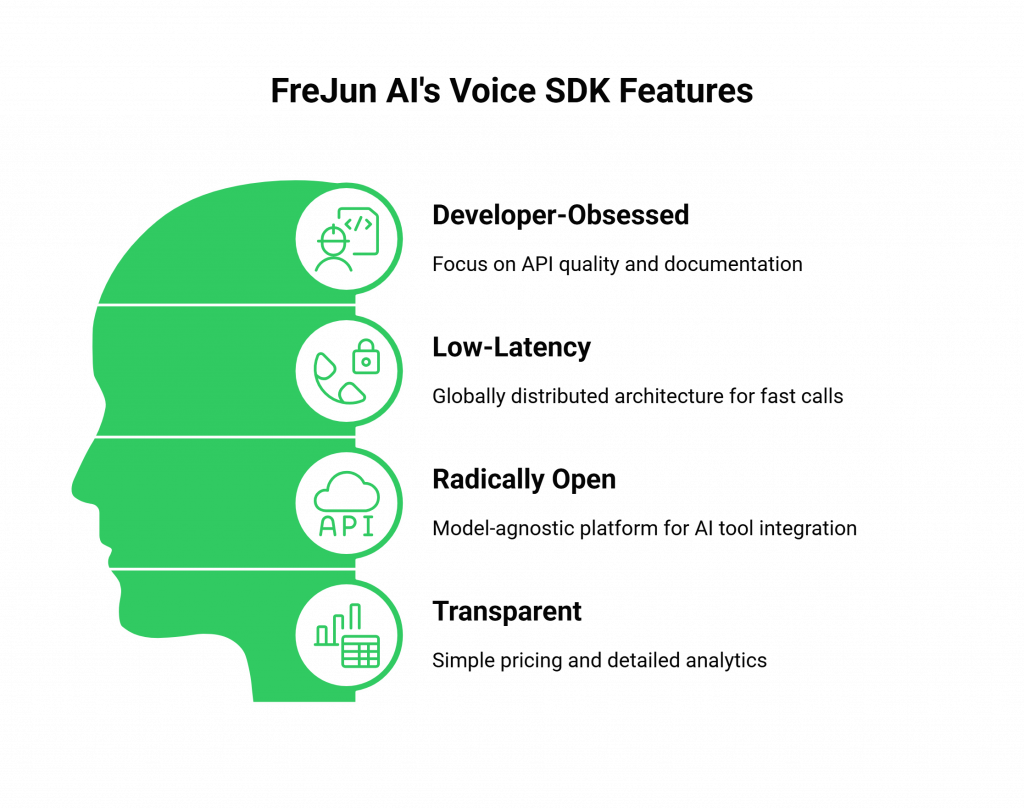
- We are Developer-Obsessed: Our APIs are the core of our product, and our documentation is our most important piece of content.
- We are Built for Low-Latency: Our globally distributed, edge-native architecture is designed to deliver the fastest possible experience for secure voice calls for AI and human conversations alike.
- We are Radically Open: Our platform is model-agnostic, giving you the freedom to build with the best AI tools on the market.
- We are Transparent: From our simple, pay-as-you-go pricing to our detailed analytics, we believe in giving you the visibility and control you need to succeed.
Also Read: LLMs + Voice APIs: The Perfect Duo for Next-Gen Business Communication
Conclusion
The process of choosing a voice SDK is a defining moment in the lifecycle of your product. It is a decision that will have a lasting impact on your user experience, your development velocity, and your ability to innovate.
By moving beyond a superficial feature comparison and conducting a rigorous, architectural evaluation based on the critical factors of developer experience, performance, scalability, and security, you can make a choice with confidence.
The best voice API for business communications is not just the one that allows you to make a call today; it is the one that empowers you to build the future of conversation tomorrow.
Want a personalized consultation to see how the FreJun AI platform aligns with your specific product requirements? Schedule a demo with our team at FreJun Teler.
Also Read: United Kingdom Country Code Explained
Frequently Asked Questions (FAQs)
While all eight factors are critical, the most foundational is the provider’s Architectural Philosophy. A truly developer-first platform will naturally lead to a better experience in terms of ease of use, flexibility, and the power to build innovative features.
The best way is to build a small proof-of-concept. Sign up for a developer account (most providers offer a free trial), get a number, and make some test calls from different geographic locations and on different network types. This hands-on experience is more valuable than any marketing claim.
An edge-native architecture means the provider has a globally distributed network of servers. It matters because it allows your user’s call to be handled by a server that is physically close to them, which is the most effective way to reduce latency and improve call quality.
It means the voice calling SDK and its platform are not tied to a specific provider of AI models. This gives you the freedom to choose the best SDK for AI apps because you can pair it with the best STT, LLM, and TTS models from any vendor (like OpenAI, Google, etc.).
An SLA is a formal commitment from the provider about the reliability and uptime of their service. A financially backed SLA (e.g., 99.99%) means the provider will have to issue you a service credit if they fail to meet that uptime promise, which is a strong signal of their confidence in their platform.