
For a modern enterprise, the voice channel is undergoing a profound and rapid transformation. The phone call is no longer a simple, one-dimensional conversation; it is evolving into a rich, data-driven, and increasingly automated touchpoint at the heart of the customer experience.
Enterprises are moving beyond simply having a phone system to strategically building their own unique voice experiences, from intelligent, AI-powered customer service agents to seamless, in-app support calls. The core technology enabling this revolution is the voice calling SDK.
This shift represents a monumental change in how large organizations approach their communication infrastructure. The old model of buying a monolithic, one-size-fits-all phone system from a legacy vendor is being replaced by a more agile, flexible, and powerful approach: building custom voice solutions on top of a programmable, cloud-native platform.
An enterprise voice SDK is the key that unlocks this capability, transforming the global telephone network into a simple, scalable, and intelligent feature of the enterprise’s own software.
This article will explore why this transition is happening, what a modern voice calling SDK provides, and how it is the essential foundation for scaling voice AI for businesses.
Table of contents
Why is the Traditional Enterprise Telecom Model Broken?
For decades, the enterprise telecom stack was a fortress built on proprietary hardware and long-term contracts. It was a world of on-premise PBXs, complex multi-year carrier agreements, and a rigid separation between the “phone guys” and the software development team. This model is fundamentally broken for a modern, agile enterprise.
The Prison of Inflexibility
The old model was the antithesis of agility.
- Slow to Change: Standing up a new contact center in a new region or even just adding a new phone number for a marketing campaign was a slow, manual process that could take weeks or months of procurement and configuration.
- A “Black Box” System: The phone system was a closed, monolithic black box. It was not designed to be integrated with other business systems. Getting call data into a CRM or building any kind of custom logic was a complex and expensive custom integration project, if it was possible at all.
- The Scalability Trap: Capacity was tied to physical hardware (like PRI lines) or rigid, pre-purchased channels. This forced enterprises into a wasteful “pay for peak” model and made it impossible to handle sudden, unexpected surges in call volume.
The Rise of Customer Experience as a Differentiator
In today’s market, the customer experience is everything. A recent study by PwC found that 86% of buyers are willing to pay more for a great customer experience. A clunky, disconnected, and inefficient voice experience is a direct threat to an enterprise’s brand and its bottom line. The traditional telecom model, with its long hold times and inability to integrate with customer data, is a major source of this poor experience.
Also Read: Best Voice API for Global Business Communication: What to Look for Before You Build
What is a Modern Voice Calling SDK and How Does it Solve These Problems?
A voice calling SDK (Software Development Kit) is a powerful layer of abstraction that sits on top of a global, cloud-native voice network (often called a Communication Platform as a Service, or CPaaS). It takes the immense, underlying complexity of global telecommunications and presents it to an enterprise’s development team as a simple, programmable, and powerful set of software tools.
It is, in essence, the cloud telephony SDK that allows your software engineers, not telecom specialists, to build, manage, and scale your voice communications.
The Key Capabilities of an Enterprise Voice SDK
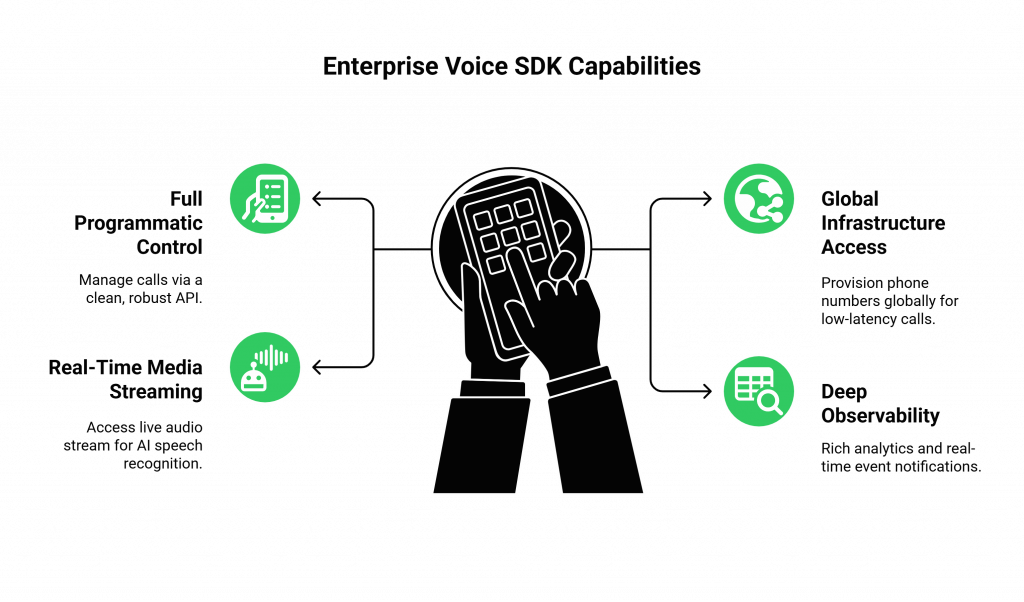
A truly enterprise voice SDK provides a comprehensive toolkit for building mission-critical voice applications. The features include:
- Full Programmatic Control: The ability to make outbound calls, receive inbound calls, and manage every aspect of the live call flow (hold, mute, transfer, record, etc.) via a clean, robust API.
- Global Infrastructure Access: The SDK is the gateway to a pre-built, globally distributed network. It allows an enterprise to instantly provision phone numbers in dozens of countries and ensure low-latency, high-quality calls for users anywhere in the world.
- Real-Time Media Streaming: This is the most critical feature for AI. It provides the programmatic access to the live audio stream of a call, which is the essential “input” for any AI’s Speech-to-Text engine.
- Deep Observability: Rich analytics, detailed call logs, and real-time event notifications (webhooks) that provide deep visibility into call performance, quality, and usage.
This API-driven, software-first approach is not just a trend; it is the new standard. A recent report from IDC forecasts that the worldwide CPaaS market, which is driven by these SDKs and APIs, will grow to over $29 billion by 2025, a clear indicator of the massive enterprise shift toward programmable communications.
Ready to empower your development team to build the future of your enterprise’s communications? Sign up for FreJun AI and explore our powerful enterprise voice SDK.
Also Read: LLMs + Voice APIs: The Perfect Duo for Next-Gen Business Communication
How is a Voice Calling SDK the Foundation for Scalable AI Calling?
The ability to build and deploy scalable AI calling solutions is one of the most powerful strategic advantages for a modern enterprise. An voice calling SDK is the non-negotiable prerequisite for this.
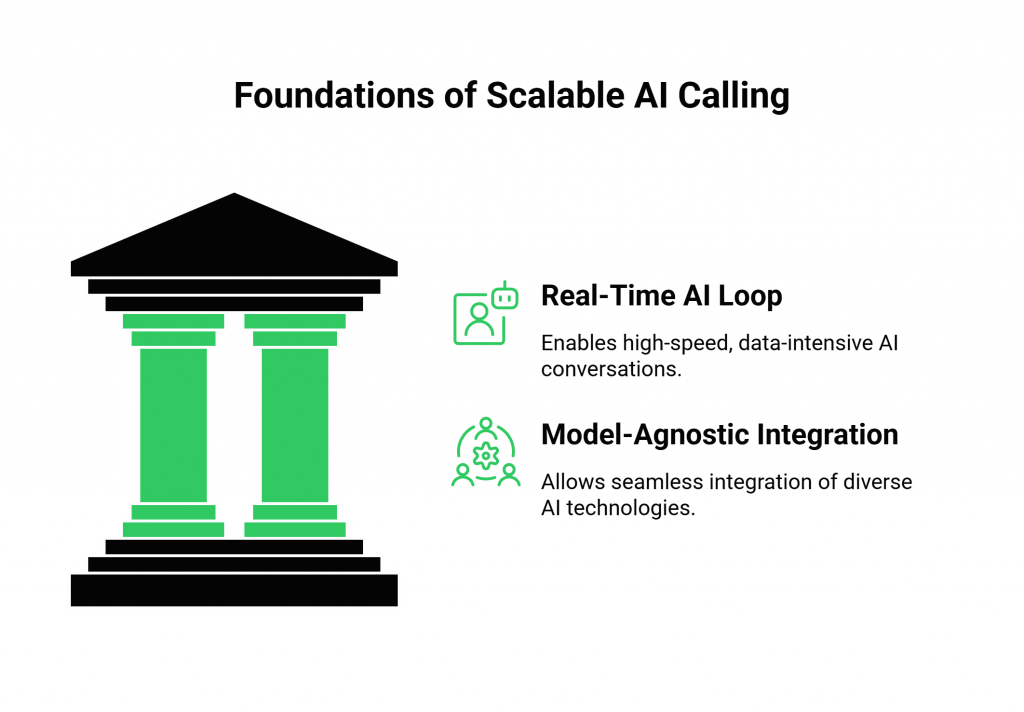
Enabling the Real-Time AI Conversational Loop
An AI conversation is a high-speed, data-intensive loop. The SDK and its underlying platform are what make this loop possible at scale.
- The Call Connection: The SDK, powered by an elastic SIP trunking infrastructure, handles the initial call connection at a global edge location to minimize latency.
- The Media Stream: The SDK’s real-time media streaming feature allows your AI application to get a live audio feed of the caller’s voice.
- The AI “Brain”: This audio is passed to your AI stack (STT, LLM, TTS) for processing.
- The Response: Your application uses the SDK’s call control functions to play the AI’s synthesized audio response back to the caller.
This loop must complete in a fraction of a second for the conversation to feel natural. A provider like FreJun AI builds an enterprise voice SDK on a low-latency AI voice platform specifically architected to support this high-speed data exchange.
Building a Bridge, Not a Silo
A key benefit of a modern voice calling SDK is that it is design to be a bridge, not another silo. It is model-agnostic, meaning you are not locked into a specific AI provider. This allows you to build a best-in-class voice AI for businesses by integrating the most powerful LLM from one provider, the most accurate STT from another, and the most natural-sounding TTS from a third. The SDK’s job is to seamlessly connect your chosen AI brain to the global voice network.
This table provides a summary of how a cloud telephony SDK meets the needs of a modern enterprise.
| Enterprise Need | Traditional Telecom Model | Voice Calling SDK Model |
| Agility & Speed | Slow, manual procurement and configuration. | Fast, programmatic control; build new experiences in days. |
| Scalability | Rigid, fixed capacity; cannot handle spikes. | Elastic and on-demand; scales to any volume instantly. |
| Integration | A closed “black box”; difficult to integrate. | API-first design; built for deep integration with business systems. |
| AI Readiness | No access to real-time media; unsuitable for AI. | Direct, real-time media streaming is a core feature. |
| Global Reach | Requires complex, country-by-country carrier contracts. | Provides instant, unified access to a global network via a single API. |
Also Read: Voice AI in Fleet Dispatch Systems
Conclusion
The era of viewing enterprise telephony as a static, monolithic utility is over. In the modern business landscape, voice is a dynamic, programmable, and strategic channel for customer engagement and operational automation.
A voice calling SDK is the technology that enables this transformation. It provides the powerful layer of abstraction that frees an enterprise’s development team from the immense complexity of global telecommunications and empowers them to build the custom, intelligent, and scalable voice experiences that will define the future of business communication.
For any enterprise looking to harness the power of scalable AI calling and build a truly modern voice AI for businesses, adopting a powerful and flexible enterprise voice SDK is the first and most important step.
Want to discuss your enterprise’s specific use case and see how our voice calling SDK can integrate with your existing technology stack? Schedule a demo with our team at FreJun Teler.
Also Read: Call Log: Everything You Need to Know About Call Records
Frequently Asked Questions (FAQs)
A voice calling SDK (Software Development Kit) is a set of software libraries and tools. It allows a developer to easily integrate voice calling features, like making and receiving phone calls, directly into their own web or mobile applications.
An enterprise voice SDK is built for the demands of a large organization. It includes features like carrier-grade reliability with SLAs, robust security and compliance (like SOC 2 and HIPAA support), advanced analytics, and the ability to scale to a massive volume of calls.
A cloud telephony SDK is another term for a voice calling SDK that is provided by a cloud-based communication platform (CPaaS). It allows developers to access the power of a global voice network without needing any on-premise hardware.
It provides two key ingredients for scalable AI calling. First, the underlying infrastructure is elastic, meaning it can handle a massive, sudden spike in call volume. Second, it provides the real-time media streaming API that is necessary for the AI to “hear” the caller and have a conversation.
The SDK is the bridge. The business builds its voice AI for businesses (the STT, LLM, and TTS models). They then use the SDK to connect this AI “brain” to the telephone network. It allows to answer calls, listen to the caller (via media streaming), and speak its response.
No. This is a key advantage. The SDK is designed for software developers. It abstracts away the low-level telecom complexity, allowing a developer who is familiar with standard web APIs to build powerful voice applications.
Yes. A key feature of a modern enterprise voice SDK is that it is model-agnostic. FreJun AI allows you to bring your own AI models. It gives you complete control over your agent’s intelligence and preventing vendor lock-in.
Yes, provided you choose a provider with a strong security posture. A reputable provider will offer end-to-end encryption (TLS/SRTP). It will be compliant with major security and privacy standards like SOC 2, ISO 27001, and HIPAA.
FreJun AI’s voice calling SDK is the developer-friendly front-end to our powerful, globally distributed Teler engine. We provide the combination of a low-latency infrastructure, a powerful and easy-to-use API, and a model-agnostic philosophy. It makes us the ideal platform for enterprises looking to build the next generation of voice experiences.