
In the anatomy of a modern, fast-growing business, the communication stack often resembles a Frankenstein’s monster. The SMS alerts are powered by one vendor’s API. The in-app VoIP calls run on another. The core connection to the global telephone network is handled by a separate elastic SIP trunking provider.
Each component was chosen at a different time to solve a specific problem, and now, your development team is saddled with the thankless, never-ending job of stitching them all together. This is the “integration tax”, a hidden but massive drain on your resources, agility, and capacity for innovation.
The strategic solution to this chaos is not a better integration tool; it is a fundamental shift in architectural philosophy. It is the move away from a collection of disparate parts and toward a single, cohesive platform: a unified voice API. For a CTO or a Head of Product, this is not just a matter of technical elegance.
Adopting a unified approach to centralizing communication infrastructure is one of the most impactful decisions you can make to accelerate your roadmap, reduce operational overhead, and build a truly scalable foundation for all future customer interactions.
This article will explore why a single API for telephony and VoIP is the cornerstone of the best voice API for business communications.
Table of contents
What is the “Fragmented Communications Stack”?
The fragmented communications stack is the default state for many scaling businesses. It is a technical debt that accumulates naturally over time, and its costs are often hidden until they become a major bottleneck. This fragmentation manifests in several key ways:
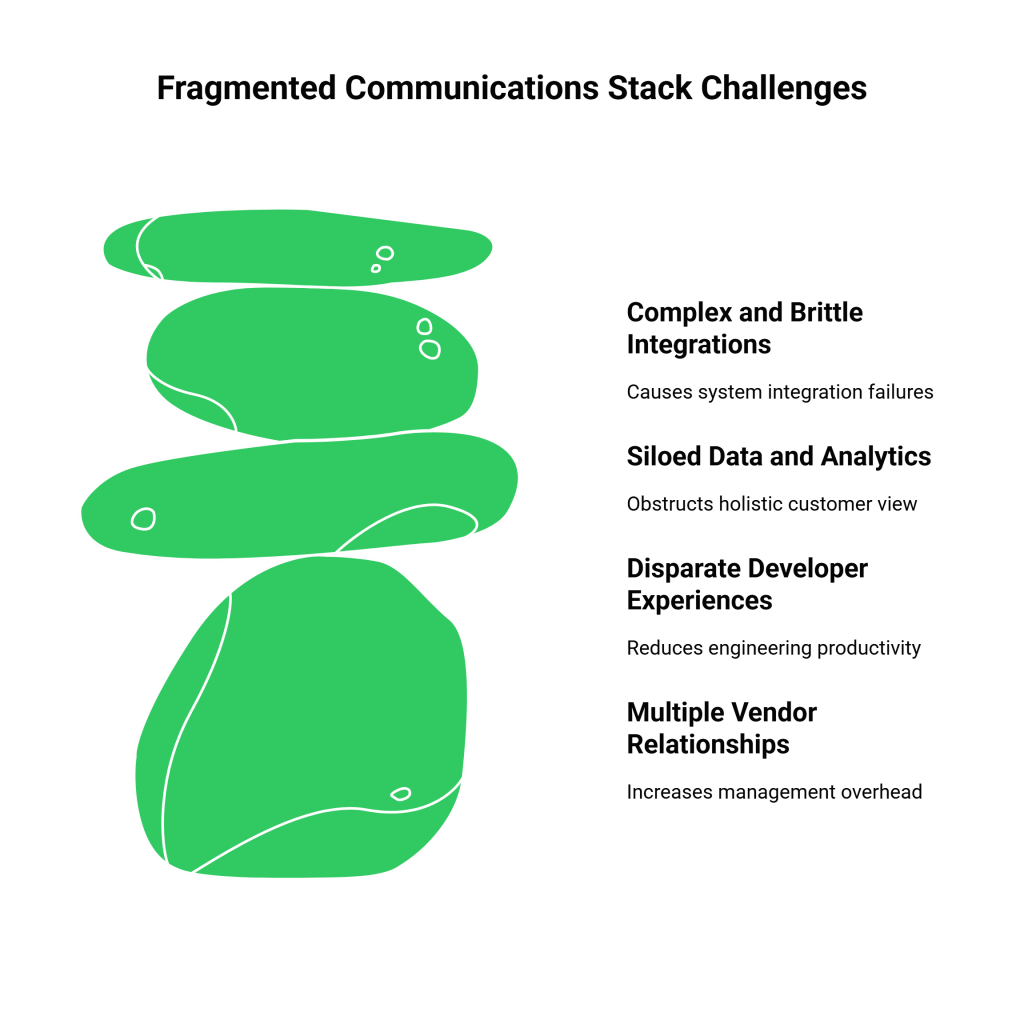
- Multiple Vendor Relationships: You have separate contracts, separate invoices, and separate support contacts for your SIP trunking provider, your API provider for in-app calling (WebRTC), and potentially another for SMS or other channels.
- Disparate Developer Experiences: Your engineering team must learn and maintain codebases for multiple APIs, each with its own authentication methods, SDKs, error codes, and documentation quirks. This cognitive load is a significant drag on productivity.
- Siloed Data and Analytics: Your call data is scattered across different platforms. The logs from your SIP trunk are in one place, while the logs for your AI voice agent’s performance are in another. This makes it incredibly difficult to get a single, holistic view of a customer’s journey or to troubleshoot a problem that spans multiple systems.
- Complex and Brittle Integrations: The “glue” holding these systems together is often a series of custom, brittle integrations built and maintained by your team. When one vendor updates their API, the entire chain can break, leading to frantic, unscheduled engineering work. The complexity of managing this kind of IT sprawl is a major concern for business leaders. A recent report from Gartner highlighted that IT complexity is one of the top barriers to achieving digital business objectives.
How Does a Unified Voice API Solve This Fragmentation?
A unified voice API is the architectural antidote to this complexity. It is a single, consistent, and powerful interface that provides access to a full spectrum of communication capabilities from a single provider. It is the embodiment of the single API for telephony and VoIP concept, and often extends even further.
Instead of having separate, specialized APIs for each function, a unified platform provides one API that can:
- Provision and manage phone numbers globally.
- Handle high-capacity, carrier-grade elastic SIP trunking.
- Initiate and control in-app VoIP calls using WebRTC.
- Provide real-time, programmatic access to media streams for AI integration.
- Orchestrate complex call flows that can seamlessly move between the PSTN and IP-based endpoints.
Also Read: How Media Streaming Powers Human-Like Conversations in AI Voice Agents
What Are the Strategic Benefits of a Unified Voice API?
The move to a unified model is not just about cleaning up your architecture diagram. It delivers a powerful set of strategic business advantages that are essential for any company that views communication as a competitive differentiator. These are the core benefits of unified voice APIs.
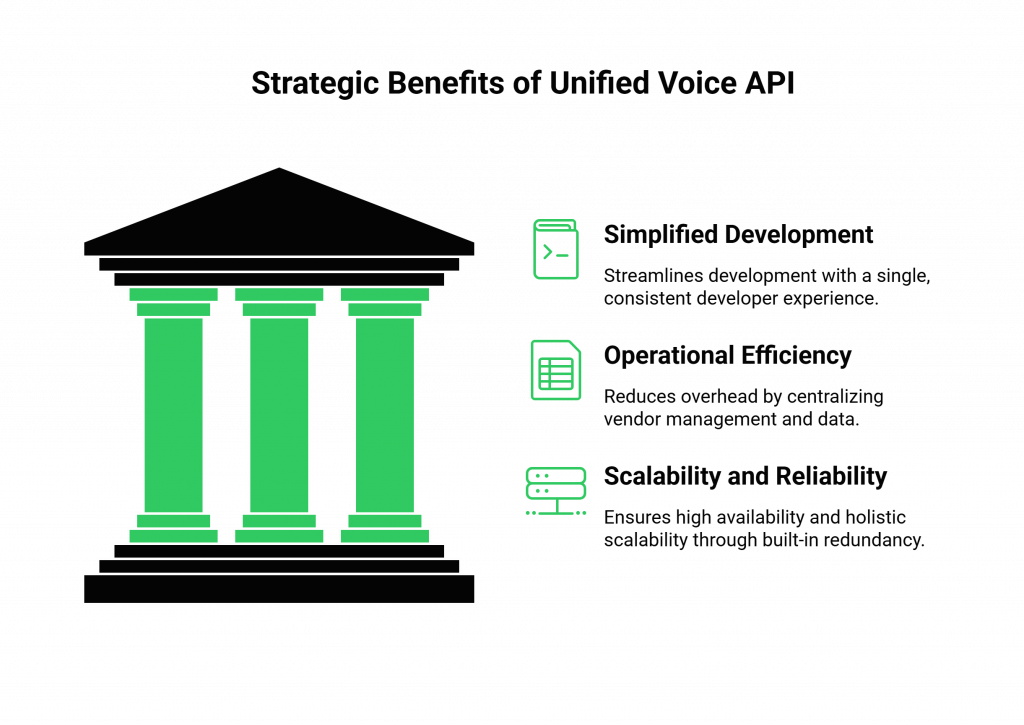
Radically Simplified Development and Faster Time-to-Market
This is the most immediate and impactful benefit. By providing a single, consistent developer experience, a unified API acts as a massive productivity multiplier for your engineering team.
- One API to Rule Them All: Your team only has to learn one set of documentation, one authentication model, and one set of SDKs. This dramatically reduces the learning curve and the cognitive load required to build and maintain your communication features.
- Accelerated Innovation: When developers are not wasting time managing multiple vendor integrations, they can spend their time building features that create value for your customers. A recent study by Harvard Business Review and Stripe found that access to better developer tools and APIs can increase developer productivity by as much as 42%, a staggering figure that translates directly into a faster time-to-market.
Unprecedented Operational Efficiency
Centralizing communication infrastructure under a single, unified platform eliminates a huge amount of operational overhead.
- Simplified Vendor Management: You have one contract, one invoice, one support team to call, and one platform to master. This simplifies procurement, accounting, and IT administration.
- A Single Source of Truth: All of your call data, logs, and analytics are in one place. This makes troubleshooting a problem exponentially easier. You can trace the entire lifecycle of a call, from the initial SIP invite to the final API command, within a single, unified dashboard.
Superior Scalability and Reliability
When you use a fragmented stack, you are responsible for the reliability of the connections between your vendors. With a unified platform, that responsibility shifts to the provider.
- Built-in Redundancy: A true unified provider manages a complex, global network of carrier relationships and data centers. The platform delivers high availability by automatically routing traffic around carrier outages or network congestion, providing a level of reliability that is nearly impossible to achieve by stitching together multiple services.
- Holistic Scalability: You no longer have to worry if your SIP trunk can handle the volume generated by your web application. The entire platform is designed to scale holistically, ensuring that every component can handle the load.
This table provides a stark contrast between the two approaches:
| Dimension | Fragmented Communications Stack | Unified Voice API Platform |
| Development | Multiple APIs, SDKs, and auth models to learn and maintain. | One single, consistent API and developer experience. |
| Operations | Multiple vendors, invoices, and support teams. Siloed data. | Single vendor management. Centralized data and analytics. |
| Reliability | You are responsible for the “glue.” Brittle integrations are a point of failure. | The platform provides built-in redundancy and managed reliability. |
| Customer Experience | Can be disjointed. Difficult to create a seamless cross-channel journey. | Cohesive and consistent. Easy to build holistic, cross-channel workflows. |
| Innovation Speed | Slow. Resources are wasted on integration and maintenance. | Fast. Resources are focused on building value-added features. |
Ready to free your developers from the integration tax and start building faster? Sign up for FreJun AI and experience the power of a truly unified voice API.
Also Read: Voice AI API: Bringing Intelligence to Voice Communication Systems
How Does FreJun Teler Delivers the Best Unified Voice API Experience?
The FreJun Teler architecture is the embodiment of the unified approach. We saw the fragmentation and complexity in the market and made a deliberate choice to build a single, cohesive platform that solves the entire voice communication problem for developers.
Our Teler engine is a single, programmable layer that seamlessly handles every aspect of voice:
- It is a carrier-grade elastic SIP trunking provider.
- It is a powerful WebRTC platform for in-app VoIP calling.
- It is a real-time media server for AI integration.
And all of this power is accessible through one simple, elegant, and powerful API. This is what we believe defines the best voice API for business communications.
We handle the immense underlying complexity of the global voice network so that you can interact with it through a single, logical interface. This is our core promise: “We handle the complex voice infrastructure so you can focus on building your AI.”
Also Read: The Complete Guide to Low-Latency Media Streaming for Developers
Conclusion
The fragmented communications stack is a hidden anchor that is weighing down the agility and innovation of countless businesses. The time, money, and developer talent wasted on managing a patchwork of disparate voice services is a massive opportunity cost.
A unified voice API is the strategic and architectural solution to this problem. By centralizing communication infrastructure onto a single, powerful, and programmable platform, you can unlock unprecedented levels of developer productivity, operational efficiency, and reliability.
This is more than just a technical decision; it is a business decision to stop building the plumbing and to start building the future of customer communication.
Have a complex, fragmented communication stack you are looking to modernize? Schedule a demo for FreJun Teler.
Also Read: How to Log a Call in Salesforce: A Complete Setup Guide
Frequently Asked Questions (FAQs)
A unified voice API is a single programming interface from one provider that allows developers to access a full range of voice communication capabilities, including elastic SIP trunking, in-app VoIP calls (WebRTC), and real-time media streaming for AI, all without needing to integrate with multiple different vendors.
The main benefit is a dramatic simplification of the development process. By providing one consistent API to learn and use, it allows engineering teams to build and deploy sophisticated voice features much faster than if they had to stitch together multiple different services.
No. UCaaS (Unified Communications as a Service) and CCaaS (Contact Center as a Service) are typically finished, off-the-shelf software applications. A unified voice API is a lower-level infrastructure platform (a CPaaS) that gives developers the building blocks to create their own custom applications.
It means moving from a model where you have multiple different vendors and technologies handling different parts of your voice communication to a model where a single, cohesive platform handles all of your voice needs, from PSTN connectivity to in-app calling.
Yes. A modern, well-architected platform like FreJun Teler is designed from the ground up to handle both. It uses a sophisticated underlying engine that can seamlessly bridge the world of traditional telephony (PSTN) and the world of internet-based voice (VoIP) and present it all through a single, logical API.
Quite the opposite. A good unified API is designed to provide maximum flexibility and granular control. Because the entire platform is programmable, you actually have more control over your call flows and user experiences than you would with a collection of rigid, disparate systems.
It is essential for AI. It provides a single point of integration for both connecting to the phone network (via SIP trunking) and getting access to the real-time media stream that the AI needs to “hear.” This simplifies the architecture of your AI application immensely.
It is typically a pay-as-you-go, usage-based model, similar to other cloud services. You pay for the phone numbers you rent, the minutes you use, and any other specific platform features, with no large upfront costs or long-term contracts.
The FreJun Teler architecture delivers the best experience because it embraces three core principles: a developer-first mindset with a powerful, simple API; a globally distributed infrastructure that ensures low latency and high reliability; and a model-agnostic approach to AI that maximizes flexibility.
The migration can be done in phases. You can start by moving one piece of your communication, like your elastic SIP trunking, to the unified platform. Once that is stable, you can then use the same platform’s API to rebuild your other voice features, like your IVR or in-app calling, allowing you to gradually consolidate onto the single platform.