
For decades, the business phone system was a fixed, predictable, and somewhat uninspiring utility. It was a necessary tool, but hardly a source of innovation. That era is definitively over. Today, voice is being reborn as a dynamic, programmable, and incredibly powerful channel for customer engagement, all thanks to a single, transformative technology: the voice API.
By moving beyond traditional, hardware-based telephony and embracing a software-driven approach, businesses are unlocking a new level of agility, intelligence, and efficiency.
The search for the best voice API for business communications is no longer a niche concern for tech startups; it is a strategic imperative for any company looking to build a modern customer experience.
A voice API is more than just a way to make and receive calls over the internet. It is a complete developer toolkit that transforms voice from a simple utility into a fully programmable component of your business’s software stack.
This shift from a static tool to a dynamic platform unleashes a host of powerful benefits that can reshape your customer interactions, streamline your operations, and provide a significant competitive edge.
This article will explore the top five benefits of integrating a voice API into your business communication strategy.
Table of contents
Radical Cost Reduction and Operational Efficiency
This is often the most immediate and tangible benefit. The traditional model of business telephony is a story of high costs and gross inefficiency, both in terms of hardware and human labor. A voice API provides a powerful one-two punch of cost reduction through automation.
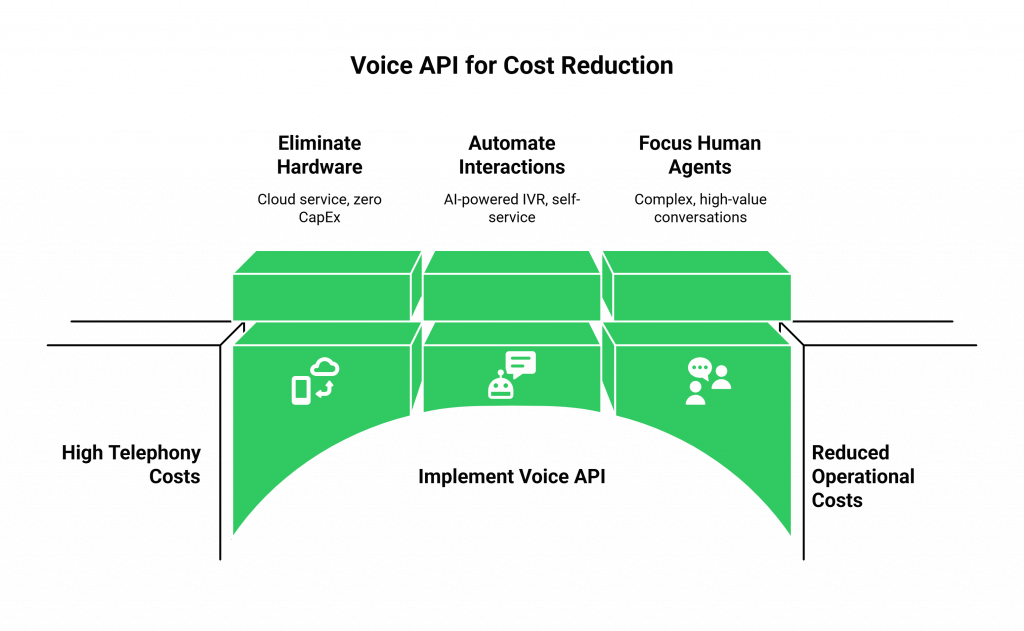
Eliminating the Burden of Hardware
The old world required a massive upfront investment in an on-premise PBX (Private Branch Exchange), a complex piece of hardware that was expensive to buy, install, and maintain. A voice API, delivered as a cloud service, completely eliminates this.
- Zero CapEx: There is no hardware to buy, which means you can stand up a powerful, enterprise-grade voice infrastructure with zero capital expenditure.
- Reduced Maintenance: You are no longer responsible for managing, patching, and upgrading a physical server. The provider handles all the infrastructure complexity, freeing up your IT team.
Automating High-Volume, Low-Value Interactions
This is where the most significant savings are realized. A huge percentage of inbound calls to any business are simple and repetitive.
- The Power of Self-Service: An AI-powered IVR or voicebot, built on a voice API, can handle the vast majority of these routine inquiries like checking an order status, paying a bill, or scheduling an appointment, 24/7 and for a fraction of the cost of a human agent. A recent Gartner report underscores this, noting that a self-service interaction can be up to 100 times cheaper than a live agent interaction.
- A More Effective Human Team: By automating the simple, repetitive tasks, you free up your skilled human agents to focus on the complex, high-value, and emotionally nuanced conversations where they can make a real difference. This not only makes your contact center more efficient but also improves agent morale and reduces burnout.
Unmatched Scalability and Business Agility
The business world is not static. Demand fluctuates, new opportunities arise, and crises can emerge without warning. A communication system that cannot adapt to this reality is a liability. The best voice API for business communications uses a foundation of cloud-native elasticity, delivering a level of scalability in voice interactions that traditional hardware simply cannot match.
Effortless Scaling to Meet Any Demand
A voice API is typically built on an elastic SIP trunking infrastructure. This means you are not tied to a fixed number of “lines” or “channels.”
- Handle Any Spike: Whether you are a retailer facing the Black Friday rush, a utility company during a storm, or a startup that has just gone viral, an elastic infrastructure can automatically scale from a handful of calls to tens of thousands of simultaneous conversations in an instant. You never have to worry about a customer hearing a busy signal again.
- Global Reach on Demand: A modern voice API provider has a global network. You can instantly provision local phone numbers in dozens of countries, allowing you to establish a local presence in a new market in a matter of minutes, not months.
The Agility to Innovate at the Speed of Software
Because a voice API is controlled by code, it allows you to build and adapt your communication workflows with incredible speed. Your development team can prototype a new AI-powered IVR, integrate voice notifications into your mobile app, or set up a dedicated line for a new marketing campaign in a single afternoon. This transforms your voice infrastructure from a slow-moving utility into an agile tool for innovation.
Also Read: Citizen Feedback Systems Using Voice AI
A Dramatically Enhanced Customer Experience (CX)
Today, customer experience is the ultimate differentiator. A voice API provides the tools to create communication experiences that are not just functional, but are genuinely seamless, personalized, and respectful of the customer’s time. This is the core of enhanced CX with AI voice. The key improvements to the customer journey include:
- 24/7 Availability: An AI voice agent built on a voice API is always on. A customer can get an answer to their question or solve their problem at 10 PM on a Saturday, not just during your 9-to-5 business hours.
- Zero Hold Time: By using AI to handle the initial call volume, you can ensure that a customer’s call is answered instantly, every single time. This single improvement can have a massive impact on customer satisfaction. A recent study found that 66% of customers are frustrated by having to wait on hold.
- Personalized and Context-Aware Interactions: Because the voice API is integrated with your other business systems (like your CRM), the conversations can be highly personalized. The AI can greet the customer by name, know their order history, and provide context-aware support, making the customer feel known and valued.
This table summarizes the core benefits for your business and your customers:
| Benefit | Impact on Business Operations | Impact on Customer Experience |
| Cost Reduction & Efficiency | Lower telecom and labor costs; frees up human agents for high-value work. | Faster resolutions due to efficient automation and better-utilized agents. |
| Scalability & Agility | Instantly handle any call volume; faster time-to-market for new voice features. | Never get a busy signal, even during peak times. |
| Enhanced CX | Builds brand loyalty and reduces customer churn. | Instant, 24/7 service with zero hold time and personalized interactions. |
| Deeper Data & Insights | Captures structured data from every call; provides a single source of truth. | Leads to better products and services based on analyzed feedback. |
| Increased Security & Compliance | Centralizes security controls; simplifies compliance for things like PCI. | Greater peace of mind that their data is being handled securely. |
Ready to unlock these benefits for your own business? Sign up for FreJun AI and explore our powerful API.
Deeper Data, Analytics, and Business Insights
A traditional phone call is an ephemeral event. A conversation happens, and then it is gone, with the only record being a manual note in a CRM, if you are lucky.
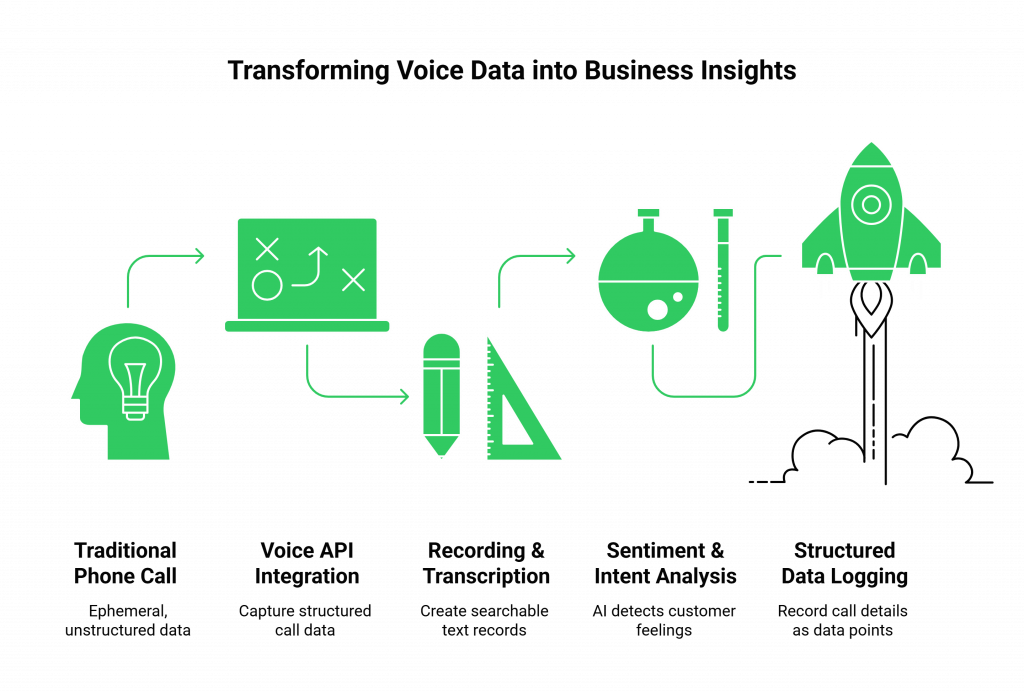
A call that passes through a voice API is a rich, structured data event that can be captured, analyzed, and turned into valuable business intelligence. Every call can be automatically:
- Recorded and Transcribed: This creates a complete, searchable text record of every customer conversation.
- Analyzed for Sentiment and Intent: AI models analyze these transcriptions to automatically detect customer sentiment, identify the primary reason for the call, and spot emerging trends or problems.
- Logged as a Structured Event: Every detail of the call including the caller’s number, the time, the duration, the outcome is logged as a structured data point.
It turns your voice channel from a communications black box into a rich source of data that helps you improve your products, refine your marketing, and train your support teams.
Also Read: How to Design Production-Grade Agent Workflows with AgentKit and Teler’s Realtime Layer
Increased Security and Compliance
In a world of increasing data privacy regulations and security threats, managing a fragmented, on-premise phone system can be a major compliance headache. The best voice API for business communications centralizes your voice infrastructure in a secure, cloud environment, making it much easier to manage security and compliance.
- Centralized Security Controls: A provider like FreJun AI implements robust security measures at the platform level, including encryption (TLS/SRTP), secure authentication, and protection against denial-of-service attacks.
- Simplified Compliance: For businesses that handle sensitive information over the phone such as credit card payments (PCI DSS) or health information (HIPAA), a modern voice API provider can not only offer compliant solutions but can also abstract away much of the complexity and risk.
As a result, companies can focus on their core operations while still meeting strict regulatory requirements. Ultimately, this approach makes secure voice communication both easier and more reliable
Also Read: SIP Trunking vs Elastic SIP Trunking: What’s the Difference and Why It Matters
Conclusion
The move to a voice API is not just a technical upgrade; it is a fundamental shift in how a business communicates. It is the key to unlocking the powerful benefits of cost reduction through automation, providing the scalability in voice interactions that a modern business demands, and delivering the enhanced CX with AI voice that customers now expect.
By transforming voice into a programmable, data-rich, and intelligent component of your software stack, the best voice API for business communications gives you the tools to build a more efficient, agile, and customer-centric organization.
Want to see how a voice API can be tailored to your specific business needs and deliver a rapid ROI? Schedule a demo with our team at FreJun Teler.
Also Read: Call Log: Everything You Need to Know About Call Records
Frequently Asked Questions (FAQs)
A voice API is a set of programming tools that allows software applications to control phone calls over the internet. It lets you build your custom voice features, like an automated AI agent or a click-to-call button in app.
It saves money primarily in two ways: by replacing expensive, traditional phone hardware and lines with a more affordable cloud-based service, and by automating routine calls with an AI, which dramatically reduces the labor costs in your contact center.
Not at all. In fact, a voice API is an ideal solution for businesses of all sizes. It is best especially for startups and small businesses. It provides access to enterprise-grade communication features without the high upfront cost or long-term contracts.
Yes. In most cases, you can port your existing phone numbers from your old provider to your new voice API provider. It ensure a seamless transition for your customers.
It improves the customer experience by providing instant, 24/7 service with zero hold time. It also enables personalized, context-aware conversations by integrating with your CRM and other business data.
No. The best voice API for business communications is design to be developer-friendly. If your team already understands standard web technologies and REST APIs, they can start building with a modern voice API.
A high-quality provider like FreJun AI operates its own global, carrier-grade network with a focus on low-latency performance. When used with a stable business internet connection, the call quality is crystal clear and highly reliable.
A voice API lets you manage inbound call flows, such as an AI support agent. It also allows you to initiate outbound calls for tasks like proactive notifications or appointment reminders.