
Today, a voice call is no longer just a conversation; it is a rich, interactive, and often automated experience. From an intelligent AI agent that can process a payment to a seamless, in-app call that connects a customer to a support specialist, voice has become a programmable, data driven channel for customer engagement.
But to build these modern voice experiences, businesses and their developers need more than just a phone line. They need a powerful, flexible, and incredibly reliable foundation. They need the best voice API for business communications.
This is the very problem that FreJun Teler was engineered to solve. We recognized from day one that the future of business voice was not about reselling traditional telecom services with a new label. It was about building a fundamentally new kind of voice infrastructure from the ground up, one that is developer-first, globally scalable, and optimized for the demanding, low-latency world of real-time AI.
The result is an experience that empowers developers to build faster, businesses to scale smarter, and customers to connect more seamlessly than ever before.
This article will pull back the curtain on the core architectural principles and platform features that make FreJun Teler the definitive choice for modern business communications.
Table of contents
What is the Core Philosophy Behind the FreJun Teler Architecture?
To build the best voice API for business communications, you must start with a clear and uncompromising architectural philosophy. The FreJun Teler architecture is built on three core pillars: a developer-first mindset, a globally distributed, edge-native infrastructure, and a model-agnostic approach to AI.
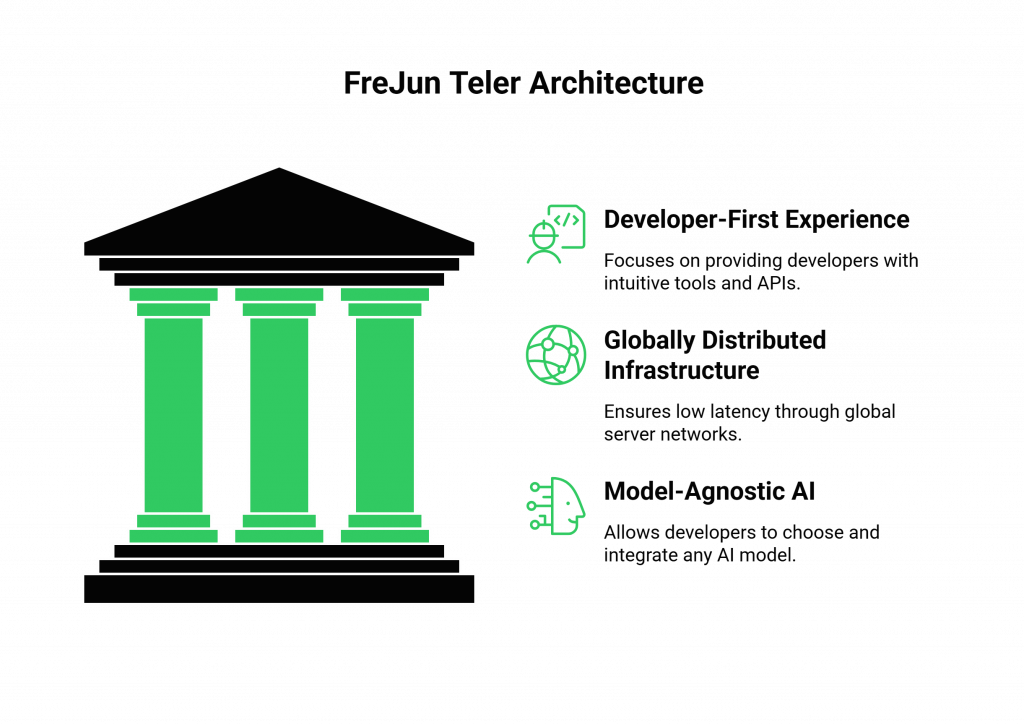
Pillar 1: A Truly Developer-First Experience
This is our foundational principle. We believe that the people building the next generation of voice applications are software developers, not traditional telecom engineers. Therefore, our entire platform is designed to speak their language.
- API-Driven Everything: We do not have features that are “API-accessible.” Our API is the product. Every function of our platform, from provisioning a number to manipulating a live call’s media stream, is controllable via our clean, well-documented, and robust REST APIs.
- Simplicity Through Abstraction: The world of telephony is a swamp of complex, decades-old protocols like SIP and RTP. Teler abstracts all of this away. A developer does not need to know what a SIP header is; they just need to know how to make an HTTP request. This dramatically lowers the barrier to entry and accelerates development time.
- Rich Developer Tools: We provide comprehensive documentation, SDKs in popular programming languages, and a powerful markup language (FML) that makes it incredibly easy to define and control complex call flows.
Pillar 2: A Globally Distributed, Edge-Native Infrastructure
The quality of a voice call, especially an AI-powered one, is defined by its speed. The enemy of speed is latency, and the primary cause of latency is physical distance. The FreJun Teler architecture is designed to defeat distance.
- Global Points of Presence (PoPs): Our Teler engine is not a single, centralized monolith. It is a globally distributed network of servers located in data centers around the world.
- Intelligent Edge Routing: When a call comes in, it is automatically routed to the Teler PoP that is geographically closest to the end-user. This means the call’s “journey” across the internet is as short as possible, which is the key to minimizing latency.
A recent industry report on edge computing highlighted that this architectural approach can reduce latency by over 50%, a critical factor for any low-latency AI voice platform.
Also Read: Integrating Elastic SIP Trunking with Your AI Voice Platform: A Step-by-Step Guide
Pillar 3: A Model-Agnostic Approach to AI
We believe that our job is to provide the best possible “nervous system” for voice, but that you, the developer, are the expert on your “brain.”
- Freedom to Innovate: Teler is completely model-agnostic. We do not lock you into a specific Speech-to-Text (STT), Large Language Model (LLM), or Text-to-Speech (TTS) provider.
- Future-Proof Your Stack: The world of AI is moving at a breathtaking pace. A new, better LLM could be released tomorrow. Our architecture allows you to swap out any component of your AI stack (your “AgentKit”) at any time, without ever having to change your underlying voice infrastructure. This gives you the agility to always be using the best-in-class AI for your specific needs.
How Does This Architecture Enable Superior Voice Experiences?
This architectural philosophy is not just a technical abstraction; it translates directly into tangible, real-world benefits that define the best voice API for business communications.
This table shows how our core architectural pillars translate into key business and developer benefits.
| Architectural Pillar | Key Feature | Direct Benefit for Your Business |
| Developer-First Mindset | Powerful and simple APIs; rich documentation. | Faster Time-to-Market: Your developers can build and deploy sophisticated voice applications in days, not months. |
| Globally Distributed, Edge-Native | Low-latency media processing; intelligent routing. | Superior Call Quality: Your real-time AI calling feels natural and instantaneous, and your human calls are crystal clear. |
| Model-Agnostic AI | Decoupled infrastructure; freedom to choose your own models. | Greater Flexibility and Control: You are never locked into a single AI provider and can always use the best tools for the job. |
The Power of Real-Time AI Calling
The ultimate test of a low-latency AI voice platform is its ability to support a seamless, real-time conversation. Let’s look at how the FreJun Teler architecture makes this possible.
- Instant Connection at the Edge: A call is answered by a Teler server close to the user.
- Real-Time Media Streaming: Our Real-Time Media API allows your application to get a live stream of the call’s audio the instant the user starts speaking.
- The High-Speed AI Loop: This audio is passed to your AI “brain” (your AgentKit) for STT, LLM, and TTS processing.
- Immediate Response: Your AI’s audio response is sent back to the Teler API, which plays it back to the user with minimal delay.
Because each step is optimized for speed and data travels shortest possible distance, the conversation feels natural and fluid. It never sounds stilted or robotic. This is the gold standard for real-time AI calling.
Ready to experience the difference a developer-first, low-latency platform can make? Sign up for FreJun AI and get your API keys to start building.
Also Read: Building Low-Latency Voice Agents with Elastic SIP Trunking and Real-Time Media APIs
What Does Voice API Mean for Your Business?
Choosing the best voice API for business communications is a strategic decision that has a direct impact on your customer experience, your operational efficiency, and your ability to innovate.
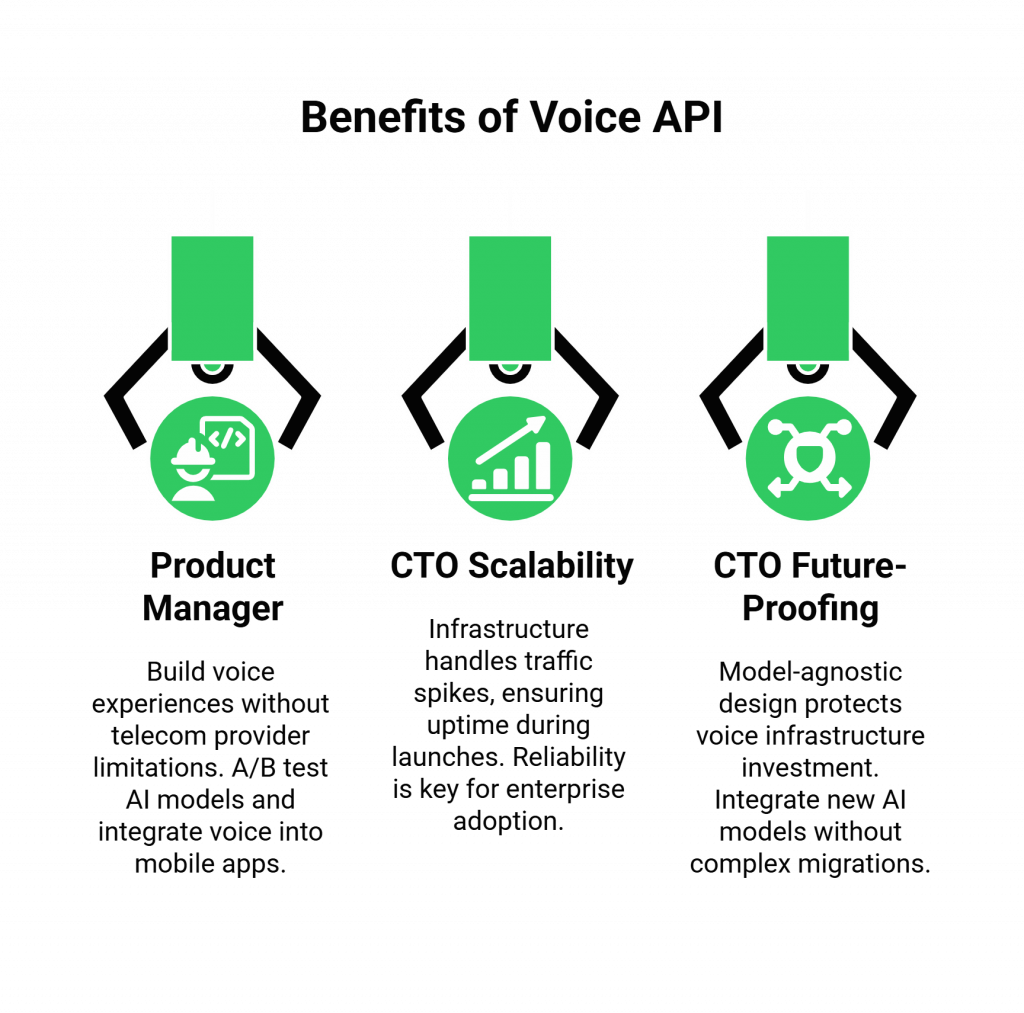
For the Product Manager: Build Without Limits
With a flexible, API-driven platform, your product roadmap is no longer constrained by the limitations of your telecom provider. If you can imagine a voice experience, your developers can build it. You can A/B test different AI models, integrate voice into your mobile app, or create complex, data-driven call routing workflows with ease.
For the CTO: A Future-Proof, Scalable Foundation
The FreJun Teler architecture provides a foundation that is both highly scalable and future-proof.
- Scalability: Our infrastructure is built to handle massive, unpredictable spikes in traffic, ensuring you are always on, even during a major product launch or a viral event. This reliability is a key factor for enterprise adoption, with one study noting that 91% of IT leaders say that platform reliability is their top concern.
- Future-Proofing: By remaining model-agnostic, we ensure that your investment in your voice infrastructure is protected. As the world of AI continues to evolve, you will always be able to integrate the latest and greatest models into your applications without a costly and complex migration.
Also Read: AI Voice Agents for Water Service Support
Conclusion
The world of business communication has irrevocably shifted from static phone lines to dynamic, programmable voice experiences. In this new world, the quality of your voice API is not just a technical detail; it is a core component of your customer experience and a key enabler of your innovation strategy.
The best voice API for business communication is built on developer-centric design, low-latency optimization, and strong architectural flexibility. This is exactly what the FreJun Teler platform delivers.
By hiding the complexity of global telecommunications and offering powerful, reliable, and easy-to-use building blocks, it empowers you to focus on what matters most: building the future of conversation.
Want a personalized tour of the FreJun Teler architecture and a deep dive into our APIs? Schedule a demo for FreJun Teler!
Also Read: United Kingdom Country Code Explained
Frequently Asked Questions (FAQs)
It is a set of programming tools (an API) that allows developers to embed voice communication features like making and receiving phone calls, building AI agents, and managing call flows, directly into their own business applications.
The FreJun Teler architecture is unique because of its three core pillars: it is developer-first (API-driven), globally distributed and edge-native (for low latency), and model-agnostic (giving you the freedom to choose your own AI models).
Low latency is the key to a natural-sounding conversation. A low-latency AI voice platform minimizes the delay between a user speaking and the AI responding. It is essential for a positive user experience in real-time AI calling.
It means the platform is not tied to any single AI provider. You are free to bring your own Speech-to-Text (STT), Large Language Model (LLM), and Text-to-Speech (TTS) models from any vendor (like OpenAI, Google, Anthropic, etc.), giving you maximum flexibility.
No. This is a key benefit. We abstract away the complex, low-level telecom protocols. If your developers are comfortable working with standard web APIs, they have all the skills they need to start building powerful voice applications on our platform.
You can sign up for a developer account on our website. You will get instant access to your API keys, our comprehensive documentation, and a free credit to start building and testing your first voice application in minutes.