
In the not-so-distant past, the power of a business’s phone system was measured in physical terms: the number of copper lines running into the building, the size of the server rack for the on-premise PBX. It was a world of rigid capacity, high costs, and immense complexity.
Then came the first wave of VoIP, and with it, SIP trunking, which began to digitize this old world. But the true revolution, the one that is enabling the current explosion in voice AI, came with the advent of elastic SIP trunking.
This is not just an incremental improvement; it is a fundamental architectural shift that has transformed voice from a static utility into a dynamic, programmable, and incredibly powerful cloud service.
For any business, developer, or IT leader looking to deploy a modern voice AI solution, understanding this foundational layer is not optional; it is essential. An intelligent AI agent is only as good as the nervous system that connects it to the world, and in the world of voice, that nervous system is elastic SIP trunking.
This article will break down what is SIP trunking, explain the critical evolution to an “elastic” model, and explore why this technology is the indispensable engine behind the modern voice AI revolution.
Table of contents
What is SIP Trunking? The Bridge from Old to New
Before we can appreciate the “elastic” part, we must first understand the core technology. SIP, or Session Initiation Protocol, is the open standard for managing real-time communication sessions like voice and video calls, over the internet. A “SIP trunk” is the virtual equivalent of the old, physical PRI lines from the phone company.
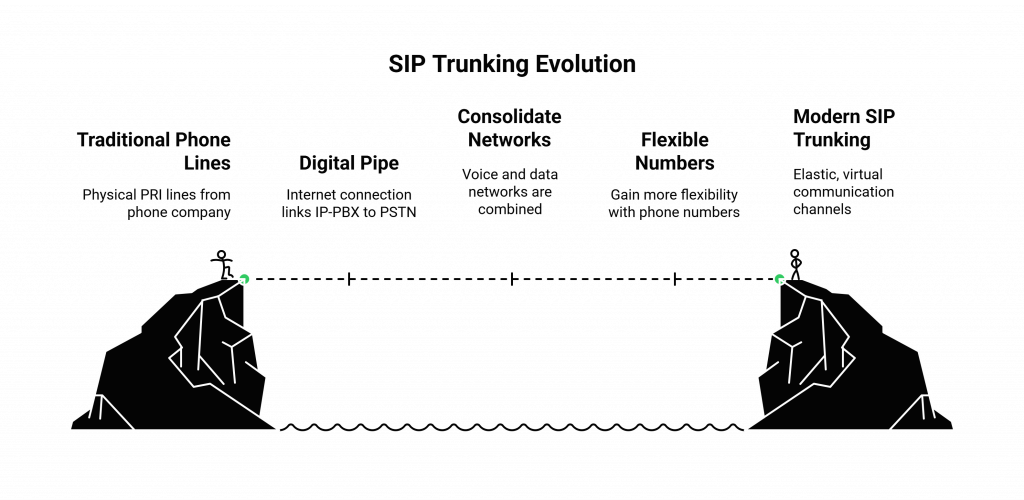
In its most basic form, a SIP trunk is a digital “pipe” that uses your internet connection to link your business’s phone system (your IP-PBX) to the Public Switched Telephone Network (PSTN). This allowed businesses to:
- Make and receive calls over the internet instead of traditional phone lines.
- Consolidate their voice and data networks.
- Gain more flexibility with phone numbers (DIDs).
This was a huge step forward, but the first generation of SIP trunking still carried a major piece of baggage from the old world: the concept of the fixed “channel.”
The “Elastic” Revolution: Breaking Free from Channels
The critical difference between standard SIP trunking and elastic SIP trunking lies in how they handle capacity.
The Old World: Traditional, Channelized SIP Trunking
The first-wave providers sold SIP trunking in a way that mimicked the old telecom model.
- Fixed Capacity: You would purchase a contract for a fixed number of “channels” or “concurrent call paths.” For example, you might buy a 50-channel trunk.
- The Busy Signal Problem: This meant you had a hard ceiling of 50 simultaneous calls. If your 51st customer called, they would hear a busy signal.
- The “Pay for Peak” Model: This forced you into a wasteful economic model. You had to predict your busiest moment of the year and pay for that peak capacity every single month, even if most of the time you were only using a fraction of it. This overprovisioning is a major source of wasted IT spend.
A recent report on cloud computing trends highlighted that optimizing cloud spend is the top challenge for organizations, and paying for idle voice channels is a prime example of this problem.
Also Read: Integrating Elastic SIP Trunking with Your AI Voice Platform: A Step-by-Step Guide
The New World: Elastic SIP Trunking
Elastic SIP trunking is a true, cloud-native model that completely abandons the concept of the purchased channel.
- On-Demand Capacity: Instead of buying a fixed number of channels, you are given access to a massive, shared pool of capacity from the provider. From your perspective, the capacity is virtually unlimited.
- True Scalability: The “elastic” nature means your scalable telephony infrastructure can handle a sudden spike in call volume—from 10 calls to 10,000—in an instant, and then scale back down just as quickly.
- The “Pay for Use” Model: This is the most profound benefit. You are no longer paying for theoretical peak capacity. You are billed based on your actual, metered usage, typically on a per-minute or peak concurrent call basis. You never pay for an idle channel again.
This architectural shift is the single most important enabler of a modern, agile voice strategy.
How Does Elastic SIP Trunking Power Modern Voice AI?
The demands of a voice AI conversation are fundamentally different from those of a human-to-human call. An AI conversation is a high-speed, data-intensive process, and elastic SIP trunking provides the three critical capabilities that make it possible at scale.
This table summarizes the core benefits of elastic SIP trunking in the context of AI.
| Benefit | How It Powers AI Voice Systems | Why Traditional SIP Fails |
| Hyper-Scalability | An AI-driven outbound campaign can make thousands of simultaneous calls. An elastic trunk scales instantly to support this. | A fixed-channel trunk would require a massive, cost-prohibitive purchase of channels that would sit idle most of the time. |
| Programmable Media Access | A developer-first elastic provider gives you API access to the real-time audio stream, which is how the AI “hears” the caller. | Traditional trunks hide the media stream, terminating it at a PBX and making it inaccessible to the AI application. |
| Low-Latency Performance | A globally distributed elastic provider can handle calls at “the edge,” closer to the user, which is critical for a natural, real-time conversation. | Centralized architectures add hundreds of milliseconds of network delay, making the AI feel slow and robotic. |
The Critical Role of a Developer-First API
The true power of modern elastic SIP trunking lies in its API. For a SIP trunking for AI voice systems to work, the developer needs granular, real-time control over the call. They need to be able to tell the infrastructure, with code, to:
- Answer a call.
- Play a welcome message.
- Fork the live audio stream and send it to a Speech-to-Text engine.
- Receive the AI’s audio response and play it back to the caller.
A provider like FreJun AI is built around this developer-first principle. Our Teler engine is not just an elastic SIP trunking service; it is a fully programmable scalable telephony infrastructure that is designed to be the foundational layer for your AI applications.
This API-driven approach is the heart of the Communication Platform as a Service (CPaaS) model, which is rapidly becoming the standard for modern business communications.
The global CPaaS market is projected to grow to over $29 billion by 2025, a clear indicator of the demand for this programmable approach.
Ready to start building on a truly modern voice infrastructure? Sign up for FreJun AI and explore our powerful, API-driven platform.
Also Read: Building Low-Latency Voice Agents with Elastic SIP Trunking and Real-Time Media APIs
A Real-World Example: An AI-Powered Appointment Scheduler
To see how this all comes together, consider an AI agent that schedules appointments for a healthcare clinic.
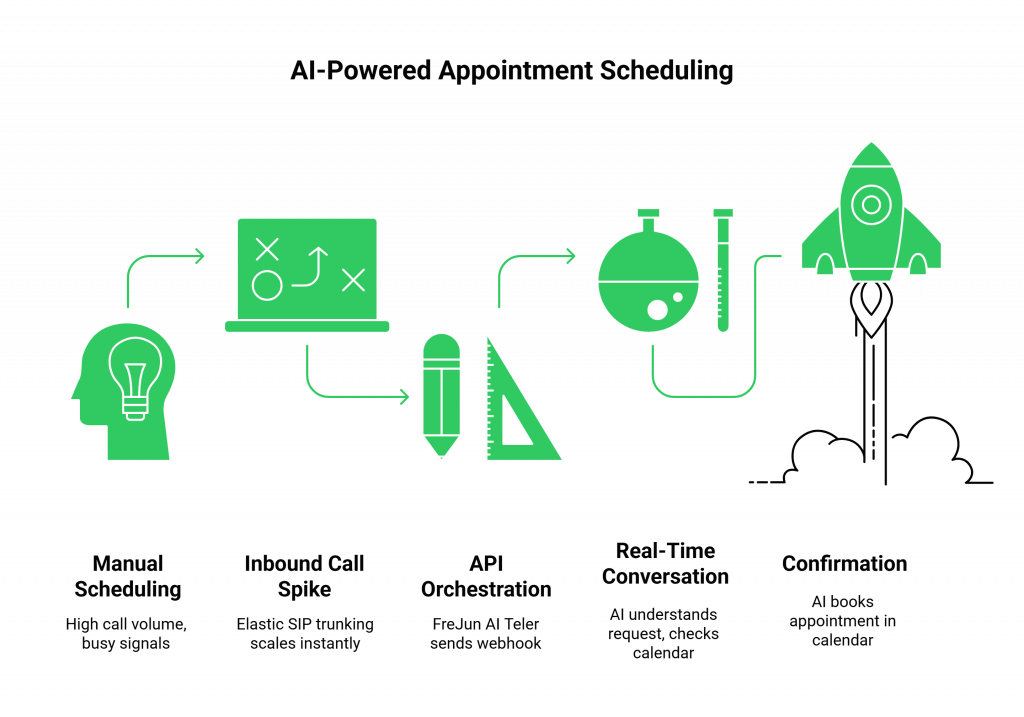
- The Inbound Call Spike: On a Monday morning, hundreds of patients call at the same time to book appointments. The elastic SIP trunking infrastructure scales instantly to answer every single call. There are no busy signals.
- The API Orchestration: For each call, the FreJun AI Teler engine sends a webhook to the clinic’s AI application (its AgentKit). The application responds with an API command to greet the caller and listen.
- The Real-Time Conversation: Teler streams the patient’s speech in real-time to the AI’s STT engine. The AI’s LLM understands the request, checks the clinic’s calendar via another API, and offers an open slot. The TTS generates the audio response.
- The Confirmation: Teler plays the AI’s response to the patient. The patient confirms the time, and the AI makes a final API call to the calendar to book the appointment.
This entire, complex workflow, happening across hundreds of simultaneous calls, is made possible by the seamless, high-speed interaction between the AI’s brain and the programmable, scalable voice network.
Also Read: AI Voice Agents for Water Service Support
Conclusion
The evolution from standard SIP trunking to elastic SIP trunking is far more than just a change in pricing models; it is a fundamental architectural revolution. It marks the transition of voice from a rigid, hardware-defined utility to a flexible, software-defined cloud service. For businesses looking to deploy modern voice AI, this is the most important distinction to understand.
The immense scalability, the developer-friendly programmability, and the low-latency performance of a true elastic SIP trunking platform are not just “nice-to-have” features; they are the absolute, non-negotiable prerequisites for building the intelligent, automated, and conversational experiences that customers now demand.
Want to see how an elastic, pay-as-you-go model could impact your business’s bottom line and enable your AI strategy? Schedule a personalized demo for FreJun Teler.
Also Read: United Kingdom Country Code Explained
Frequently Asked Questions (FAQs)
In essence, what is SIP trunking is a method of using your internet connection to make and receive phone calls for your business, replacing the need for traditional, physical phone lines from the phone company.
The key difference is capacity. Standard SIP trunking is sold in fixed “channels” (you buy 20 or 50 lines). Elastic SIP trunking provides on-demand, virtually unlimited capacity, and you only pay for your actual usage.
The main benefits of elastic SIP trunking are significant cost savings (by eliminating the need to pay for idle channels), massive scalability (the ability to handle any call volume automatically), and greater flexibility (you are not locked into long-term contracts for a fixed capacity).
A modern business experiences unpredictable peaks and valleys in demand. A scalable telephony infrastructure ensures that your communication system can grow with your business and handle sudden spikes in call volume (like from a marketing campaign) without failing.
SIP trunking for AI voice systems requires three things that only an elastic model can provide: the massive scalability to handle AI-driven call campaigns, the API access to the real-time audio stream for the AI to “hear,” and the low-latency performance needed for a natural-sounding conversation.
No, it is actually a perfect solution for businesses of all sizes, especially startups and small businesses. The pay-as-you-go model allows them to have an enterprise-grade, highly scalable phone system without the high upfront cost or long-term commitments.
Yes. You can connect an elastic SIP trunk to any modern IP-PBX or cloud-based phone system. This is often a great first step for businesses looking to gain cost and scalability benefits.
It means that the voice infrastructure can be controlled with code. Your software developers can write applications that can make calls, receive calls, and manage the live call flow by sending commands to the provider’s API.
FreJun AI provides a developer-first elastic SIP trunking platform. Our Teler engine is the core voice infrastructure that provides the scalable, low-latency connectivity, and our powerful APIs provide the tools that developers need to build sophisticated voice AI applications on top of it.
With a modern provider like FreJun AI, you can sign up for a developer account online, get your API keys, and start building and testing in minutes. You can provision a phone number and make your first API-driven phone call in less than half an hour.