
The sound of a dripping faucet is an annoyance. The sight of a burst pipe is a crisis. For millions of homeowners, a problem with their water service is a moment of immediate and urgent concern. Their first action is to call their local water utility. What happens in the next few minutes is a critical moment of truth for that utility’s customer service.
All too often, that moment is defined by a busy signal, a confusing phone menu, or a long and anxious wait on hold. This communication breakdown is a systemic problem, one that a modern AI voicebot is uniquely qualified to solve.
Water is our most essential utility, and the communication surrounding it needs to be treated with the same level of importance. From reporting a main break to asking a simple question about a bill, customers need a channel that is reliable, accessible, and instantly responsive.
By deploying an intelligent AI voicebot, water utilities can create a 24/7 virtual front office, ensuring that every customer gets the help they need, exactly when they need it, while streamlining their own operations in the process.
Table of contents
Why is Water Service Support a Unique Challenge?
A water utility’s contact center is a unique environment. The calls they receive are often a mix of routine administrative queries and high-stress emergency reports. This unpredictable blend of the mundane and the critical creates a significant challenge for a traditionally staffed operation.
The Spectrum of Customer Needs
The calls a water utility receives can be broadly categorized, each with its own level of urgency.
- Emergency Reports: These are the highest priority calls. A customer reporting a main break in their street or a sudden loss of service needs to be handled immediately.
- Billing and Account Management: These are the most frequent calls. They include simple payment calls, balance inquiries, and questions about water rates.
- Service Inquiries: These include requests to start or stop service, questions about water quality reports, or inquiries about conservation programs.
- Proactive Alerts: Customers often have questions about a notice they received, such as a boil water advisory or a planned service interruption for maintenance. A recent survey on utility customer satisfaction found that proactive communication about outages and service issues is a top driver of customer trust.
The Failure of the Traditional Model
A small team of human agents trying to manage this diverse and unpredictable call volume is a recipe for inefficiency and poor service.
- The Emergency Bottleneck: During a major event like a main break or a widespread boil water advisory, the call volume can spike by 1000% or more. This instantly overwhelms the human team, meaning that even customers with critical reports cannot get through.
- The Tyranny of the Routine: On a normal day, agents spend most of their time answering the same simple billing questions over and over. This is a massive waste of their skills and prevents them from focusing on more complex issues.
- The 9-to-5 Problem: Water emergencies do not keep business hours. A customer who discovers a leak at 10 PM on a Saturday has no way to report it until Monday morning, potentially leading to significant water loss and property damage.
Ready to build a water support system that is as reliable as the service you provide? Sign up for FreJun AI and get your API keys to start building.
Also Read: How to Integrate Teler with AgentKit: Real-time Voice Agents through the MCP Server
How Does an AI Voicebot Act as a Virtual Water Utility Agent?
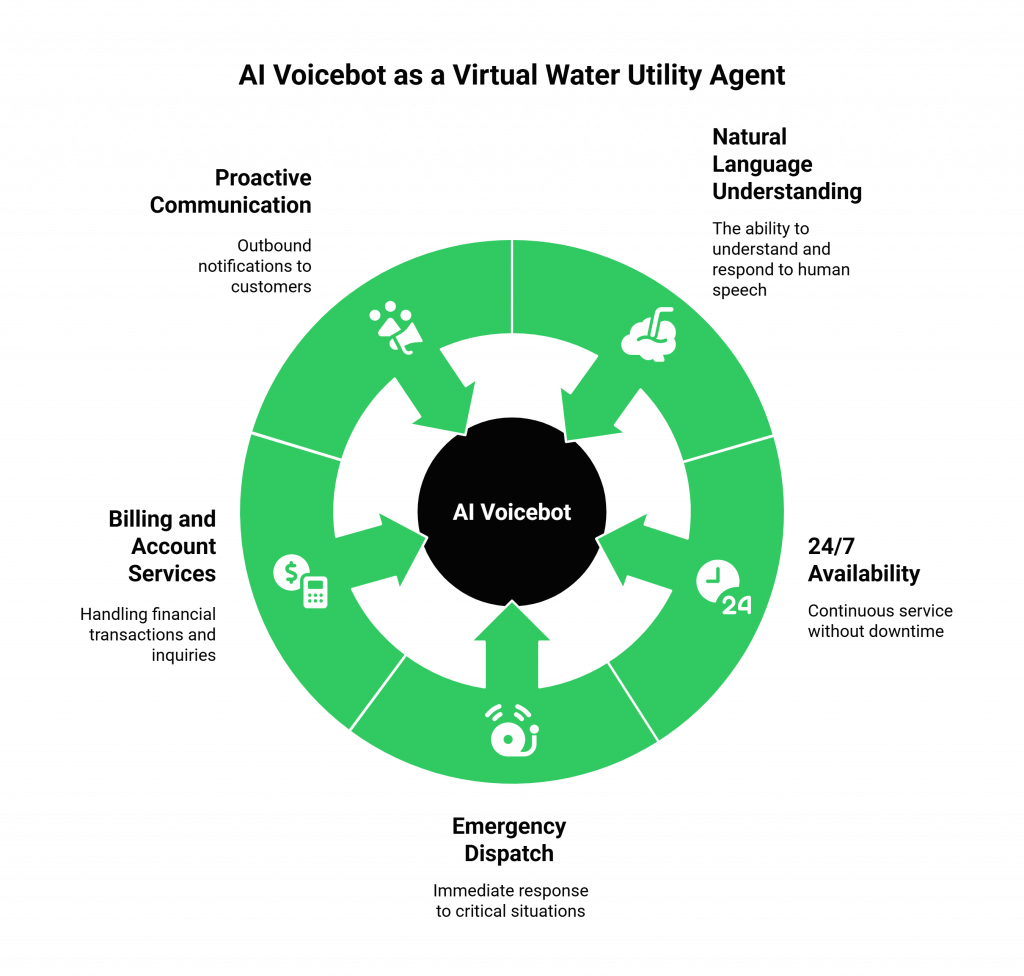
An AI voicebot provides a powerful, infinitely scalable, and always-on front line for your water utility. It understands natural language and can learn to handle the vast majority of common service and support inquiries. It transforms your customer support from a limited, reactive queue into a 24/7, proactive service center.
The experience for the customer is seamless. They call the main number and are instantly greet by a calm, professional voice. They can simply state their issue, and the AI will guide them through the process.
For this to work, the conversation must flow naturally, without any frustrating lag. This is where the underlying voice infrastructure is paramount. FreJun AI provides the carrier-grade “plumbing” that handles the real-time, low-latency audio streaming, ensuring the conversation with the AI voicebot is always clear, responsive, and reliable.
How Does It Handle Emergency Intake?
This is the most critical function. The AI voicebot can be train to be an expert emergency dispatcher.
- It is programmed to recognize keywords like “leak,” “main break,” or “no water.”
- When it detects an emergency, it can immediately begin a specific, structured questioning process to gather the critical details: the location, the severity, and the caller’s contact information.
- This information is then instantly and automatically routed as a high-priority ticket to the utility’s emergency dispatch team. The AI can even provide the caller with a reference number and an assurance that crews are being notified.
How Does It Automate Billing and Account Services?
The AI voicebot can be the 24/7 self-service portal for all billing-related needs. It can:
- Tell a customer their current balance and due date.
- Securely process a payment over the phone.
- Help a customer set up a payment plan.
- Answer questions about the current water rates.
Also Read: How to Build Edge-Native Voice Agents with AgentKit, Teler, and the Realtime API
How Does It Manage Proactive Communication?
An AI voicebot is not just for inbound calls. It can be a powerful tool for proactive outbound notifications. After the team completes a main break repair, the system automatically calls every household to inform them that their service has been restore and to provide any necessary instructions, such as running their taps to clear the lines.
Here is a clear comparison of the two support models:
| Feature | Traditional Human-Staffed Support | AI Voicebot-Powered Support |
| Emergency Handling | Can be overwhelmed by call volume, leading to delays. | Infinitely scalable, ensures every emergency call is answered instantly. |
| Availability | Limited to business hours. | 24/7/365, always on for any issue. |
| Efficiency | One call at a time, with manual data entry. | Hundreds of calls handled simultaneously with zero data entry. |
| Cost Per Call | High (fully loaded cost of a human agent). | Extremely low (a fraction of a human-handled call). |
Also Read: How MCP Servers Bridge AgentKit and Teler for AI Workflow Automation
Conclusion
The communication challenges facing a modern water utility are immense. The need to be instantly responsive during a crisis, while also efficiently managing a high volume of routine inquiries, is a task that is simply beyond the scale of a traditional, human-powered call center.
An AI voicebot provides a powerful, scalable, and customer-centric solution. By automating the front line of communication, it ensures that every customer, whether they are reporting an emergency or simply paying a bill, receives immediate and effective service. This technology is a key tool for building a more resilient, efficient, and trusted public utility.
Want to discuss how a custom AI voicebot can be tailored for your specific utility’s needs? Schedule a demo for FreJun Teler.
Also Read: UK Phone Number Formats for UAE Businesses
Frequently Asked Questions (FAQs)
It is a conversational AI program that can handle phone calls for a water utility. It can understand natural speech to handle a wide range of tasks, including taking emergency leak reports, processing bill payments, and answering frequently asked questions.
No. It is a tool designed to make them more effective. The AI voicebot handles the high volume of initial calls, especially during an emergency, and allows your human staff to focus on the most critical tasks, such as dispatching crews, managing complex cases, and speaking with escalated customers.
The AI is specifically trained to recognize keywords and phrases related to emergencies. When it detects one, it immediately prioritizes the call, gathers the essential information through a structured script, and can instantly route a high-priority alert to your human dispatch team.
Yes. Modern AI can use advanced entity extraction to identify addresses, street intersections, and landmarks from a natural conversation, which is critical for accurately logging the location of a leak or main break.
Absolutely. A platform like FreJun AI uses enterprise-grade security, encrypts all communication, and maintains full PCI compliance for securely handling payments over the phone.
Yes. If the AI voicebot integrates with your Work Order Management System, it can access the latest repair status and provide customers with an Estimated Time of Restoration (ETR) when they call.
Yes. We can use same technology for proactive outbound calling. The system can automatically call every affected household in a specific geographic area to deliver a clear, consistent, and urgent message.
FreJun AI provides the foundational voice infrastructure. We are the experts in telephony and real-time, low-latency audio streaming. Our highly reliable and scalable platform provides the “plumbing” to ensure that your AI voicebot is always on and that the conversations are always crystal clear, especially during a crisis.
Yes. This is a key benefit for serving a diverse population. By integrating with multilingual AI models, you can configure AI voicebot to communicate fluently in multiple languages.
With a modern, developer-first platform like FreJun AI, the implementation time is significantly faster than traditional telecom projects. A powerful and effective AI voicebot for handling your most critical call types can often be develop and deployed in a matter of weeks.