
You have just launched your startup. Your team is a small, agile force, your product is gaining traction, and your first real customers are starting to call. This is a moment of pure adrenaline.
But as the call volume grows from ten calls a day to a hundred, a critical question emerges: how do you build a professional, scalable voice infrastructure without the budget of a Fortune 500 company and without drowning your small technical team in the arcane complexities of traditional telecom? The answer, for a growing number of modern startups, is elastic SIP trunking.
For a startup, every decision is a balancing act between growth, cost, and agility. The old world of telephony, with its rigid contracts, expensive hardware, and long-term commitments, is the antithesis of the startup mindset.
Elastic SIP trunking shatters this old model, offering a cloud-native, pay-as-you-go approach to voice that is perfectly aligned with the needs of a fast-growing business. It is the key to unlocking an enterprise-grade communication stack on a startup’s budget and timeline.
Table of contents
What is the “Voice Problem” for a Growing Startup?
As a startup evolves, its communication needs change dramatically. The simple “call my cell phone” approach that worked for the first few customers quickly becomes a bottleneck and a liability. The “voice problem” for a startup is not just about answering calls; it is about building a foundation that can support rapid, unpredictable growth.
The Challenge of Unpredictable Scale
This is the defining characteristic of a startup. One week you might have 50 customer calls. The next, after a successful product launch or a viral marketing campaign, you could have 5,000.
- The Old Way: A traditional phone system (like a PRI line) would require you to guess your peak capacity far in advance and pay for it, whether you used it or not. Guess too low, and your customers get a busy signal during your biggest moment. Guess too high, and you are burning precious cash on idle infrastructure.
- The Startup Need: You need a system that can scale up to handle a massive spike in traffic in an instant and then scale back down to zero just as quickly, so you only ever pay for what you actually use.
The Burden of Complexity and Cost
Startups run on lean teams and tight budgets. They cannot afford to hire a dedicated team of telecom engineers or invest tens of thousands of dollars in on-premise hardware.
- The Old Way: Setting up a traditional business phone system was a complex project involving physical installation, hardware maintenance contracts, and specialized expertise. This is a critical issue when financial discipline is paramount. In fact, a detailed analysis by CB Insights found that running out of cash is the #1 reason startups fail.
- The Startup Need: You need a software-centric, API-driven solution that your existing developers can understand and manage. You need a system that has a low upfront cost and a simple, transparent, usage-based pricing model to conserve that vital cash flow.
Also Read: How Brokers Use Inbound Call Handling?
How Does Elastic SIP Trunking Solve These Problems?
Elastic SIP trunking is a technology that was practically custom-made for the startup ecosystem. It takes the rigid, hardware-based model of traditional telephony and transforms it into a flexible, software-based service that lives in the cloud. It is the perfect solution to the startup’s voice problem.
What Does “Elastic” Actually Mean?
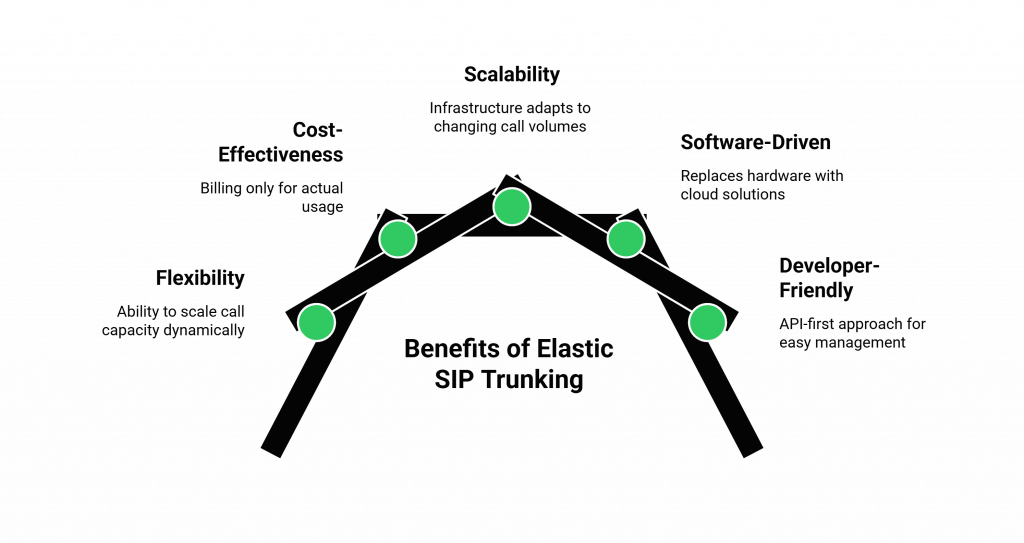
The “elastic” in elastic SIP trunking is its most powerful feature. It means that your capacity to make and receive calls is not tied to a fixed number of physical lines or pre-purchased channels.
- Instead of buying channels in rigid blocks (like a PRI’s 23 channels), you get access to a massive, shared pool of capacity.
- You are only billed for the actual number of concurrent calls you are using at any given moment.
- This means you can go from one call to one thousand calls and back down to one, and your infrastructure will scale automatically to meet the demand. You never have to worry about a customer hearing a busy signal, and you never have to pay for capacity you are not using.
The Shift from Hardware to Software
Elastic SIP trunking is a fundamentally software-driven technology. It replaces the need for an expensive on-premise IP-PBX with a cloud-based solution or a simple, software-based PBX. For a startup, this means:
- Zero Hardware Footprint: There is no expensive box to buy, install, or maintain in a server closet.
- Developer-Friendly Control: Modern providers offer a powerful, API-first approach. This means your development team can manage your voice infrastructure just like they manage your other cloud services (like AWS or Stripe). They can provision numbers, configure call routing, and even build custom voice applications using code.
A recent report from Twilio, highlighted that companies using APIs to build their communication stack were able to get new products to market 3.7 times faster, a critical advantage for any startup.
Here is a simple breakdown of how elastic SIP trunking aligns with the startup mindset:
| Startup Requirement | Traditional Telephony | Elastic SIP Trunking |
| Handle Unpredictable Growth | Rigid, requires long-term capacity planning. | Highly scalable, adjusts to demand in real-time. |
| Minimize Upfront Costs | High, requires expensive hardware (PBX). | Low to zero, no hardware required. |
| Maintain Agility | Slow to change, requires physical installation. | Fast and flexible, managed via software and APIs. |
| Transparent, Usage-Based Pricing | Fixed monthly costs for unused capacity. | Pay-as-you-go, only for what you use. |
| Developer-Friendly | Requires specialized telecom expertise. | API-driven, can be managed by your existing dev team. |
Also Read: Voice Assistants in Luxury Travel Experiences
How Does FreJun AI’s Platform Empower Startups?
At FreJun AI, we understand that for a startup, a voice provider is not just a utility; it is a growth partner. Our entire platform, from our underlying elastic SIP trunking engine (Teler) to our developer tools, was designed to remove the traditional barriers to entry for building a world-class voice infrastructure.
We provide a developer-first experience that is perfectly suited for a startup’s technical team. Our well-documented APIs and SDKs mean that a developer who is comfortable with modern web technologies can get a professional voice system up and running in a matter of hours, not weeks.
We handle all the backend complexity of carrier relationships, network management, and global infrastructure, so your team can focus on what they do best: building your product. We offer a simple, transparent, pay-as-you-go pricing model with no upfront commitments, which is exactly what a startup needs to manage its cash flow effectively.
Ready to build a voice infrastructure that can keep pace with your startup’s ambition? Sign up for FreJun AI and get your API keys to get started.
Conclusion
In the fast-paced, high-stakes world of a startup, you cannot afford to have your growth constrained by outdated technology. The ability to communicate with your customers in a professional, reliable, and scalable way is not a luxury; it is a fundamental requirement for success.
Elastic SIP trunking provides the perfect solution. It is a modern, cloud-native technology that is philosophically aligned with the startup ethos of agility, scalability, and efficiency.
By embracing a developer-first elastic SIP trunking platform, startups can level the playing field, building an enterprise-grade voice infrastructure without the enterprise-grade complexity or cost, and ensuring they are always ready for that next big wave of customer calls.
Have a specific use case in mind for your startup? Want to see how our APIs can help you build it? Schedule a demo with our team at FreJun Teler.
Also Read: UK Mobile Code Guide for International Callers
Frequently Asked Questions (FAQs)
1. What is elastic SIP trunking in simple terms?
It is a way to connect your business’s phone system to the internet to make and receive calls. The “elastic” part means you can use as many or as few phone lines as you need at any moment, and you only pay for what you actually use.
2. Do I need to be a telecom expert to use elastic SIP trunking?
No. A developer-focused provider like FreJun AI abstracts telecom complexity, enabling any web-API-savvy developer to manage voice infrastructure easily.
3. What is a “concurrent call” or “call path”?
Concurrent call or Call Path refers to the number of calls that are active at the same exact moment.
4. Can I keep my existing business phone number?
Yes. In most cases, you can port existing phone numbers from old provider to your new elastic SIP trunking provider.
5. Is the call quality of elastic SIP trunking as good as a traditional phone line?
Yes. When implemented correctly with a high-quality provider and a stable internet connection, the call quality is typically crystal clear and indistinguishable from a traditional landline.
6. How does this technology help me build an AI voice agent?
An API-driven elastic SIP trunking platform underpins voice AI by giving developers real-time audio access to connect STT, LLM, and TTS models.
7. What kind of phone system works with elastic SIP trunking?
It works with any IP-based phone system. This includes most modern on-premise IP-PBXs, cloud-based PBX services, and custom applications that you build yourself.
8. Can our voice infrastructure scale globally as our startup grows?
Absolutely. A key benefit of a platform like FreJun AI is our global infrastructure. You can instantly provision local phone numbers in countries around the world.