
Picture the final, critical moments of a package’s journey: the last mile. The delivery driver is navigating an unfamiliar neighborhood, running against a tight schedule. They arrive at the address, but there is a locked gate and no one is answering the buzzer.
The driver now has a choice: abandon the delivery and move on, or pull over, find the customer’s number, and try to make a call, a manual, time-consuming, and often unsafe distraction.
On the other side, the customer is anxiously waiting, wondering where their package is. They decide to call the main support line, only to be met with a long wait. This daily communication chaos is a massive strain on a company’s inbound call handling resources and the single biggest point of failure in the delivery process.
The last mile is not just the most expensive part of logistics; it is also the most personal. It is the moment where a brand’s promise is either kept or broken. Ineffective communication on the day of delivery leads to failed attempts, frustrated customers, and overwhelmed support teams.
By implementing an intelligent Voice AI system, businesses can automate and streamline these critical interactions, creating a delivery experience that is seamless, safe, and efficient for everyone involved.
Table of contents
Why is Managing Delivery Day Communication So Critical?
The final mile of delivery is a complex dance of timing, navigation, and communication. When one of these elements breaks down, the entire process grinds to a halt. The consequences of poor communication on the day of delivery are not minor inconveniences; they are significant operational and financial problems that directly impact a company’s bottom line and its relationship with its customers.
The stakes are incredibly high because this is where the most money is spent. The last mile can account for over 53% of the total cost of shipping. A failed first attempt can easily double that cost for a single package. The primary consequences of a communication breakdown include:
- Increased Failed Delivery Rates: When a driver cannot contact a customer to resolve an issue like a locked gate or a confusing address, the delivery fails. This leads to the costly process of returning the package to the depot and attempting redelivery later.
- Reduced Driver Productivity: Every minute a driver spends trying to manually call a customer is a minute they are not driving to their next stop. This directly reduces the number of successful deliveries they can make in a day.
- Poor Customer Experience: For the customer, a missed delivery is a broken promise. The frustration is compounded when they are unable to easily contact the driver or support for a real-time solution.
- Overwhelmed Inbound Call Handling: Every failed delivery and every confused customer creates an inbound call. This flood of problem-related calls overwhelms customer service agents, increases wait times, and drives up support costs.
Also read: Voice AI For Emergency Response Centers
How Does Traditional Communication Fail on Delivery Day?
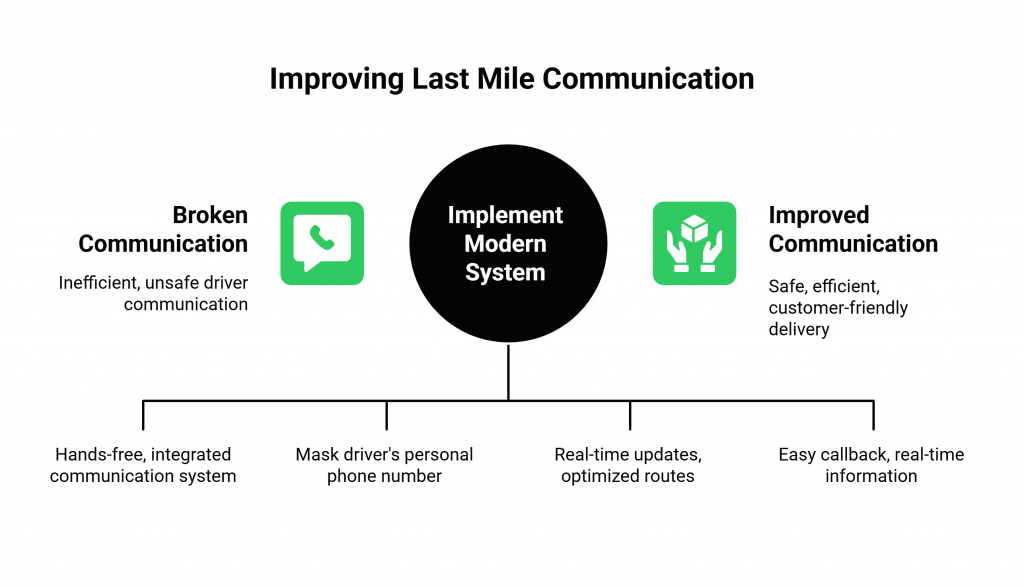
The traditional communication methods used during the last mile, namely, the driver’s personal cell phone, are fundamentally broken. They are a clumsy and unsafe workaround for a systemic problem, creating risks and inefficiencies for both drivers and customers.
How Does It Compromise the Driver?
For drivers, the pressure to communicate is a direct conflict with their primary responsibility: to drive safely.
- Distracted Driving: Using a handheld phone to make a call while driving is a major safety hazard. It is a leading cause of accidents and puts the driver, the public, and the company at risk.
- Privacy Concerns: Drivers are often hesitant to use their personal phone numbers to call customers. While some apps offer number masking, it is often an unreliable, multi-step process.
- Inefficiency: The process of pulling over, looking up a number, making a call, and waiting for an answer is a significant time sink that disrupts the flow of their optimized route.
How Does It Frustrate the Customer?
For customers, the communication experience is often confusing and unhelpful.
- The Unknown Number Problem: Most people do not answer calls from numbers they do not recognize. A driver’s call is likely to go straight to voicemail, defeating the purpose of the call.
- The Inability to Call Back: If a customer misses the call, they have no easy way to reconnect with the driver. Calling the main support line often leads them to an agent who has no real-time information about the driver’s location, which is a major failure of traditional inbound call handling.
Here is a clear comparison of the old way versus a modern Voice AI approach:
| Feature | Traditional Manual Calls | Voice AI-Powered Communication |
| Driver Interaction | Manual, requires taking hands off the wheel. | Hands-free, voice-activated commands from a driver app. |
| Customer Contact | Uses the driver’s personal number or a clunky masked number. | Uses a consistent, professional, and branded company number. |
| Connectivity | Relies on the customer answering an unknown number. | Can leave intelligent, interactive messages or provide automated options. |
| System Integration | No connection to the TMS; the interaction is not logged. | Fully integrated with the TMS; every call is logged and tracked. |
| Inbound Call Impact | Increases the volume of problem calls to the main support line. | Drastically reduces the volume of calls and automates many of them. |
Also read: Inbound Call Handling for Public Utilities
How Can Voice AI Revolutionize Delivery Day Interactions?
Voice AI acts as an intelligent, automated communication bridge between the driver, the customer, and the central dispatch system. It creates a closed-loop system that is safe for the driver, convenient for the customer, and incredibly efficient for the business. This system dramatically improves your inbound call handling by solving problems before they happen.
How Does It Create a Safer, Smarter Driver Experience?
A Voice AI can be integrated directly into the driver’s mobile application. This enables powerful, hands-free communication.
- A driver can use a simple voice command like, “Call customer,” to initiate an anonymized, recorded call through the system.
- If a driver encounters an issue, they can say, “Report delivery exception: locked gate.” The AI understands this, logs the exception in the TMS, and can even automatically trigger a call to the customer.
How Does It Provide a Proactive and Interactive Customer Journey?
Instead of waiting for a problem, Voice AI allows you to get ahead of it.
- The system can automatically trigger a call to the customer when the driver is a few stops away, saying, “Hi, this is an automated alert from Express Delivery. Your driver is approaching and will be at your address in approximately 15 minutes.”
- If a driver reports an issue like a locked gate, the AI can instantly call the customer and provide interactive options: “Our driver is at your location but cannot access the building. Please press 1 to speak with the driver, or press 2 to provide an access code.”
How Does It Transform Your Inbound Call Handling?
A Voice AI system is not just for outbound communication; it is also a powerful tool for your inbound call handling. When a customer calls your main number on the day of delivery, they can be instantly routed to an automated system.
- The AI can recognize their phone number, pull up their delivery status in real time, and provide an accurate ETA.
- It can provide a self-service channel for customers to add last-minute instructions, like, “Please leave the package on the back porch.”
- This automation deflects a huge percentage of the most common delivery day calls, freeing up your human agents to handle true escalations.
Ready to build a communication system that is as efficient as your routes? Sign up for FreJun AI and get your API keys to start building today.
Also read: AI Voicebot for Exam Information Hotlines
Conclusion
The last mile of delivery is the final and most important promise a company makes to its customer. The chaos of delivery day communication, powered by outdated and unsafe methods, is the single biggest threat to keeping that promise.
By embracing Voice AI, businesses can solve this long-standing challenge. This technology creates a safe, hands-free environment for drivers, a proactive and convenient experience for customers, and a highly efficient workflow for the entire operation.
It is the key to reducing failed deliveries, cutting costs, and transforming your inbound call handling from a reactive problem center into a proactive customer success engine.
Want to discuss how a custom Voice AI can integrate with your specific routing software and driver app? Schedule a personalized demo for FreJun Teler.
Also read: UK Mobile Code Guide for International Callers
Frequently Asked Questions (FAQs)
It is a system that uses a conversational AI voicebot to automate communication between delivery drivers, customers, and the central dispatch system. It enables hands-free calling for drivers and provides proactive, automated notifications and self-service options for customers.
No, it is a tool designed to augment them. The AI handles the high volume of routine, repetitive communications. This frees up your human dispatchers and agents to focus on high-value tasks like managing complex exceptions, resolving disputes, and providing a human touch for escalations.
The central system routes all calls through a consistent company number, ensuring the driver’s personal number is never reveal to the customer and the customer’s number is never reveal to the driver.
This is a key consideration. A model-agnostic platform like FreJun AI lets you use a specialized Speech-to-Text (STT) model trained to filter out background noise such as a running engine or road sounds, and accurately understand the driver’s voice commands.
The system is designed with a clear escalation path. If the AI detects a complex issue or if the customer asks to speak to a person, it can seamlessly transfer the call to a live human agent who will already have the context of the delivery.
It integrates directly with your Transportation Management System (TMS) or other logistics platforms via an API. This allows it to get real-time data on driver locations and delivery schedules and to automatically log all communications.
Yes. While voice is the core, the system can also trigger other actions, such as sending an SMS with a tracking link after a call or emailing a photo confirmation of a successful delivery.
It improves it dramatically in two ways. First, by proactively solving problems, it reduces the number of frustrated customers who need to call in. Second, it can automate the handling of the delivery-related calls you do receive, providing 24/7 self-service for customers.
FreJun AI is not the AI model. We provide the foundational voice infrastructure—the “plumbing.” We are the experts in telephony and real-time, low-latency audio streaming. Our reliable and scalable platform ensures that the critical conversations between your AI, your drivers, and your customers are always crystal clear.
With a modern, developer-first platform like FreJun AI, the implementation time is significantly faster than traditional telecom projects. A powerful and effective system for automating your key delivery communications can often be developed and deployed in a matter of weeks.