
Picture the nerve center of a busy logistics company: the dispatch control room. It is a cacophony of blinking lights on a map, ringing phones, and the crackle of two-way radios. A dispatcher is juggling three screens, trying to reroute a driver stuck in traffic while simultaneously confirming a delivery on the other side of the city.
This high-stress, highly manual process is the daily reality for fleet operations everywhere. It is a system stretched to its breaking point, where a single missed communication can lead to a costly delay. This is precisely the operational chaos that a modern AI voicebot is engineered to solve.
The fleet management and telematics industry is already in a period of massive technological adoption, with the market for telematics solutions projected to grow to over $108 billion by 2028. This shows a clear demand for smarter, more connected vehicle operations.
By integrating Voice AI directly into dispatch systems, companies can move beyond simple tracking and into the realm of intelligent, real-time communication, transforming their dispatch center from a reactive call hub into a proactive command center.
Table of contents
Why is Traditional Dispatch Communication So Broken?
The traditional tools of fleet dispatch, the phone and the two-way radio, are decades-old technologies that have not kept pace with the speed of modern logistics. They create significant inefficiencies and, more importantly, introduce serious safety risks. This old way of communicating is fundamentally broken for both the driver on the road and the dispatcher in the office.
How Does It Compromise Driver Safety?
For drivers, every interaction with a handheld device is a dangerous distraction. Fumbling with a radio microphone or trying to answer a call on a cell phone takes their hands off the wheel, their eyes off the road, and their focus away from driving. The consequences of this are severe.
The National Highway Traffic Safety Administration reported that distracted driving was responsible for 3,308 fatalities in 2022 alone. A communication system that requires manual interaction is a system that compromises safety.
How Does It Overwhelm Dispatchers?
For dispatchers, the primary challenge is the sheer volume of low-value, repetitive communication. A huge portion of their day is spent on routine check-in calls and status updates, asking questions like, “What’s your ETA?” or “Have you arrived at the customer site?”
This constant stream of manual check-ins is not only a massive drain on their productivity but also a significant source of stress and burnout. It keeps them from focusing their attention where it’s needed most, managing exceptions, solving problems, and making strategic routing decisions.
Also Read: Why Choose Inbound Call Handling Solutions?
How Does an AI Voicebot Act as a Virtual Dispatcher?
An AI voicebot integrated into a fleet dispatch system acts as an intelligent, automated assistant for both the driver and the dispatcher. It creates a seamless, hands-free communication channel that automates routine tasks and allows for instant, clear communication when it matters most. It is not just a tool; it is a fundamental redesign of the entire dispatch workflow.
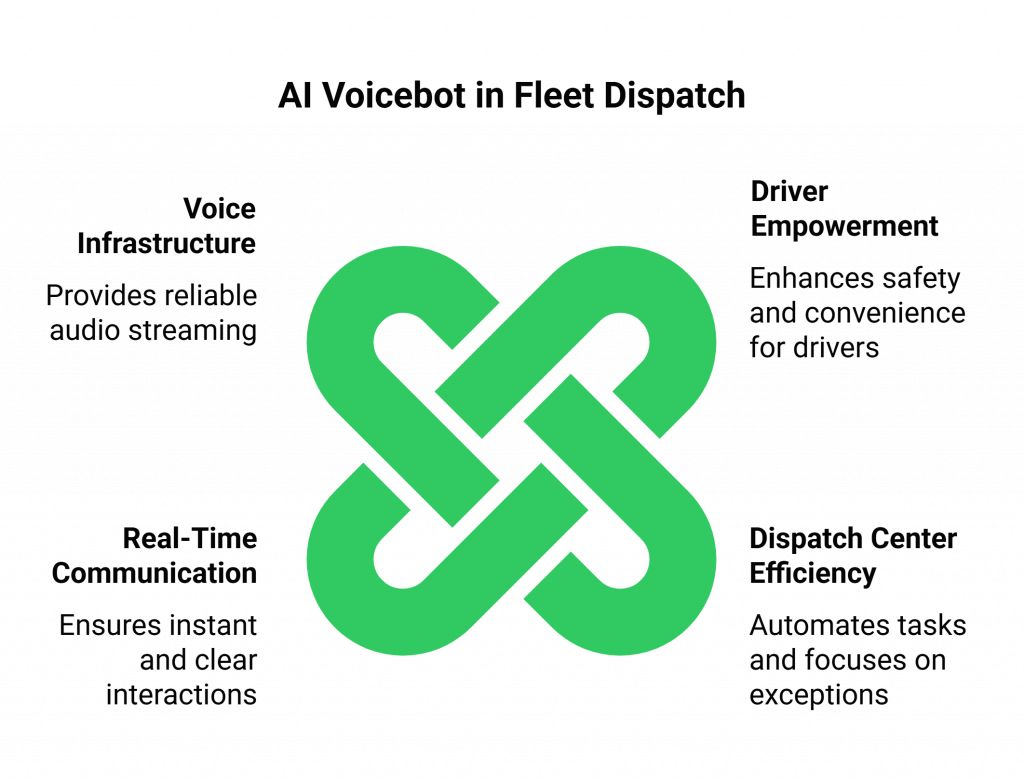
This is not a simple chatbot. A sophisticated AI voicebot is deeply integrated with your Transportation Management System (TMS). It understands the context of each driver’s route, schedule, and current status. For this to be effective, the conversation must be flawless and in real-time. This is where the underlying voice infrastructure is the most critical component.
FreJun AI provides the enterprise-grade “plumbing” that handles the real-time, low-latency audio streaming. This ensures that when a driver speaks a command, the AI understands it instantly, and its response is heard without any frustrating delay, making the interaction as natural and safe as possible.
How Does It Empower Drivers on the Road?
For drivers, the primary benefit is safety and convenience. By interacting with the dispatch system using simple, natural voice commands, they can keep their hands on the wheel and their eyes on the road.
Key hands-free capabilities include:
- Automated Status Updates: A driver can simply say, “I have arrived at the pickup location,” or “Delivery complete.” The AI voicebot understands this, converts it to text, and automatically updates the TMS with a timestamp and location stamp.
- Proactive Route Notifications: If a dispatcher needs to reroute a driver, the system can initiate a call to the driver’s hands-free device. The AI voicebot can say, “Alert: A new, faster route is available due to an accident on your current path. Say ‘Accept’ to receive the new turn-by-turn directions.”
- Instant Information Retrieval: A driver can ask for critical information without looking at a screen. For example, “What is the gate code for this delivery?” or “Confirm the contact person at this location.”
How Does It Supercharge the Dispatch Center?
For dispatchers, the AI voicebot automates the noise, allowing them to focus on the signals. It takes over the most repetitive parts of their job, transforming their role from a manual operator to a true logistics manager. Key benefits for dispatchers include:
- Management by Exception: Instead of manually checking in with every driver, the system alerts dispatchers only when a driver reports a problem or when it detects a deviation from the plan (e.g., a truck stops for too long).
- Automated Check-Calls: You can program the system to automatically call drivers who haven’t provided an update within a set timeframe, ensuring no one falls off the radar.
- Broadcast Messaging: A dispatcher can record a single message (e.g., “Warning: a major storm is approaching the western region, all drivers proceed with caution”) and have the AI voicebot call and deliver it to a specific group of drivers simultaneously.
Also Read: Building a Voice Agent with OpenAI or Claude
What Are the Tangible Business Benefits of This Technology?
Integrating an AI voicebot into your fleet dispatch system is a strategic investment that delivers powerful returns across the board. It is a direct upgrade to your safety protocols, your operational efficiency, and your bottom line. Here is a clear comparison of the two approaches:
| Feature | Traditional Dispatch Communication | AI-Powered Dispatch Communication |
| Driver Interaction | Manual, requires using hands for radio or phone. | Hands-free, voice-activated commands. |
| Status Updates | Relies on the driver to call in or the dispatcher to call out. | Automated based on driver’s spoken updates or geofencing. |
| Dispatcher Focus | Repetitive, manual check-ins with every driver. | Managing exceptions and solving complex logistical problems. |
| Data Accuracy | Prone to human error, relies on manual note-taking. | Highly accurate, with automated, timestamped digital logs. |
| Safety | High risk of distracted driving. | Significantly enhanced safety with a hands-free system. |
Ready to build a dispatch system that listens? Sign up for FreJun AI and get your API keys to start building a safer, smarter fleet.
How Can You Integrate a Voice AI into Your Fleet System?
Implementing a voice AI solution is a more accessible project than it may seem. It involves a clear, logical process of connecting your existing systems to a powerful voice infrastructure.
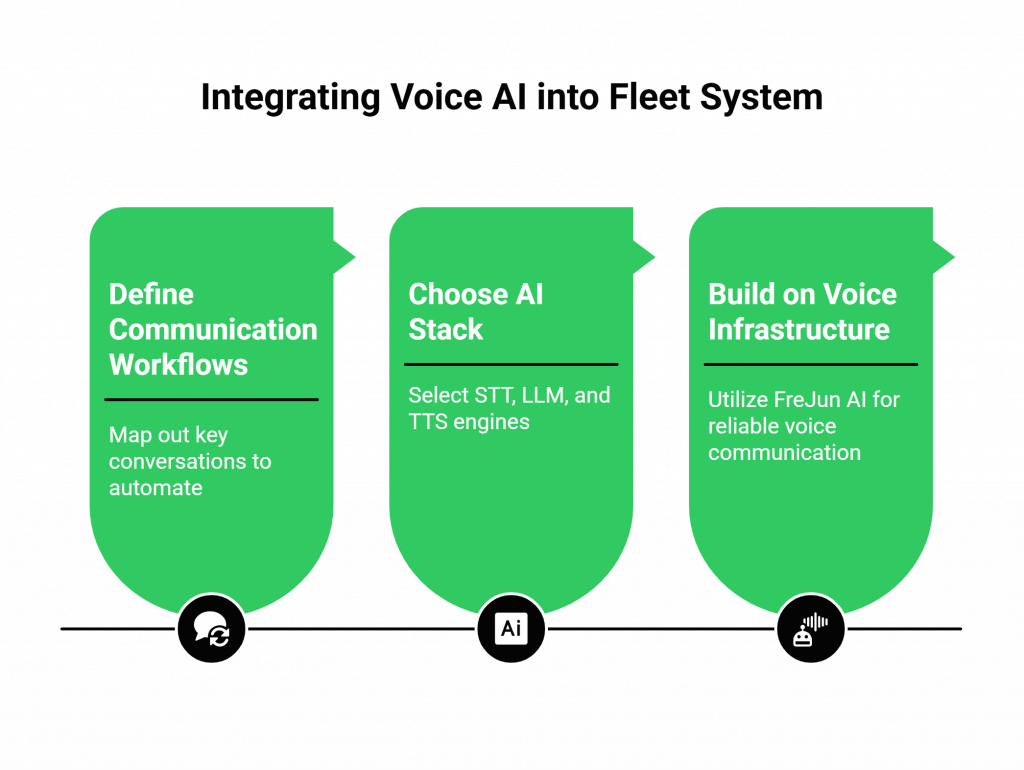
- Define Your Communication Workflows: The first step is to map out the key conversations you want to automate. This could be the “arrival confirmation” flow, the “delay reporting” flow, or an “emergency alert” flow.
- Choose Your AI Stack: You will need the core components of conversational AI: a Speech-to-Text (STT) engine to understand the driver, a Large Language Model (LLM) to process the request, and a Text-to-Speech (TTS) engine to create the voice response. This is where the flexibility of your infrastructure provider is key. A model-agnostic platform like FreJun AI gives you the freedom to choose the best-in-class AI models for your specific needs, such as a model trained to understand noisy, in-cab environments.
- Build on a Reliable Voice Infrastructure: The intelligence of your AI is only as good as its ability to communicate clearly and in real-time. This is the essential role of FreJun AI. We provide the enterprise-grade, low-latency “plumbing” that handles the actual calls and audio streaming. We handle the complex voice infrastructure so you can focus on building your AI.
Also Read: Secure Ways to Stream Call Audio to AI
Conclusion
The dispatch center is the beating heart of any fleet operation, but for too long it has been powered by outdated and inefficient communication methods. An AI voicebot represents a fundamental leap forward, transforming the dispatch process from a manual, reactive system into an intelligent, proactive, and automated one.
By enabling safe, hands-free communication for drivers and automating routine tasks for dispatchers, this technology creates a more efficient, safer, and more scalable fleet. It is the key to unlocking a new level of operational excellence and building a logistics operation that is truly ready for the future.
Want to discuss how a custom AI voicebot can integrate with your existing TMS and driver applications? Schedule a personalized demo with our logistics specialists at FreJun Teler.
Also Read: Call Log and Call Details: How to Monitor Business Communication
Frequently Asked Questions (FAQs)
It is a conversational AI program that is integrated into a fleet’s Transportation Management System (TMS). It acts as a virtual dispatcher, allowing drivers to communicate hands-free and automating routine status updates and check-in calls.
No, it is a tool designed to make them more effective. The AI voicebot handles the high volume of repetitive communications, which frees up your human dispatchers to focus on high-value tasks like complex problem-solving and managing exceptions.
Choosing the right Speech-to-Text (STT) model solves this challenge. A model-agnostic platform like FreJun AI lets you use a specialized STT engine trained to filter out background noise and accurately understand a driver’s voice.
The system can be programm with an emergency protocol. A driver could say a predefined “safe word,” and the AI voicebot would immediately recognize it and escalate the alert, for example, by patching a live call through to a supervisor and sending the driver’s GPS coordinates.
It integrates directly with your Transportation Management System (TMS) or other logistics software via an API. This allows it to get real-time data on routes and schedules and to automatically update the system based on driver communications.
For example, if a route needs to change, a dispatcher can trigger the AI voicebot to proactively call the driver’s hands-free device and verbally deliver the new instructions.
Yes. A platform like FreJun AI is built with enterprise-grade security. It uses encryption and secure protocols to protect all communication and data, ensuring that your operational information remains confidential.
No, FreJun AI provides the foundational voice infrastructure. We are the experts in telephony and real-time, low-latency audio streaming. Our reliable and scalable platform provides the “plumbing” to ensure that the conversations between your drivers and your AI are always crystal clear.
You can train the Large Language Model (LLM) you integrate with the system on your specific terminology, such as ‘LTL,’ ‘deadhead,’ or location codes, so it fully understands the unique language of your operation.
The system automatically transcribes and timestamps each voice interaction, creating a rich, accurate, searchable record of all driver communications for compliance, training, and operational analysis.