
A flat tire on a dark, deserted road. The engine suddenly going silent in the middle of rushing highway traffic. These are not just inconveniences; they are moments of high stress and vulnerability. The first thing you do is reach for your phone to call for help. But what happens next can either calm your nerves or amplify your anxiety.
Being put on hold, struggling to explain your location to a distracted agent, and waiting endlessly for an update is an all too common and frustrating experience. This critical first point of contact is where an efficient inbound call handling process is not just important, it’s essential for a driver’s safety and peace of mind.
Now, imagine a different scenario. You call, and an instantly responsive, calm voice answers. It already knows your location and guides you through a few simple questions. Within a minute, help is dispatched, and you receive a confirmation with a precise arrival time.
This is not a futuristic dream; it is the reality made possible by handling roadside assistance with Artificial Intelligence. AI is transforming emergency response, turning a moment of panic into a streamlined, efficient, and reassuring process.
Table of contents
What Makes Roadside Assistance Calls So Challenging?
The call center for a roadside assistance provider is one of the most demanding customer service environments. The entire system of inbound call handling must be prepared for a unique set of challenges that standard call centers rarely face.
First and foremost, the callers are almost always under significant stress. They might be stranded, scared, or angry. This emotional state can make it difficult for them to communicate clearly.
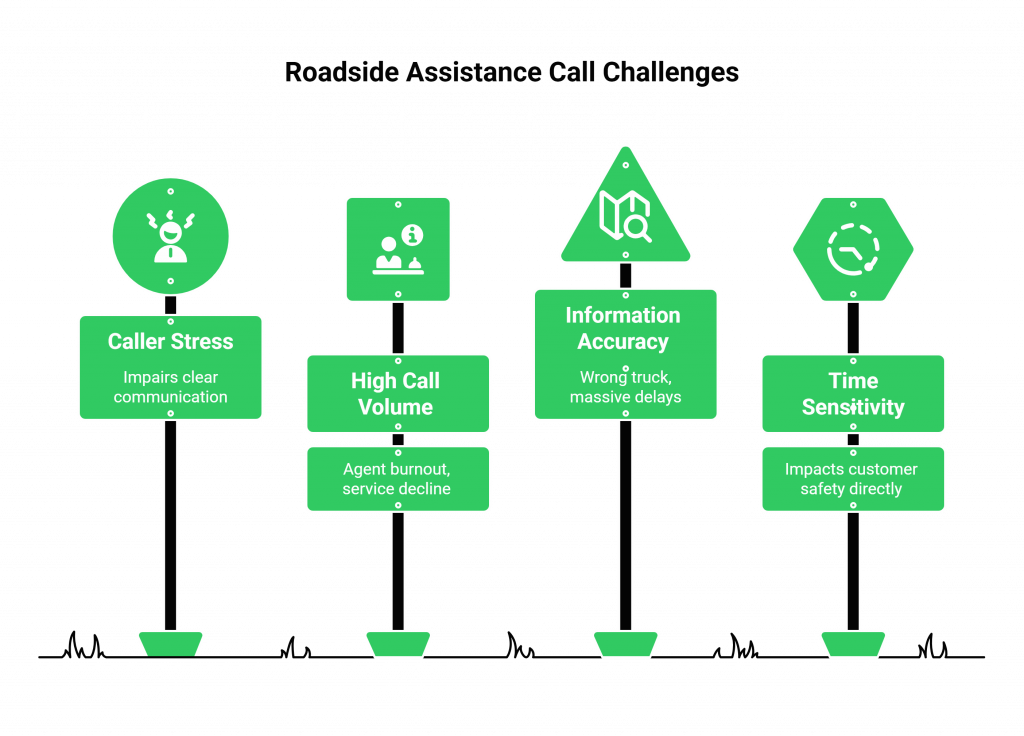
Human agents need extensive training in de-escalation, but during a major storm or holiday weekend, call volumes can skyrocket, leading to agent burnout and a decline in service quality. The sheer volume of roadside assistance events is massive; in the United States alone, AAA responds to over 30 million calls for help each year.
Second, accurate information is critical. An agent needs to capture the caller’s precise location, the make and model of their vehicle, and the nature of the problem. A mistake in any of these details can lead to the wrong type of truck being sent to the wrong place, causing massive delays and escalating the driver’s frustration.
Finally, every second counts. The longer a driver is stranded on the side of the road, the greater the risk. An inefficient inbound call handling process that involves long hold times and manual data entry directly impacts the safety of the customer.
Also Read: AI Voicebot for Flight Change Requests
How Does AI Transform Inbound Call Handling for Roadside Services?
Artificial Intelligence, specifically conversational AI, is uniquely equipped to meet these challenges. An AI powered system can manage the initial inbound call handling with a level of speed and accuracy that is difficult for a purely human team to maintain, especially during peak times. It acts as a super efficient and infinitely patient first responder.
How Can AI Understand and Calm a Stressed Caller?
When a person calls, an AI agent greets them with a calm, empathetic tone. Instead of relying on a simple ‘press one for a flat tire’ system, the AI uses advanced Speech-to-Text (STT) and Natural Language Processing (NLP) to understand the caller’s natural speech, even when they speak quickly or sound upset.
The AI can be programmed to use reassuring language, guiding the caller through the process step by step. For example, it might say, “I understand this is a stressful situation. I’m here to help. First, can you confirm that you are in a safe location away from traffic?” This empathetic approach helps to de-escalate the caller’s anxiety right from the start of the call.
How Does AI Instantly Capture Critical Information?
This is where AI truly excels. While the AI is having a conversation with the caller, it is simultaneously parsing and structuring critical data. It can automatically pull the caller’s location from their phone’s GPS, eliminating any guesswork and can ask for the license plate number and instantly cross reference it with a database to confirm the vehicle’s make, model, and color.
It can understand the nature of the problem through simple questions. For example:
- “Are your hazard lights on?”
- “Do you need a tow, or do you have a flat tire?”
- “Is the vehicle drivable?”
This information is captured and validated in seconds, with a near zero error rate, ensuring the correct type of help is dispatched. The speed of this initial data gathering is crucial. A study on customer service response times showed that 66% of adults believe that valuing their time is the most important thing a company can do. In an emergency, this is magnified tenfold.
Also Read: Automating Tour Bookings with Voice AI
How Does AI Automate the Dispatch Process?
Once all the information is collected, the AI doesn’t just pass the data to a human. It takes the next step and can integrate directly with the dispatching software to find the nearest available and appropriate service vehicle. It then automatically sends the job details, including the precise location and nature of the problem, directly to the tow truck driver’s mobile terminal.
The entire process, from the moment the call is answered to the moment help is on the way, can be completed in under a minute. This table clearly illustrates the efficiency gains:
| Task | Traditional Human Agent Process | AI Powered Process |
| Initial Call | Caller waits on hold, then connects to an agent. | Call is answered instantly by the AI. |
| Information Gathering | Agent manually types in location, vehicle, and issue details. | AI automatically captures GPS location and parses issue from conversation. |
| Verification | Agent may need to repeat information back to confirm accuracy. | AI verifies data against databases in real time. |
| Dispatch | Agent manually searches for and assigns a nearby service vehicle. | AI automatically identifies and dispatches the closest unit. |
| Confirmation | Agent informs the caller that help is on the way. | AI sends an automated text with the ETA and a live tracking link. |
What Technology is Needed to Build an AI Powered System?
Building an AI that can handle such a critical task requires a robust and reliable technology stack. It’s an ecosystem where each component must work flawlessly with the others.
The core of the system is the conversational AI itself, which consists of the STT engine to transcribe the user’s voice, the Large Language Model (LLM) to understand intent and make decisions, and the Text-to-Speech (TTS) engine to create a natural voice response.
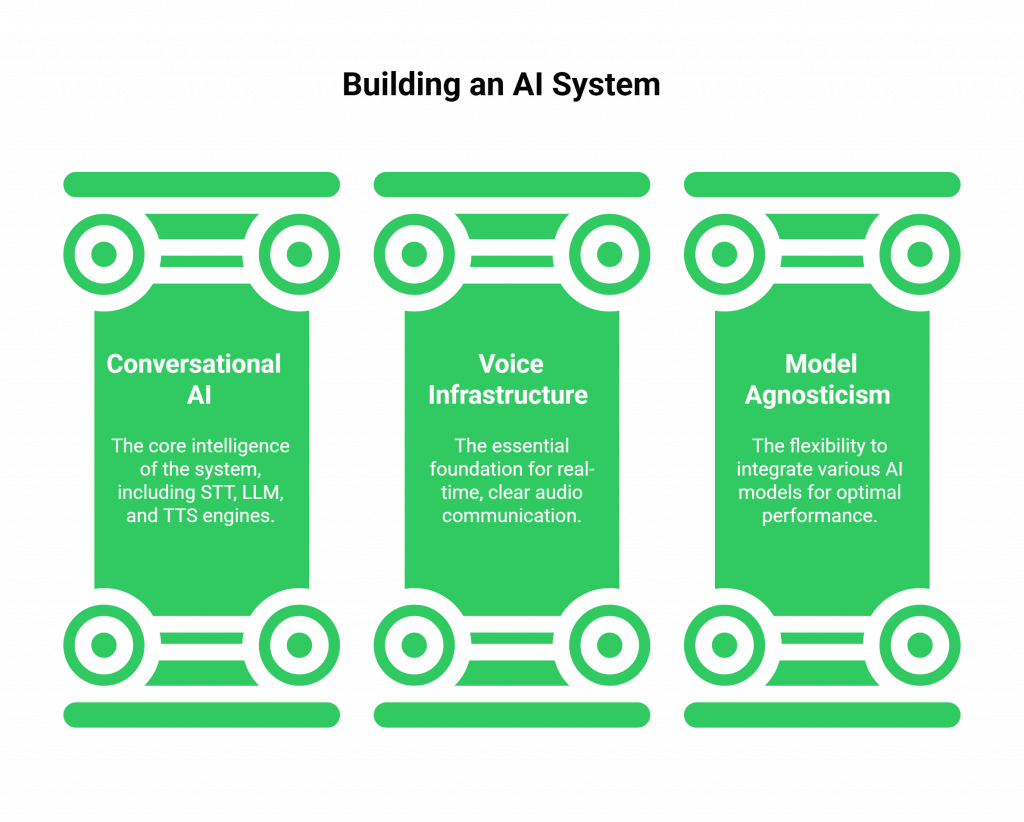
However, none of this intelligence matters if the conversation itself is delay. This is why the voice infrastructure is arguably the most critical component. A platform like FreJun AI provides this essential foundation.
FreJun AI is not the AI itself; it is the “plumbing” that ensures the conversation can happen in crystal clear, real time quality. It handles the complex telephony and low latency audio streaming. For a roadside assistance call, where a caller might have a weak cell signal, this reliability is non negotiable.
Furthermore, FreJun AI operates as a model-agnostic platform. A roadside assistance company can choose the best STT, LLM, and TTS models for its needs, such as an automotive-trained LLM or a calming TTS voice, and FreJun AI seamlessly connects these best-in-class models.
Ready to build a response system that saves time and reduces stress? Sign up for FreJun AI and get your API keys to get started.
Also Read: Voice API for Airline Customer Support
What Are the Benefits for Everyone Involved?
Adopting an AI first approach to inbound call handling for roadside assistance creates a powerful positive impact for the stranded motorist, the service provider, and even the human call center agents.
The motorist gets a dramatically faster response. Their anxiety is reduced by a calm, efficient process, and they receive clear, constant communication about when help will arrive. This transforms a negative experience into one where they feel cared for and in control.
The service provider sees huge operational gains. The efficiency of the AI allows them to handle a much higher call volume without increasing staff. The accuracy of the data capture reduces costly errors, like sending the wrong truck. This leads to lower operational costs and a higher rate of customer satisfaction.
And what about the human agents? The AI handles the high volume, repetitive data gathering tasks. This frees up the human agents to manage the truly complex and emotional calls, the ones that require genuine human empathy and problem solving skills. Instead of being data entry clerks, they become true emergency specialists.
Conclusion
The experience of being stranded on the side of the road will never be pleasant, but the experience of calling for help can be. By leveraging the power of AI, roadside assistance companies can transform their inbound call handling from a potential bottleneck into their greatest asset.
An intelligent, automated system provides the speed, accuracy, and efficiency that a high stress emergency situation demands. It ensures that every call is answered instantly and every driver gets the right help, right away.
This is not about replacing human compassion with cold technology. It uses technology to handle logistics with robotic precision and frees human experts to provide care when it matters most. For roadside assistance, a well designed AI system is the ultimate co-pilot, ensuring a safer and more reassuring journey for everyone.
Want to learn how a reliable voice infrastructure can revolutionize your emergency response system? Schedule a personalized demo with our team at FreJun Teler.
Also Read: Telephone Call Logging Software: Keep Every Conversation Organized
Frequently Asked Questions (FAQs)
It is a conversational AI agent designed to be the first point of contact when a driver calls for help. It can understand the caller’s problem, gather necessary information like location and vehicle type, and automate the dispatch of a service vehicle.
The system can automatically access GPS data from your smartphone during a call and provide a precise location to the dispatch system without requiring you to describe it.
A robust voice infrastructure like FreJun AI’s maintains call clarity even on low-bandwidth connections, which is critical for roadside emergencies.
No. It is designed to handle the majority of standard calls, which involve data collection and dispatch. This frees up human agents to focus on more complex or emotionally charged situations that require a human touch.
Because automation handles intake and dispatch, the AI sends a service vehicle within a minute of the call.
Yes. Enterprise-grade platforms prioritize security, using strong encryption and protocols to protect user data and ensure confidentiality.
Absolutely. The system integrates with multilingual AI models that understand and speak multiple languages and regional accents.
FreJun AI provides foundational voice infrastructure, handling real-time, low-latency audio streaming that connects callers to AI models reliably.