
Imagine you are managing a fleet of fifty delivery trucks. One driver is stuck in unforeseen traffic, another can’t find the drop off location, and a third has a vehicle malfunction. Your phone is ringing off the hook, and you are trying to text drivers for updates while simultaneously reassuring an anxious customer. This chaotic, high stress scenario is a daily reality in logistics.
Communication is the backbone of fleet management, but traditional methods like texting and manual calls are inefficient and often unsafe. This is where a modern solution comes in: integrating a voice API for developers directly into your fleet management system.
The logistics industry is under constant pressure to become faster and more efficient. A voice enabled system empowers drivers and dispatchers to communicate hands free, in real time, turning every vehicle into a connected, intelligent hub.
This article explores how a voice API can fundamentally transform fleet operations, boosting safety, efficiency, and customer satisfaction.
Table of contents
What Is a Voice API?
An API, or Application Programming Interface, is like a messenger that lets different software programs talk to each other. You use them every day. When an app on your phone shows you the weather, it’s using an API to ask a weather service for that information.
A voice API does the same thing, but for voice communication. It allows developers to add voice features like making calls, receiving calls, and streaming audio directly into their own applications.
For a fleet management system, this means you can build communication tools right into the software your drivers and dispatchers are already using. It’s the key technology that makes a voice API for developers so powerful; it turns any application into a communication platform.
Why is Hands Free Communication So Critical in Fleet Management?
For fleet managers, driver safety is the number one priority. Anything that takes a driver’s eyes off the road or hands off the wheel is a serious hazard. Using a handheld mobile device while driving is a major cause of accidents. The National Highway Traffic Safety Administration reports that distracted driving claimed 3,308 lives in 2022 alone. By law and by logic, fleets must minimize these risks.
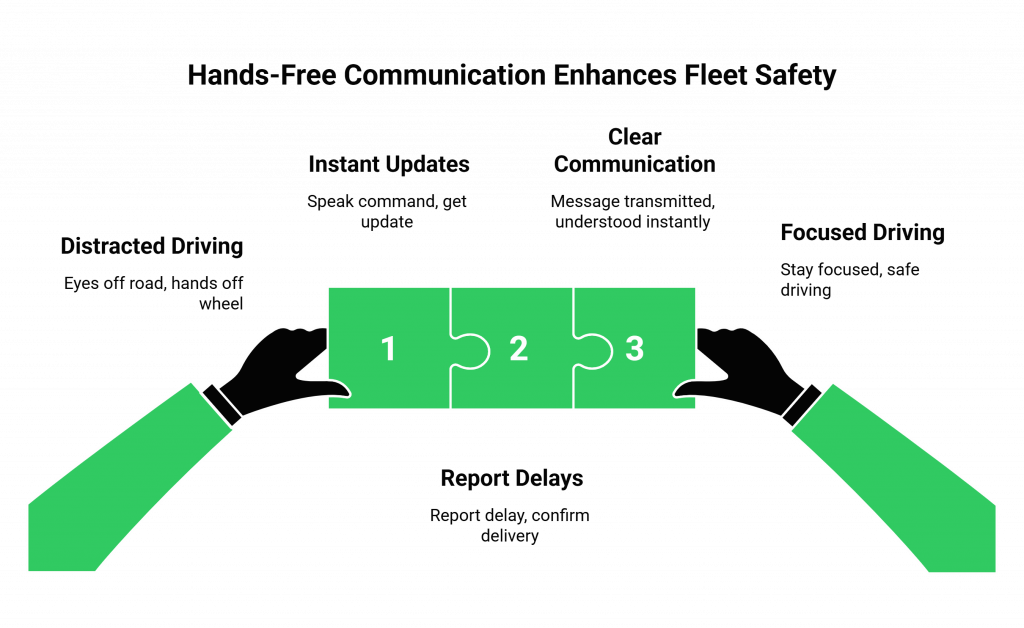
This is where voice communication becomes essential. A driver can simply speak a command to their dashboard or headset to get an update, report a delay, or confirm a delivery. They don’t have to unlock a phone, find a contact, and type a message. This hands free approach allows them to stay focused and safe.
However, for this to work effectively, the communication must be instant and clear. Any lag or delay can be just as distracting as a manual process. This is why the underlying infrastructure is so important.
A platform like FreJun AI is built for low latency real time audio streaming. It ensures that when a driver speaks, the message is transmitted and understood instantly, making the interaction as natural and seamless as talking to a passenger.
Also Read: How Voice AI in Banking is Reducing Queue Times?
How Can a Voice API for Developers Transform Fleet Operations?
Integrating a voice API into your fleet management software is not just about making calls. It’s about creating a smarter, more connected, and automated workflow. It touches every part of the operation, from the driver on the road to the customer waiting for a package.
How Does It Enable Real Time Dispatch and Coordination?
A driver’s route can change in an instant due to traffic, weather, or a last minute customer request. A voice API for developers allows for instant, two way communication between the driver and the dispatch center.
- Push to Talk: Developers can build a “push to talk” feature directly into the fleet app. A dispatcher can broadcast an urgent message to a specific driver or a group of drivers in a certain area with a single click.
- Direct Calling: If a driver needs immediate assistance, they can use a simple voice command like “Call dispatch” to be connected instantly, without fumbling with a phone.
- Emergency Alerts: In an emergency, a driver can trigger an automated voice call to their manager or an emergency service with a preset keyword.
How Does It Automate Status Updates?
One of the most time consuming tasks for drivers is manually updating their status. A voice API can automate this process entirely. A driver can simply say:
- “I have arrived at the customer location.”
- “Package delivered successfully.”
- “En route to the next stop.”
The system’s AI, connected through the voice API, understands these phrases, converts them to text, and automatically updates the fleet management software and logs the timestamp. This eliminates manual entry, reduces errors, and gives dispatchers a real time view of the entire fleet’s progress.
Also Read: How Are Real Estate Agents Using AI for Inbound Calls?
How Does It Streamline Customer Communication?
Keeping customers informed is crucial for satisfaction. A recent study found that 93% of consumers want to stay informed throughout the delivery process. A voice API for developers can automate this communication.
For example, the system can trigger an automated voice call to a customer when their driver is 15 minutes away, providing a personalized and professional touch. This reduces the number of “Where is my order?” calls to your support center. Here’s how a voice API improves operations across the board:
| Operational Area | Challenge with Traditional Methods | Solution with a Voice API |
| Driver Safety | Distraction from using handheld devices for calls and texts. | Hands free, voice activated communication keeps focus on the road. |
| Dispatch Efficiency | Manual calls and texts to coordinate routes and handle issues. | Instant push to talk and direct calling within the fleet app. |
| Status Reporting | Drivers must stop or use devices to manually update their status. | Voice commands automate updates, saving time and reducing errors. |
| Customer Service | Support staff manually call customers with delivery updates. | Automated ETA notifications and delivery confirmations via voice calls. |
Also Read: How Retailers Use Voice AI for Customer Support?
Ready to see how easy it is to embed powerful voice features into your application? Sign up and get your API keys from FreJun AI to start building.
What Should You Look for in a Voice API for Developers?
Choosing the right voice API for developers is critical. You are not just buying a product; you are choosing an infrastructure partner. Here are the key factors to consider.
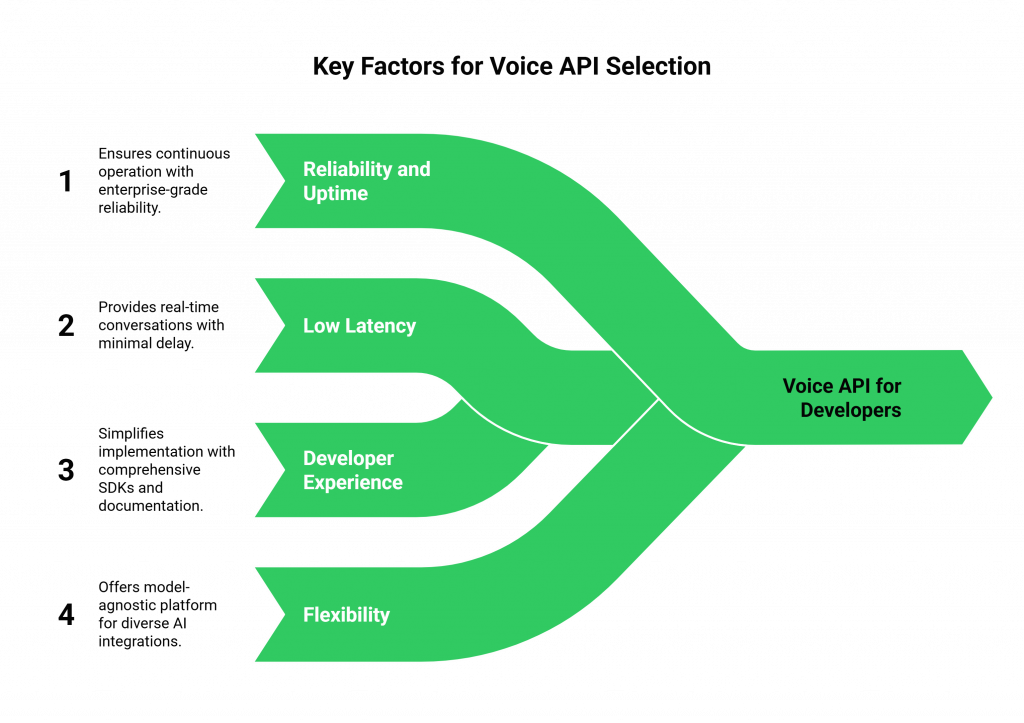
- Reliability and Uptime: In logistics, downtime is not an option. A missed call can mean a missed delivery. You need a platform with enterprise grade reliability and geographically distributed infrastructure to ensure it’s always online. FreJun AI is built for this level of dependability.
- Low Latency: For real time conversations to feel natural, there can’t be any delay. The API must be optimized for low latency audio streaming. This is a core feature of FreJun AI, ensuring conversations between drivers and AI are fluid.
- Developer Experience: A great voice API for developers should be easy to implement. Look for comprehensive SDKs, clear documentation, and a developer-first approach. This speeds up your development time and lets you launch features faster.
- Flexibility: Your business needs are unique. The best voice infrastructure doesn’t lock you into a specific AI provider. A model agnostic platform like FreJun AI gives you the freedom to bring your own Speech-to-Text (STT), Large Language Model (LLM), and Text-to-Speech (TTS) services. This allows you to choose the best AI for your specific use case.
Conclusion
The future of fleet management is connected, automated, and voice enabled. By moving beyond outdated communication methods, logistics companies can create a safer environment for their drivers, a more efficient workflow for their dispatchers, and a better experience for their customers. The key to unlocking this future is a powerful and reliable voice API for developers.
By integrating voice directly into fleet management systems, businesses can solve some of their biggest challenges, from reducing distracted driving to automating tedious manual tasks. Choosing an infrastructure partner like FreJun AI, which handles the complex telephony layer, allows you to focus on what you do best: building incredible AI powered solutions.
Want to discuss your specific fleet management use case? Schedule a demo with our team at FreJun Teler.
Also Read: How to Log a Call in Salesforce: A Complete Setup Guide
Frequently Asked Questions (FAQs)
The main benefit is improved driver safety. It enables hands free communication, allowing drivers to stay focused on the road while sending and receiving critical information.
Though a data connection is needed, the system can work on low bandwidth, queuing messages to send once connectivity is restored.
No. Platforms like FreJun AI prioritize developers, providing robust SDKs and clear documentation that streamline integration and let you launch in days, not months.
With a model agnostic platform like FreJun AI, yes. You can bring your own STT, LLM, and TTS providers, giving you the flexibility to choose the best AI technology for your needs.
It automates routine status updates from drivers, freeing dispatchers from making constant check in calls. This allows them to focus on managing exceptions and handling more complex logistical challenges.
Absolutely. You can train the AI model connected to the voice infrastructure to recognize custom commands, phrases, and terminology specific to your company’s operations.
It can power automated outbound calls to customers, providing them with real time updates on their delivery status and estimated arrival times, which significantly improves the customer experience.
Yes, a cloud-based voice infrastructure like FreJun AI is built to scale. It can handle a high volume of simultaneous calls and communications, whether you have ten trucks or ten thousand.