
Imagine trying to sell or rent a house in today’s fast-paced world. Potential buyers or renters are busy, often juggling multiple responsibilities, and don’t always have the time to visit every property in person. This challenge often means missed opportunities for real estate agents and a frustrating search for clients.
What if there was a way to offer immersive, interactive property tours anytime, anywhere, without needing a human agent present? Enter the world of virtual property tours powered by AI voice agents.
These intelligent AI voicebot systems are changing the game, making property exploration more accessible, engaging, and efficient than ever before.
Table of contents
- What Are Virtual Property Tours, and Why Do They Matter?
- How Do AI Voice Agents Enhance Virtual Property Tours?
- Why Should Real Estate Embrace AI Voice Agents?
- How Can AI Voice Agents Create Personalized Property Experiences?
- What Are the Key Features of an Effective AI Voice Agent for Virtual Tours?
- Why is Security and Reliability Paramount for Voice Infrastructure?
- Conclusion
- Frequently Asked Questions (FAQs)
What Are Virtual Property Tours, and Why Do They Matter?
Virtual property tours are digital representations of real estate that allow potential buyers or renters to explore a property remotely. Think of them as open houses that are always open. Traditionally, these tours might involve static 360-degree photos or pre-recorded videos. However, with the integration of AI voice agents, these tours transform from passive viewing experiences into dynamic, interactive conversations.
Why do they matter so much? In an increasingly digital world, convenience is king. People expect instant access to information and experiences. For the real estate industry, this means adapting to new technologies to meet evolving customer demands.
Virtual tours broaden the reach of a property, allowing international buyers or those with limited mobility to explore homes they might never have seen otherwise. They also pre-qualify leads, as interested parties can get a comprehensive feel for a property before committing to an in-person visit, saving time for both agents and clients.
How Do AI Voice Agents Enhance Virtual Property Tours?
An AI voice agent takes a standard virtual tour and elevates it to a truly interactive experience. Instead of just clicking through images, users can converse with the AI, asking questions about room dimensions, nearby amenities, pricing, or anything else they want to know. This turns a viewing into a personalized dialogue, mimicking the experience of having a knowledgeable agent by your side.
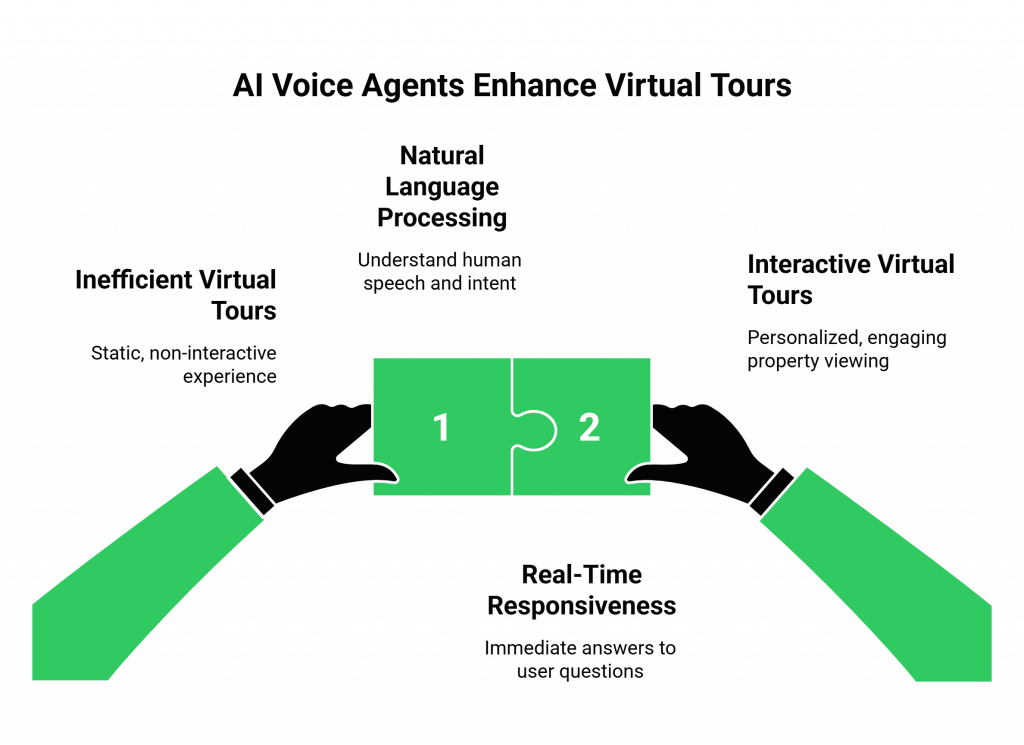
The core enhancement comes from the ability of the AI voicebot to understand natural language and provide real-time information. It’s like having a digital concierge for every property.
This level of interaction can significantly improve user engagement and satisfaction. When buyers can get immediate answers to their specific questions, they feel more informed and connected to the property.
What is the Role of Natural Language Processing in AI Voice Agents?
Natural Language Processing (NLP) is the brain behind an AI voice agent’s ability to understand human speech. It allows the system to interpret spoken questions, identify key information, and determine the user’s intent.
For example, if a potential buyer asks, “How many bedrooms does this house have?” or “What schools are in the area?”, NLP helps the AI voicebot to process these varied phrases and extract the core request.
Without sophisticated NLP, AI voice agents would struggle to go beyond simple, pre-programmed commands. It’s NLP that enables them to engage in fluid, human-like conversations, making the virtual tour feel less like an interaction with a machine and more like talking to a real person.
This technology constantly improves, leading to even more natural and accurate interactions over time.
Also Read: Benefits of Using OpenAI’s AgentKit with Teler
How Does Real-Time Responsiveness Impact User Experience?
Real-time responsiveness is absolutely crucial for a positive user experience in virtual tours with AI voice agents. Imagine asking a question and having to wait several seconds for a reply. This delay breaks the flow of conversation and can quickly lead to frustration. The goal is to mimic human conversation as closely as possible, where responses are immediate.
Low latency in the voice interaction ensures that there are no awkward pauses, making the dialogue feel natural and seamless. When an AI voicebot can process speech, interpret the query, retrieve information, and vocalize a response almost instantly, the user remains engaged and immersed in the tour.
This immediacy is key to keeping potential buyers focused and interested, preventing them from disengaging due to slow feedback.
Ready to start building your own powerful AI voice agents for virtual property tours and beyond? Sign up for FreJun AI!
Why Should Real Estate Embrace AI Voice Agents?
The real estate industry is notoriously competitive. Standing out requires embracing innovation that genuinely adds value for clients and streamlines operations for businesses. AI voice agents offer a powerful tool to achieve both. They address critical pain points like limited availability for showings and the time-consuming process of answering repetitive questions.
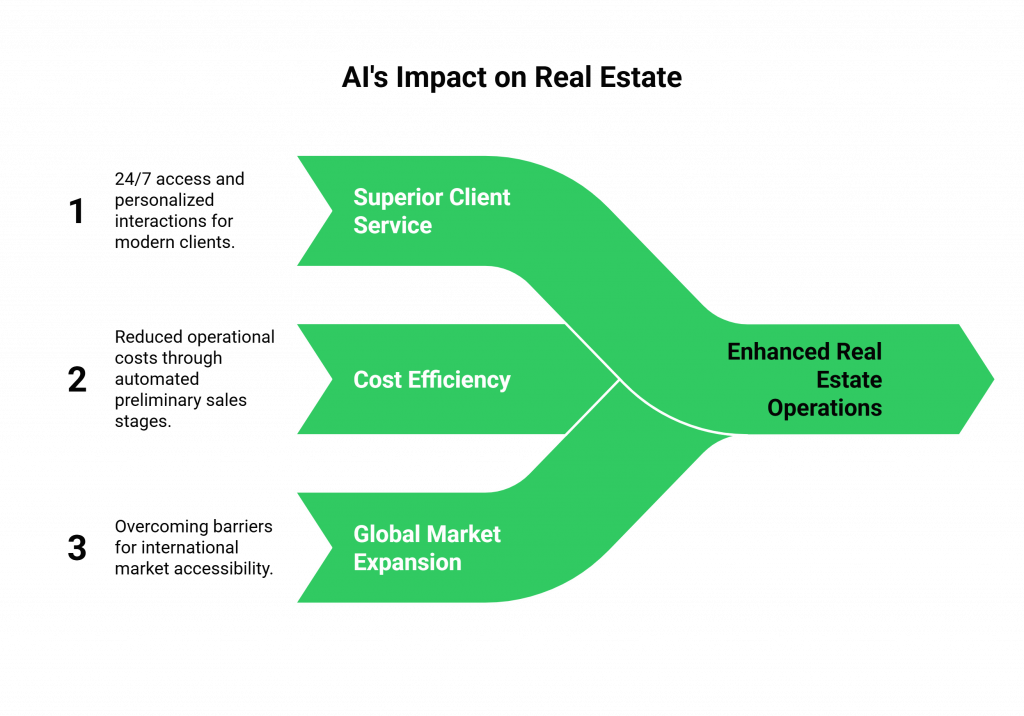
By adopting AI voice agents, real estate companies can offer a superior service that caters to the modern, tech-savvy consumer. This not only attracts more potential buyers but also positions the agency as forward-thinking and committed to leveraging technology for client benefit.
The ability to provide 24/7 access to detailed property information through an interactive voice experience is a significant competitive advantage.
How Do AI Voice Agents Drive Cost Efficiency in Real Estate?
One of the most compelling reasons for real estate to adopt AI voice agents is the potential for significant cost efficiency. Traditionally, agents spend a considerable amount of time conducting initial showings, answering common questions, and following up with leads. Many of these tasks are repetitive and can be automated.
An AI voicebot can handle the initial screening of potential buyers, provide detailed property information, and even schedule follow-up calls for agents. This frees up human agents to focus on high-value activities like negotiation, closing deals, and building client relationships.
By automating the preliminary stages of the sales funnel, businesses can reduce operational costs associated with staffing and agent time, leading to a more streamlined and profitable operation.
Consider the following comparison of tasks:
| Task Category | Human Agent Role | AI Voice Agent Role | Cost/Time Impact |
| Initial Showings | Conducting in-person tours, travel time | 24/7 virtual tours, no travel | Significant Cost Reduction (Time & Travel) |
| Information Answering | Answering repetitive questions about properties | Instantly provides accurate details on demand | High Efficiency Gain (Agent time reallocated) |
| Lead Qualification | Manual questioning to gauge buyer interest | Pre-qualifies leads based on interactive queries | Improved Lead Quality, reduced wasted agent time |
| Scheduling | Coordinating availability for viewings | Automated scheduling, instant booking confirmations | Time Savings, reduced no-shows |
| Follow-up | Manual calls/emails to nurture leads | Automated reminders, tailored notifications | Consistent Nurturing, less manual effort |
Also Read: Why Reliability Matters in Voice AI Calls?
What Role Does AI Play in Global Market Expansion for Real Estate?
The global real estate market is vast and diverse, presenting both immense opportunities and significant challenges. Language barriers, time zone differences, and geographical distances can make it difficult for agencies to reach international buyers effectively. AI voice agents are powerful tools for breaking down these barriers.
An advanced AI voicebot can be programmed to speak multiple languages, instantly translating property information and interacting with potential buyers from around the world in their native tongue. This capability dramatically expands a property’s reach beyond local markets, making it accessible to a global audience 24/7, regardless of where they are located.
For example, a buyer in Tokyo can explore a property in London at their convenience, asking questions in Japanese and receiving immediate responses. This global accessibility can significantly boost sales opportunities and diversify client portfolios for real estate businesses.
How Can AI Voice Agents Create Personalized Property Experiences?
Personalization is a key driver of engagement and conversion in almost every industry, and real estate is no exception. A generic tour might provide basic information, but a personalized experience makes a potential buyer feel understood and valued. AI voice agents are uniquely positioned to deliver this.
By tracking user interactions and questions within a virtual tour, an AI voicebot can learn about a buyer’s preferences. For instance, if a buyer repeatedly asks about properties with large backyards or specific school districts, the AI can highlight relevant features or suggest other properties that match these criteria.
This level of tailored interaction makes the search process far more efficient and enjoyable, ultimately leading to higher satisfaction and a greater likelihood of a successful sale.
What Are the Key Features of an Effective AI Voice Agent for Virtual Tours?
For an AI voice agent to be truly effective in virtual property tours, it needs a robust set of features that ensure seamless, intelligent, and reliable interactions. These features go beyond basic speech recognition and touch upon the core capabilities that make the experience feel natural and productive.
Is Conversational Context Management Important?
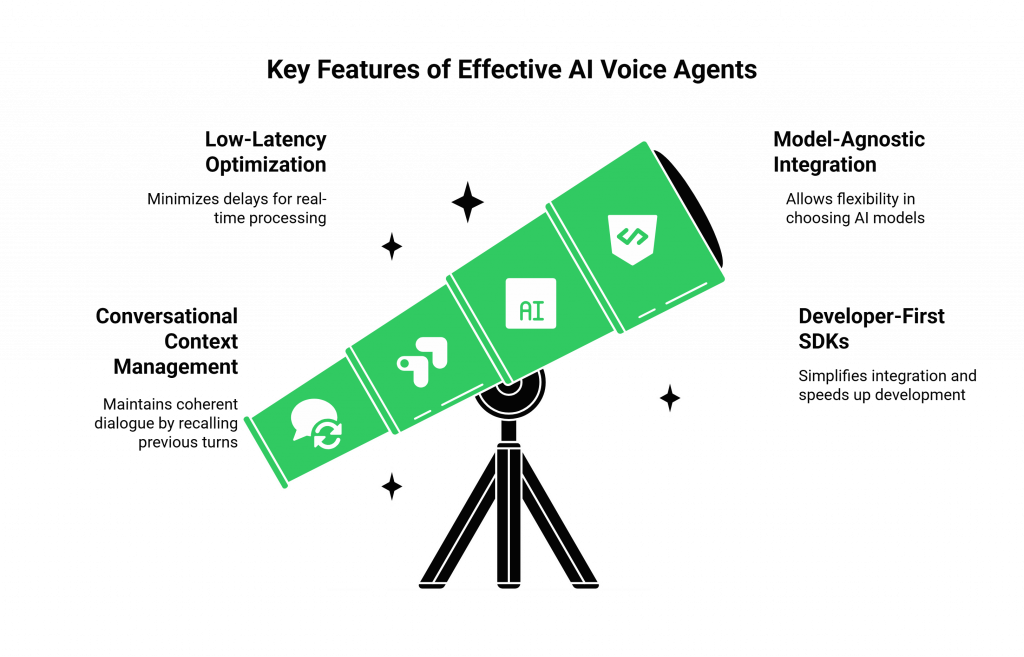
Absolutely. Conversational context management is vital for an AI voicebot to maintain a coherent and natural dialogue. Imagine asking, “How big is the master bedroom?” and then following up with, “What about the bathroom next to it?” If the AI doesn’t remember that “it” refers to the master bedroom, the conversation quickly breaks down.
Context management allows the AI to recall previous turns in the conversation, understanding references and continuing a thread of thought. This capability is essential for answering follow-up questions, clarifying details, and guiding the user through a complex virtual environment without losing track of what they’ve already discussed.
It makes the interaction feel intelligent and intuitive, rather than a series of disconnected questions and answers.
Why is Low-Latency Optimization Crucial for Voice AI?
Low-latency optimization refers to the process of minimizing delays in voice communication. For an AI voice agent facilitating virtual property tours, this means that when a user speaks, the system processes the audio, understands the request, generates a response, and plays it back almost instantly. This real-time processing is not just a nice-to-have; it’s a fundamental requirement for a natural conversation.
Without low latency, there would be awkward pauses between questions and answers, mimicking a slow or unreliable phone connection. These delays can frustrate users, disrupt their immersion in the virtual tour, and ultimately lead them to abandon the experience.
FreJun AI, for instance, focuses precisely on this, providing the real-time media streaming and low-latency audio processing needed to ensure conversations flow smoothly and naturally. We handle the complex voice infrastructure so you can focus on building your AI.
How Does Model-Agnostic Integration Benefit Real Estate Developers?
Model-agnostic integration is a significant advantage for real estate developers building AI voice agents. It means that the underlying voice infrastructure, like FreJun AI, does not dictate which specific AI models (Speech-to-Text, Text-to-Speech, or Large Language Models) you must use. Instead, it allows developers to “bring their own” preferred AI services.
This flexibility is incredibly powerful. Developers can choose the best-in-class STT for accuracy, the most natural-sounding TTS for their brand, and the most powerful LLM for conversational intelligence, all while using FreJun AI to handle the complex real-time voice streaming and telephony.
This prevents vendor lock-in, allows for customization, and enables businesses to future-proof their voice solutions by easily swapping out AI models as technology evolves. It means real estate companies can tailor their AI voicebot to their exact needs, ensuring optimal performance and a unique brand voice.
Also Read: How to Maintain Call Quality in Voice AI?
What Makes Developer-First SDKs So Important?
Developer-first SDKs (Software Development Kits) are crucial because they empower developers to build and integrate AI voice agents into their platforms with ease and speed.
These SDKs provide pre-built tools, libraries, and documentation that simplify complex tasks, allowing developers to focus on the unique aspects of their real estate application rather than reinventing the wheel for voice infrastructure.
For instance, FreJun AI provides comprehensive SDKs for both client-side and server-side development. This means developers can easily embed voice features into their websites or mobile apps (client-side) while managing call logic and AI integrations in their backend systems (server-side).
This streamlined approach significantly reduces development time and effort, enabling real estate businesses to launch sophisticated, production-grade AI voice agents in days, not months. It puts the power in the hands of the developers, accelerating innovation.
Why is Security and Reliability Paramount for Voice Infrastructure?
In any enterprise application, especially one dealing with sensitive client data and high-value transactions like real estate, security and reliability are non-negotiable. For the voice infrastructure supporting AI voice agents, these aspects are even more critical. Businesses cannot afford downtime, dropped calls, or security breaches that could compromise client trust or operational integrity.
Enterprise-grade reliability ensures that the voice service is always available, even during peak demand, guaranteeing an uninterrupted experience for potential buyers. Security by design protects conversational data and ensures compliance with privacy regulations.
FreJun AI understands this deeply, building its infrastructure for high availability and robust security protocols. This focus on foundational strength allows real estate businesses to deploy their AI voicebot solutions with confidence, knowing their voice layer is stable and protected.
In fact, by 2025, it’s projected that 75% of customer interactions will involve AI, highlighting the need for secure and reliable AI infrastructure. (Source: Gartner)
Conclusion
The real estate industry stands on the brink of a major transformation, with AI voice agents leading the charge in redefining how properties are showcased and sold. Virtual property tours, enhanced by an intelligent AI voicebot, offer unparalleled convenience, personalization, and efficiency for both buyers and sellers.
By leveraging natural language processing, low-latency communication, and model-agnostic flexibility, these agents create immersive and responsive experiences that cater to the modern consumer. They drive cost efficiencies, expand market reach, and free up human agents to focus on high-value tasks.
As technology continues to evolve, the integration of AI voice agents with VR/AR and predictive analytics promises an even more exciting future for real estate. Embracing this technology is not just about staying competitive; it’s about pioneering the next generation of property interactions.
Want to learn more about the infrastructure that powers the most advanced voice chat bots? Schedule a demo with FreJun AI today.
Also Read: Call Log: Everything You Need to Know About Call Records
Frequently Asked Questions (FAQs)
An AI voice agent in real estate is a sophisticated computer program that can understand human speech, process information, and respond verbally in a natural-sounding voice. For virtual property tours, it acts like a digital real estate agent, guiding visitors through properties and answering their questions in real time.
Traditional virtual tours are passive, but AI voice agent tours are interactive, letting users ask questions and receive instant, personalized answers for a richer experience.
Yes, with advanced Natural Language Processing (NLP) capabilities, modern AI voice agents are designed to understand a wide range of complex questions. They can interpret context, clarify ambiguities, and provide detailed information, much like a human agent would.
Key benefits include 24/7 availability, stronger engagement, cost savings through automation, better lead qualification, global reach, and personalized experiences.
Integrating an AI voice agent can be streamlined with developer-first SDKs and model-agnostic platforms like FreJun AI. These tools provide the necessary infrastructure and flexibility, allowing developers to connect their chosen AI models easily and embed voice features into existing web or mobile applications.
An AI voice agent can answer questions about property specs, nearby amenities, pricing, market trends, historical data, and specific home features.
Advanced AI voice agents support multiple languages, letting international buyers tour properties in their native language and expanding market reach.