
In the world of real estate, the CRM is the central nervous system of a broker’s business. It is the repository of their most valuable assets: their client relationships, their pipeline of leads, and their history of deals. The phone, on the other hand, is the heart, the real-time, high-stakes channel where those relationships are built and where deals are won or lost. For decades, these two critical systems have lived in separate, disconnected worlds.
This disconnect is a massive, silent drain on the productivity of every agent and broker. It creates a world of manual data entry, missed opportunities, and a frustrating lack of real-time context. What if you could build a bridge between these two worlds? What if you could create a system where every phone call was an intelligent, data-rich event that could automatically update your CRM in real-time?
This is the transformative power of a modern voice API for developers. It is the essential architectural component that allows you to create a deep, two-way integration, transforming your CRM from a passive database into an active, “conversation-aware” partner in your sales process.
This guide is for the forward-thinking brokerages and the real estate tech developers who are ready to build this powerful competitive advantage.
Table of contents
Why is a Disconnected CRM a “Leaky Bucket” for Real Estate?
When your phone system and your CRM don’t talk to each other, you are operating with a massive blind spot. This disconnect creates a “leaky bucket” that is constantly losing your most valuable assets: your data, your time, and your deals.
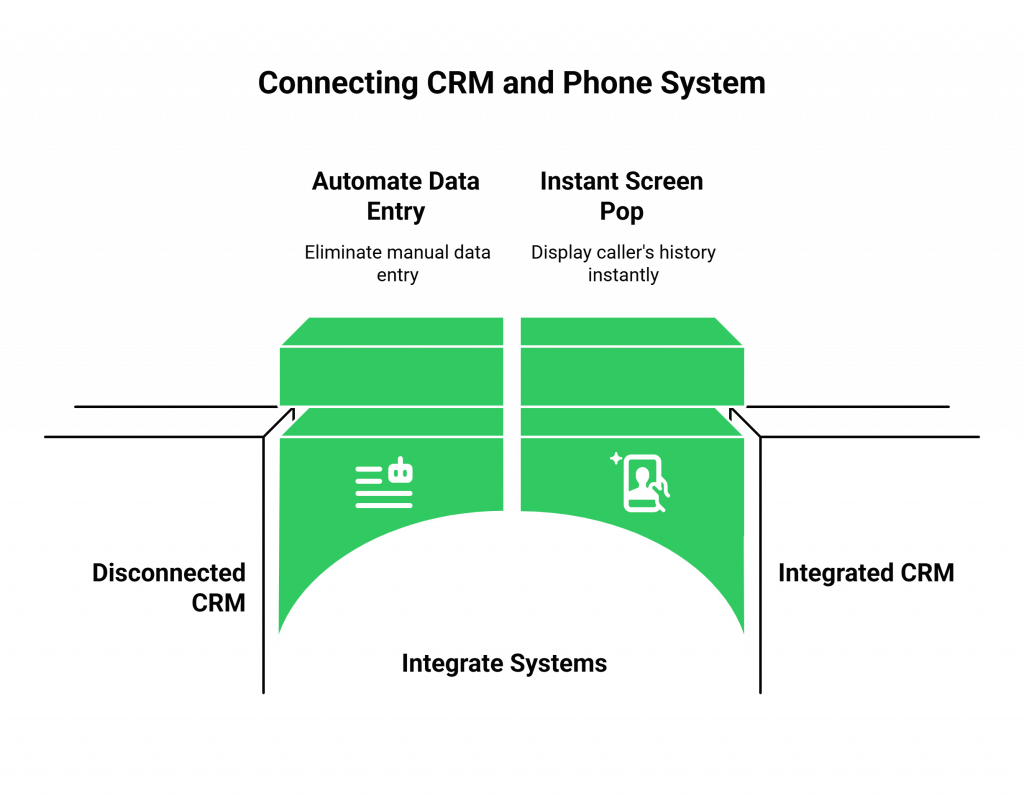
What is the “Data Entry” Black Hole That Agents Hate?
After a long day of showings and client meetings, the last thing a busy agent wants to do is spend an hour manually typing up call notes, logging their calls, and updating contact records. A
s a result, this crucial task is often done poorly, inconsistently, or not at all. This leads to a CRM that is filled with incomplete records, outdated information, and missing context, making it impossible for a team to collaborate effectively or for a manager to get an accurate view of the sales pipeline.
This is not just a minor issue; it’s a huge productivity drain. Studies have shown that sales reps can spend up to 20% of their time on administrative tasks like manual data entry.
How Does a Lack of Integration Kill “Speed to Lead”?
In real estate, speed is everything. When a hot new lead calls in about a listing, the first few seconds of that call are critical. In a disconnected system, the agent has to ask the caller to wait while they manually search for their phone number in the CRM to see if they are an existing contact. They have no instant “screen pop” with the caller’s history, their saved properties, or the specific listing they are interested in.
This fumbling for information creates an unprofessional first impression and slows down the entire sales process at the most critical moment.
A landmark study from the Harvard Business Review found that companies that attempted to contact a potential customer within an hour of receiving an inquiry were nearly 7 times as likely to have a meaningful conversation.
Also Read: Why Reliability Matters in Voice AI Calls?
What Does a “Conversation-Aware” CRM Actually Do?
A deep voice integration, powered by a voice API for developers, transforms your CRM from a passive database into an active, intelligent partner in the sales process. The difference between the old way and the new way is a night-and-day improvement in workflow and efficiency.
| Feature | Traditional “Silent” CRM | “Conversation-Aware” CRM with Voice API Integration |
| New Lead Creation | Manual entry after a call is missed or a voicemail is left. | An AI answers the call 24/7, and a new lead is automatically created in the CRM via an API call. |
| Inbound Call “Screen Pop” | Agent manually searches for the caller’s number while the caller waits. | The CRM record for the inbound caller automatically “pops” on the agent’s screen the moment the phone rings, providing instant context. |
| Call Logging & Recording | Agent manually logs the call and adds a brief, subjective, and often incomplete note. | Every call is automatically logged, and a link to the full call recording and AI-generated transcript is attached to the record. |
| “Click-to-Call” | Agent looks up a number in the CRM and manually dials it from their phone. | The agent can click a phone number in the CRM, and the call is automatically initiated through their headset or softphone. |
| Automated Follow-Up | The agent has to manually set a reminder in their calendar to make a follow-up call. | An AI can automatically trigger a follow-up call or text message based on the outcome of the previous call, which was logged in the CRM. |
How Do You Architect This Deep Integration?
Modern, real-time APIs and webhooks enable backend engineers to build this two-way conversation between your CRM and your voice platform.
What is the Role of the Voice Infrastructure API?
This is the foundational layer, the “central nervous system” of your integration. A developer-first voice API for developers platform like FreJun AI is the essential bridge. FreJun AI provide the powerful, real-time APIs and webhooks that are the building blocks for this integration.
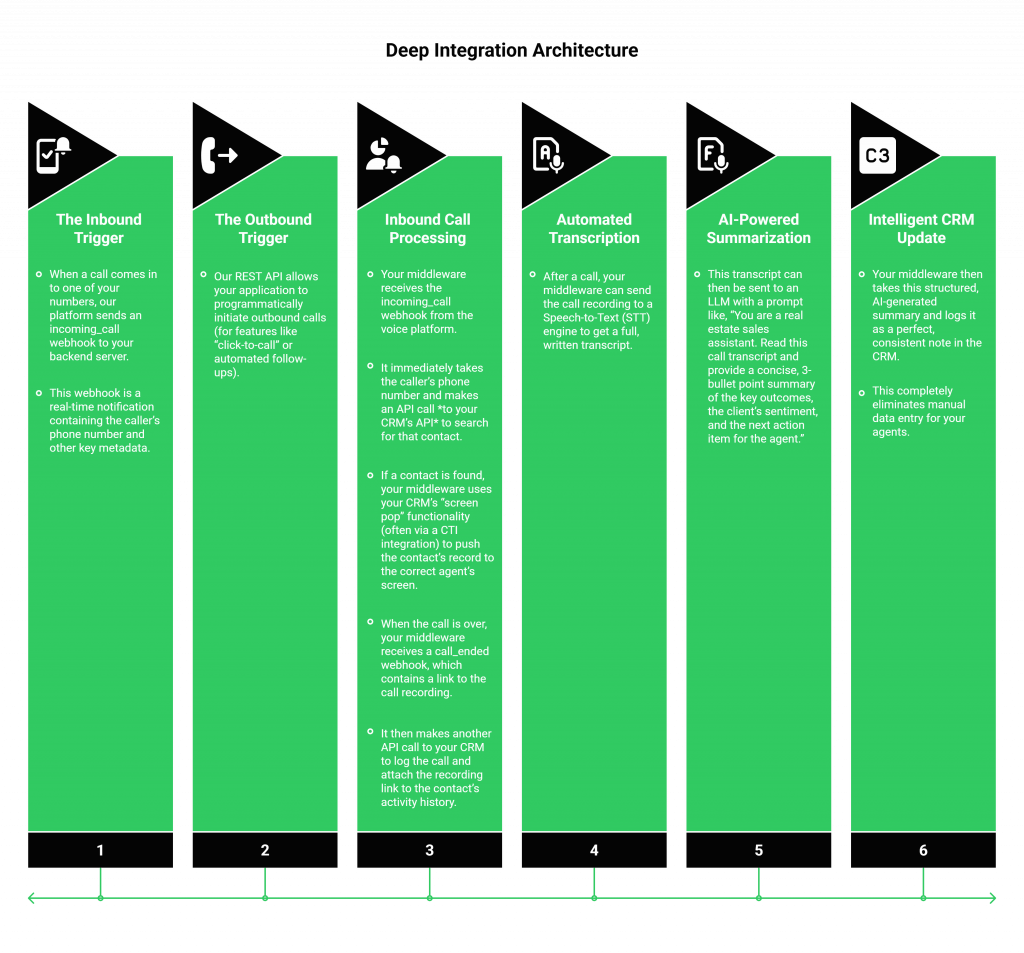
- The Inbound Trigger: When a call comes in to one of your numbers, our platform sends an incoming_call webhook to your backend server. This webhook is a real-time notification containing the caller’s phone number and other key metadata.
- The Outbound Trigger: Our REST API allows your application to programmatically initiate outbound calls (for features like “click-to-call” or automated follow-ups).
How Do You Build the “Middleware” Integration Service?
Your custom backend application is the “middleware” that sits between the voice platform and your CRM. Its job is to be the intelligent “translator” and “traffic cop” between these two powerful systems.
- For an Inbound Call: Your middleware receives the incoming_call webhook from the voice platform. It immediately takes the caller’s phone number and makes an API call to your CRM’s API to search for that contact.
- If a contact is found, your middleware uses your CRM’s “screen pop” functionality (often via a CTI integration) to push the contact’s record to the correct agent’s screen.
- When the call is over, your middleware receives a call_ended webhook, which contains a link to the call recording. It then makes another API call to your CRM to log the call and attach the recording link to the contact’s activity history.
Also Read: Enterprise-Grade Voice Infrastructure Explained
How Can You Layer on AI for “Superhuman” Data Entry?
This is where the integration becomes truly transformative, creating a next-level conversational interface. You can add an AI layer to your middleware to automatically analyze and understand every single conversation.
- Automated Transcription: After a call, your middleware can send the call recording to a Speech-to-Text (STT) engine to get a full, written transcript.
- AI-Powered Summarization: This transcript can then be sent to an LLM with a prompt like, “You are a real estate sales assistant. Read this call transcript and provide a concise, 3-bullet point summary of the key outcomes, the client’s sentiment, and the next action item for the agent.”
- Intelligent CRM Update: Your middleware then takes this structured, AI-generated summary and logs it as a perfect, consistent note in the CRM. This completely eliminates manual data entry for your agents.
Ready to build a CRM that never misses a single detail from a call? Sign up for FreJun AI to start your voice integration project.
What is the Business Impact of a Deep Voice API Integration?
This is not just a technical upgrade; it’s a fundamental improvement to your entire sales workflow that delivers a massive ROI and a significant competitive advantage.
- A Massive Boost in Agent Productivity: By eliminating manual dialing and data entry, you can give each of your agents back hours of their time every single week, allowing them to focus on high-value, relationship-building activities.
- A “Leak-Proof” Sales Funnel: The combination of a 24/7 AI receptionist for missed calls and instant screen pops for live calls ensures the system captures every lead and engages each one with full historical context.
- Data-Driven Sales Coaching: With a searchable, AI-summarized record of every sales conversation, managers gain full visibility. They can move beyond anecdotal feedback. Coaching becomes targeted and data driven. This helps improve individual performance. It also elevates the entire brokerage.
Also Read: How to Maintain Call Quality in Voice AI?
Conclusion
In real estate, your CRM is your most valuable asset. Your phone is your most powerful sales tool. For years, these systems have stayed disconnected. This disconnect slows productivity. It also creates leaks in your sales funnel.
The modern voice API for developers is the powerful bridge that unifies them. By creating a deep, two-way voice integration, you can transform your CRM from a passive database into an active, intelligent, and “conversation-aware” partner in your sales process. This is the key to building a more efficient, more data-driven, and more profitable brokerage.
Want to see a live demonstration of a voice API populating a real estate CRM record in real time? Schedule a demo for FreJun Teler!
Also Read: Call Log: Everything You Need to Know About Call Records
Frequently Asked Questions (FAQs)
A voice API enables deep, two-way integration between your phone system and CRM, supporting automated call logging, screen pops, and real-time synchronization.
A “screen pop” is a feature where an incoming phone call automatically triggers the caller’s record to “pop up” on the agent’s computer screen. This is a core feature of a good voice integration.
Click-to-call lets users dial CRM phone numbers instantly through their headset or softphone, eliminating manual dialing and improving calling efficiency.
The voice API sends a webhook to your application containing the caller’s phone number (Caller ID). Your application then uses your CRM’s API to search for a contact record that matches that phone number.
No. This integration works with most modern, cloud-based CRMs (like Salesforce, HubSpot, Zoho, etc.) that have a well-documented API.
Webhooks act as real-time triggers, notifying your application when calls start or end so it can execute actions like creating CRM call logs.
Yes. Your application can transcribe call recordings, summarize them with an LLM, and automatically log the summary in the CRM.
Yes, but security is critical. Encrypt all API communications with HTTPS and store all API keys securely.
FreJun AI delivers a developer-first voice API, providing reliable telephony, real-time call event webhooks, and call recording for deep two-way integrations.