
The airline industry operates on a razor’s edge. It is a world of immense logistical complexity, tight margins, and, most importantly, high-stakes customer emotion. A single flight delay, a lost bag, or a confusing booking process can transform a passenger’s dream vacation into a stressful nightmare.
For an airline’s contact center, this means being on the front line of one of the most demanding and time-sensitive customer support environments in the world.
The traditional, queue-based, human-powered call center is simply no longer equipped to handle this level of pressure. The modern traveler, armed with a smartphone and an expectation of instant service, will not tolerate waiting on hold for 45 minutes to ask a simple question.
This is why the airline industry is at the forefront of a massive technological shift, moving towards a more intelligent, automated, and scalable model of customer support, all powered by a voice API for developers.
This guide is for the architects and engineering leaders at modern airlines. We will explore how a voice API is not just a tool, but the foundational infrastructure that allows you to build a next-generation customer support operation, one that is not only more cost-effective but also dramatically more responsive to the needs of the modern traveler.
Table of contents
Why is the Traditional Airline Call Center Facing “Terminal” Congestion?
The traditional airline call center is a system that is perpetually in a state of crisis. It is a model that is fundamentally mismatched with the “spiky,” unpredictable nature of air travel.
What Happens During an “Irregular Operation” (IROP)?
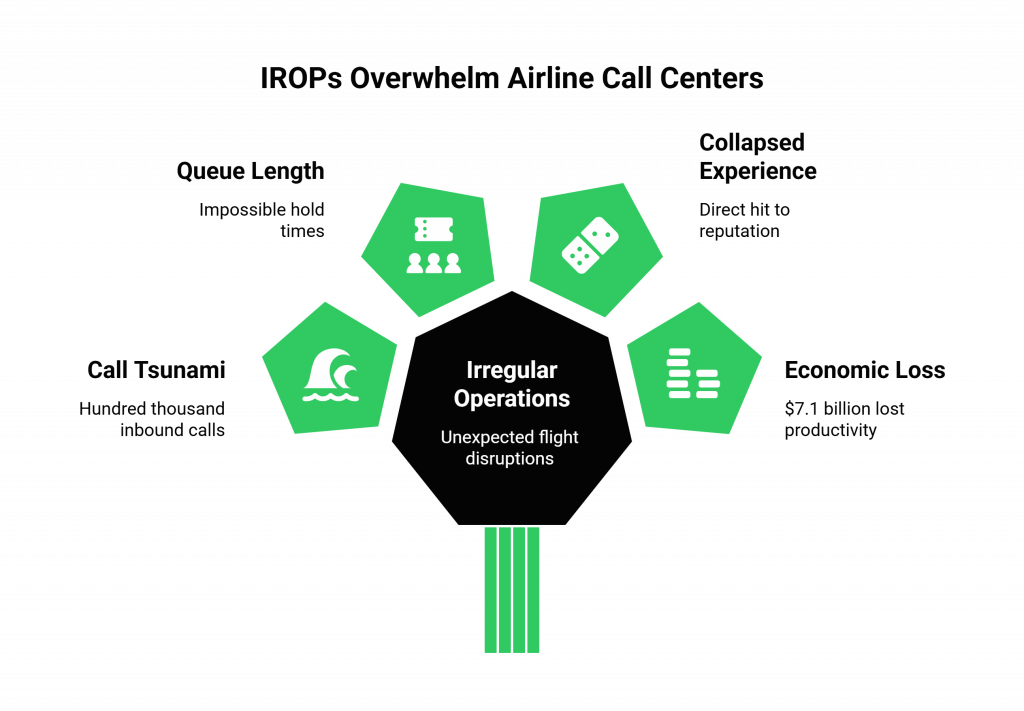
An IROP is any unexpected event, like a major weather storm or a mechanical issue, that causes a cascade of flight delays and cancellations. When this happens, an airline’s call center is hit with a literal tsunami of inbound calls.
A system that was designed to handle a few thousand calls an hour is suddenly faced with a hundred thousand. The queue grows to an impossible length, the hold times are measured in hours, and the customer experience completely collapses. This isn’t just a bad experience; it’s a direct hit to the airline’s reputation and bottom line.
The cost of these disruptions is staggering. A 2023 report from the U.S. Travel Association found that travel-related issues, including delays, cost the U.S. economy an estimated $7.1 billion in lost productivity.
What is the Cost of Handling Repetitive, Low-Value Queries?
Even on a “blue sky” day, a huge percentage of an airline’s call volume is for simple, repetitive, and low-value inquiries:
- “What is my flight status?”
- “What is the baggage allowance for my flight?”
- “Can I get a copy of my itinerary?”
When your highly-trained, expert human agents are forced to spend their day acting as human search engines for this basic information, you are not only wasting a massive amount of money, but you are also contributing to agent burnout.
Also Read: Best AI Agent for Call Centers: Features That Matter
How Does a Voice API Solve These Core Challenges?
A voice API for developers is the architectural key that unlocks a new, more resilient, and more intelligent model for airline customer support. It is the bridge that connects your core airline operations systems (your reservation system, your flight status system, etc.) to the world of conversational AI and automation.
A modern, API-first voice infrastructure like FreJun AI provides the foundational layer. We provide the infinitely scalable, globally reliable, and carrier-grade “nervous system” that an airline’s mission-critical communication demands.
What are the “High-Flying” Use Cases for a Voice API in an Airline?
Let’s move beyond the theory and look at the specific, practical workflows that a voice API for developers enables.
How Can You Build a 24/7 “Flight Status” and Information Bot?
The Goal: To provide instant, 24/7, self-service answers to the most common passenger questions.
The Workflow: An AI voicebot, built on top of the voice API, answers the call.
- AI: “Thank you for calling Skyward Airlines. I’m an AI assistant. I can help you check your flight status, get information on baggage policies, or connect you to a support agent. How can I help?”
- Passenger: “I need to check the status of my flight to London tomorrow.”
- AI: “I can help with that. Could you please say or enter your flight number?”
The AI then makes a secure, real-time API call to the airline’s flight status system and provides an instant, accurate update. This one automation can deflect a massive percentage of inbound calls.
How Can You Create a “Proactive Rebooking” Agent for IROPs?
The Goal: During a major disruption, the goal is to move from a reactive to a proactive communication strategy.
The Workflow: When a flight is canceled, a proactive outbound AI agent, powered by the voice API for developers, can automatically call every single passenger on that flight.
- AI: “Hello, this is an automated alert from Skyward Airlines regarding your flight 123 to London, which has unfortunately been canceled due to weather. We have automatically rebooked you on the next available flight, which departs at 8 PM from the same gate. To accept this change, press 1. To hear other options, press 2.”
The Business Impact: This is a complete game-changer. Instead of having 200 terrified passengers all trying to call your overwhelmed contact center at the same time, you are proactively providing them with a solution. This dramatically reduces the inbound call spike and turns a moment of crisis into a moment of impressive, proactive customer service.
Also Read: Voice Bot Example Workflows for Sales Teams
| Feature | Traditional IROP Response | AI-Powered Proactive Response |
| Communication Mode | Reactive (Passengers call in) | Proactive (Airline calls out) |
| Call Volume | Massive, unmanageable spike | Drastically reduced, manageable volume |
| Hold Times | Hours | Near-zero |
| Customer Emotion | Panic, frustration, anger | Relief, reassurance, satisfaction |
| Agent Experience | Overwhelming, high-stress | Focused on the most complex edge cases |
Ready to build an airline support system that can handle any storm? Sign up for FreJun AI and explore our powerful outbound APIs.
How Can You Offer “Intelligent Self-Service” for Changes and Ancillaries?
The Goal: To empower passengers to manage their own bookings through a simple, conversational interface.
The Workflow: A passenger can call the AI to:
- Change a Seat: “I’d like to change my seat on my flight to London. Can I get an aisle seat?”
- Add an Ancillary: “I need to add an extra checked bag to my reservation.”
- Make a Simple Itinerary Change: For non-complex changes, the AI can access the booking system’s API to process the change and handle any fare difference.
What Makes FreJun AI the Right Choice for an Airline?
An airline’s communication infrastructure is a mission-critical system that demands the absolute highest levels of reliability and performance. A consumer-grade voice API for developers is simply not an option.
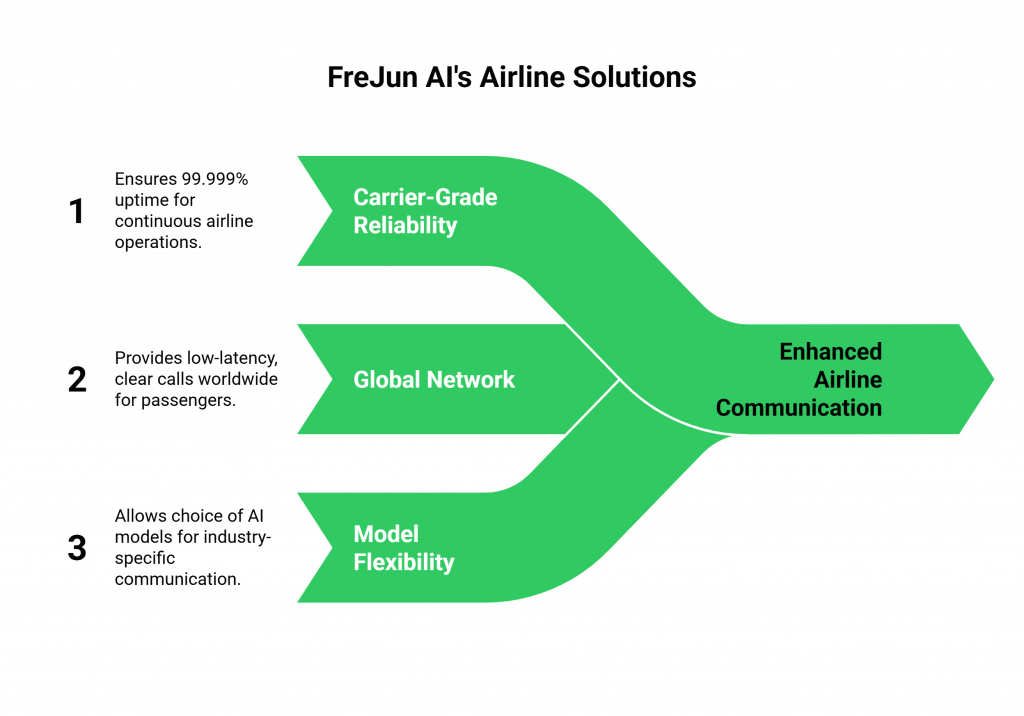
FreJun AI is an enterprise-grade voice infrastructure provider.
- Carrier-Grade Reliability: Our platform is built with the “five nines” of uptime that an airline’s 24/7 operation requires.
- Global, Low-Latency Network: Our globally distributed network ensures that your passengers in New York, London, and Tokyo all get the same crystal-clear, low-latency call quality.
- Model-Agnostic Flexibility: We give you the freedom to choose the “best-of-breed” AI models that can understand the unique and complex jargon of the travel industry and speak with the professional, reassuring voice of your brand.
Also Read: Voice Assistant Chatbot Use Cases in 2025
Conclusion
In the airline industry, customer support is not a department; it is an integral part of the core operational product. The traditional, human-powered call center is an outdated model that is failing to meet the demands of the modern traveler, especially during moments of disruption.
By embracing a modern, API-first approach and building on a foundation of an enterprise-grade voice API for developers, an airline can create a customer support system that is not just more efficient, but is a true competitive advantage. It’s about building a system that is as resilient, scalable, and intelligent as the airline itself.
Want to discuss how our global infrastructure can support your airline’s specific operational needs? Schedule a demo for FreJun Teler.
Also Read: Automated Workflow Tools: Top Solutions for Seamless Automation
Frequently Asked Questions (FAQs)
A voice API for developers is a platform that allows an airline’s software to programmatically control phone calls. This is the core technology that enables the creation of AI-powered voice agents that can automate tasks like checking flight status, rebooking flights, and answering common questions.
The biggest benefit is scalability, especially during “Irregular Operations” (IROPs) like a storm. An AI-powered system built on a voice API can handle a virtually unlimited number of calls, preventing the call center from being overwhelmed.
Yes. Through a secure API integration with the airline’s own reservation system (often a PSS or GDS), the AI can be given the authority to check for available seats and modify a passenger’s booking according to pre-defined business rules.
When a flight is canceled, the airline’s operational system can trigger an event. This event can then be used to initiate a series of automated outbound calls via the voice API for developers.
Yes, but it must be architected for security. The entire system, from the voice API to the application’s backend, must be built with end-to-end encryption and strong access controls to protect the sensitive Passenger Name Record (PNR) data.