
You have built a brilliant voice AI. The LLM is smart, the conversational design is flawless, and the TTS voice is remarkably human-like. You launch it, and the first call comes in.
But instead of a smooth, intelligent conversation, the customer hears a garbled, choppy mess. Words are dropping out, the audio sounds robotic, and the entire experience is unintelligible. Your brilliant AI “brain” has been completely undermined by a terrible phone connection.
In the world of voice AI, call quality is not a secondary concern; it is the bedrock of the entire experience. It is the physical medium through which your AI’s intelligence is delivered.
A low-quality call is like trying to have a deep conversation in the middle of a loud concert; it doesn’t matter how smart the person you’re talking to is; the message will be lost in the noise.
This guide is for the architects and engineers who understand that a voice AI is a real-time system where the quality of the “pipe” is just as important as the intelligence at the end of it.
We will explore the technical factors that define call quality, the architectural choices that ensure it, and the monitoring strategies you need to maintain it for your inbound call handling solution.
Table of contents
Why is Call Quality a “First Principles” Problem?
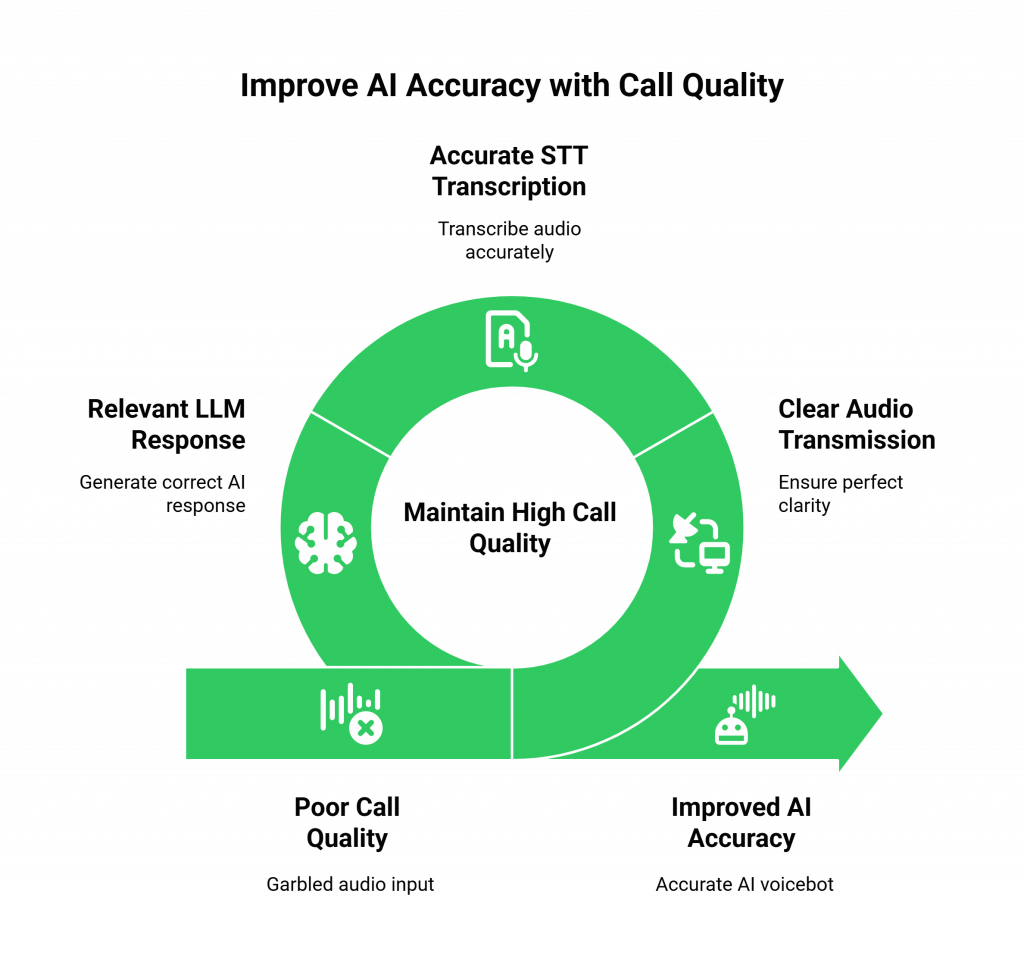
Before a single word can be transcribed by your STT or a single thought can be processed by your LLM, the raw audio must travel from the user’s phone, across the global telephone network, to your application, all with perfect clarity.
If this first, physical step fails, the entire, sophisticated AI pipeline that follows is useless.
How Does Poor Quality Destroy the User Experience?
Poor audio quality is not just a minor annoyance; it is a direct and massive source of customer frustration. It forces the user to repeat themselves, it makes the AI sound stupid (because it’s working with garbled input), and it projects an image of an unprofessional, low-quality brand. This experience is a direct driver of customer churn.
A recent report from Qualtrics found that poor customer experiences are costing businesses a staggering $4.7 trillion in lost consumer spending globally.
What is the “Garbage In, Garbage Out” Effect on AI Accuracy?
The accuracy of your entire AI system is mercilessly dependent on the quality of the input audio. A Speech-to-Text (STT) engine, no matter how advanced, cannot accurately transcribe a garbled, choppy audio stream.
When the STT produces a flawed transcript, it sends “garbage” to your LLM, which in turn leads to a completely irrelevant or incorrect response. Maintaining high call quality is the single most important thing you can do to improve the accuracy of your AI voicebot.
Also Read: Best AI Agent for Call Centers: Features That Matter
What are the Technical Gremlins That Degrade Call Quality?
“Bad quality” is a subjective term, but in the world of telecommunications, it is the result of a few specific, measurable network impairments. To maintain quality, you must understand and defeat these “gremlins.”
| Network Impairment | What It Is | What the User Hears |
| Packet Loss | When small “packets” of the audio data are lost as they travel over the internet. | Gaps in the audio, missing words, or a “clipped” sound. |
| Latency | The total time it takes for an audio packet to travel from the speaker to the listener. | The delay in the conversation, leading to awkward, unnatural pauses. |
| Jitter | The variation in the arrival time of the audio packets. | A choppy, garbled, or “robotic” sound as the system tries to reorder the packets. |
What is the Architectural Blueprint for High-Quality Voice?
You cannot “fix” a bad call with software. High quality must be architected into the very foundation of your inbound call handling system. This requires a strategic partnership with a voice infrastructure provider that is obsessively focused on quality.
Why is a Global, Private Network the Only Real Solution?
The public internet is a chaotic, “best-effort” network. It does not guarantee quality. An enterprise-grade voice provider does not rely on it for their core audio transport. They build their own global, private network with high-quality, direct connections (peering) to major carriers and cloud providers.
This is a massive investment, but it is the only way to guarantee a low-latency, low-jitter path for your audio data, bypassing the congestion of the public internet. This is a core architectural principle of a high-quality voice infrastructure provider like FreJun AI.
Also Read: Voice Bot Example Workflows for Sales Teams
What is the Role of a “Jitter Buffer”?
Even on a great network, some small amount of jitter is inevitable. A key piece of technology that combats this is the “jitter buffer.” This is a small, temporary holding area for incoming audio packets.
It intelligently reorders the packets into the correct sequence before playing them out, which can smooth over minor network imperfections and dramatically improve the perceived audio quality.
A high-quality voice platform will have a sophisticated, adaptive jitter buffer built into its media servers.
How Do Modern Audio Codecs Improve Quality?
A “codec” is the algorithm that compresses and decompresses the audio data. While traditional phone calls used old, low-fidelity codecs, modern inbound call handling solutions can use advanced codecs like Opus.
Opus is a highly efficient codec that can deliver crystal-clear, high-fidelity audio, and it is “resilient” to packet loss, meaning it can gracefully handle minor network issues without a catastrophic drop in quality.
Ready to build your voice AI on a foundation of crystal-clear audio? Sign up for FreJun AI and experience the difference.
How Do You Proactively Monitor and Troubleshoot Call Quality?
You cannot maintain what you cannot measure. A proactive approach to call quality requires a deep, real-time visibility into the health of every single call.
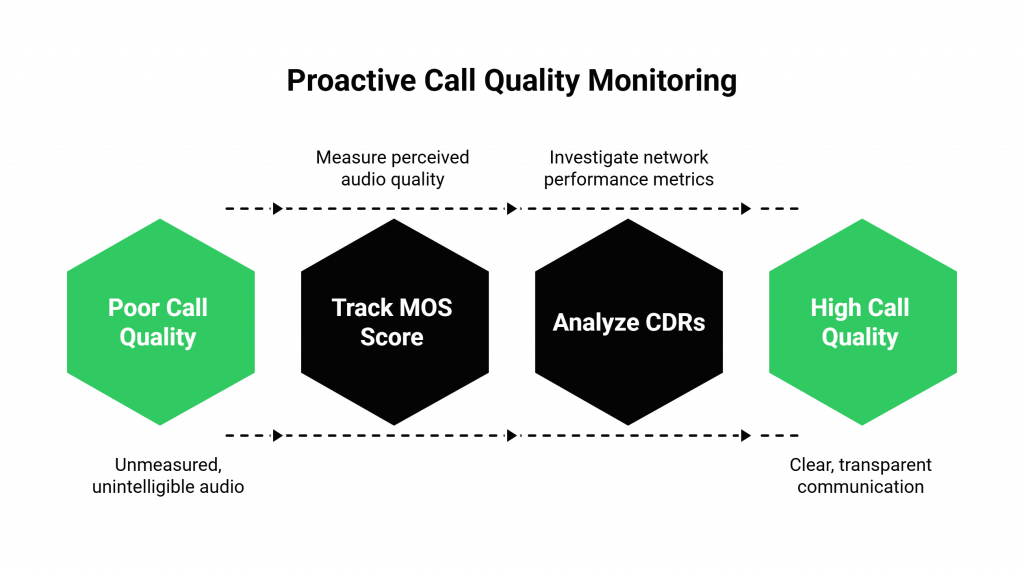
- The Mean Opinion Score (MOS): This is the industry-standard metric for perceived audio quality. It’s a score from 1 (unintelligible) to 5 (perfectly clear), and it’s calculated by an algorithm that analyzes the audio stream for impairments. Your voice API provider must give you a MOS score for every single call.
- Detailed Call Detail Records (CDRs): For any call with a low MOS score, you need to be able to dive deep. An enterprise-grade voice platform will provide a detailed CDR that shows you the specific network metrics for that call: the average jitter, the peak jitter, and the percentage of packet loss.
This level of deep, transparent observability is a hallmark of a developer-first platform. This is the philosophy behind FreJun AI: we don’t just provide a “black box” service; we provide a “glass box” infrastructure with the tools you need to see and understand the performance of your mission-critical communications.
Also Read: Voice Assistant Chatbot Use Cases in 2025
Conclusion
In the world of voice AI, the quality of the conversation is paramount. A brilliant AI delivered over a garbled, choppy connection is a failed investment. Maintaining high call quality is not a secondary concern; it is the foundational prerequisite for a successful inbound call handling automation strategy.
A voice infrastructure partner ensures your AI’s brilliant voice is always heard with perfect clarity by building for quality with a global private network, advanced jitter buffering, and deep, transparent monitoring.
Want to see the difference a high-quality voice infrastructure can make? Schedule a one-on-one demo with our team at FreJun Teler!
Also Read: Automated Workflow Tools: Top Solutions for Seamless Automation
Frequently Asked Questions (FAQs)
While several factors are important, a low-jitter, low-packet-loss network connection is the most critical foundation for clear, intelligible audio.
The Mean Opinion Score (MOS) is an industry-standard score from 1 (bad) to 5 (excellent) that provides a holistic measure of the perceived audio quality of a call. An average MOS above 4.0 is generally considered high quality.
These are two key network metrics that degrade call quality. Packet Loss is when small “packets” of the audio data are lost as they travel over the internet, causing gaps in the audio. Jitter is the variation in the arrival time of those packets, which causes a choppy or “robotic” sound.
A codec (coder-decoder) is an algorithm used to compress and decompress digital audio data. Modern codecs like Opus can provide high-fidelity audio and are more resilient to network problems than older codecs used in the traditional phone system.
The public internet is a “best-effort” network with no quality guarantees. A top-tier voice provider builds their own private, global network with direct connections to major carriers. This allows them to route your audio data over a high-quality, uncongested path, which dramatically reduces jitter and packet loss.
It will struggle. A Speech-to-Text (STT) engine’s accuracy is directly dependent on the clarity of the input audio. A high-jitter, high-packet-loss call increases the Word Error Rate (WER) and confuses the AI’s “brain.”
You should start by looking at the Call Detail Record (CDR) for that specific call from your voice API provider. The network metrics in the CDR (MOS, jitter, packet loss) will help you diagnose if the problem was a network issue or something else.
It depends on the network conditions, but generally, a web-based call using a modern codec like Opus over a stable internet connection can achieve a higher fidelity (clearer sound) than a traditional phone call.
FreJun AI‘s role is to provide the high-performance voice infrastructure that is the foundation of call quality. We obsessively engineer our globally distributed private network to minimize jitter, latency, and packet loss. We also provide our users with the deep, real-time monitoring tools they need to ensure their inbound call handling is always operating at peak performance.
A jitter buffer is a small, temporary holding area for incoming audio packets. A sophisticated voice platform uses an adaptive jitter buffer to intelligently reorder packets that arrive out of sequence, which smooths over minor network imperfections and dramatically reduces the user’s perception of jitter.