
For a developer building a simple voice application, the magic of a voice API for developers is its simplicity. You get an API key, you buy a phone number, you write a few lines of code, and your application can talk. It’s a fantastic experience.
But for an enterprise architect designing a mission-critical, globally distributed communication system, that simplicity can be deceiving. What is the massive, complex machine that is humming silently behind that simple API call?
This is the world of enterprise-grade voice infrastructure. It is a world of carrier-grade reliability, obsessive low-latency engineering, and fortress-like security. It is a fundamentally different class of technology, built to a standard that is orders of magnitude more demanding than a consumer-grade service.
This guide is for the enterprise architect, the CTO, and the engineering leader. We will pull back the curtain and explain the non-negotiable architectural pillars that define a true enterprise-grade voice infrastructure.
This is not just a list of features; it is a framework for understanding the deep, structural differences that separate a simple API provider from a true infrastructure partner.
Table of contents
Why is “Enterprise-Grade” a Completely Different Standard?
An enterprise operates at a scale and with a level of risk that demands an uncompromising standard for every component in its technology stack. The voice infrastructure, as the direct line to the customer, is one of the most critical.
| Feature Area | Standard Voice API | Enterprise-Grade Voice Infrastructure |
| Reliability | “Best effort” uptime, occasional glitches. | Financially-backed “Five Nines” (99.999%) SLA, full redundancy. |
| Scalability | May have soft or hard limits on concurrent calls. | Elastic, cloud-native architecture for virtually infinite scale. |
| Performance | Relies on the public internet, variable latency. | Global private network, optimized for ultra-low latency. |
| Security | Basic API key authentication. | Defense-in-depth: SRTP/TLS encryption, webhook validation, etc. |
| Support | Standard helpdesk, community forums. | 24/7 direct access to expert-level network and software engineers. |
| Compliance | Limited or no support for industry regulations. | Dedicated compliance programs for HIPAA, PCI DSS, GDPR, etc. |
The business impact of these differences is enormous. A recent report by Forrester on the economic impact of a comparable API platform highlighted a 211% ROI for enterprises, driven heavily by the improved reliability, scalability, and security that an enterprise-grade platform provides.
What Are the “Five Pillars” of an Enterprise-Grade Architecture?
A true enterprise-grade voice infrastructure is built on five unwavering architectural pillars. You must demand proof of excellence in all five.
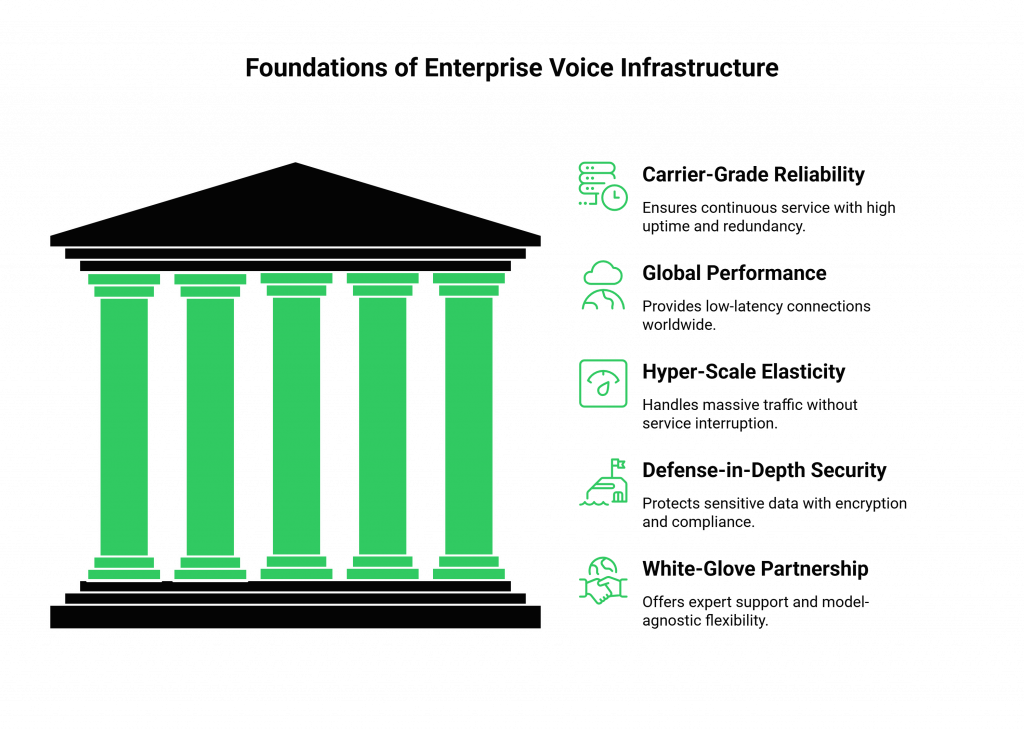
Pillar 1: How Do You Achieve “Carrier-Grade” Reliability?
This is the absolute foundation. The platform must be as reliable as a utility.
- The “Five Nines” SLA: You should demand a legally binding Service Level Agreement (SLA) that guarantees “five nines” of uptime (99.999%). This is not a marketing promise; it’s a contractual obligation with significant financial penalties for failure.
- Full Geographic Redundancy: The provider must operate out of multiple, geographically separate, and fully independent data centers with an “active-active” setup. This ensures that a catastrophic failure in one region (like a power outage or a natural disaster) has zero impact on your service.
Also Read: Best Practices for Voice API Integration in SaaS
Pillar 2: How is Global, Low-Latency Performance Engineered?
For a global enterprise, a fast connection is not a luxury; it’s a necessity.
- A Global Private Network: An enterprise-grade provider does not simply route your calls over the public internet. They have invested hundreds of millions of dollars in building their own global, private network with high-quality, direct “peering” relationships with major telecommunication carriers and cloud providers. This is the only way to guarantee a low-latency, low-jitter path for your audio data.
- Global Points of Presence (PoPs): The provider must have a global network of PoPs. This allows your calls to be routed over the shortest possible path, minimizing the physical distance the audio has to travel.
Pillar 3: What Does “Hyper-Scale” Elasticity Mean?
An enterprise cannot have a “busy signal.” The platform must be able to handle any traffic you throw at it.
- Cloud-Native, Elastic Architecture: The platform must be built on a modern, elastic architecture that can automatically scale its capacity to handle a massive number of concurrent calls. The concept of a “hard limit” on concurrent sessions should not exist. This is a core design principle of a modern voice infrastructure platform like FreJun AI.
Ready to build your mission-critical voice application on a true enterprise-grade foundation? Sign up for FreJun AI and explore our architecture.
Also Read: Best AI Call Agent Platforms for Lead Qualification
Pillar 4: How is “Defense-in-Depth” Security Architected?
An enterprise voice API for developers is a gateway to your most sensitive customer interactions. It must be a fortress.
- Encryption by Default: All communication must be encrypted by default, with SRTP for the call audio and TLS 1.2+ for all API traffic.
- A Culture of Compliance: The provider must have dedicated, in-house teams and certified programs for industry-specific compliance regulations like HIPAA (requiring a BAA), PCI DSS, and GDPR.
Pillar 5: What Does a “White-Glove” Partnership Look Like?
An enterprise doesn’t just need a good API; it needs a true infrastructure partner.
- 24/7 Expert-Level Support: You need a dedicated support channel that gives you direct access to the senior network and software engineers who build and maintain the platform.
- A Model-Agnostic Philosophy: This is a critical, strategic feature for an enterprise. A model-agnostic platform like FreJun AI gives you the freedom to always use the “best-of-breed” AI models from any provider, preventing vendor lock-in and future-proofing your AI strategy.
Also Read: Voicebot Online vs Voice Chatbot Online Platforms
Conclusion
The move to a programmable, API-driven voice strategy is one of the most powerful moves a modern enterprise can make. It is the key that unlocks a new world of intelligent automation, deep customer insights, and a truly unified customer experience.
But this power comes with immense responsibility. Choosing your voice API for developers is a foundational, long-term architectural decision.
By using these five pillars as your uncompromising evaluation framework, you can cut through the marketing hype and select a true infrastructure partner that is ready to meet the demanding and mission-critical needs of your enterprise.
Want to see how our infrastructure and SLA stand up to the rigorous demands of your enterprise? Schedule a demo for FreJun Teler.
Also Read: Call Logging Software: The Complete Guide to Tracking and Managing Every Business Conversation
Frequently Asked Questions (FAQs)
The main difference is a contractual and architectural commitment to the “five pillars”: carrier-grade reliability (backed by a strong SLA), global low-latency performance, massive scalability, ironclad security, and a white-glove developer and support experience.
“Five nines” refers to 99.999% uptime. It’s a gold standard for reliability in the telecommunications industry, translating to no more than 5.26 minutes of downtime over an entire year.
A private network is a global network that the voice provider owns or leases, with direct, high-quality connections to major carriers. It allows them to route your call audio over a more reliable and less congested path than the public internet.
A PoP is a physical data center where a service provider has network equipment. A voice API for developers with multiple PoPs around the world can route your calls through the one closest to your user, which is a key strategy for reducing latency.
A model-agnostic API provider, like FreJun AI, is not tied to a specific AI vendor. It’s an enterprise-grade feature because it prevents vendor lock-in and gives a large company the strategic flexibility to always use the best and most cost-effective AI models on the market.
An SLA is a contractual commitment from a service provider that guarantees a specific level of service, most importantly, a minimum level of uptime. It should include financial penalties (service credits) if the provider fails to meet this guarantee.
It will have dedicated, certified programs for industry-specific regulations. For healthcare, this means being willing and able to sign a Business Associate Agreement (BAA) to comply with HIPAA. For payments, it means providing a PCI-compliant solution.
Peering is a direct, often settlement-free interconnection between two networks. An enterprise-grade voice provider will have direct peering relationships with major telephone carriers, which can significantly improve call quality and reliability.
FreJun AI’s value proposition is that we are a specialized, infrastructure-first provider that is obsessively focused on delivering on the “five pillars” of an enterprise-grade service. We provide the high-performance, secure, and reliable voice foundation that allows an enterprise to build their own custom, “best-of-breed” voice AI solutions without compromise.
An enterprise should conduct a rigorous Proof of Concept (PoC). This involves not just a “Hello, World!” test, but also load testing to check for scalability, latency testing from different global regions, and a “support test” by opening a genuinely difficult technical ticket to evaluate the quality of their engineering support.