
You have just launched your new, state-of-the-art voice AI. It’s a masterpiece of engineering. The AI is brilliant, the conversational design is flawless, and the user experience, when it works, is magical. But then the reports start trickling in. A user in London complains of “choppy, robotic-sounding audio.”
A high-value customer in Singapore gets a “call cannot be completed as dialed” error. During your peak traffic hour, the API starts timing out, leaving your AI completely silent.
In the world of voice AI, reliability is not a feature; it is the feature. A brilliant AI that is delivered over a crackly, unreliable connection is a useless AI. The user’s perception of your AI’s intelligence is directly and mercilessly tied to the quality of the line it’s speaking on.
This is why, for a developer building a mission-critical voice application, the choice of your voice API for developers is the single most important architectural decision you will make. It is the foundational pillar upon which your entire application rests.
This guide will take a deep, engineering-focused look at what “reliability” really means in the context of voice AI and why it is the non-negotiable prerequisite for a successful deployment.
Table of contents
What is the “Pyramid of Voice AI Needs”?
To understand the importance of reliability, it’s helpful to think of a “Pyramid of Needs” for a voice AI, similar to Maslow’s hierarchy.
- (Base) Connectivity & Reliability: Can the call be connected successfully? Is the audio clear and stable? If this foundational layer fails, nothing else matters.
- (Middle) Speed & Low Latency: Is the conversation fast and responsive, or is it filled with awkward, unnatural pauses?
- (Top) Intelligence & Accuracy: Is the AI’s answer correct and helpful?
Most developers spend 90% of their time focused on the top of pyramid, the AI’s intelligence. But your users will never get to experience that intelligence if the foundational layer of reliability is crumbling. A dropped call is the ultimate failure, a “fatal error” in the user experience. The importance of this is not just theoretical.
Also Read: Best Practices for Voice API Integration in SaaS
How Do We Define and Measure “Reliability” for a Voice API?
“Reliability” is not a vague marketing term; it is a set of specific, measurable, and contractually guaranteed engineering metrics. A true enterprise-grade voice API for developers must be held to the highest standard across these key areas.
| Reliability Metric | What It Measures | Why It Matters for Voice AI | The Enterprise-Grade Standard |
| Uptime / Availability | The percentage of time the service is online and available. | If the API is down, your phone system is down. This is the most fundamental measure of reliability. | 99.999% (“Five Nines”) |
| Call Completion Rate | The percentage of call attempts that are successfully connected. | A low completion rate means your customers are getting busy signals or “call failed” errors, which is a catastrophic failure. | > 99.5% |
| Mean Opinion Score (MOS) | A score from 1 (bad) to 5 (excellent) that measures the perceived audio quality. | This is the ultimate measure of call clarity. A low MOS score means the audio is choppy, distorted, or robotic, making the AI impossible to understand. | Average MOS > 4.0 |
| Webhook Reliability | The percentage of real-time event notifications that are successfully delivered to your app. | If a webhook is dropped, your application’s logic will break, and the conversation will stall. | > 99.99% |
What Architectural Choices Lead to a Reliable Voice API?
Achieving this level of reliability is not an accident. It is the result of a series of deliberate, and very expensive, architectural decisions made by the API provider. When you are evaluating a vendor, you are not just buying their software; you are buying their architecture.
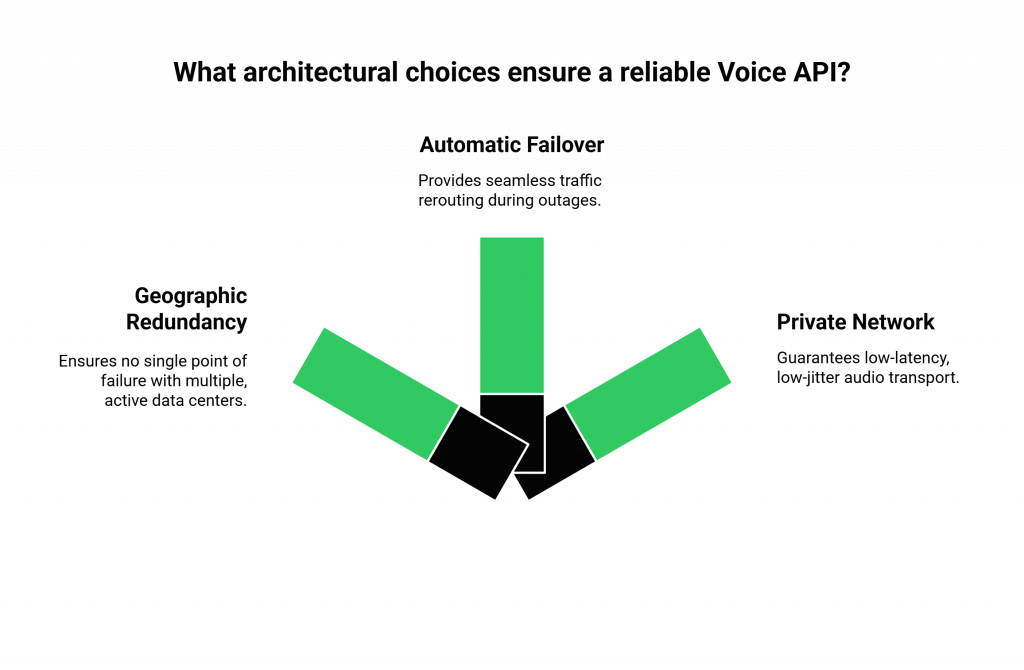
How is “Carrier-Grade” Redundancy Built?
A reliable platform is built with “no single point of failure.”
- Geographic Redundancy: The provider must operate out of multiple, geographically separate, and fully independent data centers. They should have a “hot-hot” or “active-active” setup, meaning that all their data centers are live and serving traffic at all times.
- Automatic Failover: The system must be able to automatically and instantly reroute traffic if one data center or one network path goes down. This failover should be completely seamless to your application and your end-users.
Also Read: Best AI Call Agent Platforms for Lead Qualification
What is the Role of a Global, Private Network?
The public internet is a chaotic, “best-effort” network. An enterprise-grade provider does not rely on it for their core audio transport. They build their own global, private network with high-quality, direct connections (peering) to major carriers and cloud providers.
This is a massive investment, but it is the only way to guarantee a low-latency, low-jitter path for your audio data, bypassing the congestion of the public internet.
Ready to build your mission-critical voice application on a foundation of carrier-grade reliability? Sign up for FreJun AI and explore our architecture.
How Can You, as a Developer, Build a Resilient Application?
Reliability is a shared responsibility. While you must choose a reliable provider, you must also architect your own application to be resilient to the inevitable small failures of a distributed system.
- Design for Webhook Failures: Your webhook endpoint should be highly available. But even more importantly, your voice provider should have an automated retry mechanism. A platform like FreJun AI will automatically try to resend a webhook a few times if your server doesn’t respond, giving your application a chance to recover from a momentary glitch.
- Implement Graceful Error Handling: What happens if an API call to your LLM times out? Your code shouldn’t just crash. It should have a “fallback” path, like playing a message to the user: “I’m having a little trouble connecting to my brain right now. Please try again in a moment.”
- Use the Provider’s Status Page: Your application can be programmatically integrated with your voice provider’s status page. If they declare a major incident, your application can automatically switch to a “degraded service” mode, for example, by routing all calls to a simple “We are experiencing technical difficulties” message instead of to your AI.
Also Read: Voicebot Online vs Voice Chatbot Online Platforms
Conclusion
In the world of voice AI, your application is only as good as its weakest link. A brilliant AI delivered over a fragile, unreliable connection is a failed application. Reliability is the silent, invisible feature that underpins the entire user experience. It is the foundation of trust.
When you are choosing a voice API for developers, you are not just buying a set of features; you are buying a promise. You are buying an SLA, an architecture, and a partnership. By prioritizing reliability above all else and by holding your provider to the highest possible standard, you can build a voice AI that is not just intelligent, but is a trusted, dependable, and mission-critical part of your business.
Want to learn more about our “five nines” SLA and the redundant architecture that backs it up? Schedule a demo for FreJun Teler!
Also Read: Call Logging Software: The Complete Guide to Tracking and Managing Every Business Conversation
Frequently Asked Questions (FAQs)
While uptime is foundational, the Mean Opinion Score (MOS) is arguably the most important user-centric metric. It measures the actual, perceived quality of the audio, which is what the user ultimately cares about.
“The nines” are a shorthand for uptime percentages. “Three nines” is 99.9%, “four nines” is 99.99%, and “five nines” is 99.999%. For a mission-critical voice API for developers, you should look for a “five nines” guarantee.
An SLA is a contractual commitment from a service provider that guarantees a specific level of service, most importantly, a minimum level of uptime. It should include financial penalties (service credits) if the provider fails to meet this guarantee.
A PoP is a physical data center where a service provider has network equipment. A voice API provider with multiple PoPs around the world can route your calls through the one closest to your user, which is a key strategy for improving reliability and reducing latency.
Reliability is about being consistently available and high-quality. Scalability is about maintaining that reliability even when the volume of traffic grows massively. You need both. An enterprise-grade system must be both reliable and scalable.
A good API provider will give you the tools. You should have access to a real-time analytics dashboard and detailed Call Detail Records (CDRs) that show you the quality metrics (like MOS) for every single call.
Failover is the process of automatically switching to a redundant or standby system in the event of a software, hardware, or network failure. A reliable voice API must have automatic failover between its globally distributed data centers.
FreJun AI is an infrastructure-first company. Reliability is our core product. Our platform is built on a globally distributed, fully redundant, multi-region architecture. We are committed to providing a carrier-grade, five-nines level of reliability, backed by a strong SLA.
A reliable voice API provider will have a webhook retry mechanism. If they try to send a webhook to your server and it fails, they will automatically try to send it again a few more times. This gives your application a chance to recover from a momentary glitch.
The public internet is a “best-effort” network, which means it doesn’t guarantee quality. A top-tier voice provider builds their own private, global network with direct connections to major carriers. This allows them to route your audio data over a high-quality, uncongested path, which dramatically improves call quality and reliability.